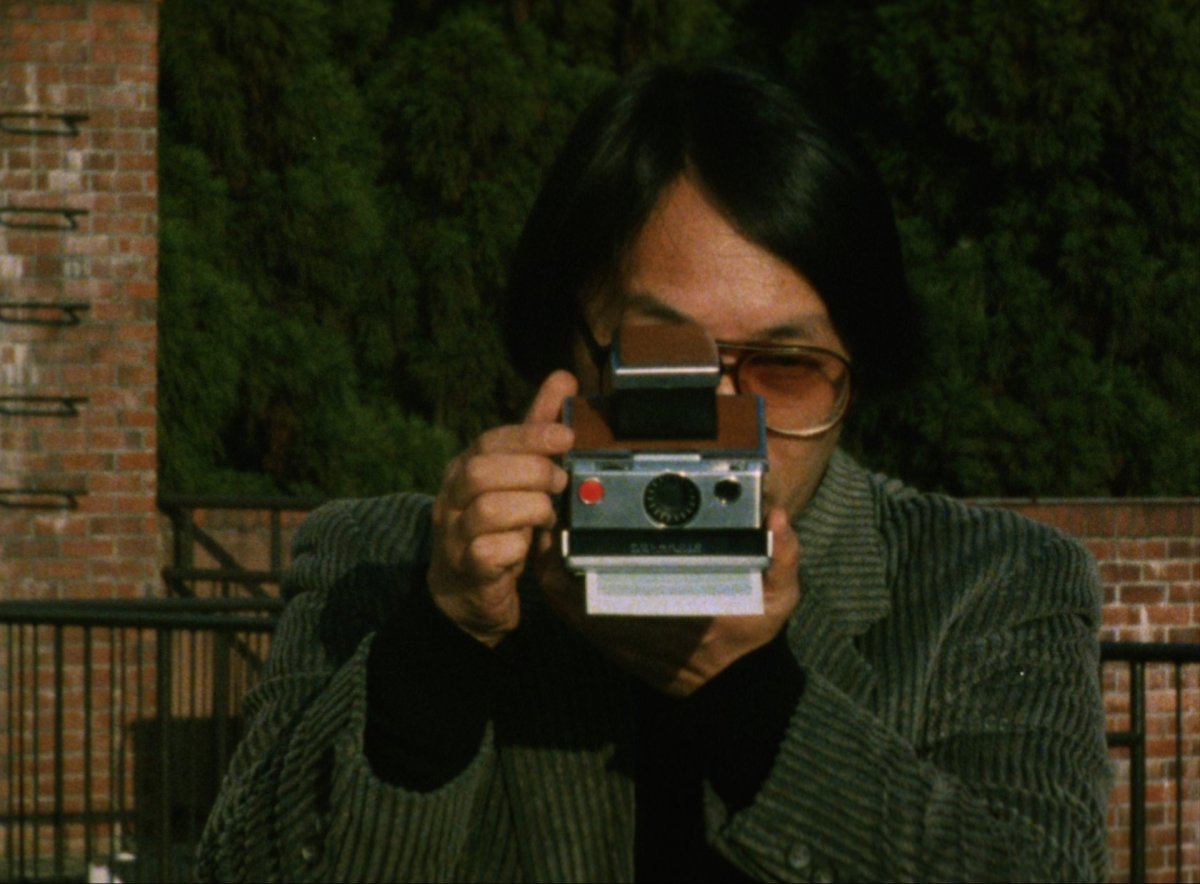
In a career spanning more than fifty years Matsumoto made short and feature movies and moved freely from documentary to art-house films, and from pure experimental cinema to expanded cinema and video installations, in a very unique process of hybridization and genre overlapping that has few parallels in the world of cinema and image making.
In the seven months since his passing, prompted by the tragic event, I decided to
re-watch some of his works and see the ones I had not yet watched, and in October I was at the tribute screening of some of his works organized at this year Yamagata International Documentary Film Festival. This cinematic (re)discovery has been a total revelation, even though I’ve been familiar with his movies for a long time – Funeral Parade of Roses was one of the movies that introduced me to ATG and the Japanese cinema of the period, and more than 10 years ago I delved into the DVD box set of his experimental works – Matsumoto’s death lead me to (re)consider his work from a different perspective. Matsumoto not only as a documentarist or solely as an avant-garde director, but in a broader sense, Matsumoto as a filmmaker, intellectual and film theorist of major importance in the history of Japanese post-war cinema.


Rewatching his works gave me also the opportunity to reread parts of Yuriko Furuhata’s Cinema of Actuality — one of the best books on Japanese cinema in my recent memory and a volume where Matsumoto plays a key role — discover The Cinema of Virtuality – The Untimely Avant-Garde of Matsumoto Toshio, a different take on his later career and an answer to Furuhata’s book, and last but not least finally read Matsumoto seminal essay A Theory of Avant-Garde Documentary, a short but pregnant manifesto he wrote in 1963 on the convergence of non-fiction and avant-garde cinema.
This viewing and reading experience in all its glorious variety cemented my opinion that Matsumoto’s body of work is one of the most powerful, complex and relevant artistic endeavor that Japan has witnessed in the second half of the last century. A towering figure in post war Japanese cinema, Matsumoto’s trajectory in the medium might seem simple and straightforward on the surface — from the world of documentary in the late 1950s and 1960s to the art-house in the 1970s, and eventually exploring the possibilities of experimental cinema and art installations in the last part of his life — but each one of his work is composed, in different degrees of course, of elements of fiction, avant-garde and non-fiction. In Funeral Parade of Roses, for instance, the story is interspersed with interviews with transvestites about their lifestyle in a pure documentary style, while the segment with the speech balloons is almost a materialization on film of the aesthetics of manga and advertisement, and the non-liner, circular structure of the movie itself is pure avant-garde. Yet all his other works have, in one way or another, a hybrid quality that was present since the very beginning of his career, Ginrin (1955) his debut, is a surreal dream in a shape of a PR movie, The Song of Stones (1963) a TV documentary drifting towards contemporary and abstract art, For the Damage Right Eye (1968) a work charged with political meanings smashed in kaleidoscopic explosions, and Ki or Breathing (1980) an experimental short that blends images of a nature-like documentary with a Butoh dance performance in a shape of an ancient poem.
Writings/rebirth/ellipse
To some extent, the importance of his writings, essays that inspired countless film scholars and filmmakers and sparked fascinating debates, is paradoxically even more significant, at least in Japan, than his movies. As Yuriko Furuhata acutely points out in her book
Matsumoto’s critical writings published in the journal Kiroku Eiga (Documentary film, 1958–64), in particular, played a decisive role in shifting the ground of Japanese documentary discourse. His theorization of documentary as a properly avant-garde method of reflexively interrogating reality significantly changed the meaning of the word documentary, and had a wide-reaching impact not only on the immediate circle of documentary filmmakers, but also on filmmakers like Oshima who were working within the studio system at the time.
Ōshima himself was partly inspired by The Song of Stone when he made the documentary Diary of Yunbogi (1966), a movie entirely made of still photos he took in Korea, and, like Matsumoto himself, was highly influenced by Alain Resnais’ earlier documentaries, Van Gogh (1948), Toute la Memoire du Monde (1956), and especially Guernica (1950). The two Japanese engaged in heated debates in the late 1960s and in the early 1970s, particularly after Matsumoto decided to participate to the Expo ’70 in Osaka with a video installation, an event that is still considered today by many scholars the beginning of the end of a period when political radicalism and art went hand in hand and merged.
Ōshima attacked Matsumoto for hypocritically denouncing formalistic conservatism while offering his support to the existing form of film and profit distribution. Matsumoto retorted with the claim that too much political film maintained a core structure inherited from that which it opposed with only its surface content.” (S. C. Ridgely, Japanese Counterculture: The Antiestablishment Art of Terayama Shuji)
The fact is that Matsumoto throughout his career had been very faithful to the idea that art should be first and foremost a method of changing the way of seeing, perceiving and therefore the way of thinking. While he wrote extensively about documentary, his statements were about cinema and visual expression in general, the cinematic art for Matsumoto should be primarily understood as a method of challenging habituated modes of perception, and although this attitude is more overtly present in his short experimental works from the mid 1970s onward, I don’t think it is too far fetched to say that crossing boundaries and experimenting was in full display since his beginnings. Going back again to his beginnings, Ginrin, a short movie made to advertise bicycles, looks more like a surrealist piece of art than a PR film, a child while leafing through a bicycles’ magazine falls asleep and dreams about dancing bikes and floating rings, a work whose poetics are not very dissimilar to those displayed in the early Surrealist experiments on film. This approach would be fully developed, theorized and put on paper in the aforementioned A Theory of Avant-Garde Documentary
the task of contemporary art must be to set itself to finding new ways to destroy that naive faith in the object, the too-classical understanding of the human [ningenzo] that is based on a conciliatory attitude toward the object.
(A Theory of Avant-Garde Documentary, Toshio Matsumoto)
Similar theoretical preoccupations are waved in his next two movies, Nishijin and The Song of Stones. The latter is a short documentary made in 1963, to this day one of my favorite Japanese nonfiction movies, a cine-poem, the definition is given by Matsumoto himself in the Japanese DVD commentary, directly inspired by Guernica.
The Song of Stones is Composed entirely of rephotographed snapshots of Japanese stonecutters at a quarry in Shikuko taken by the LIFE cameraman Ernest Satow, (…) an ambitious work that deviates from the conventional practice of both film and television documentaries of the time. Matsumoto used the technique of stop-motion animation to rephotograph hundreds of snapshots Satow had already taken at the quarry. Matsumoto then edited them in-camera, frequently using dissolves and superimpositions to lend the impression of movement to otherwise immobile images.” (Furuhata, id.)
With this process of remediation Matsumoto was able to place back at the center of the visual art the life of the inert matter, the absolute speed of motionless photos, transforming the stasis in movement through editing, editing conceived thus as rhythm and rhythm as rebirth. Even if the movie on the surface is not directly concerned with political issues ー there is of course the hard labor of the stone cutters, but it’s not the central theme of it ー Matsumoto saw it also “as a possible metaphor of rebirth after the failure of the ANPO protests in 1960” (from the commentary on the Japanese DVD), a rebirth to be attained through aesthetics. Rebirth has been a fundamental and crucial term for Matsumoto throughout his entire career, the process of bringing life to something apparently lifeless, dead, lost, inert or just static through the cinematic and artistic process is a very important point in his approach to cinema and visual arts in general. He was interested in bringing on the foreground the act of seeing more than focusing on the overtly social or political meanings, thus liberating the potential for a cinema of sensation and pure perception, detached from the obsession with the dichotomy subject/object, or, as nicely put by Joshua Scammel, “his films are not about an individual subject, but about subjectivity as such” (Cinema of Virtuality, 2016).
from the very beginning Alan Resnais had never intended to “show” Picasso’s Guernica
Resnais does not intend to “show” Picasso but to “see” him; what he aims to record is his own vision
The point of view from which documentarists today should engage with post World War I avant-garde films is clear: they should aim at the negation of negation, to sublate what the documentary has been until now, and what the avant-garde film has been until now. To put it another way, we should grasp the totality of the conflict and the unity between the exterior world and the interior world, aiming for a synthesis of both in the possibilities of a new form of film. And the key to that possibility I discover in Resnais’s Guernica.
The real problem is that just as naturalism [shizenshugi] is most comfortable clinging naively the thing-in-itselfness of the exterior world, they [the avant-garde] are most comfortable clinging to the thing-in-itselfness of the interior world. They lack the toughnes [kibishisa] to bring the interior and the exterior worlds into juxtaposition, by unceasingly engaging their concrete subjectivity.
(Toshio Matsumoto, id.)
This collision and juxtaposition of the interior and the exterior is another major philosophical concept that traverses his entire oeuvre, a very interesting take on this motif is offered by Michael Raine in the introduction to A Theory of Avant-Garde Documentary:
he rejected the privileging of original over copy, principle over consequence, and preferred the tense “oppositism” or dialectics of Okamoto Taro (in his writing on the avant-garde around 1950) or the “elliptical thinking” of Hanada Kiyoteru (a style of thought that like the ellipse maintained two foci, never collapsing into a single center). Rather than a self-contained subject describing a stable object, Matsumoto conceived of subject and object in dialectical relation, in orbit around each other.

This “elliptical thinking” and the aforementioned concept of rebirth find its perfect embodiment in one of his most celebrated experimental shorts, Atman (1975), by far one of my favorite films made by Matsumoto. Let me quote Scammel again to describe what Atman is/seems to be/is not:
Atman begins with an overwhelming opening sequence: a camera
in rapid orbit around a sitting Oni. But the film immediately shows the same sequence again, much slower, so that the audience can see that they had just been tricked: the camera was not in movement at all. The technique is very simple: a series of still photographs are edited together in sequence around the figure. Each still is held for an equal number of frames before moving on to the next, an equal distance around the figure.
This is already enough to create the illusion of the camera spinning around the
figure. But another element is added: within the duration of each still, there is an artificial zoom (created in editing, not in camera), so that the camera seems to be zooming towards the figure at each step around it, giving it a double movement impossible to capture within the camera. But after slowing down the illusion so that the audience sees a series of stills rather than movement, the film gradually speeds up until movement is again seen.The Cinema of Virtuality, Joshua Scammel
Documentary/finale/beginning
One of the novelties Matsumoto brought to cinema discourse in Japan, an approach that is much fresh today as it was fifty years ago, is the shifting in perspective from a documentary practice obsessed with the object filmed to one where the formal aspects of the movie have the same importance.
As I have made clear above, the most urgent task facing us as documentary filmmakers is to break up from its very foundations the impasse created by the so-called Griersonian phenomenology-above-all method, and to liberate the meaning of the phrase “documentary filmmaker” \dokyumentarisuto\ from the fetters of naturalism
a methodological and deliberate dissolution of the human [ningen kaitai] through an encounter with the object [objet no hakken\ and the materialist self-dissolution of the human itself.
(Toshio Matsumoto, id.)
Significant in this regard is to note that one of the critics Matsumoto moved to the new generation of Japanese documentarists, especially those working on the so called self-documentary, was a certain degree of self-indulgence and lack of questioning the ego and the subjectivity of the director.
(Re)discovery Matsumoto’s oeuvre for the new generations of documentarists and directors is of absolute importance ー Discovering Images—The Age of Matsumoto Toshio by the way is the title of a massive documentary (700 minutes!) on Matsumoto directed by Takefumi Tsutsui and screened at the YIDFF in 2015 that unfortunately I couldn’t see. While new digital technologies have helped the democratization of the image and the development of novel forms of cinema, one of the downsides of this process, particularly in Japan, is that many new directors and documentarists tend to focus more on the themes or on the object filmed and less on the form and on the aesthetics of filming. The attention with which Matsumoto throughout his career engaged with the image and its creation, continuously (re)discovering it, could definitely help and inspire the next generation of filmmakers yet to come. A good starting point for this discovery could be a new Blu-ray released by…..
Further readings and links:
Cinema of Actuality: Japanese Avant-Garde Filmmaking in the Season of Image Politics, Yuriko Furuhata, 2013.
A Theory of Avant-Garde Documentary, Toshio Matsumoto, 1963 (translation, 2012)
The Cinema of Virtuality – The Untimely Avant-Garde of Matsumoto Toshio, Joshua Scammel, 2016. , Joshua Scammel, 2016.
Matsumoto Toshio interviewed by Aaron Gerow, Documentarists of Japan # 9
 Asian Docs