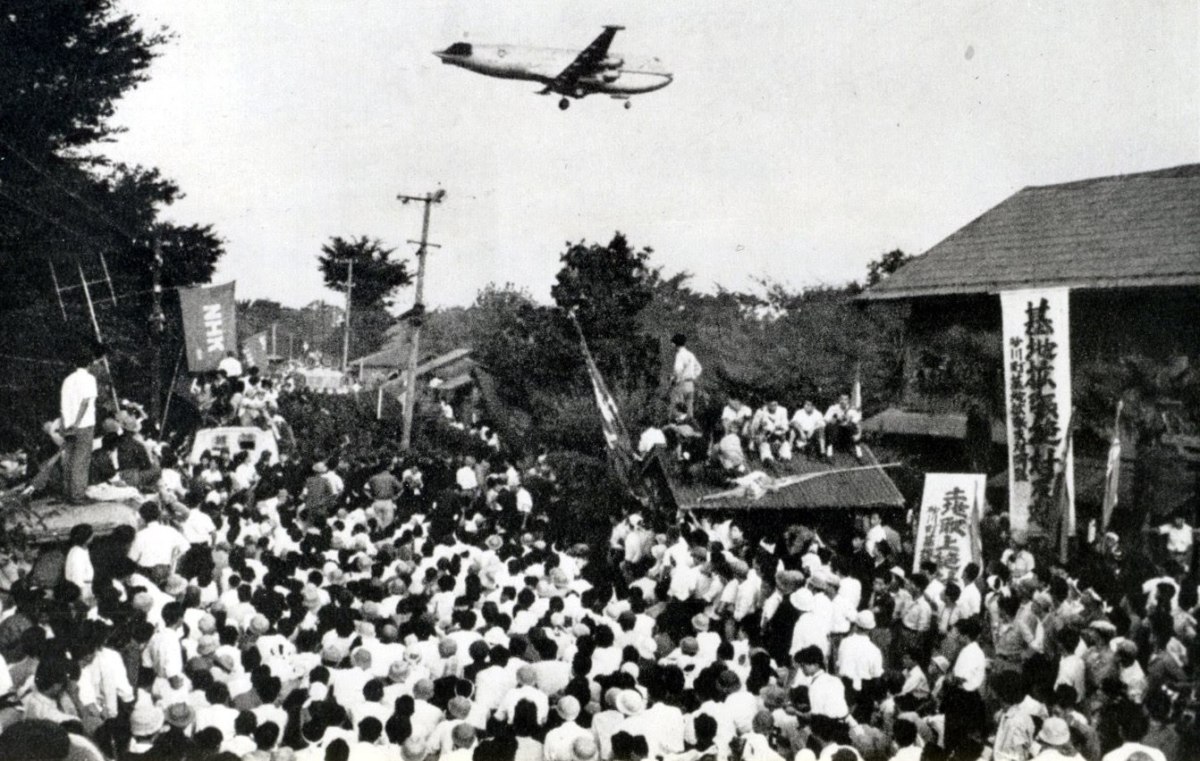
Before the battle of Sanrizuka to halt the building of Narita airport, and before the massive revolts of 1968-69, there was Sunagawa and the resistance against the expansion of the American base in Tachikawa (Tokyo). In the third installment dedicated to the struggle, Kamei Fumio, the grandfather of Japanese documentary, captures the clashes and fights of the farmers, labor unions and students groups (Zengakuren among others) with the police. The always useful YIDFF, a festival that held a huge Kamei retrospective in 2001, gives us more background:
This is the third film in the Sunagawa series following The People of Sunagawa (1955) and Wheat Will Never Die(1955). Making use of the second film in the series, it explains the progress made during last year’s struggle and then documents the state of this year’s efforts. On October 12, 1956, 53 surveyors and 1,300 armed police rushed the gathered union and Zen Gaku Ren (the All Japan Federation of Self-Governing Students Associations) members who then formed a scrum to protect themselves. 278 people from both sides were injured. On the 13th, at the protest’s peak, 5,000 workers and Zen Gaku Ren members had been mobilized when the police attacked the demonstrators’ picket lines. 844 protesters and 80 police were injured. Public opinion erupted against the the violence of the armed police and the government’s lack of a policy, and on the 14th, the radio suddenly announced that the government would stop its survey. Sunagawa overflowed with joy and excitement, and a victory demo was held. On the 15th, a National People’s Rally was held to celebrate the victory of Sunagawa’s fight against the base, and protesters who had sustained grave injuries came from the hospital to address the meeting.
Stylistically the movie has many of the elements that would be used by Ogawa and his group in their Narita/Sanrizuka series: hand-held camera scenes of pure chaos shot in the midst of the fights, but also moments of peace when traditional songs are sung and meals are communally eaten by farmers, students and labor union members.
Here is a short but impactful scene of one of the first clashes between the protesters and the police in the Autumn of 1956:
It is interesting to notice that two points of view are here used to depict the situation: one that shows the fight from the outside, from a certain distance that is, and the other where the camera is engulfed by the bodies of the participants and is actively part of them. The gaze of the movie is without any doubts on the side of the inhabitants of Sunagawa, an aesthetic statement that reflects and results from the choice by the cameraman and the crew to live together with the farmers and students for several months.
Here, like in many other of his documentaries, Kamei also uses narration, but the voice explaining the timeline of the facts and commenting on what is going on on screen, sometimes with emphasis, is that of a female. In the film and in the struggle, Women, mainly middle-aged or old farmers, are always on the front-line and a vital part of the resistance, like in the documentaries about Sanrizuka (although infamously they were not an active part of the Ogawa collective itself).
It is also worth noting how the Sunagawa struggle is one of the few battles against the state/power in Japan that in the end was won by the people. If it is true that in 1959 the Supreme Court overturned the previous decision of the Tokyo District Court that found all the U.S. bases on Japanese land unconstitutional, in 1968 the plan for the extension of the base was cancelled, and finally in 1977 the base was given back to Japan. As pointed out by Dustin Wright “Without the farmers of Sunagawa, the Anpo (Japan-U.S. security treaty) protests of 1960 would have been something else entirely”, equally I think it is not too far fetched to say that without Kamei Fumio and his works on the Sunagawa struggle, the Sanrizuka/Narita series and consequently the post-war Japanese documentary landscape would have been something completely different.
Record of Blood: Sunagawa is available on DVD in Japan (no English subtitles) as a part of this box set released by Iwanami Shoten.
On Kamei’s Fighting Soldiers (戦ふ兵隊 1939)
 Asian Docs