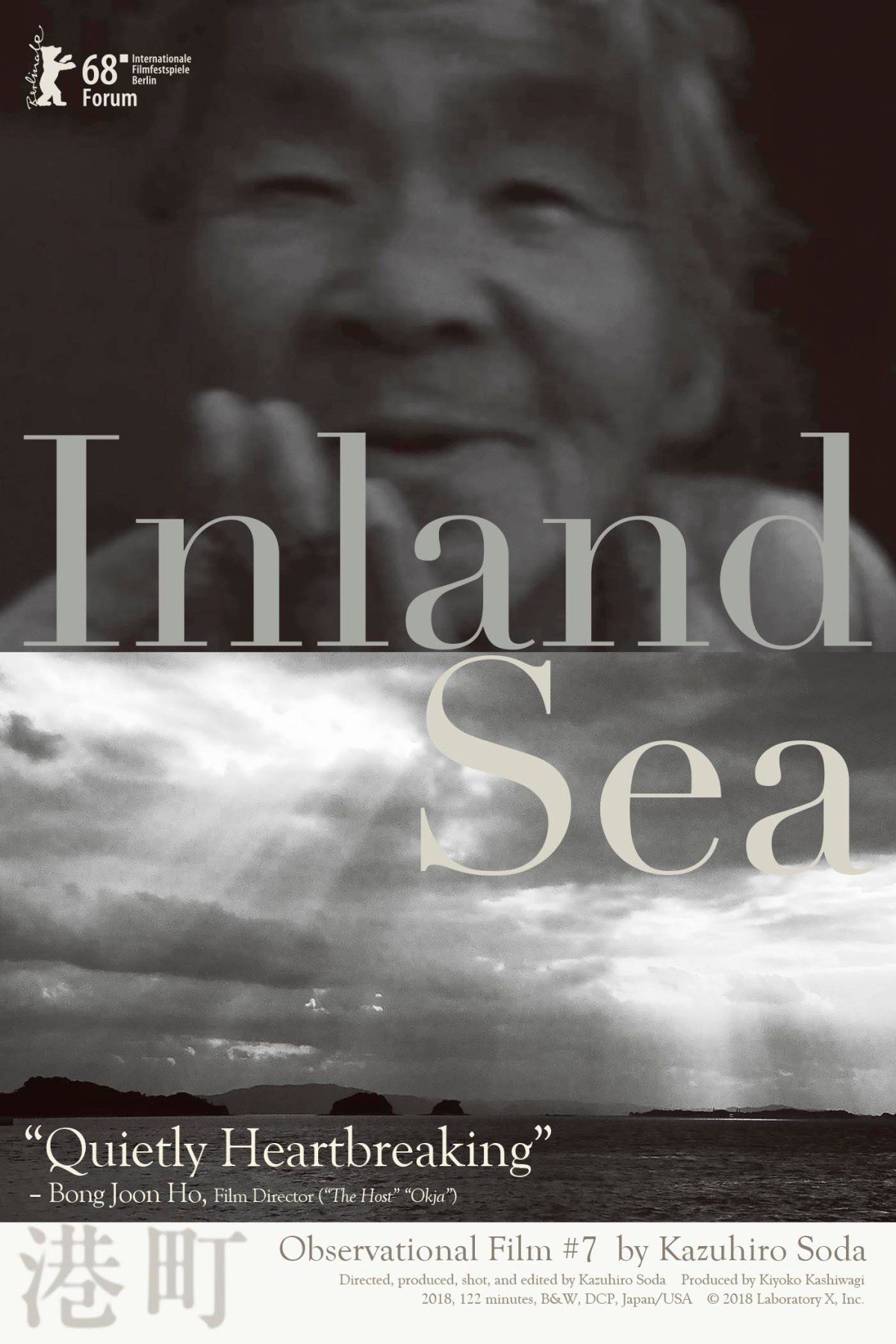
Screen at this year edition of the Berlinale (Forum), Inland Sea is the latest documentary by one of the most interesting and original voice working in Japanese non-fiction today, Sōda Kazuhiro. Based in New York, Soda in the last 10 years or so has built an impressive body of work, Inland Sea is the seventh documentary in his ongoing observational series, among my favorite Theatre 1 and 2, a diptych about playwright Oriza Hirata and his theatrical company, and Oyster Factory, a documentary premiered at the Locarno International Film Festival in 2015. Inland Sea was filmed soon after Oyster Factory, in fact the town is the same, Ushimado, a small village facing the Seto Inland Sea in Okayama prefecture. While in the previous film Soda focused his gaze on a small oyster factory and the problems of surviving in a globalized world (you can read more here), in Inland Sea he follows three elderly people living in the village and their daily activities. Here the synopsis:
Wai-chan is one of the last remaining fishermen in Ushimado, a small village in Seto Inland Sea, Japan. At the age of 86, he still fishes alone on a small boat to make a living, dreaming about his retirement. Kumi-san is an 84 year old villager who wanders around the shore everyday. She believes a social welfare facility “stole” her disabled son to receive subsidy from the government. A “late – stage elderly” Koso-san runs a small seafood store left by her deceased husband. She sells fish to local villagers and provides leftovers to stray cats. Foresaken by the modernization of post-war Japan, the town Ushimado’s rich, ancient culture and tight-knit community are on on the verge of disappearing.
While, as mentioned above, the film is part of his observational series, from the very first scene is clear how Soda with his camera and his voice is an important and catalytic presence in the relational texture that is Inland Sea. As Nichols would put it, while Sōda is filming and representing a certain reality, the documentary and the act of filming itself becomes also an important part of that reality. More than in his other works, his voice and that of his wife and their presence is here a fundamental part of the movie, often the people filmed converse with Sōda and we, as spectators, are always aware of the relationship between the camera and its environment. Naturally all documentaries are works of fiction, to one degree or another, but to my eyes acknowledging the presence of the camera and its effects in a documentary shot in an observational style, is one of the main qualities of the movie. It’s a honest and ethic filmic approach that I really value as important, especially in the contemporary documentary landscape, an approach that stems also from the style and methodology adopted by Sōda:
I spontaneously roll my camera, watching and listening closely to the reality in front of me, banning myself from doing research or prescribing themes or writing a script before shooting. I impose certain rules (‘The Ten Commandments’) on myself to avoid preconceptions and to discover something beyond my expectation.
The movie is shot in its entirety in black and white, the only case in Sōda’s filmography, just the very last scene, a boat floating, is in colour. I haven’t read so much about the movie, I wanted to experience it without preconceptions, so I don’t know the reason behind not shooting in colour, but certainly this choice gives a very distinctive elegiac tone to the movie, and a flavour of obsolescence and marginality to the places and the people depicted in it. Compared to Sōda ’s previous movies there is, at least in the first hour or so — the last 30 minutes are basically a very long and touching monologue of one of the old ladies, Kumi-chan — less talking and more insistence on the daily routine of Wai-chan and Koso-san, long periods of time are spent with the old man on the boat, fishing, and with the old lady, selling the fish.
By focusing on a place on a relatively far corner of Japan, far away from the metropolitan excitement that too often is associated with Japan, a place not yet forgotten, but on the edge of disappearing, and where the population is shrinking — the akiya (empty houses) seen in a sequence are becoming part of the present and near future of the archipelago — Sōda is also hinting, consciously or not, to one of the crucial issues of contemporary Japan and its geopolitical construction as a nation. That is, the parasitic relationship between sprawling urban centers and countryside, often forgotten, exploited (as highlighted by the situation in Fukushima or the Rokkasho Reprocessing Plant), or reduced to the folkloric image and touristic destination of Japan National Railway’s posters. In a post on his blog last year commenting on the Ogawa Pro’s Sanrizuka series, Soda wrote that, I’m paraphrasing, the struggle and resistance to the construction of the airport, because of the thick dialect spoken by the farmers at the time, almost incomprehensible to a person born and raised in Tokyo, felt like an act of exploitation perpetrated by the central state towards its colonies.
Another aspect of Sōda’s style that really stands out in Inland Sea and a direct consequence of his methodological approach, is the absence of any explanation on the historical background and context of the subject filmed. His films do not offer any extra information about the people he meets and the places he shoots, but the camera and his documentaries are, in a certain way, an extension of his gaze. It is up to us the viewers to decipher and image what stories lie behind the landscapes and the people captured on screen, for instance we don’t know if the stories told by the very talkative Kumi-san, to whom the movie in dedicated (she passed away in 2015), are completely true or to what degree they’re even truthful, yet this is life and it is here presented in all its complexity, sadness and beauty.
https://player.vimeo.com/video/250935060
Inland Sea – Trailer from Laboratory X on Vimeo.
 Asian Docs
One thought on “Inland Sea 港町 (Sōda Kazuhiro, 2018)”