
From today I will also use this blog as a sort of ongoing diary to briefly comment on the non-fiction movies I watch, those worth writing about. For more important works, I will still keep writing single and longer reviews, as I’ve been doing for the last couple of years.
I’m also on Letterboxd, but often the Asian documentaries I watch are not listed there, in addition, here I can ponder a bit more before writing down my thoughts.
In recent months I’ve been focusing again on documentaries made Taiwan, here you can read an essay I wrote for the journal Cinergie, about contemporary documentary in the island. In the piece I’ve touched on how hybridity is a feature that surfaces in Taiwanese cinema throughout all its history and evolution. Crossing borders, a sense of displacement, and a national identity always shifting and in flux, are often preoccupations at the center of movies produced in Taiwan, and the non-fiction landscape is, in this sense, no exception. Although far from being masterpieces, the five films I’ve recently watched, most of them shorts, continue along this path. An additional fascinating point for me is that some of them are also works made or produced in Taiwan, but not necessarily about Taiwan.
Crazy Calligraphy streaming Taiwan (Adiong Lu, 2012)
Kesan is a self-taught calligrapher, but also a poet who has spent almost his whole life “performing” the ancient art of calligraphy in a small town in southern Taiwan. Seen by his wife and his daughter more like a weirdo than an artist, the man has nonetheless kept doing what he thinks is his mission, teaching calligraphy and Chinese culture to the common people, for free. An interesting, but not completely successful portrait of a singular man and his obsession.
A Summer Afternoon (Chia-ho Tai, 2018)
Phnom Penh before the national general election, images and sounds of the apparently unimportant moments of Cambodian daily life, before an important political and social event. Very short, definitely too short (a missed opportunity?), reminded me of certain landscape films.
Flow streaming (Ming-Yen Su, 2018)
Shot beautifully in black and white, this film follows a vendor to Toad Mountain, an old residential area in the suburbs of Taipei, in search of his lost memories and something that is probably forever gone. Something disappeared like the changed landscape of the area, now just a collections of ruins. A short work that moves between the waking and the dream state, the present and the past, the real and the imaginary.
Burma Monk Life (Yong-chao Lee, 2016)
Nine minutes in the apparently peaceful life of a group of monks in northern Myanmar, the offerings, the walking, the sound of sutras, the bare landscape, and the poverty of the villages they inhabit. Almost a counterpart of Midi Z‘s 14 Apples.
Gold (Yong-chao Lee, 2018)
Shot on an iPhone, the short film follows the daily activities of a young worker on a rusty boat, mining incessantly for gold in a river in Myanmar while thinking about Lily, his far away love. While I liked the aesthetic touch of Burma Monk Life, I could not really connect with this one.
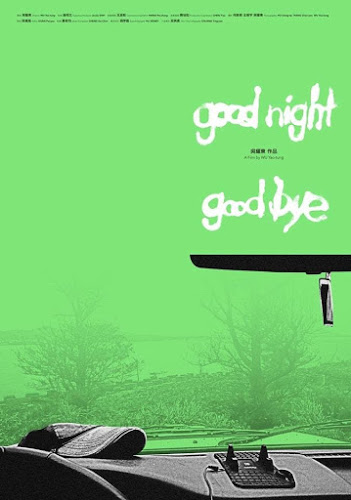
Goodnight and Goodbye (Adon Wu, 2018)
The longest of the bunch, and definitely the most seen in the festival circuit around the globe, Goodnight and Goodbye is a personal documentary through which Adon Wu searches and eventually reunites with his old friend Tom, after almost 20 years. The movie works as a sequel to Swimming on the Highway (1998), his thesis film as a student of art, a documentary screened at the Yamagata International Film Festival the following year, where it won the Ogawa Shinsuke Prize. Swimming on the Highway was about the turbulent relationship between the two friends, especially Tom’s self-destructive attitude towards life and his battle against AIDS.
Goodnight and Goodbye tries to close the circle, functioning as a sort of revisitation and remembrance of their, old, relationship, tracking down Tom, meeting him and together recollecting the time spent in front of the camera twenty years before.
Two decades without seeing each other is a long time, in the meantime Wu got married and moved forward in life, but the first movie and its often-criticized exploration of the personal matters described in it, must have haunted the director for all this time. In making his new documentary, Wu was probably moved by an intense feeling to meet again with his old friend, but also by a selfish and understandable attempt to find an interior peace for himself. On a pure aesthetic level and as a work in itself, I didn’t really latch with and particularly enjoy Goodnight and Goodbye, however I think the movie works on other levels. As an attempt to express an apology in images for instance, and also as a primal example of the myriad of implications, moral above all, that personal documentary as a sub-genre brings along with it.
 Asian Docs