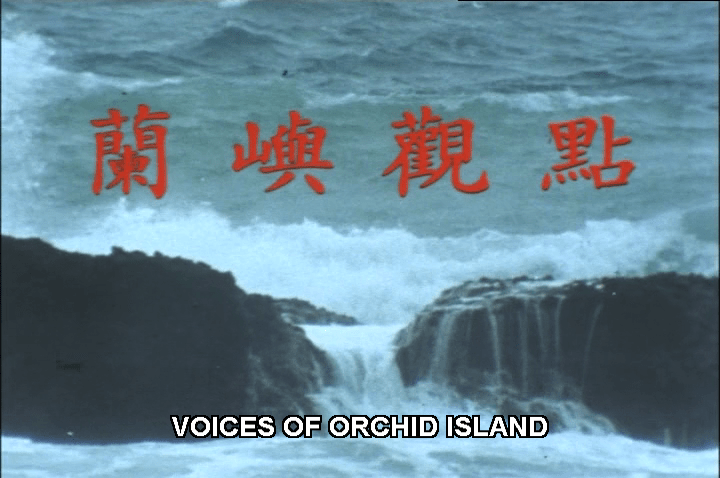
Hu Tai-Li (1950-2022) was one of the prominent ethnographic filmmakers active in Taiwan, a professor, an anthropologist, and also the president, for two decades, of Taiwan International Ethnographic Film Festival. Throughout her career, both as a documentarian and as a visual anthropologist, she tackled issues related to national and native identity, colonialism, and how the culture and traditional practices of the tribes inhabiting the island(s) are surviving in contemporary Taiwan.
At the beginning of the 1990s Hu went to Orchid Island, 45 miles off the southeast coast of Taiwan in the Pacific Ocean and just 20 miles away from the Philippines, to explore how the native people, the Yami, were affected by the influence from outside: tourism, TV people, anthropologists, mass-media…
Voices of Orchid Island opens with a self-reflexive touch, we see director Hu discussing the documentary she is going to make with some of the people who are going to be filmed in a short, casual, but significant exchange of opinions on a beach. There she talks with three people (and a kid) from different ethnic groups, two of them are from the Yami tribe, while the third man is of the Bunun tribe, an ethnic group external to the island, and who, at the time of filming, had been living there for three years, working as a doctor. While two of the people are welcoming the director and her endeavor, the youngest among them (from the Yami tribe) has an interesting response:
I often feel that the more research anthropologists do on this island, the worse the island is harmed. I feel anthropologists come to Orchid Island just so they can advance to a certain social status. They just use Orchid Island as a tool, they don’t benefit the subject of their research.
In the next scene we hear the voice and see a guide on a bus full of tourist from mainland Taiwan, explaining about the Yami people while filming them (the tourists). We (the viewers) are already thrown on the side of the outsiders/tourists, and fed with information and data about the native people. After this “lecture”, it is unsettling to see the group getting off the bus and hoarding throughout the village like it was some sort of tourist spot or a zoo where to admire some sort of rare animals. Hu constructs a cynical mirror of sort where we cannot hide our own reflection, the tourists are “us” viewers, trapped in a cursed routine by which we experience places we’re not familiar with, and objectify people who live differently from us. It is really compelling how the director is able to hint at the problematics at work in the island just in a couple of minutes of well-edited images.
“They don’t regard us as human beings” “They called us barbarians in loincloths” complain two of the Yami people interviewed, but we also hear a deeper and more material complaint:
Recently some TV crews came here (…) sometimes we see ourselves on television, and we feel we’re being exploited for profit, we don’t benefit at all, but the people who film us do. They earn all the money, not us.
On the one side we have the villagers’ will not to be exploited or misrepresented, on the other, the bureaucrats and various heads of tourism, usually from mainland Taiwan, who welcome mass tourism as the sole industry in the island. The whole first part of the movie is dedicated to explore these power relations and how the Yami react and interact with Han Chinese while trying to preserve their way of life. Everything however is more complex and layered than it might appear at first sight, it is not a clash between two different and rigid worlds, but more a nuanced blending of the two parts. We discover, for instance, that the Yami are forced (or maybe they’re doing it willingly?) to stage their biggest festival and a very important ritual dance, mainly for attracting tourists, and in doing so keeping the flow of money that guarantees their survival.
In the second section of the movie, we meet again with the doctor we saw at the beginning, he’s running a clinic in the island and his experiences with patients are as difficult as they are fascinating. The shamanic healing practices they are accustomed to, and the refusal, but also their mediated and occasional acceptance, of a medicine practice alien to them, brought from mainland Taiwan, is an unsolvable dilemma that Hu is able to convey with empathy towards the subjects filmed. This is for me the most accomplished and most powerful part of the entire documentary.
For instance, if someone didn’t want to live, how was I to change that? He believed his injury was caused by an evil ghost entering his leg and I couldn’t change his mind.

In the last section, the film moves to the resistance of some island’s inhabitants against the big nuclear waste storage facility completed by Taipower at the beginning of the 1980s. The fight and civil resistance is promoted also by a group of Christians, creolized Christians to be precise, and it intertwines with another big problem affecting the island, that of young people leaving for Taiwan in search of jobs and opportunities.
First they told us they were building a military harbor, then a canning factory. They fooled us and kept us in the dark.
While the resistance against Taipower is a fascinating subject, amplified by the colonialist aspect of the question, an approach that disregard ethnic minorities and exploit their powerlessness, the movie just hints at it and does not explored fully its potential. It definitely would have benefited the documentary to stay a bit longer and delve deeper into the topic, or even better, to make a separate work about the nuclear waste site (it’s very possible that there are already other works out there on the subject that I’m not aware of).
In closing, Voices of Orchid Island is a captivating work, not only because it presents a complex, challenging, and multilayered glimpse at the situation of the place at a specific time in history, but also because it shades light on what it means to approach and confront oneself with “different” cultures, Eduardo Viveiro de Castro would say different natures, and what this encounter implies for “us” filming/viewing subjects, and for the people being filmed as well.
If you want to know more about the contemporary documentary scene in Taiwan, I’ve written a piece here.
 Asian Docs
One thought on “Voices of Orchid Island ( Hu Tai-Li, 1993)”