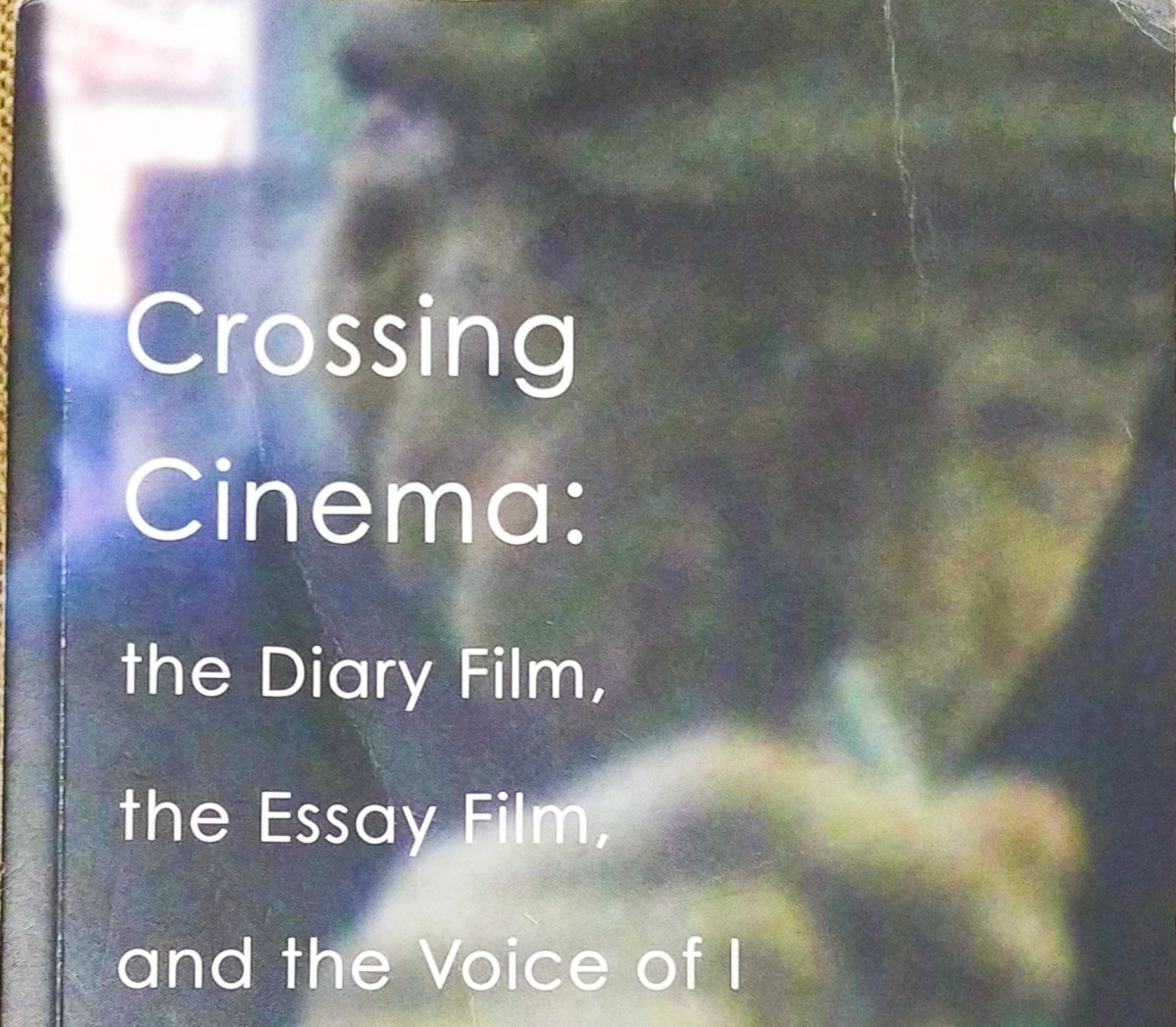
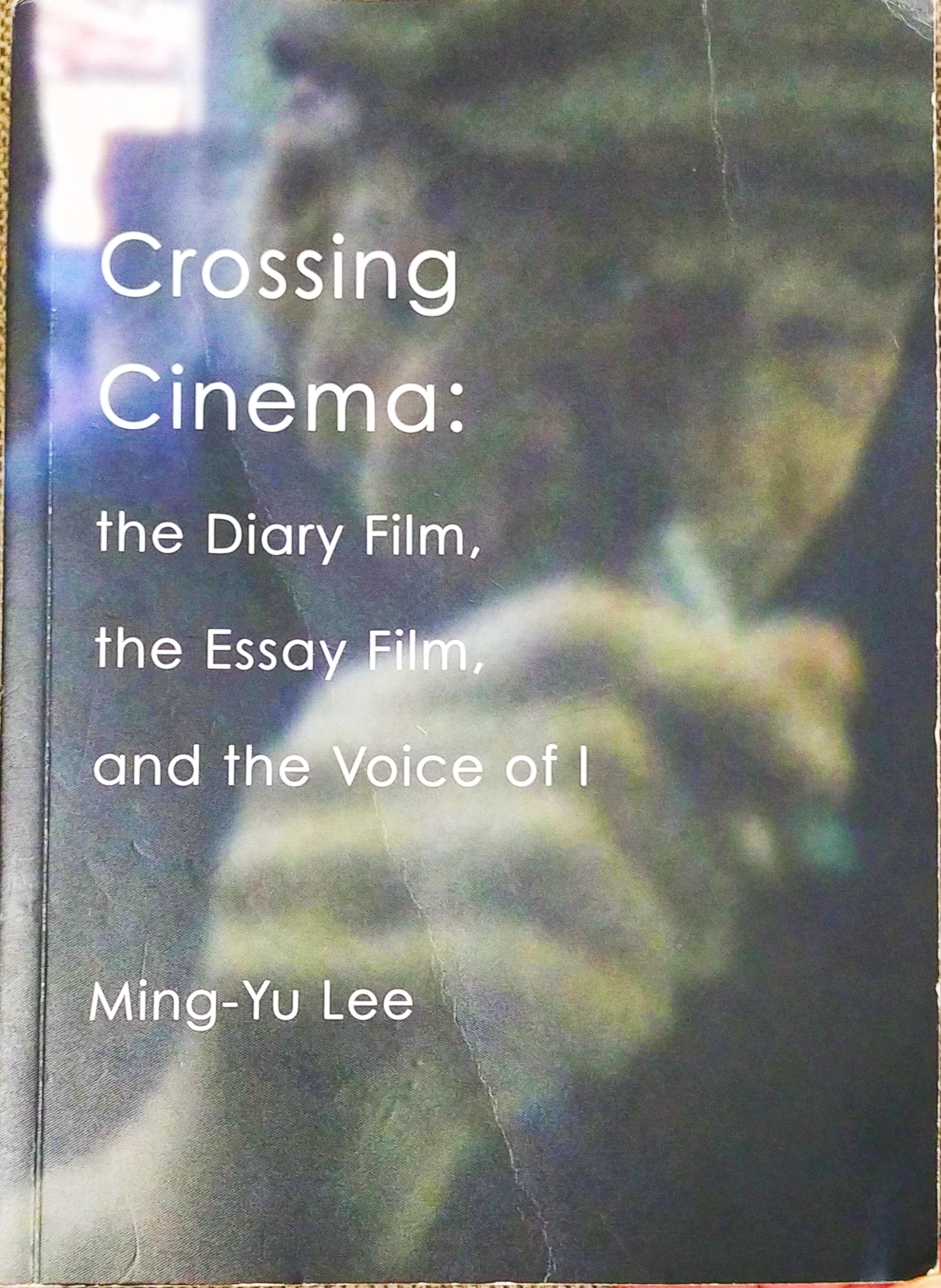
Crossing Cinema: the Diary Film, the Essay Film, and the Voice of I is a volume published by Bookman Books in 2022, and written by Taiwanese scholar and filmmaker Lee Ming-Yu on the possibilities and aesthetics of essay and diary films. I came to the author through my interest towards Taiwanese filmmaker Liu Na’Ou (discovering The Man Who Has a Camera was a revelation for me), to whom the first insightful essay in the volume is dedicated, but I discovered through the book a far richer cinematic landscape, one that explores the possibilities of the visual diary and the essay film. As stated by the author on the back cover:
This book focuses on the unique forms of expression of diary film and essay film, especially how authorship of filmmakers can be integrated in the voice-over as a narrative strategy in first-person cinema. The book is divided into two sections: the first section “essays” contains three chapters, and in these chapters I use films of Liu Na’Ou, Hollis Frampton, Jonas Mekas, and José Luis Guerín as cases for filmic textual analyses, to discuss the issues of authorial presence, the voice-over narration, and audiovisual structure. In the second section “interviews”, four important researchers and filmmakers contribute their thoughts and reflections on how the essay film and the diary film can be approached and understood.
The first part of the volume is very interesting and rich with insights, but here I’d like to focus more on the second section. The first conversation, a correspondence between Lee and scholar and professor Laura Rascaroli was the one that resonated with me the most. Rascaroli is known, among other things, for her research and publications on personal cinema and the essay film, reflections that are here mirrored in the style used, an exchange of emails she had with Lee over three months, between May and July 2016. What I found particularly fascinating in their exchange is the parallel drawn between diary films and the practice of microhistory, as Rascaroli writes:
Diary-making is a form of history from below, of microhistory: and this is so needed at a time when history from above continues to rewrite our everyday stories as a function of a political goal. Brexit, which you evoked at the end of your last entry, is a case in point, an abrupt and divisive contestation of just this kind of appropriation. I love the diary film not least because it is a channel through which our microhistory can interconnect and so too be a part of a living social fabric in a wider world.
The open-endedness of the diary form is also a remark I found very poignant:
As Lejeune says, ‘autobiography turns towards the past’, while the diary moves along, heading towards the future, which is unknown to anyone. (Lee)
Epistolarity is, like the diary, a form that is always open to the next ‘entry’. As Raymond Bellour has written, ‘The letter goes on and on. If it is a real letter, it never stops saying, wanting, wanting to say more’ (Rascaroli)
It goes without saying that the interview with Jonas Mekas is also a chest of treasures. Here on the use of voice-over in his works:
Lee:
When you record your voice-over…
Mekas:
It’s not really…maybe, I don’t know if I would call it voice-over. It’s just part of the film. It has the same function as images, which is not a voice-over, it’s just another element. Voice- over is like you make comments about the images that you see. I don’t make comments about the images. I add another level of content. So it’s not a comment, not a voice-over. You could say that the image-over, sometimes the sound is more important, sometimes images. Images illustrate the sound.
and about diary films and cinéma vérité:
Lee: Does the diary film have something to do with Cinéma vérité?
Mekas: No, no. Cinéma vérité was a variation of the documentary film. The documentary has forms, scripts. It is a scripted gene of cinema. Illustrated with footage. Scripted documentary film, they write a script and they find the footage to illustrate the script, Cinema vérité try to get rid of script scenario, the outcome [wasn’t] determined, there was always a different subject they chose or the theme was different. It was not scripted. They were collecting materials from real life, to illustrate a certain idea. The technique was more open, more real. (…) The diaristic kind of cinema does not have any idea, no predetermined scripts, because you cannot plan life…
To summarize, these are the chapters of the book:
Part one: Essays
1.Re-Discovering Liu Na’Ou and His Man with a Camera: Authorial I. Written Diary, and Cinematic Writing.
2.The Parenthetical Voice-over: Dialectical Audiovisual Structure in Hollis Frampton’s (nostalgia) and Jonas Mekas’s The Song of Avila
3. Film-Letter: The Beginning, Exchanging, and Narration in Jonas Mekas and José Luis Guerín’s Correspondence
Part two: Interviews
4. Correspondence: Ming-Yu Lee/Laura Rascaroli
5. Jonas Mekas: To My Dear Friends
7. Joseph Morder: I’d Like to Share This with Someone
6. Roger Odin: Home Movie. The Diary Film, and P-Cinema
Ming-Yu Lee (李明宇) is a filmmaker and Assistant Professor of Radio, Television and Film at Shih Hsin University (Taipei, Taiwan). Research Interests include the Diary Film, Experimental Film, Essay Film, First-Person Cinema, and Film-making. Independent Filmmaker, photographer and film editor having directed several experimental shorts including Time Variations, Going Home, Home Not Yet Arrived, Four Years of Miller. Works deal with the relationship between diary film, home movies, experimental film and questions of identity.
The book can be purchased here.
 Asian Docs