Sōda Kazuhiro has become, in the last decades, one of the most distinct voices working in the contemporary documentary scene. Based in New York, a city where he moved for studying and eventually work for the Japanese public broadcasting NHK in the second half of the 1990s, Sōda has been directing, shooting, and editing (with his wife Kashiwagi Kiyoko as a producer) his independent documentaries for almost two decades. Sōda has also been writing, in Japanese, about filming, and social and political issues for quite some time, on his blog, but also in articles and in books.
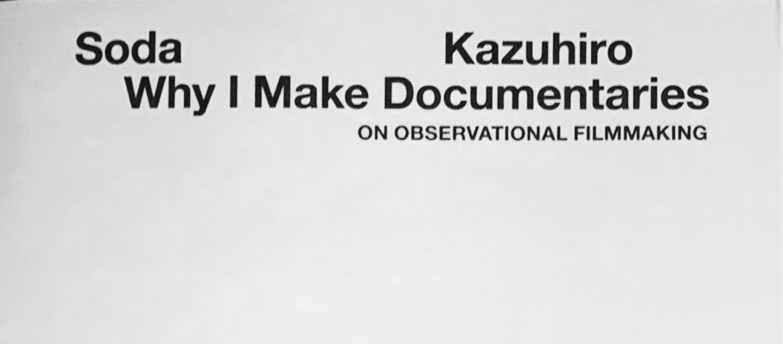
なぜ僕はドキュメンタリーを撮るのか Naze boku wa dokyumentarii wo toru no ka is a volume published in 2011 dealing with the process, issues, theory, and discoveries of making non-fiction movies, and was recently translated into English as Sōda Kazuhiro – Why I Make Documentaries (208 pages, Viaindustriae, Milan 2023, edited by Silvio Grasselli, translated by Matt Schley).
This publication is a reflexive diary on his own work in pursuit of answers to many crucial questions which have arisen along his extensive research path. It is the first curated English version of Kazuhiro’s most enlightening and complete writings, enriched with a new iconographic apparatus derived from his films and an updated introduction by the author himself. Discover why seeking answers to such basic things as ‘What is a documentary?’ and ‘Why do I make documentaries?’ turns out to be essential practice for one of the most prominent Japanese filmmakers today.
As written above, the volume originally was published in Japan in 2011, after the Tōhoku earthquake and tsunami, a tragedy that almost pushed Sōda to halt and cancel the project, and it is structured around Peace (2010), the third documentary directed independently by the Japanese. In the book Sōda recalls how the film came into existence, through the invitation to make a short movie by the DMZ International Documentary Film Festival in South Korea, but also the unexpected encounters while filming, and the difficulties in shaping a work centered around a community of people and cats in Okayama city, Japan. Describing the process of making Peace is for Sōda a chance to reflect on his working method, his belief in what documentary cinema can do, and other important issues related to the ethics and philosophy of filming. Famously, Sōda describes his method and style as observational filmmaking, and when making independent documentaries always tries to follow a series of rules he has himself established:
1 No research.
2 No scripts.
3 No meetings with subjects.
4 Roll the camera yourself.
5 Shoot for as long as possible.
6 Cover small areas deeply.
7 Do not set up a theme or goal before editing.
8 No narration, superimposed titles, or music.
9 Use long takes.
10 Pay for the production yourself.
The volume covers a lot of fascinating themes and topics significant for those who are interested in nonfiction filmmaking. First of all, citing also the writings of Satō Makoto, the power and responsibility that holding and pointing a camera at someone entails. “A documentary camera (especially in the hands of a skilled filmmaker) mercilessly gouges out and lays bare its subject’s subconscious; their inner soul, or what I call people’s ‘soft spots’” writes Sōda. “Depending on how things go, it can leave a subject deeply hurt. In that sense, there’s a possibility for a documentarist to become an assailant, and a very real risk for the camera to become a tool of violence.”
Some beautiful pages are also dedicated to the filmmakers Sōda considers his main influences, the American direct cinema of the 1960s, and especially Frederick Wiseman, who remains for the Japanese author to this day a guiding star in the world of documentary. As the technical innovations helped to shape nonfiction cinema at the end of the 1950s and beginning of the 1960s, so did the digital revolution that occurred at the beginning of this century. “The biggest impact this technology had was in freeing documentaries from the production and exhibition format of film” writes Sōda, “Up until then, if you wanted to exhibit your work on a big screen with any semblance of quality, you had no choice but to shoot, edit and project on either 16 or 35mm film. But using this new camera and the DV format allowed you to shoot on digital, edit on a computer, and even show your film using a digital projector. It opened up a whole new path.”
These new tools allowed Sōda to embark in a career of independent filmmaking, a path that was also kindled and forged in contrast to what he had experienced in the world of documentaries made for TV during the 1990s. There are strong echoes here with what Kore’eda Hirokazu has to say about working for TV, although with some major differences, Kore’eda was lucky to work in a different period, with more freedom, and with some enlightened colleagues and producers, Sasaki Shōichirō in primis. Everything on TV, according to Sōda, is often scripted, and once the director or the producers set a theme or a goal for the program, the reality captured is distorted, biased, and without anything left to chance, the latter being one of the most powerful elements in a documentary. As an example of this modus operandi, Sōda brings his personal experience of working with NHK after the terrorist attacks on 9/11 2001. In the aftermath of the tragedy, the Japanese broadcaster was looking for images of tears and cooperation, while Sōda often witnessed in New York scenes of normal daily life and quarrels.
Being open to chance and randomness is a key point for Sōda’s approach to documentary, and it is fascinating to read that he was influenced and inspired in this by the art and the creative method used by Jackson Pollock, and by the way dance was conceptualised by Merce Cunningham, a performer Sōda was able to know and meet through his wife, a professional trained dancer.
Some of the most inspiring pages are the ones dedicated to the art of editing, and a paragraph titled “Changing Yourself Through Observation”, where Soda associated the act of observing through documentary with vipassana meditation, a subject he ended up writing a book about in 2021.
“Many people may think of ‘observation’ as something done in a cool and distant way. But that couldn’t be further from the truth. The act of observation is almost always accompanied by a change in the observer’s way of seeing the world. One loses one’s sense of tranquility, and, before long, is compelled to observe one’s own self as well.”
In conclusion, it is fair to say that beyond the pleasure of reading the reflections of one of the most prominent documentarians working today, this volume is also important in that it is an essential addition to expanding literature, available in English, on film theory produced in Asia.
The book is available for purchase here.
 Asian Docs