
As usual, the list below reflects my tastes, interests and viewing habits during the year. Some works are from 2023, but only became available here in Japan in 2024. Synopses, in italics, are from Letterboxd. Films are listed in no particular order:
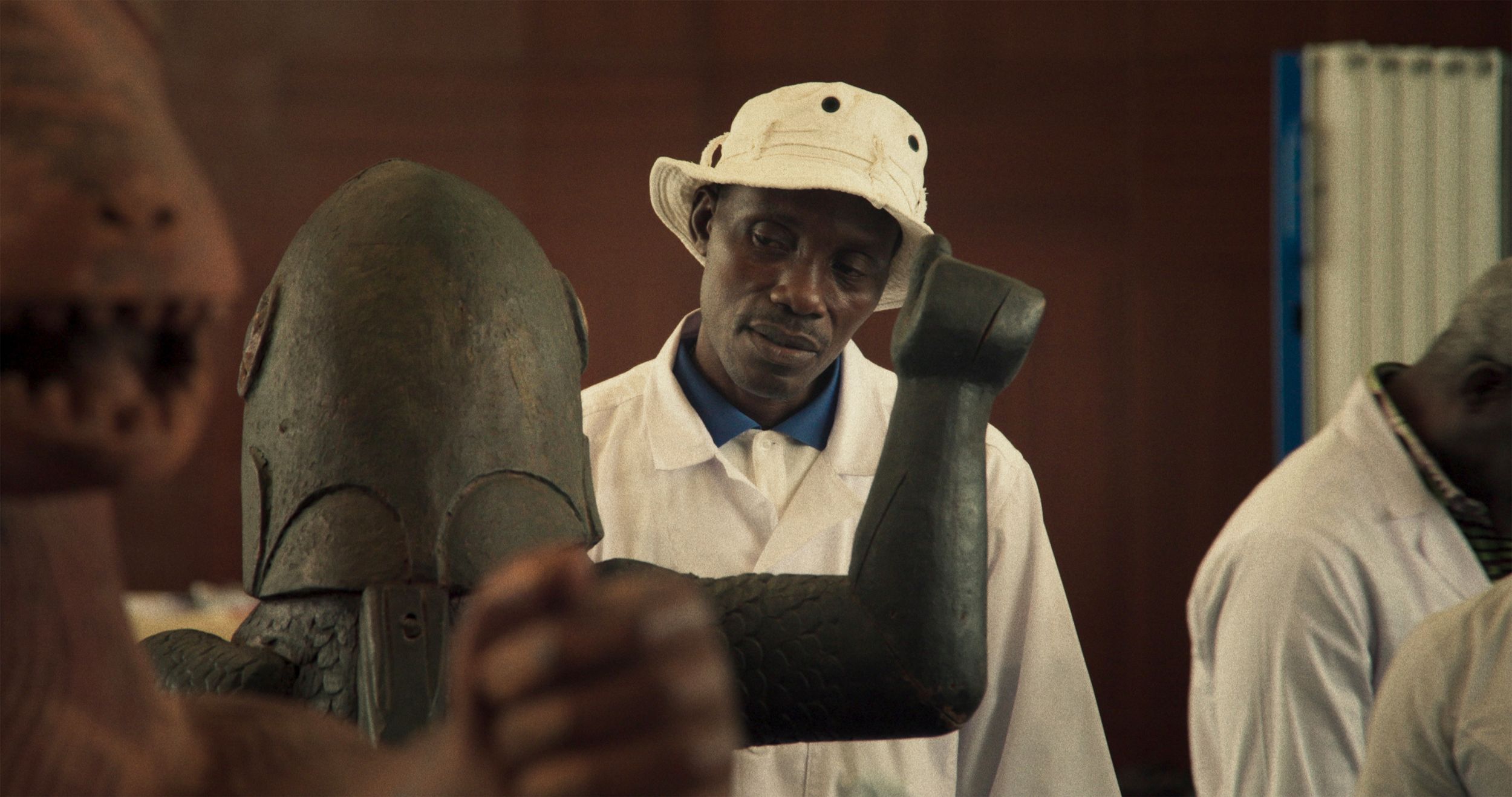
Dahomey (Mati Diop)
Thousands of royal artifacts of Dahomey, a West African kingdom, were taken by French colonists in the 19th century for collection and display in Paris. Centuries later, a fraction returned to their home in modern-day Benin. This dramatized documentary follows the journey of 26 of the treasures as told by cultural art historians, embattled university students, and one of the repatriated statues himself.
Dahomey is a mesmerising experiment, both visually and thematically: it poses so many questions about decolonisation, essentialism, the traces in the present left by the actions in the past, language, art, religious practices, politics, and the life of objects (Object Oriented Onthology?), while hinting at possible lines of flight…Diop has an incredible talent in capturing the beauty of people and things, and blend them together…
“I am the face of the metamorphosis”
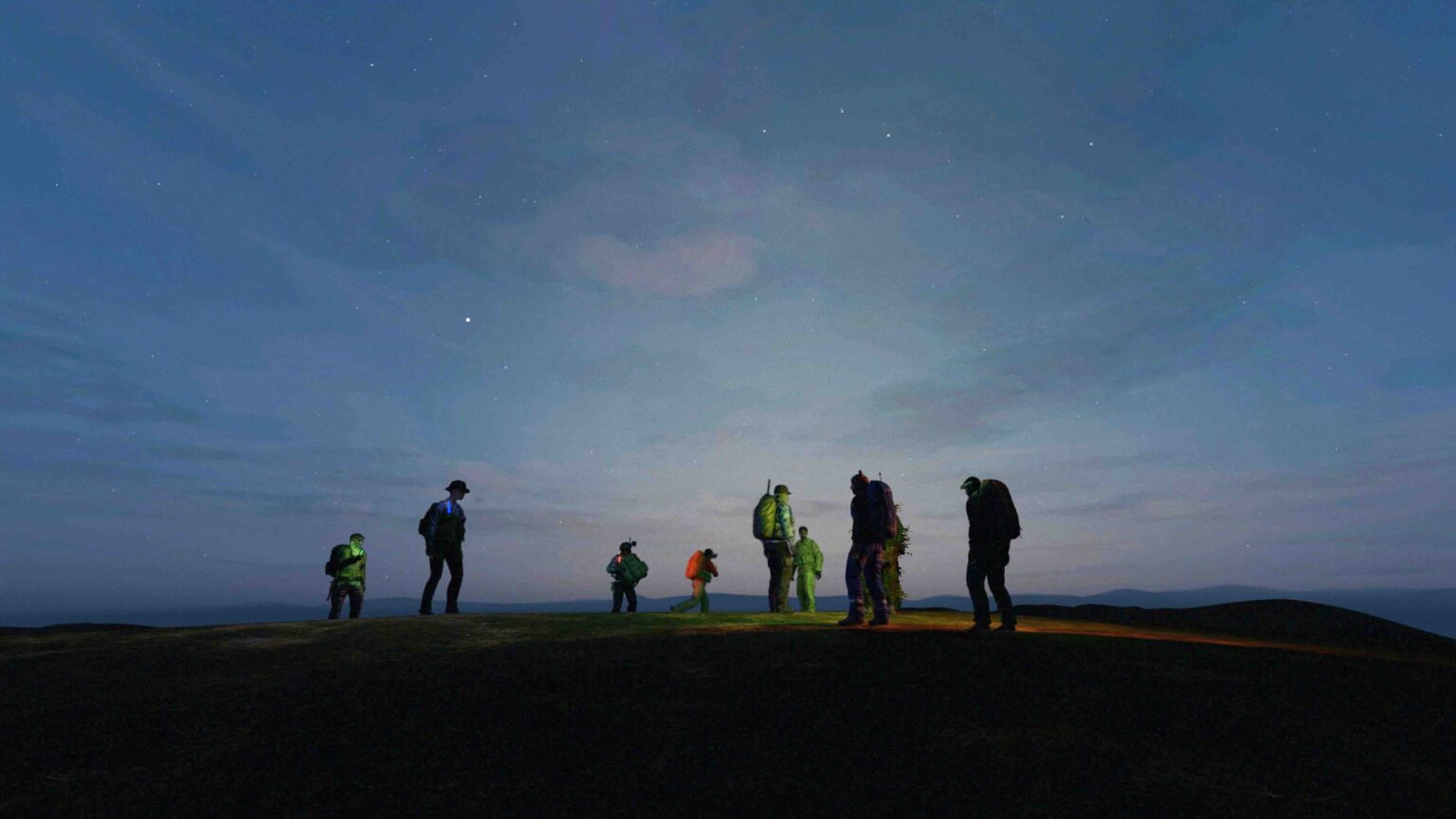
Knit’s Island (Ekiem Barbier, Guilhem Causse, Quentin L’helgoualc’h)
Somewhere on the internet is a land where communities pretend to live out a survivalist fiction. The avatars of the directors of Knit’s Island spent 963 hours there, creating a fascinating film resulting from their encounter with these communities. The “players” reveal their fears and fantasies, in an at times unsettling blurring of the real and the virtual.
I am not a gamer, and not particularly interested in online videogames, but when I first saw it at the Niigata International Animation Film Festival, it blew my mind. The reality of the virtual, complex, subtle, and much much more.
No Other Land (Yuval Abraham, Basel Adra, Rachel Szor, Hamdan Ballal)
Made by a Palestinian-Israeli collective, this documentary shows the destruction of the West Bank’s Masafer Yatta by Israeli authorities and the unlikely friendship that blossoms between Palestinian activist Basel Adra and Israeli journalist Yuval Abraham.
The Voices Of The Silenced (Park Maeui, Pak Su-nam)
Director Park Soo-nam, a second-generation Korean resident in Japan who is losing his eyesight, decides to digitally restore 16mm film she shot a long time ago, relying on her daughter Park Ma-eui’s eyesight. The blood, tears, and numerous corpses of Koreans living in Japan are clearly engraved in the film filmed over 50 years.
Hiroshima – Nagasaki (Ikezoe Shun)
Voices from Tsuyoshi Yamaguchi, who was twice exposed to the atomic bombs in Hiroshima and Nagasaki and later became a storyteller, as well as those who continue the storyteller activities with his daughters, grandchildren, and great-grandchildren, and other people who were twice exposed to the atomic bombs. How will a storyteller who was not involved in the story pass on the memories in the future?
Clouds of War (Mikami Chie)
This is the latest documentary by journalist and filmmaker Mikami Chie, a director whose previous works (The Targeted Village, Boy Soldiers: the Secret War in Okinawa, We Shall Overcome) have focused on the current situation in the Ryūkyū archipelago (Okinawa), its complex geopolitical history and the resistance of its people against the various American bases operating on the islands. Filmed over the course of eight years, beginning in 2015, Clouds of War documents the construction of military harbours and ammunition depots by the Japanese Self-Defence Forces, and more broadly, the general militarisation of the main island of Okinawa, Yonaguni, Miyako and Ishigaki. These frightening changes affecting the land and its citizens, such as the construction of underground shelters in Yoneguni or a plan to evacuate the inhabitants to Kyūshū, are being done in preparation for the next war on the horizon, the one between China and Taiwan.


Soundtrack to a Coup d’État (Johan Grimonprez)
In 1960, United Nations: the Global South ignites a political earthquake, musicians Abbey Lincoln and Max Roach crash the Security Council, Nikita Khrushchev bangs his shoe denouncing America’s color bar, while the U.S. dispatches jazz ambassador Louis Armstrong to the Congo to deflect attention from its first African post-colonial coup.
The Oasis I Deserve (Inès Sieulle)
Replika is a public platform that allows anyone to create a relationship with a chatbot trained by artificial intelligence. This chatbot has been designed to replace us with our loved ones after our death. Thus, its goal is to learn as much as possible about us in order to reproduce us identically. Through a walk that takes place only from the subjective point of view of Replikas, we see them evolve and discover the images & sounds of the world around them through a system of videos generated by artificial intelligence. Phone conversations that Replikas have with users fill the narration. The Oasis I Deserve is not a film that questions the system of machine/human domination under the axis of a future war against the machine. It is a film that is mainly human. It speaks about our relationship to the unknown and how we share violence. (source).
I was really impressed by the subject tackled and by the way the images, Francis Bacon like, are able to convey the themes and the feelings explored .
Black Box Diaries (Itō Shiori)
Journalist Shiori Itō embarks on a courageous investigation of her own sexual assault in an improbable attempt to prosecute her high-profile offender. Her quest becomes a landmark case in Japan, exposing the country’s outdated judicial and societal systems.
A powerful example of how women can reclaim their agency through the visual medium.
Underground (Oda Kaori)
The latest work by the Japanese artist, I have written about it, here: Sculpting space with light.
Discoveries:
Mother of Many Children (Alanis Obomsawin, 1977)
This film is an album of Native womanhood, portraying a proud matriarchal society that for centuries has been pressured to adopt different standards and customs. All of the women featured share a belief in the importance of tradition as a source of strength in the face of change.
Obomasawin’s first feature-length documentary is also one of her best (along with Kanehsatake and Restigouche, in my opinion): insightful, touching, multi-layered and beautifully constructed.
Echigo Okumiomote: A Traditional Mountain Village (Himeda Tadayoshi, 1984)
I wrote an article about the film: here.
A Grasscutter’s Tale (Fukuda Katsuhiko, 1985)
Part of the Sanrizuka notes that Fukuda took after he left Ogawa Pro in the late 1970s and the group moved to Yamagata, A Grasscutter’s Tale is a crucial film in the history and development of documentary practices in Japan. It occupies two spaces at once: a militant cinema and a cinema that explores the waves of history through the personal; in other words, it’s an oral film that uses images to explore the physical and historical space of a place.
Fukuda experiments with style and form, for example: one segment about a dream is completely dark except for a bright light in the top left corner of the screen, and in another, the narration explains, again on a black screen, how the re-enactment of an episode from the old lady’s life was scrapped at the request of her son, who was in it.
The episodic structure of the film, which is made up of 19 chapters (some comic, some tragic) that explore episodes in the life of the protagonist, does not capture a totality, but provides an image that leaves room for the creation of meanings. This is also reflected in the visual style used, where images and words are parallel and do not touch each other, so to speak.
I was lucky enough to attend a screening of the documentary in 16mm, the greens of the crops and grass are almost tactile, and the time-lapse scene of the setting sun, here a fiery red, is similar to that used in Magino Village: A Tale.
addendum (January 5, 2024): I forgot Tokyo Trial (Kobayashi Masaki, 1983), one of the fews examples of found footage/compilation documentary in the history of Japanese cinema.
 Asian Docs