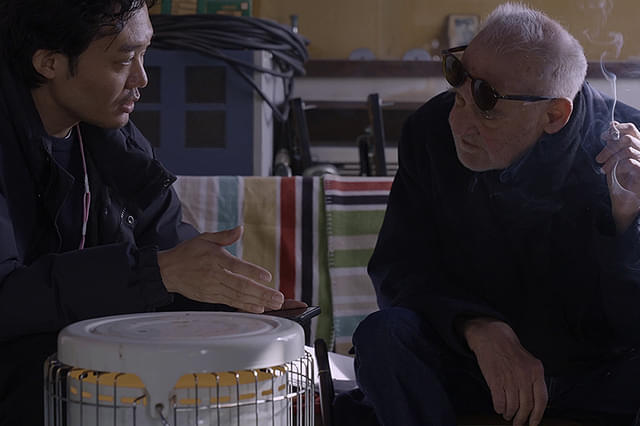
Fukushima with Béla Tarr documents a two-week workshop held by the Hungarian filmmaker in February 2024 in the Japanese area hit by the 2011 Tōhoku earthquake and tsunami. The documentary is directed by Oda Kaori, who studied with Tarr at film.factory, his film school in Sarajevo, more than a decade ago, a period that led to Oda’s debut film Aragane (2015).
I found Fukushima with Béla Tarr fascinating on so many levels, not least the director’s abrasive personality, which – as some reviewers have pointed out – at first seems almost like a caricature of the artistic persona he has developed over the years. What also struck me was his varied interactions with each filmmaker; there is a sense, at least from what we can gather from the documentary, that he likes some of the participants’ approach to filming more than others. Tarr’s comments, suggestions and conversations with the filmmakers also reveal how he sees cinema and the filmmaking process, at least in the limited conditions of the workshop: only two weeks, no familiarity with the area and the language for many of the participants. Perhaps it’s because of the limited time available that Tarr pushes everyone, sometimes almost aggressively, to visualise the ideas they have in mind in images, rather than just talking about them or explaining the context of what’s happening.
Some of the most interesting technical tips he gives the workshop participants are also prime examples of his idea of cinema, such as holding a shot longer than one would normally do, it’s always possible to shorten it later, or how paying attention to the interplay of light and darkness enhances the visual impact and the meanings conveyed by the work.
The best quality of the documentary, in my opinion, is the time it spends and stays with the group of people involved in the workshop, allowing the camera to capture the distinctive personality of each filmmaker and how each of their projects progresses, or in some cases crumbles, towards the deadline. It is this familiarity with the subjects that makes the work more organic and meaningful as it unfolds, and leads the viewer to care about, or at least become more familiar with, all the people involved, not just the filmmakers and Tarr, but also the interpreters, drivers and ordinary people filmed here. All this takes place against the backdrop of the lives of the people of Fukushima affected by the triple disaster, the subject of the works produced in the workshop, of which we, the viewers, get only a glimpse. Among the most fascinating of these stories is that of a kamishibai performed by two women in an abandoned cow shed, now in ruins, and told from the animals’ point of view (Tale of Cows directed by Fukunaga Takeshi).
On a technical level, Oda’s decision to use mostly static shots with very little camera movement is very effective in creating a restrained cinematic space centred around the people portrayed and their interactions. But perhaps the Japanese filmmaker’s greatest effort, as is often the case with this type of documentary, was in the editing room, deciding what to include, how to include it, how to structure it, and what to leave on the cutting room floor.
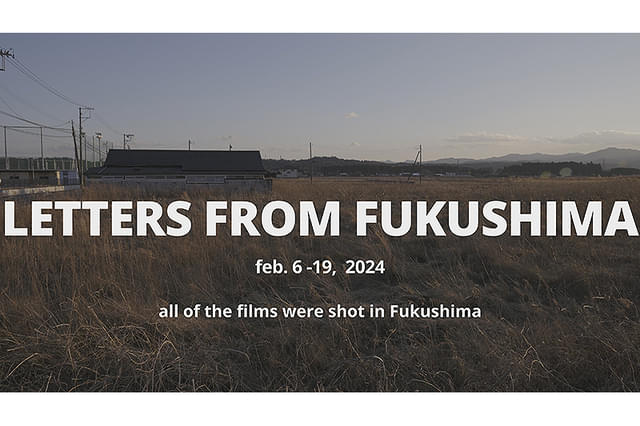
The short films made by the 7 filmmakers have been compiled into an omnibus film, Letters From Fukushima. Below is the description of each short film (from the Tokyo International Film Festival’s webpage):
“Nappo” After 13 years of silence, the instruments are played again. Nappo gathers Fukushima children at Odaka Church. Singing and dancing, they breathe new life into the land. Director: Lin Po-Yu 2024/Color/9min/Japanese
“Wall” A man from Namie Town had to relocate his landscaping business after the disaster. One day, he begins working on a garden in the office, which has been untouched. Director: Ooura Miran 2024/Color/28min/Japanese
“Long Long Hair” In a Fukushima hair salon, daily interactions unveil personal stories, resilience, and the beauty of life after the Great East Japan Earthquake and the nuclear accident. Director: Iizuka Minami 2024/Color/23min/Japanese
“From F” Fukushima, Family, Female, and Future. A story about various Fs, starring 17-year-old-girl who wants to be a dancer while attending an evening school in Fukushima. Director: Shimizu Shumpei 2024/Color/10min/Japanese
“Letters from Fukushima” “Woman, Life, Freedom” is a social movement seeking gender equality. Through three scenes of Fukushima, the film honors the women who gave their lives for dignity. Director: Roya Eshraghi 2024/Color/27min/Japanese, Persian
“The Guests” After a nuclear radiation leak at the Fukushima power plant in 2011, a group of Southeast Asian auto mechanics is dispatched to work in this land… Director: Xu Zhien 2024/Color/28min/Filipino, Japanese
“Tale of Cows” Two women who survived the 2011 Tohoku Earthquake, perform a Kamishibai picturebook about the abandoned cows during the Fukushima nuclear power plant accident. Director: Fukunaga Takeshi 2024/Color/29min/Japanese
 Asian Docs