Read the YIDFF 2025 preview here, and report 2 here
Let’s start from the end. This is a short review of the last movie I saw in Yamagata, SPI by Sayun Simung, whose Millets Back Home I saw at the festival almost exactly 10 years ago.
The film explores what it means to be part of the Tayal Indigenous people in Taiwan in the 2020s. Director Simung approaches this through a first-person documentary, turning the camera toward her own family—as she did in Millets Back Home—crafting both a tribute to her late grandfather and an intimate portrayal of everyday life in the small mountain village of Sqoyaw.
At the center of the film lies the concept of Gaga, a term apparently difficult to translate, but that has been rendered as Tayal law and cosmology in academic papers. Simung embarks on a search for what Gaga means for her and her relatives, depicting the everyday life of her family while interspersing scenes of natural landscapes—shot in a different aspect ratio—during which she addresses the spirit of her late grandfather. The world of dreams—SPI means “dream” in the Tayal language—as well as that of the ancestors and spirits is a constant but subtle presence throughout the documentary. It unfolds as a sort of hidden dialog between the living and the dead—a theme, once again not in the foreground, that I noticed in many of the documentaries I saw in Yamagata this year.
Unlike many of the works presented in this year’s New Asian Currents, SPI avoids formal experimentation, its apparent simplicity, however, becomes a strength, allowing the film to convey on screen the small joys and struggles the director’s family has to face.
After a meandering opening, the film gains momentum, shifting gears when we discover that the director’s younger sister is pregnant at just seventeen. This development opens up one of the most fascinating sections of the work. At first, the grandmother cannot accept her granddaughter’s pregnancy—because she is too young and also because, possibly, the future husband belongs to a different indigenous group, the Paiwan. One of the most memorable sequences depicts the meeting between the two families: different languages are spoken, and Mandarin becomes the bridge of communication. They discuss how the wedding customs of each group—all of which involve the slaughter of an animal, slightly differ. During these long conversations, the camera often cuts to the faces of the young couple, silent and visibly lost.
As is often the case in documentaries about Taiwan’s indigenous peoples, it is striking to see how traditions and beliefs evolve while seemingly remaining the same. A particularly significant moment comes during a Tayal year-end ceremony, where fireworks light up the night sky. The following shot shows the village from afar, with a church and bell tower standing out—echoing an earlier scene where the grandmother visits the church.
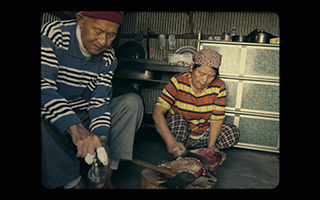
Yet this ongoing search for what defines a Tayal way of life in contemporary Taiwan is only one layer of the film. SPI concludes with a brief, tender scene filmed while the grandfather was still alive, showing him cutting pork—an emblematic choice that underscores how the documentary also serves as a heartfelt farewell from the director to her beloved grandfather, intertwining the personal loss with the broader meditation on tradition and identity.
Just a final note on the title, I would have preferred to keep a translation more faithful to the original which is, I believe, something like Dreams in the Fire Room.
 Asian Docs
6 thoughts on “YIDFF 2025 – report 1: SPI (Sayun Simung)”