We Shall Overcome 「戦場ぬ止み」available on DVD

Just a short post to announce that our friends at Zakka Films are putting out on DVD another interesting Japanese documentary, We Shall Overcome 「戦場ぬ止み」(Ikusaba nu todomi) directed by Mikami Chie in 2014 and nominated by The Kinema Junpo poll as the second best Japanese documentary of 2015.

As the American based label’s page states:

A hundred thousand non-combatants—one in four Okinawans—died in the brutal Battle of Okinawa at the end of World War II. Postwar, the U.S. military forcibly constructed military bases throughout Okinawa. Even today, 43 years since Okinawa’s reversion to Japan and 70 years since the war, 74% of all U.S. military facilities in Japan are crowded onto the Okinawan islands.

We Shall Overcome reports on what is actually going on right now in Okinawa. Today there are plans to construct a brand new military base that requires reclaiming a portion of a beautiful ocean where rare coral and the vanishing dugong make their home. Most Okinawans are opposed to this base, and have launched protests, on sea and on land, to somehow stop construction. Okinawa’s rage has boiled over. In November 2014, Takeshi Onaga was elected Governor of Okinawa in a landslide victory on a platform opposing new base construction. But the national government refuses to budge. It uses subsidies to buy off some Okinawans and uses the Okinawan Prefectural riot police against others, pitting Okinawans against Okinawans. Tensions build daily at the scene of the protests, with injuries and arrests.

Violent confrontations are not the only subject of this documentary. It also reveals the rich culture and way of life of people who have had to live alongside the U.S. military bases, the music and humor they have carefully nurtured in spite of Okinawa’s harrowing history. The film conveys to the world Okinawa’s wish that an end be made to seventy years of conflict.

Mikami is a journalist and filmmaker who in 2013 authored another movie set in and about Okinawa and the struggle of their people, The Targeted Village, the theatrical version of which was screened at the 2013 edition of Yamagata International Documentary Film Festival. I very clearly remember that after a packed morning screening, many young viewers (especially women) came out of the theater in tears and moved by the experience.
We Shall Overcome is narrated by Cocco, singer and actress herself from Okinawa, cinema lovers will certainly remember her as the disturbed protagonist of Tsukamoto Shin’ya’s Kotoko and as the subject of a music documentary by Kore’eda Hirokazu, Daijōbu de aru yo ni Cocco owaranai tabi「大丈夫であるように-Cocco 終らない旅」.

You can purchase We Shall Overcome directly from Zakka Films website using Amazon payments.

youtu.be/FEc_D_meOBY
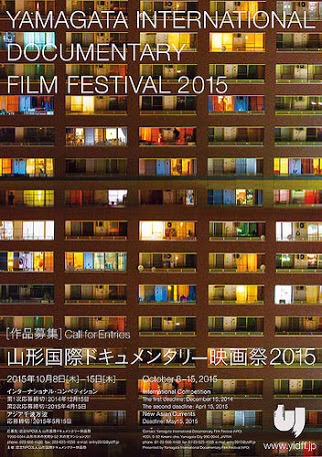
Yamagata International Documentary Film Festival 2015 – International Competition and New Asian Currents

The Yamagata International Documentary Film Festival has completed its line-up, once more a rich and very interesting one, at least if you’re into the world of non-fiction cinema. The biennial event co-established in 1989 by Ogawa Shinsuke and dedicated to the exploration of the world of documentary, in its broadest sense, will take place as usual, in the Japanese city of Yamagata next October from 8th to 15th.                        I’ll be there for 3 days, from the 10th to the 12th, and hopefully I’ll be able to write down and post something, possibly a brief daily report, after-screening parties permitting….anyway, let’s see what this year program is offering us, of course I’ll focus more on the Japanese works.

These are the sections:

– International Competition

– New Asian Currents

– Perspectives Japan

– Yamagata Rough Cut!

– Latinoamérica The Time and the People: Memories, Passion, Work and Life

– Double Shadows—Talking about Films that Talk about Films

– Past and Future Stories of the Arab Peoples

– Cinema with Us 2015

– Yamagata and Film

The competition this year is graced with the presence of some big names such as Patricio Guzmán and Pedro Costa, in Yamagata with The Pearl Button and Horse Money respectively. Another title, among the 15 in competition, that has attracted my attention is the long (334′) Homeland (Iraq Year Zero) by Abbas Fahdel, “two years in the life of a family amidst the Coalition Forces’ 2003 invasion of Iraq”.                                         There will be only one documentary representing Japan in competition, We Shall Overcome (戦場(いくさば)ぬ止(とぅどぅ)み) from director Mikami Chie who 2 years ago was at the festival with her The Targeted Village (標的の村). We Shall Overcome continues to explore and document the ongoing “battle” of Okinawans against the plan to build a new American base in Henoko, and telling the story of Fumiko, an elderly woman who witnessed the battle of Okinawa in 1945, the film is connecting the past with the present of the archipelago. The documentary is also enriched by Cocco‘s voice over, the singer and actress herself is from Okinawa and is known by Japanese cinema fans because of her amazing and phisical performance in Tsukamoto Shin’ya’s Kotoko (2011).

Three Japanese docs and thus more to talk and write about in the New Asian Currents section, a selection that in total includes 20 works from different parts of Asia.  Distance is the debut behind the camera for Okamoto Mana, reading the description on the festival site it seems to be a sort of self-documentary, created by crossing family home movies with new shooting material, and in doing so reflecting on the director’s family and her past. The second work made by a Japanese is Each Story (Okuma Katsuya) a movie that takes place in India and “For their summer homework, Jigmet and Stanzin are assigned to study the Epic of King Gesar, passed down from generation to generation in the northern Indian region of Ladakh, where the boys live. As they splash in the river and run through the streets, the boys come to understand each story shared with them by the adults of their village.”                                                         Last but not least there’s Aragane, the feature debut for Oda Kaori, an artist leaving in Sarajevo and studing in a graduate program under Tarr Béla. I had the privilege of watching the documentary on a sample screening, and although it was on a TV screen, I was very impressed.  The camera follows patiently and almost hypnotically the workers of an old coal mine in Bosnia down into the darkness of their daily routine. Aragane is visually stunning, Oda knows how to use the digital for her cinematic purposes, partly documentary and partly experimental cinema, the movie possesses an impressive sound design, and a stilistic and poetic touch akin to the works produced by The Sensory Ethnography Lab (SEL) at Harvard University (Leviathan, Manakamama). I’m really looking forward to seeing it on a big screen and with a proper sound system.

Not from Japan but worth mentioning are the two Special Invitation Films: Almost a Revolution (Hong Kong, by Kwok Tat Chun, Kong King Chu) and Sunflower Occupation (Taiwan, by the Sunflower Occupation Documentary Project), both of them dealing with students street protests and uprising occured in Hong Kong and Taiwan in the last two years.

In the next post I’ll write about Perspectives Japan, a selection of new Japanese docs, and Latinoamérica—The Time and the People: Memories, Passion, Work and Life, a retrospective on the so called Third Cinema (Tercer Cine) and its resonances with the contemporary non-fiction production in Latin America.