
Prompted by several online comments describing it as a cinematic experience close to the works by The Sensory Ethnography Lab or Aragane, I finally had the chance to watch Machines, the debut documentary directed by Rahul Jain and set in a textile factory in Gujarat, India.
It’s not a documentary made or about East or Southeast Asia, thus strictly speaking it is out of the areas usually covered in this blog, nonetheless I found it so compelling that I made an exception. Here the description of the movie from FestivalScope:
To the south of the Indian metropolis of Surat in Gujarat province lies a vast industrial zone that has been growing ever since the 1960s. Director Rahul Jain filmed the grueling daily routine in just one of the many textile factories there. In the factory, man and machine seem to have fused into one being. It is dark and dank, and barely any daylight penetrates the space. The labor is heavy and mind-numbing, and the work days seem endless. We are drawn into a gloomy world where the cacophonous beat of machinery sets the rhythm of toil. Jain is as interested in the mysterious connection between worker and product (the fabrics are treated mechanically, but also with love) as he is in the degrading conditions. Each shift lasts 12 hours, for adults and children alike, and wages are extremely low. Short interviews are interspersed throughout the observational sequences, some of which are captivating in their beauty while others are painful to watch – such as when we see a boy nodding violently in his struggle to stay awake.
Formally one of the focal points of the movie is the cacophonous sounds of the factory as experienced every day by the workers, here as in many contemporary documentaries similar in style and scope to Machines, works that stress the sensory experiences captured on video/film, the sound design plays a key role in the construction of the movie. The use of light and the color palette are also two aesthetic elements that stand out from the very first scenes. The neon lights inside the factory resonate with the cold tonality of the gray walls and the metallic machines, making the milky white of the textiles stand out as if ethereal rags. Particularly compelling is also the contrast between the warm and thick colors of some textiles, red, yellow and purple, and the darkness and coldness of the working environment, formally one the best qualities of the documentary because it symbolizes the gulf between the beautiful and refined textile produced and the inhuman labour conditions inside the factory.
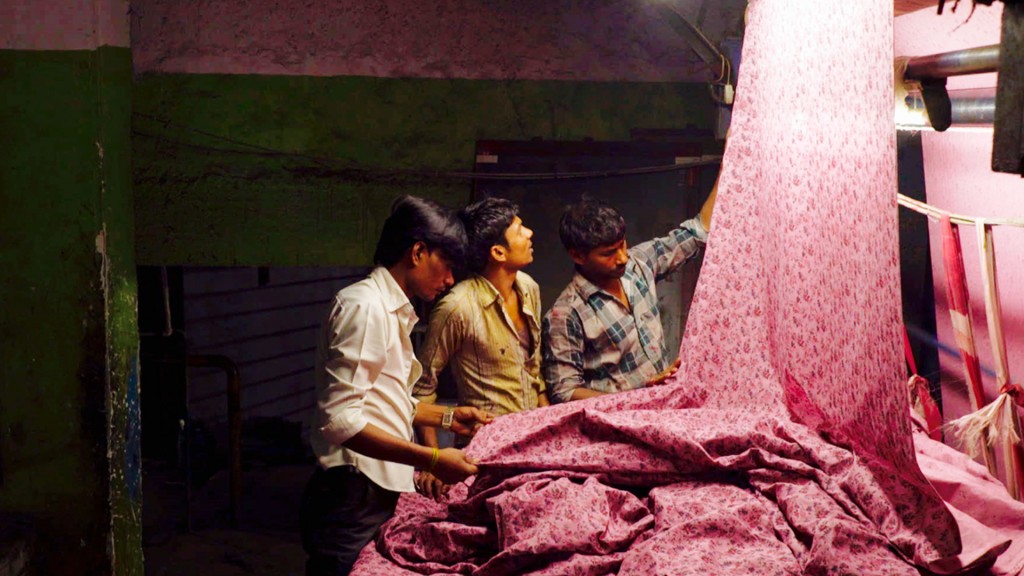
The reason the movie is one of the best non-fiction pics I’ve seen this year however is the shift from a documentary purely focused on the sensory and the visual, to a more socially charged work. It is around 20-25 minutes into the movie that we see some workers been interviewed, a man who made debts to travel to the factory and support his family, but who has almost accepted the fate of being poor, a young boy revealing how everyday at the gate he’s so exhausted he wants to go back, and another man more critical of the system and particularly of the absence and weakness of unions.
Towards to end, the movie introduces also the owner of the company, a figure speaking empty words and lamenting how the workers want more money just to spend it in tobacco, alcohol and leisure he comes out as the epitome of the capitalist.
Machines however does not offer a simple and Manichean picture of the exploited workers against the evil owners, but a problematized and more complex depiction of the situation. A worker for instance, candidly admits he likes his job even if it is very hard, “God gave us hands, so we have to work”, after all they are still workers proud of their manual skills, and others, while criticizing the harsh conditions, state how this is the destiny of the poor and something almost unavoidable. I’m not an expert on India, but this could be directly linked to the class division of society that still permeates and shapes the country, or more probably to the production of subjectivity that characterizes this late phase of capitalism, especially in the new emerging superpowers. While these could be honest statements, and they probably are, we shouldn’t forget that the workers know this is a movie that eventually will be seen by the owners, thus forcing them to hold back part of the truth. To add a further layer of complexity, towards the end the documentary has an interesting meta-filmic shift when a large group of workers addresses directly the camera and Rahul Jain behind it, essentially criticizing him for exploiting them by making a movie and not helping them improving their working conditions instead.
One final not on the title. The machines of the title are of course those seen and heard during the whole movie, and the workers reduced to the status of a machine. The machine however is also the bigger picture and the given state of affairs, the capitalistic machinery that permeates society and shapes its people. As Deleuze wrote, I’m paraphrasing, you cannot escape the machine, out of the factory/office, the machine is everywhere, in the school, in the family, in everyday relations, in yourself, everywhere.
 Asian Docs
You must be logged in to post a comment.