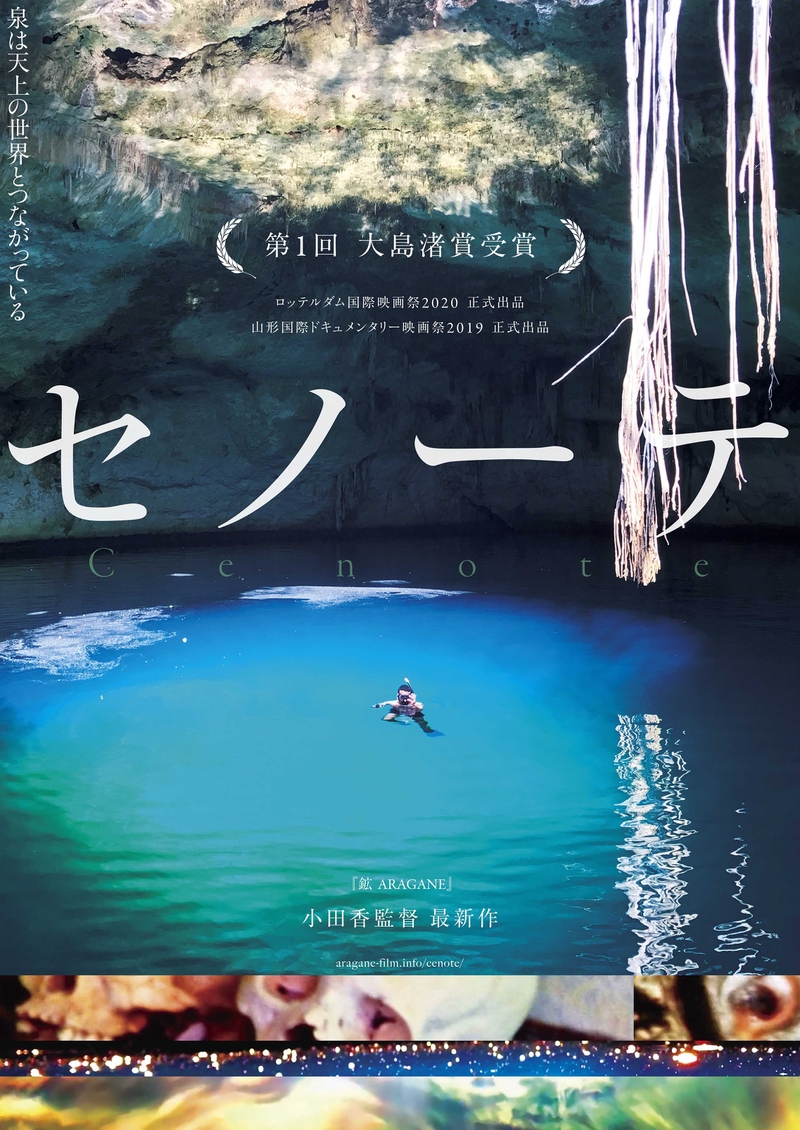
I wrote a longer and in-depth piece on Cenote, Aragane, Towards a Common Tenderness, and Oda’s filmmaking more in general for a film publication (hopefully out next year), so what follows are just some of my thoughts on the movie, and my experience with Cenote after multiple viewings.
My interview with Oda, and my piece on Aragane.
The past and present of those living around the cenotes coalesce in this mysterious place. Long-lost memories echo in hallucinatory turquoise underwater footage, an entrancing game of light and dark. Swimming in these sinkholes, director Oda Kaori encounters intriguing shapes and beams of light, the water heaves, drops fall like razor blades.
After debuting on the international scene with Aragane in 2015, although Thus a Noise Speaks (2010) was her actual debut in the film/documentary scene, two years later young filmmaker Oda Kaori released Towards a Common Tenderness, her second feature film. This is a movie about her journey from Japan to Europe, and there across the borders of the former Yugoslavia, and also about the possibilities, limitations, and responsibilities that come with documentary filmmaking. Her new film, Cenote, is again shot outside of Japan, this time in Northern Yucatan, Mexico, and almost completely filmed with an iPhone inside a few ts’onot/cenotes, sinkholes that were used by ancient Mayans as a primal source of water. Some of these sinkholes were also used during ritual sacrifices, and in the Mayans belief system they were considered holy springs able to connect this world to the afterlife.
When I first saw Cenote at a special screening organized at the Aichi Arts Center in Nagoya exactly a year ago, in July 2019 (the movie was partly funded by the venue), what impressed me the most were the first twenty minutes of the film. It was an exhilarating sensorial experience, almost an unveiling of a new world: the abstract images shot underwater and those gliding on the surface of the liquid, blended with grainy images of people whispering old Mayan stories, all of this soaked in a haptic soundscape, are to this day one of the best combination of images and sound I saw on screen in recent years. However, the second part of the work did not really work for me, the incredible first part was not followed by an equally intense second half, I couldn’t completely connect with it, especially with the way the movie was constructed. This was my reaction after the first viewing, anyway.
In the months that followed, I had the chance to watch Cenote several more times, one more time on the big screen at the Yamagata International Documentary Film Festival in October, and later on through a screener I was kindly given. After multiple viewings some recurring patterns and figures presented throughout the movie started to slowly reveal, and Cenote began to resonate with me in a very different manner compared to when I first saw it. I realized how the whole work is permeated with a dialogic tension, a relation between complementary opposites. For instance, cenotes as a geological phenomena resulting from the impact of a shower of meteorites with the crust of the earth, on the one side, and these sinkholes as a mythical space connecting with the afterlife, on the other. A tension between opposites that is also embodied in the aesthetics deployed by Oda, the digital images shot underwater with an iPhone are counterpointed with those shot in Super 8 and depicting faces, animals, festivals, and ceremonies honoring the dead. This exploration of afterlife and the deceased and their relation with the space they used to inhabit is what especially surfaced for me after multiple viewings. The connection between the dead and the living, and the blurring of the two reigns is made more explicit in a brief and beautiful passage when the movie gazes at funeral rituals in the area, when human bones and skulls are brushed, polished and collected with extreme care as remnants of past lives, but somehow still very present.
While I think Aragane is a more accomplished and well-balanced work, I believe Cenote is a more deep (non pun intended) and powerful visual experience, and definitely a film more important for Oda’s career. First of all, the movie gave her the chance to became the recipient of the first Ōshima Nagisa Prize, an award newly established by Pia Film Festival for “young, new talents who pioneer the future of film and attempt to spread their wings around the world”, and secondly to be invited to different film festivals around the world, such as Nippon Connection and Japan Cuts. This international recognition will hopefully expand even further her career, giving Oda the chance, and the funds, to work on the next project. It seems that after having explored two of the classic elements of nature, earth in Aragane, and water in Cenote, she would like to make her next work in (!) and about space, as she stated in a couple of interviews.
More importantly from an aesthetic point of view, with Cenote Oda not only went back to the sensorial filming approach used in Aragane, but she also expanded it and enriched it with the poetic touches that permeates Towards a Common Tenderness. As I wrote at the beginning of this article, the peaks in Cenote are very high and point towards an idea of cinema and filmmaking that, in my opinion, has yet to realize its full potential.
 Asian Docs
2 thoughts on “Cenote (Ts’onot) セノーテ (Oda Kaori, 2019)”