Idemitsu Mako What a Woman Made (2026)/part 3

Continuing my articles about the exhibition, Part 3 (Part 1 here, Part 2 here)

The retrospective Idemitsu Mako What a Woman Made, currently on view at the Tokyo Photographic Art Museum (July-September 2026), is one of the most comprehensive exhibitions ever devoted to the pioneering video artist and filmmaker. Bringing together films, video works, installations, and archival materials, it offers an unprecedented overview of more than five decades of Idemitsu’s artistic practice, tracing the evolution of a body of work that has consistently explored gender, domesticity, motherhood, and the mediated construction of female identity, especially in Japan.
I visited the exhibition, which also featured special screenings of Idemitsu’s works, over two days in July, immersing myself completely in her world. It was one of the most extraordinary artistic experiences I’ve had in 2026, an aesthetic revelation that continues to resonate within me.
From the museum’s homepage:

Idemitsu Mako (b. 1940) is a pioneering artist in the fields of experimental film and video art in Japan. After spending time in the United States during the 1960s, she began creating works that explored themes such as the lives of women, family, and the relationship between media and society, using film and early video as her mediums. Her video works from the 1970s onwards in
particular incorporate the narrative techniques of television melodramas to depict themes such as mother-child relationships, the dynamics of marriage, and women’s social roles from a unique perspective. In recent years, as the global conversation surrounding gender and the body continues
to grow, her practice has received renewed attention.
The Tokyo Photographic Art Museum acquired Idemitsu Mako’s complete film and video works, as well as her major installation pieces, between 2017 and 2018. This large-scale retrospective offers a comprehensive overview of Idemitsu’s artistic practice, including works that are being exhibited for
the first time since their acquisition by the museum. A total of 45 works, including those in the museum’s collection, will be presented through exhibitions and screenings.

As a future reference for myself and for anyone who might stumble upon this page, I’ll be publishing my notes on every work I saw during my two-day stay in Tokyo. They’re rough impressions rather than finished reviews, but I hope they’ll prove useful, whether as a personal archive or for readers interested in Idemitsu remarkable body of work.
Hopefully I longer piece will eventually emerge from this work in progress.(Works are listed in the order I saw them)

Part 3

“My 16 mm works are about creating another world to escape the rigid routine of daily life. Even now, film retains something of that quality, whereas video is a reflection of everyday reality. These two mediums exist as completely distinct entities. When I shoot on film, I want to detach myself from daily life and capture images that are incredibly beautiful. I actually love these kinds of films. For me, film and video stand clearly apart from each other.”
Interview with Idemitsu Mako The Complete Works of Idemitsu Mako, 1970-1996, Pandora, 1996, p. 21

Yoji, What’s Wrong With You? (1987) video
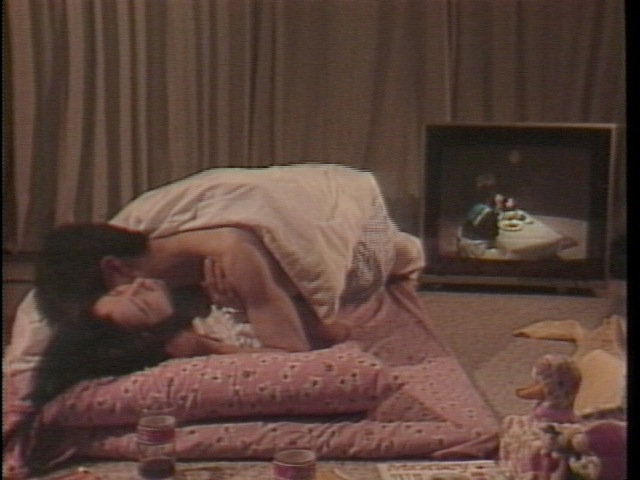
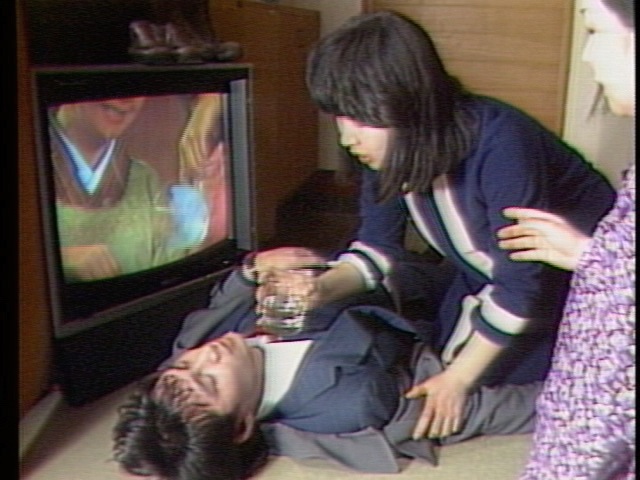
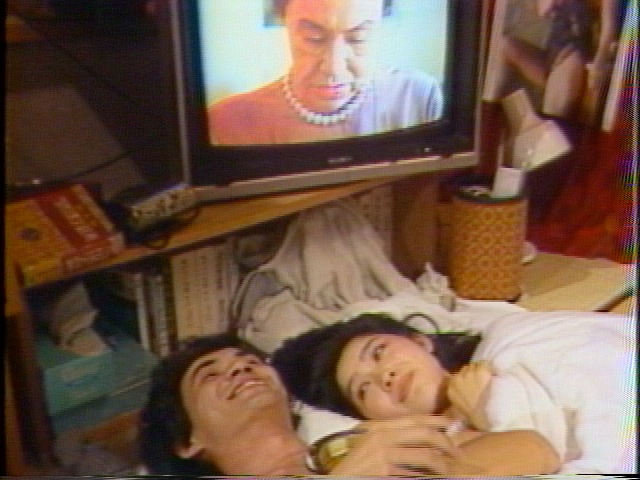
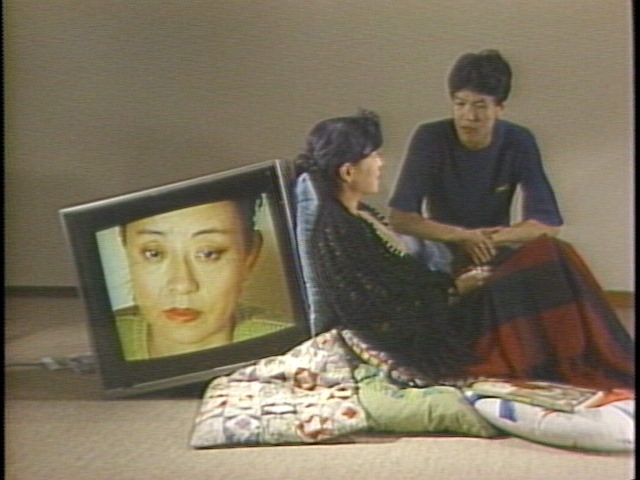
Of of Idemitsu’s best works. A Brechtian family psychodrama where absurdity reigns. Television screens function as magnifying lenses, enlarging and externalising the protagonists’ inner lives. The relationship between mother and son unfolds in a surreal, almost comical, and at times perverse register (as in the scene where the mother gazes at a monitor showing her son’s naked body), while the characters speak largely through clichés and stock phrases.
While the central narrative revolves around a mother struggling with the gradual loss of her connection to her son, and the prospect of old age, the simple mise-en-scène, and especially the pervasive presence of television screens (here arranged in more playful and unconventional ways than in Idemitsu’s earlier works) also turns the video into an almost X-ray-like examination and deconstruction of the social roles and expectations internalised by women in Japanese society.
Television monitors as a Cronenbergian and Ballardian materialization women’s dreams, memories, unrealized aspirations, fears, and desires…
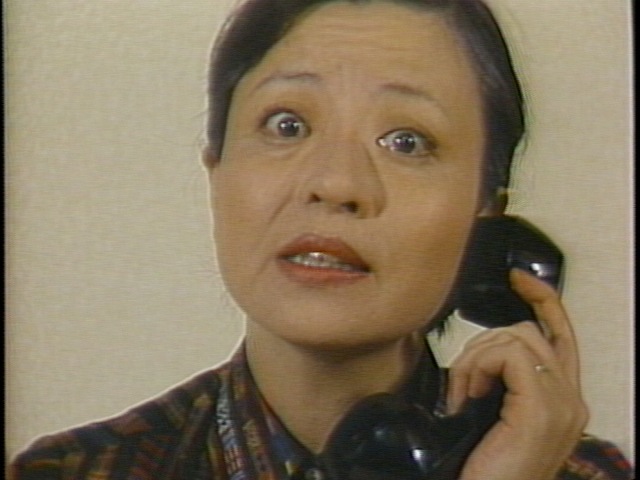
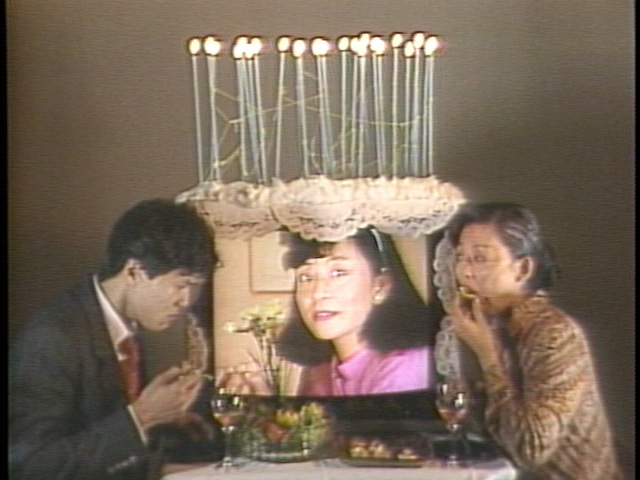
Grandmother, Mother, Daughter (1976) was displayed at the exhibition entrance on three TV monitors stacked in a column. In the piece, Idemitsu’s grandmother, mother, and daughter each appears in one screen with several packs of cigarettes, improvising and playfully interacting with them.
Women’s labor as captured and controlled by cameras?
First installation by Idemitsu and possibly the first instance in which she used monitors inside the frame, at least the first on video.

Animus Part 2 (1982) video
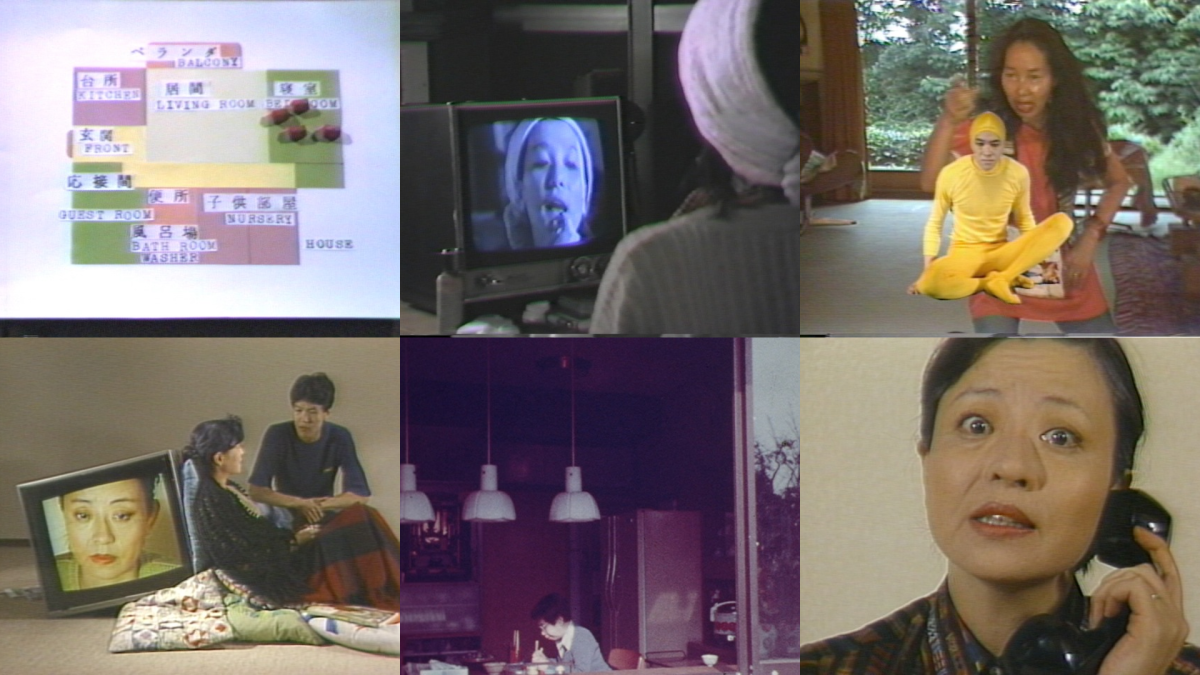
Another work inspired by Idemitsu’s fascination with women performing on stage. This time, Neo-Dada artist Kishimoto Sayako performs Messenger from Hell in Idemitsu’s living room. Over the footage, the filmmaker overlays an image of a pantomime figure in a yellow suit, and an oversized face. The work also includes English narration that does not fully translate Kishimoto’s words and carries a slightly ironic tone.
Kishimoto’s fierce performance brought to mind the avant-garde theater of the 1970s. The title, Animus, refers to the Jungian concept of the masculine side of the female psyche. Kishimoto was a fascinating artist.

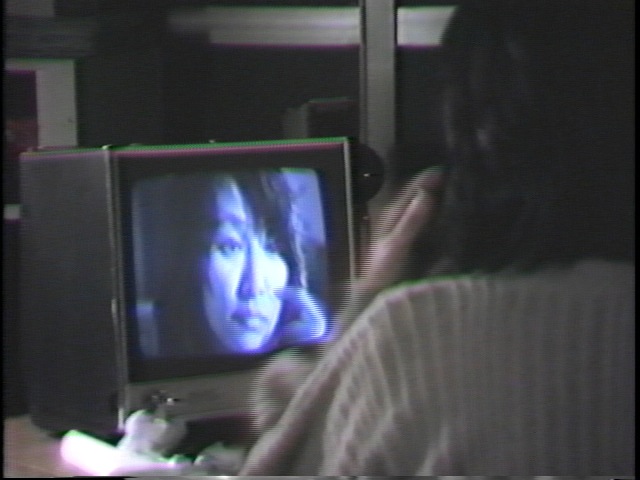
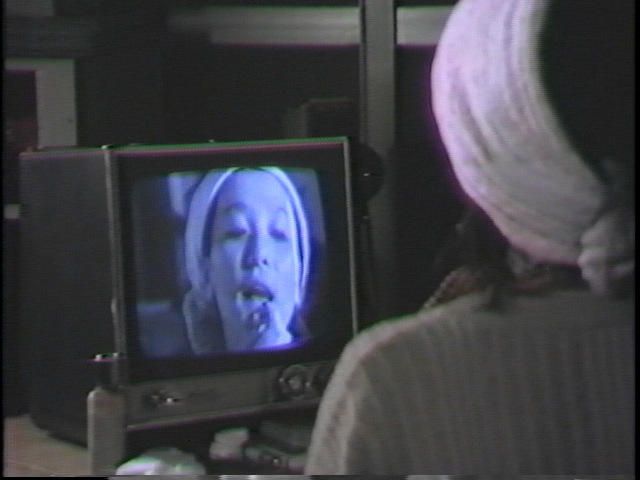
Make Up (1978) video
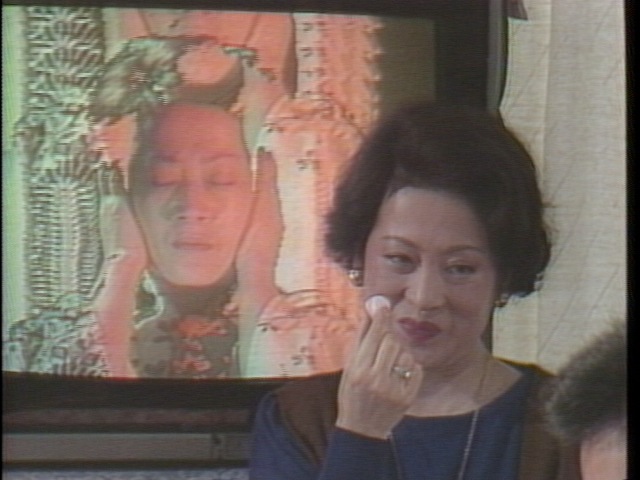
Idemitsu is doing her make-up and uses a monitor as a mirrow.
Video as a make-up, a distortion, but also a revealing tool for self-awareness, and at the same time anticipating today’s obsession with one’s own image as continuosly reflected by contemporary mediascape (smartphone’s selfies, social media, etc.)
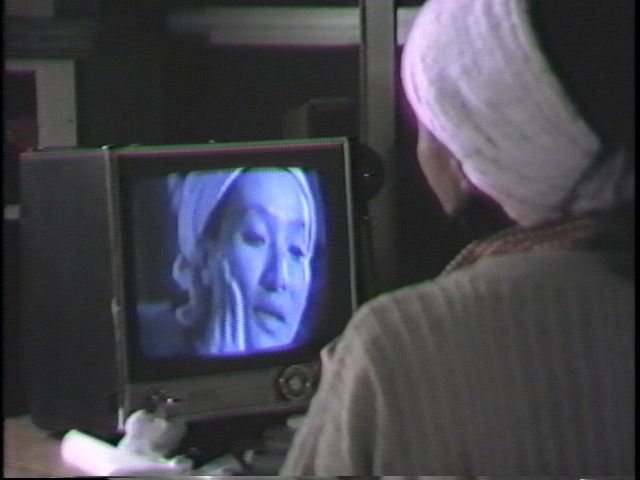
At Yukigawa 3 (1979) 16mm
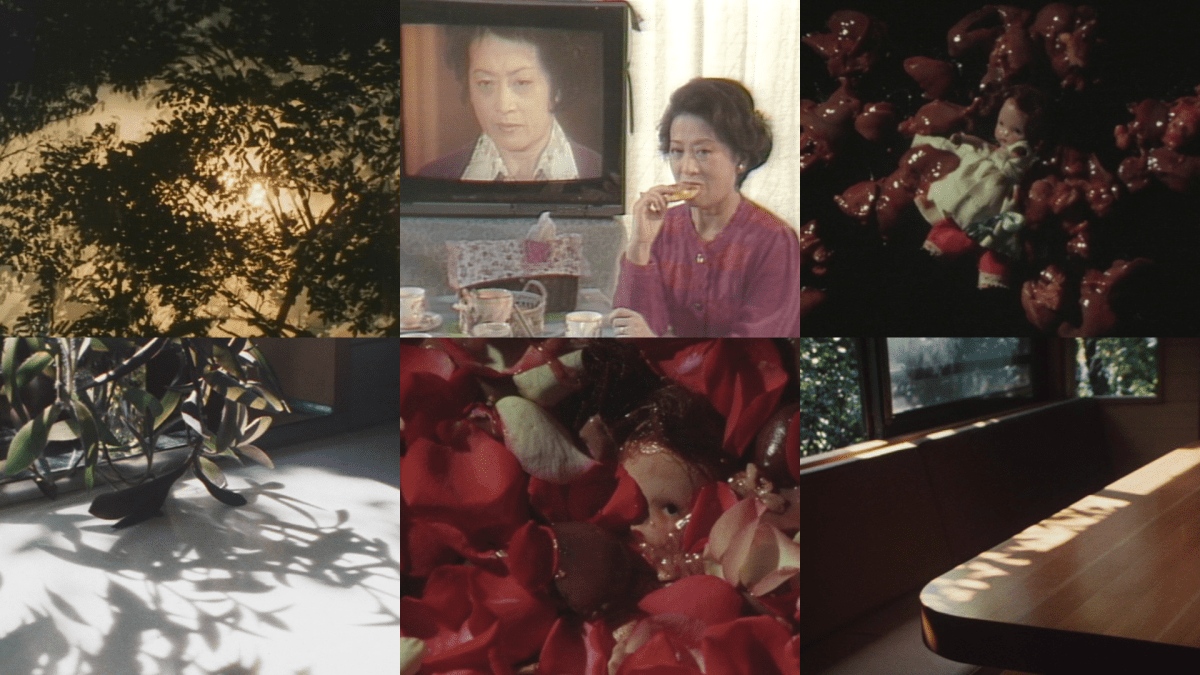
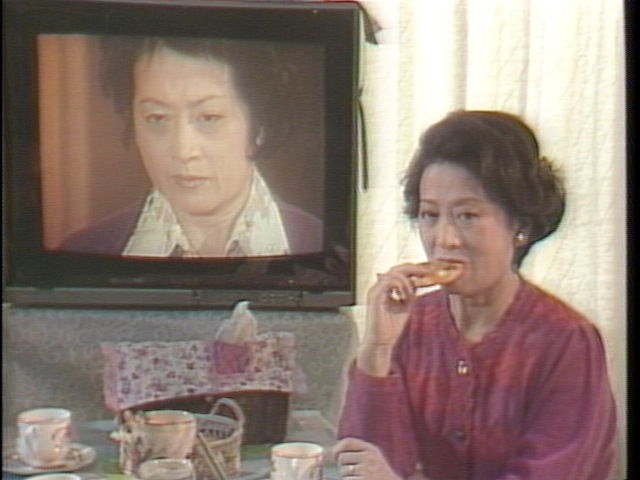
Everyday scenes of Idemitsu’s mother and the artist herself are intercut with images of the gardens surrounding their houses in Yukigaya and Aobadai, accompanied by Chopin piano music.
The editing is fast, alternating between interior spaces, where the mother sits at a table eating and drinking, and shots of trees gently swaying in the garden. Occasionally, the voices of children can be heard in the background.

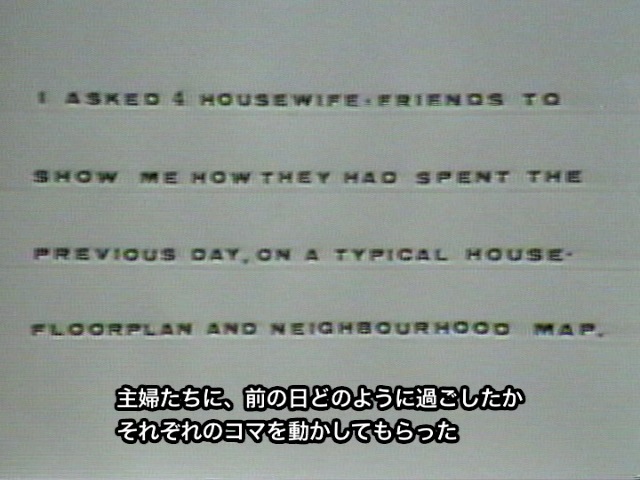
Housewives and a Day (1979) video
This was one of the highlights of the exhibition for me. While extremely simple in both structure and execution, it gradually acquires new layers of meaning as it unfolds.
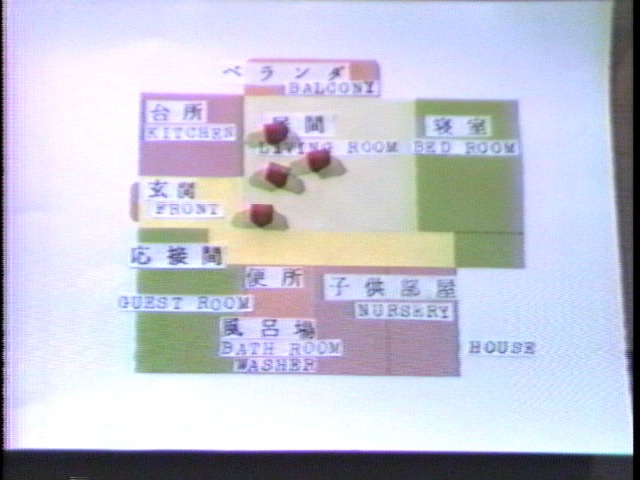
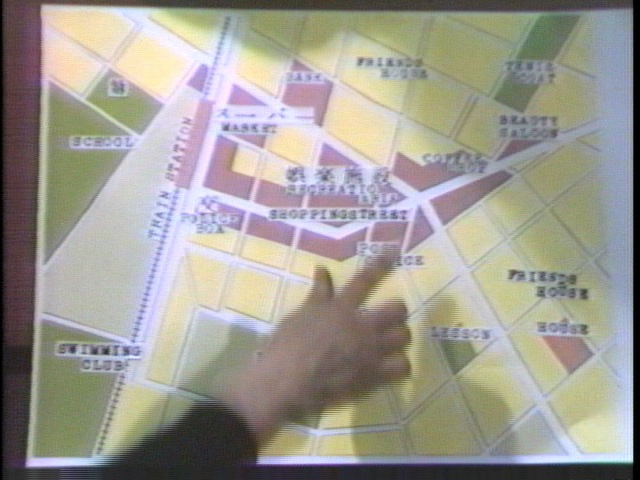
Four housewives, living in Idemitsu’s neighbourhood, gather around a table with a floor plan of a typical house placed in front of them. Using the map as a guide, they reconstruct their daily routine, recalling what they did and where they went the previous day.
Through this simple setup, the women trace their movements around the house while chatting freely and cheerfully about yesterday’s chores, often struggling to remember the exact sequence of their actions. At a certain point, the floor plan is replaced by a map of the surrounding neighbourhood as they describe going grocery shopping, picking up their children from school, returning home, and heading back out again to run more errands.
Beyond documenting their routines and movements, the video creates an opportunity for these women to talk about their everyday lives and give voice to experiences that usually remain invisible or unspoken. As the work progresses, it increasingly becomes a space for sharing and solidarity among housewives (it should be noted that the women all appear to belong to the middle class). The exhibition catalogue describes the work as an experiment reminiscent of sandplay therapy, one that gradually fostered greater self-awareness among the four participants.
The use of video technology also plays a crucial role in shaping the work. If I’m not mistaken, the piece consists of a single continuous take, or perhaps just two, and this technical choice informs both its aesthetic and the way its themes emerge.
Idemitsu Mako What a Woman Made (2026)/part 2

Continuing my articles about the exhibition, Part 2 (Part 1 here)

The retrospective Idemitsu Mako What a Woman Made, currently on view at the Tokyo Photographic Art Museum (July-September 2026), is one of the most comprehensive exhibitions ever devoted to the pioneering video artist and filmmaker. Bringing together films, video works, installations, and archival materials, it offers an unprecedented overview of more than five decades of Idemitsu’s artistic practice, tracing the evolution of a body of work that has consistently explored gender, domesticity, motherhood, and the mediated construction of female identity, especially in Japan.
I visited the exhibition, which also featured special screenings of Idemitsu’s works, over two days in July, immersing myself completely in her world. It was one of the most extraordinary artistic experiences I’ve had in 2026, an aesthetic revelation that continues to resonate within me.
From the museum’s homepage:

Idemitsu Mako (b. 1940) is a pioneering artist in the fields of experimental film and video art in Japan. After spending time in the United States during the 1960s, she began creating works that explored themes such as the lives of women, family, and the relationship between media and society, using film and early video as her mediums. Her video works from the 1970s onwards in
particular incorporate the narrative techniques of television melodramas to depict themes such as mother-child relationships, the dynamics of marriage, and women’s social roles from a unique perspective. In recent years, as the global conversation surrounding gender and the body continues
to grow, her practice has received renewed attention.
The Tokyo Photographic Art Museum acquired Idemitsu Mako’s complete film and video works, as well as her major installation pieces, between 2017 and 2018. This large-scale retrospective offers a comprehensive overview of Idemitsu’s artistic practice, including works that are being exhibited for
the first time since their acquisition by the museum. A total of 45 works, including those in the museum’s collection, will be presented through exhibitions and screenings.

As a future reference for myself and for anyone who might stumble upon this page, I’ll be publishing my notes on every work I saw during my two-day stay in Tokyo. They’re rough impressions rather than finished reviews, but I hope they’ll prove useful, whether as a personal archive or for readers interested in Idemitsu remarkable body of work.
Hopefully I longer piece will eventually emerge from this work in progress.
(Works are listed in the order I saw them)

Part 2

“My 16 mm works are about creating another world to escape the rigid routine of daily life. Even now, film retains something of that quality, whereas video is a reflection of everyday reality. These two mediums exist as completely distinct entities. When I shoot on film, I want to detach myself from daily life and capture images that are incredibly beautiful. I actually love these kinds of films. For me, film and video stand clearly apart from each other.”
Interview with Idemitsu Mako The Complete Works of Idemitsu Mako, 1970-1996, Pandora, 1996, p. 21

Women (1977) video
The work was presented as a six-monitor installation, arranged in two vertical columns of three monitors each. According to the exhibition catalogue:
“Idemitsu visited ‘Hoki-boshi’, a space for women, and asked four women involved in the women’s liberation movement to participate in this work. She gave each of them a video camera and shot them as they used those cameras to go about their own filming. Idemitsu also screened the footage shot by these four women and the footage she had filmed on two monitors at her home, and watched it together with the participants, a process that she also filmed. In the exhibition, these three types of footage were shown on a total of six monitors. This installation was created for a solo exhibition at the Shirakaba Gallery in Ginza; currently, only the tapes for two of the six monitors survive.”

Emotional Volatility About My Father (1981) 16mm
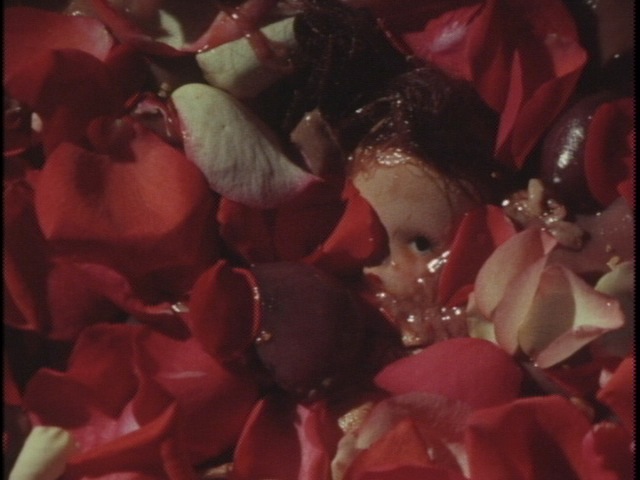
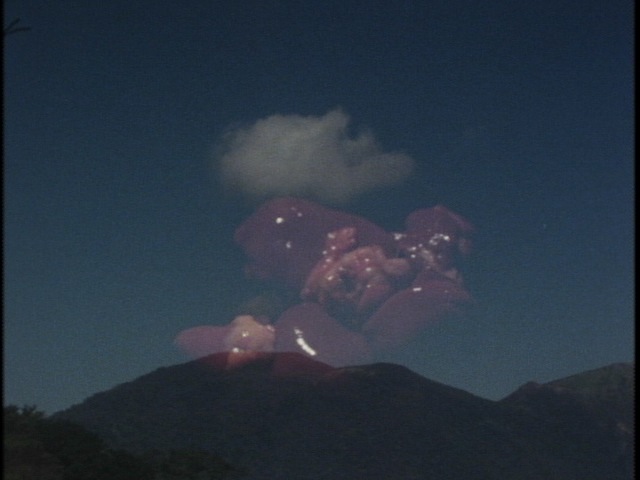
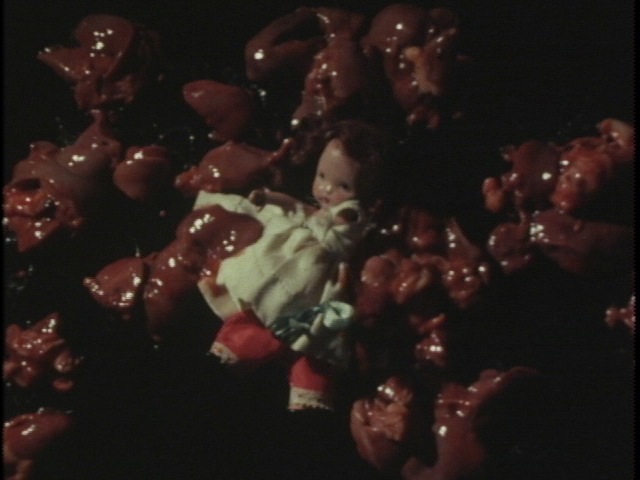
Showed on video. Idemitsu’s father, who disowned his daugher when she got married in the U.S., died in 1981. This work is a reaction to th epassing of the man: a doll born from a bamboo (Kaguya hime, but it’s Mako herslef?), firstly covered in petals, and later in pieces of raw meat…oppression by her father?

*
Play and Capriciousness (1984) 16mm
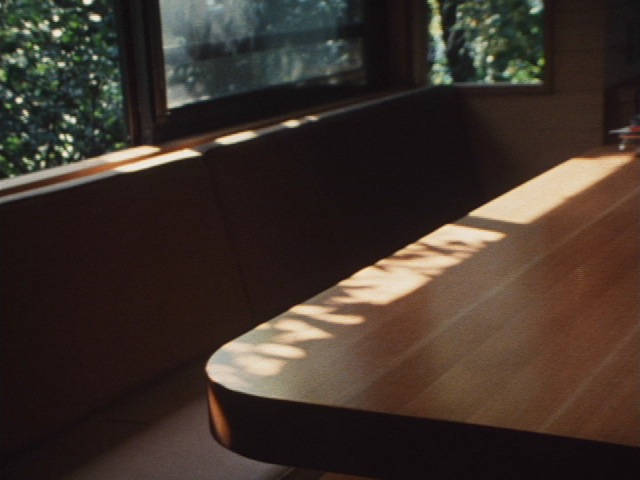
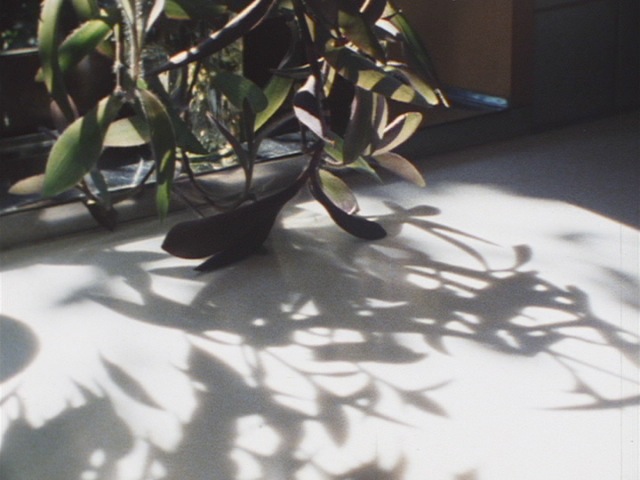
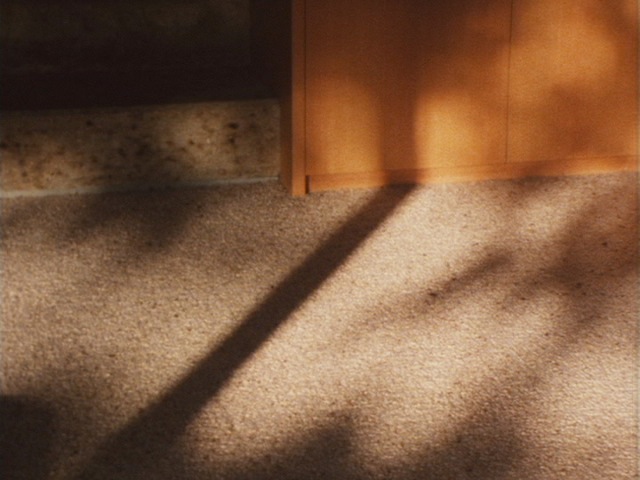
Images of interior spaces: chairs, sofas, flowers, blades of light projected onto walls, plants in the gardens, everything bathed in a winterly twilight. These images are interspersed with words by Idemitsu herself about the children she left in America after her divorce in 1981.
Melancholic in tone this is very distant from her experimentations on video, and the angry and sarcastic tone she is more famous for in this period. Nonetheless, Play and Capriciousness is one of her most affective films….there is no sounds just silence and soothing images broken very seldom by Idemitsu words, almost whispered…words about families living with kids in her neighbourhood…people forming new families…in a way this film is a confession, a realization that, with her children becoming independent and going far away, a new phase of her life has begun. As the exhibition catalogue notes, it was precisely after her separation from her husband (she would later remarry) and her children’s departure that Idemitsu’s artistic output increased dramatically.

*
Whispering Light (1985) 16mm
Follows a similar structure and emotional register to Play and Capriciousness, this time as an elegiac tribute to Idemitsu’s mother, who had recently passed away.
Once again, images of nature, green landscapes, trees, and foliage, are interwoven with Idemitsu’s own words. For me though, the film is somewhat less powerful than the previous, perhaps due to the use of sound. While Play and Capriciousness gained much of its emotional force from its almost absolute silence and the sole presence of Idemitsu’s voice, Whispering Light introduces a more cacophonous, experimental soundscape that often dominates the moments when narration is absent that breaks, for me, the fluidity of the piece.
That being said, the passages in which Idemitsu recalls her mother are deeply moving: Idemitsu recalls for instance how her mother wanted to learn English and play golf, but that her father never allowed her to do so; or how, after his death, she remained alone in the large living room, sitting quietly in a corner.

The Marriage of Yasushi (1986) video
“We men are who made Japan great.” Following the Great Mother trilogy, Idemitsu continued to dissect and ridicule the tectonic plates underlying Japanese society through her “Jungian dramas”.
In The Marriage of Yasushi, the complex psychological and social dynamics surrounding family, gender, and power are pushed to an even more exaggerated and theatrical extreme.
The relationship between mother and son reaches new heights, largely thanks to Ozawa’s remarkable performance in the role of the mother. Funny, excessive, and at times unsettling, she smiles almost constantly, with a grin that reveals her delight whenever she can reclaim her son’s attention and possess him exclusively. The character becomes both absurd and frightening, embodying the emotional control and unconscious desires that Idemitsu often explored through her maternal figures.
The other central configurations — mother, son, father, and husband — are perhaps more bitter and strained than ever before.
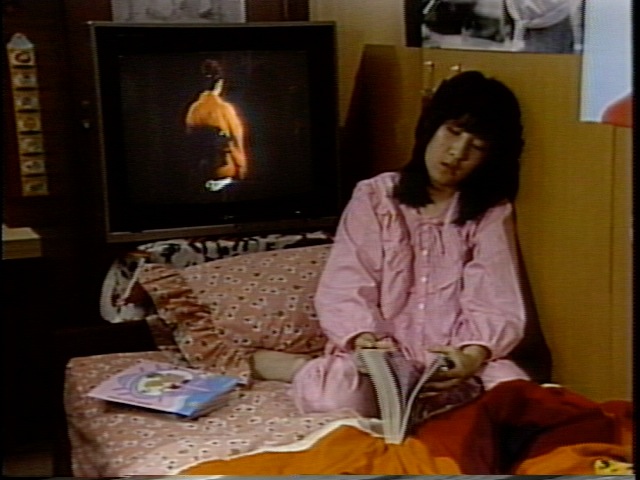
One of Idemitsu’s most accomplished works from this period, The Marriage of Yasushi is also among her most carefully written and structurally fascinating pieces, especially for the use of sound in relation with her signature mark, the monitors. Again, what we see inside these screens are different temporalities of the protagonists and of the lives of others, but what really takes things to another level here is the sound editing. Idemitsu constantly shifts between the conversations happening inside the monitors and those taking place outside them, blurring the boundaries between different times and spaces.


* images are from the artist’s official homepage

Idemitsu Mako What a Woman Made (2026)/part 1

The retrospective Idemitsu Mako What a Woman Made, currently on view at the Tokyo Photographic Art Museum (July-September 2026), is one of the most comprehensive exhibitions ever devoted to the pioneering video artist and filmmaker. Bringing together films, video works, installations, and archival materials, it offers an unprecedented overview of more than five decades of Idemitsu’s artistic practice, tracing the evolution of a body of work that has consistently explored gender, domesticity, motherhood, and the mediated construction of female identity, especially in Japan.
I visited the exhibition, which also featured special screenings of Idemitsu’s works, over two days in July, immersing myself completely in her world. It was one of the most extraordinary artistic experiences I’ve had in 2026, an aesthetic revelation that continues to resonate within me.
From the museum’s homepage:

Idemitsu Mako (b. 1940) is a pioneering artist in the fields of experimental film and video art in Japan. After spending time in the United States during the 1960s, she began creating works that explored themes such as the lives of women, family, and the relationship between media and society, using film and early video as her mediums. Her video works from the 1970s onwards in
particular incorporate the narrative techniques of television melodramas to depict themes such as mother-child relationships, the dynamics of marriage, and women’s social roles from a unique perspective. In recent years, as the global conversation surrounding gender and the body continues
to grow, her practice has received renewed attention.
The Tokyo Photographic Art Museum acquired Idemitsu Mako’s complete film and video works, as well as her major installation pieces, between 2017 and 2018. This large-scale retrospective offers a comprehensive overview of Idemitsu’s artistic practice, including works that are being exhibited for
the first time since their acquisition by the museum. A total of 45 works, including those in the museum’s collection, will be presented through exhibitions and screenings.

As a future reference for myself and for anyone who might stumble upon this page, I’ll be publishing my notes on every work I saw during my two-day stay in Tokyo. They’re rough impressions rather than finished reviews, but I hope they’ll prove useful, whether as a personal archive or for readers interested in Idemitsu remarkable body of work.
Hopefully I longer piece will eventually emerge from this work in progress.
(Works are listed in the order I saw them)

Part 1

“My 16 mm works are about creating another world to escape the rigid routine of daily life. Even now, film retains something of that quality, whereas video is a reflection of everyday reality. These two mediums exist as completely distinct entities. When I shoot on film, I want to detach myself from daily life and capture images that are incredibly beautiful. I actually love these kinds of films. For me, film and video stand clearly apart from each other.”
Interview with Idemitsu Mako The Complete Works of Idemitsu Mako, 1970-1996, Pandora, 1996, p. 21


Another Day of a Housewife (1977) Video
Presented on a big television, this is the work that opens the exhibition.
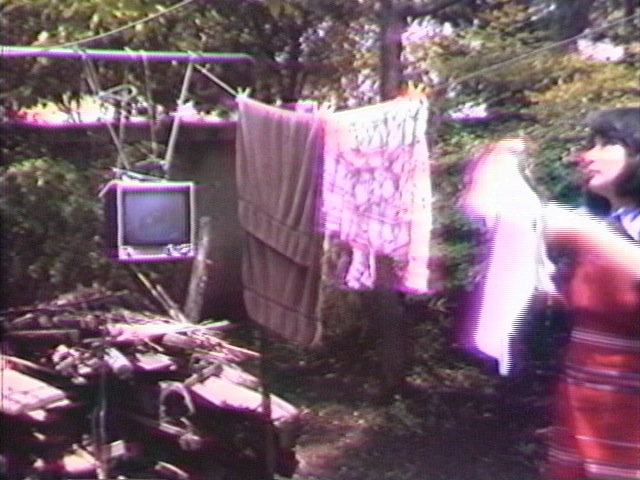
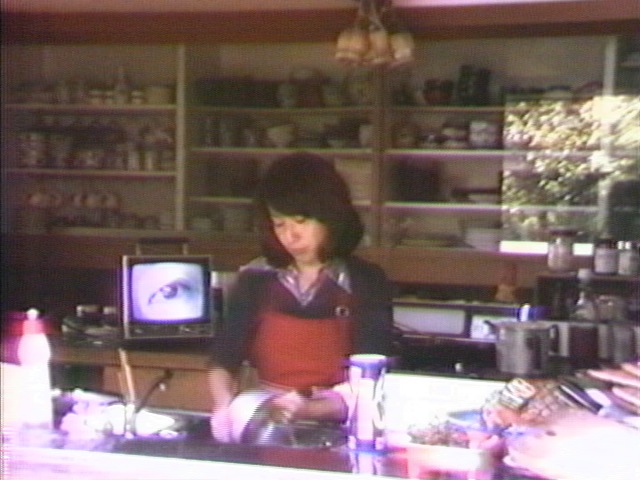
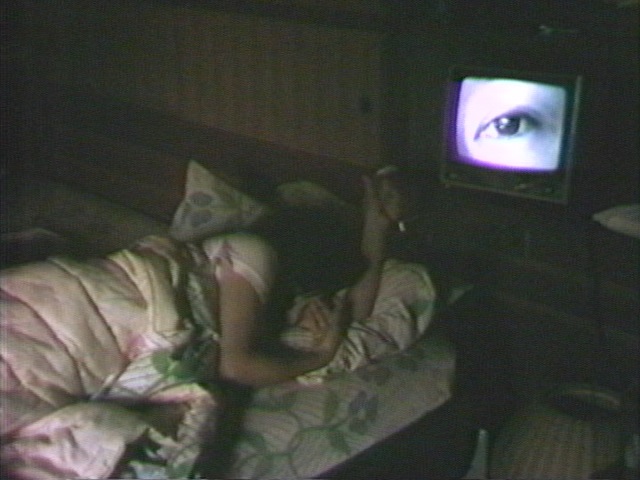
This early video observes the everyday routines of a housewife—played by Idemitsu herself—through a series of long, static takes. Waking up, cooking, washing the dishes, grocery shopping, hanging laundry, calling friends on the phone. Throughout the film, a giant eye—again, the filmmaker’s own—repeatedly appears on a television monitor, silently watching the protagonist.
The constant presence of this eye is deeply unsettling. It evokes the omnipresence of the media, but even more powerfully, especially in the film’s darker, more intimate scenes, it comes to embody the internalized gaze of society: an apparatus of self-surveillance through which the protagonist judges and disciplines herself. The eye is at once external and internal, suggesting that social expectations have become inseparable from the housewife’s own consciousness.
Although this is not the first work in which Idemitsu incorporates television monitors, Grandmother, Mother, Daughter (1976) is probably the one, it is perhaps the first in which they function as a channel and window to the protagonists’ inner world. This formal device would become increasingly central to her work throughout the 1980s, eventually evolving into one of the defining features of her visual language, often referred to as the “Mako Style.”

*

Woman’s House (1972) 16mm
First work in 16mm by Idemitsu, the film is the recording, a re-composition of Womanhouse, an exhibition conceived by Judy Chicago and Mirian Schapiro at the California Instutite of Arts in 1971.
Small objects, clothes, interiors of a room, curtains, dolls, everything bathed in bright light. The screen is saturated with white from the very first shot. Surreal: fake breast cover the ceiling and walls, later giving way to sunny-side-up eggs.

What a Woman Made (1973) video
Static white sceen with a voice talking on it, the topic is gender roles for children as expected and codified in Japanese society. The image on screen is out of focus, abstract-like, and only toward the end does it gradually come into focus, revealing a tampon swirling in a toilet bowl. Idemitsu’s first significant work, also from a feminist point of view.

Great Mother (Harumi) (1983) video
Great Mother (YUMIKO) (1984) video
Great Mother (Sachiko) (1984)
Trilogy inspired by the Jungian concept of the “Great Mother”.
The relationship between mother and daughter varied in each work, but it’s alway excessive in hate or love.
The rebellious girl in the seond part seems to represent Idemitsu herself, who grew up in an affluent and powerful family.
In the last segment the mother/daughter relationship it’s not only very strong, but also a necessary shield, a safe space, against the violence, physical and mental, perpetrated daily by the husband (another vile male figure in the Idemitsu’s universe). Of the three the last is perhaps the nastiest in relation to the position and role played by the man, who is a representation of the alpha male/Japan/masculinity embedded in Japanese society.
Worth noting: in the last video, the television monitor is used also horizontally, as a table.
What is most astonishing here is the way the television monitors function not only as a means of materializing Jungian archetypes, but also of introducing multiple temporalities. They become windows onto the past or onto moments from another person’s life, collapsing different psychological and temporal dimensions into the same video space (“video is time” as Nam June Paik has stated and Maurizio Lazzarato expanded upon).

*

At Santa Monica 3 (1975) 16mm
Black-and-white silhouettes, the sun slowly setting, shifting patterns of light and shadow, reflections in constant motion. Accompanied by music by John Cage “String Quartet in Four Parts”, the film unfolds as an impressionistic vision of her house in Santa Monica and surroundings, where Idemitsu lived for many years. Probably the best work of her first period (in 16mm), at least amongst the ones I’ve seen.

Next (1973) 16mm
Single channel video form the original 16mm, Next collects together several works by artist CIBA: colorful geometrical shapes on white background, reds and yellows predominate.

At Any Place 4: From the Habanera of a Housewife by Yoneyama Mamako (1978) 16mm
Projected on a wall of the exhibition on single-channel video. Idemitsu continues her interest in shooting and re-elaborating on stage performances, here pantomime Yoneyama Mamako’s performance is overlayed with images of natural places she filmed. Visually and for its use of a wide range of music is a very fascinating work.

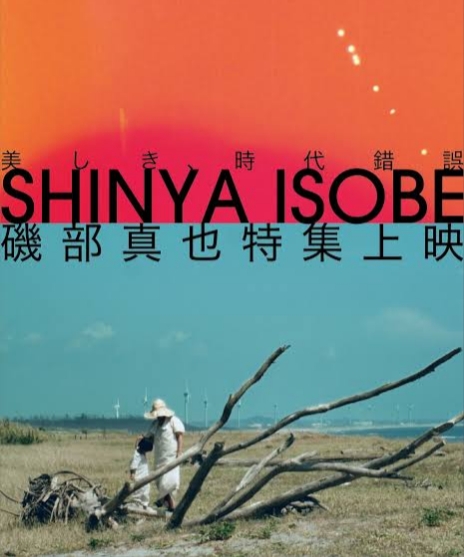
Isobe Shinya Retrospective: A Beautiful Anachronism (2025)

A traveling retrospective dedicated to Isobe Shinya, one of the most interesting directors in the contemporary Japanese experimental film scene, was held in various cities in Japan in recent months (with more places and dates to come). At the end of June, the retrospective, 美しい時代錯誤 A Beautiful Anachronism, visited Nagoya Cinema Neu (formerly Nagoya Cinematheque), where I had the pleasure of meeting Isobe and attending a screening of five of his films made between 2009 and 2022. An excerpt of his new work, which is still in progress, was also screened.

A primary theme running through all of Isobe’s works is time—more specifically, the various temporalities and durations that the camera can capture and create. Isobe’s preferred film medium is 8 or 16 millimeters, but he almost always edits and works on his films digitally. The exceptions are Dance, shot and edited on film, and Humoresque, which was shot in digital.
His time-lapse and long exposure works capture extended periods of time and greatly accelerate the pace at which we usually experience it. This gives the viewers a sense of vertigo and a new perspective on things. It invites us to reconsider our position in the world, hinting at different times: seasonal, geological, astronomical.

The first film presented at the retrospective was Dance (2009), an assignment Isobe completed for the Film Research Institute as part of a class he was taking at the time. The six-minute short was shot in 8mm over the course of a week, with filming taking place for about five or six hours every night in a room where a girl was living. The room was dark, and the only source of light during the shooting came from the streetlights outside.
The altered and accelerated time of the work highlights the quasi-life of the objects in the room and offers an accumulation of personal memories—the young protagonist was Isobe’s girlfriend at the time and she would eventually become his wife (later seen in Humoresque).

Objects and ruins also play a central role in his next work, EDEN (2011), Isobe’s graduation project at Image Forum Film Institute. Filmed over the course of a year and a half, with monthly visits of three or four days, to the abandoned Matsuo mine complex (operating from 1914 to 1979) in Iwate Prefecture. The film captures the area’s decay and showcases how life moves forward when is freed from the anthropic element. The images and hypnotic music create the impression of a ghost village slowly being reclaimed by vegetation and slipping into (human) oblivion.
First, the camera focuses on the interiors of former miners’ and their families’ homes. Then, in time-lapse segments, the camera pans to the open spaces surrounding the village and the expanse of the sky. Isobe makes his work almost meta-cinematic by superimposing images of the mines within a room and including stop-motion shots reminiscent of Itō Takashi‘s work. These shots feature photographs of the area within frames of the ruins themselves. As with most of Isobe’s work, EDEN has a pivotal moment toward the end: a crescendo accompanied by a sudden burst of rock music when snow starts to slowly rise from the ground in reverse, with the crystals ascending to the sky.

As you can see in the short clip posted below, music plays an important part in his next film too, For Rest (2017). Here Isobe shifts his focus to the decomposition of a set table in a forest. Filmed over five years with progressively longer intervals in the woods at the foot of Mount Fuji in Shizuoka Prefecture, the film documents the table’s decomposition and the gradual takeover by vegetation and insects. Isobe originally intended to film it in the Aokigahara Forest in Yamanashi; thus, the theme of death permeates the whole work. As Isobe stated, the film “contrasts the human tendency to separate and distance life and death from each other with the cycle of life in nature.”

Even more distant from our everyday lives in scope is the cosmic time depicted in Isobe’s 2020 masterpiece, 13. This short film is composed of images of the sun captured at 13-second intervals from the same position over five years.
The result is a cosmic journey through time and space, but structurally confined from a fixed point of view, depicting the sun’s passage across the sky where light, time, and space beautifully converge to create an abstract calligraphy on a red and purple canvas.
I previously wrote about 13 here.

The final piece in the retrospective, Humoresque (2022), was also filmed over about five years. It is Isobe’s first work shot entirely digitally, marking a departure from his previous works. It is different also in that the subject is in this case his family: his wife and young son. What impressed me most about Humoresque was the subtle play and experimentation with sound. All of the sounds were added in post-production (I think); this is the first time Isobe has worked with sound distortion rather than time distortion. The result is a playful, powerful, and subtly experimental home movie of sorts.

Isobe is currently shooting his next film. The provisional title is April, so it was introduced, although he said it might change. An excerpt was screened at the retrospective, and from the few minutes shown, it appears to be composed of images of rivers, water, and other natural elements overlapping. It looks really promising.

Docs: Images and Records – Yebisu International Festival for Art & Alternative Visions 2025 – report 2: Nihon University Film Study Club Special

This is the second dispatch from this year Yebisu International Festival for Art & Alternative Visions. Your can reda the first one here.

Founded in 2009, this year’s edition of the Yebisu International Festival for Art & Alternative Visions is dedicated to exploring the possibilities and problems posed by the changing nature of moving images in our time. Titled Docs: Images and Records, the event, currently taking place at the Tokyo Photography Art Museum, features a variety of works (films, installations, photography, performances and talks) that reflect on the meaning of representation through the visual medium and, in particular, question the meaning of the word ‘documentary’, a term that has become increasingly ossified (both on the big and small screen) and synonymous with the word ‘factual’. Or, as stated on the web page of the festival:

A document is a record of fact-based information, traditionally in the form of words but more recently also as images such as photographs and moving images. The word “documentary,” meanwhile, has come to be used not only as an adjective meaning “factual” or “consisting of documents,” but also as a noun referring to a film expressing facts.

The Lumière brothers’ Exiting the Factory (1895), which is a record of people leaving a factory, is widely recognized as the starting point of the history of motion pictures. People at the time were astonished to see scenes from their everyday lives being recorded and replayed before their eyes as if the events were actually happening right there. Today, 130 years after the invention of moving images, it is entirely unexceptional for people to record and share their daily lives through photographs and videos. Meanwhile, the definition of a photograph has been expanded to include digital images and that of moving images now encompasses digital video; in digital form, these media can be manipulated more freely than before, resulting in a more complex and ambiguous relationship between facts and the images that represent them. Held on the occasion of the 30th anniversary of the Tokyo Photographic Art Museum, the Yebisu International Festival for Art & Alternative Visions 2025 will focus on the transformation of these media. By examining a wide range of works through the lens of images and words, the festival will pursue a reconsideration of documents and documentary.

I was able to attend a couple of screenings last week, a special dedicated to discovering Japanese television documentaries and independent works that inhabit documentary and experimental cinema called Japanese Post-Documentary, and two of the four Commission Projects created specifically for this year’s event.

Japanese Post-Documentary Special 3: Nihon University Film Study Club Special brings together four short films made by a collective of students at the famous university; according to what was explained in the presentation, the versions screened at the event are digital restorations of the films based on footage from the Tokyo Photographic Art Museum Collection.

Conversation between Nail and Sock (釘と靴下の対話,1958), by Hirano Katsumi and Hiroh Koh, was perhaps the best of the bunch, a surrealist dream set at the university, heavily influenced by Bunuel and with stylistic choices reminiscent of Bresson, while Record N (Nの記録, Kanbara Hiroshi and Motoharu Jōnouchi, 1959) is a short film documenting the immediate aftermath of the Isewan Typhoon (Typhoon Vera), a disaster that struck the central part of the archipelago in September 1959, killing more than 5,000 people and displacing thousands more. Similar in its immediacy to the documentaries produced in the immediate aftermath of the Tōhoku earthquake and tsunami of March 2011, it differs profoundly from them in that many of its images show bodies swept away by floodwaters or trapped in collapsed houses, and in that it is accompanied by light and pop music, choices that make it, in parts, exploitative and perhaps unethical. However, as scholar and researcher Hirasawa Gō pointed out in the talk following the screening, images of such disasters were not easily accessible at the time – this was the late 1950s, an era when television was not yet popular in every household – and so the very raw footage, and the fact that it was screened at the university, was both an act of documentation and witnessing, and a protest that went against the grain of social norms.

Pu Pu (1960) is definitely the most surrealist of the four films showcased at the festival, and was made within the club in response to and in support of the protests against the US-Japan Security Treaty that took place and shook the country in 1960. Following these uprisings, it was decided to reorganise the Nihon University Film Study Club into the New Film Study Club, and as a result the VAN Lab for Film Science was founded. Bowl (椀, 1961), perhaps the best known of the four shorts, was one of the first results of this shift, a work I couldn’t really relate to – I found the first part almost unbearable, while the second was more aesthetically accomplished – but which undoubtedly has a raw energy and anger about it, and which also marks the directorial debut of Adachi Masao.

Sculpting space with light: Underground (Oda Kaori, 2024)

Underground spaces accumulate traces and memories of past presences, both non-human ones created over thousands of years by geological processes, and those left by human activity and histories. Over the past three years, Japanese artist and filmmaker Oda Kaori has explored and focused her attention on some of these underground places in Japan, seeking to capture and evoke past existences through images and sounds. The result of this research, which has also led to other productions in various media, is アンダーグラウンド Underground (2024), a sonic and visual experiment that was presented at the 37th edition of the Tokyo International Film Festival in the Nippon Cinema Now section last November. 

At least three years in the making, Underground is her most experimental work to date, and a project that concludes a phase of Oda’s career dedicated to exploring subterranean spaces with Aragane (2015) and continued with the underwater world with Cenote (2019), but one that may also herald a new path, more experimental, for the artist. If you want to know more about Oda and her previous work, I’ve written a long essay about her first three works, or there’s also an interview I did with her – although it was almost ten years ago, at the beginning of her career. 

The interest in the Japanese underground and in the past lives it evokes is thus a continuation of the path that the artist took with Aragane and Cenote, but here with a focus on the subterranean spaces of the archipelago. An early result of this exploration of Japan’s underground spaces was released last year, Gama (2023), a medium-length film that brings to light, almost literally, the stories of forced mass suicides of Okinawan people in gamas (natural caves), during the latter stages of the Pacific War. Much of the footage shot for Gama was reused in Underground and combined with images from another project, a nearly ten-minute installation created for the city of Sapporo in 2022. To complete Underground, Oda combined all this material with others shot in Yubari, Shimane, Saga, and Hyogo, although the locations are never specified in the film.

The biggest departure and difference from her previous works is Oda’s decision to use Yoshigai Nao as “shadow” in the film, an almost phantasmatic presence that moves freely throughout the work, connecting different places and different times, and the meaning of which is never explained. This addition brings a performative element to Underground that is almost absent from her other films. Yoshigai is a coreographer, dancer, and director herself, and has made some interesting works such as Grand Bouquet (2019) and Shari (2021); まさゆめ Masayume (2024), her latest – which I have unfortunately not seen – was produced as Cenote by the Aichi Arts Center and screened in Nagoya last November.
Yoshigai also has a prominent role in Gama, as most of the images from the hybrid documentary released in 2023 are reused in Underground. This is probably the main problem I have with Oda’s latest film, the central part is a repetition of what was done and shown in Gama, and although I know that it is the other way round – Gama came out of the Underground project and not vice versa – I feel that the images of Okinawa could have been left out.

While Underground is perhaps less effective when it combines material that is too visually disparate – at least for me the film does not work when it weaves together Yoshigai’s performance with the more abstract images shot underground – it excels in the more visually and sonically experimental moments. In the director’s own words “the underground world is pitch black, and nothing can be seen unless light is shone on it. It is not reflected. The act of shining light on the darkness felt like an act of sculpting the space with light”. This play of light and darkness, the overlapping of the artificial and the natural – the use of film superimposition is first class – and the materiality of the images, which I understand were shot on film, find a magnificent parallel in the sound, a sonic tapestry that, in the most inspired moments, manages to elevate the whole film.

If I’m not mistaken, at the moment Oda is working on smaller projects, she will be screening one of her shorter works, shot digitally, about her mother, at the next Yebisu International Festival for Art & Alternative Visions between next February and March. 

Report: Yamazaki Hiroshi’s special screening at the National Film Archive of Japan (October 2023)

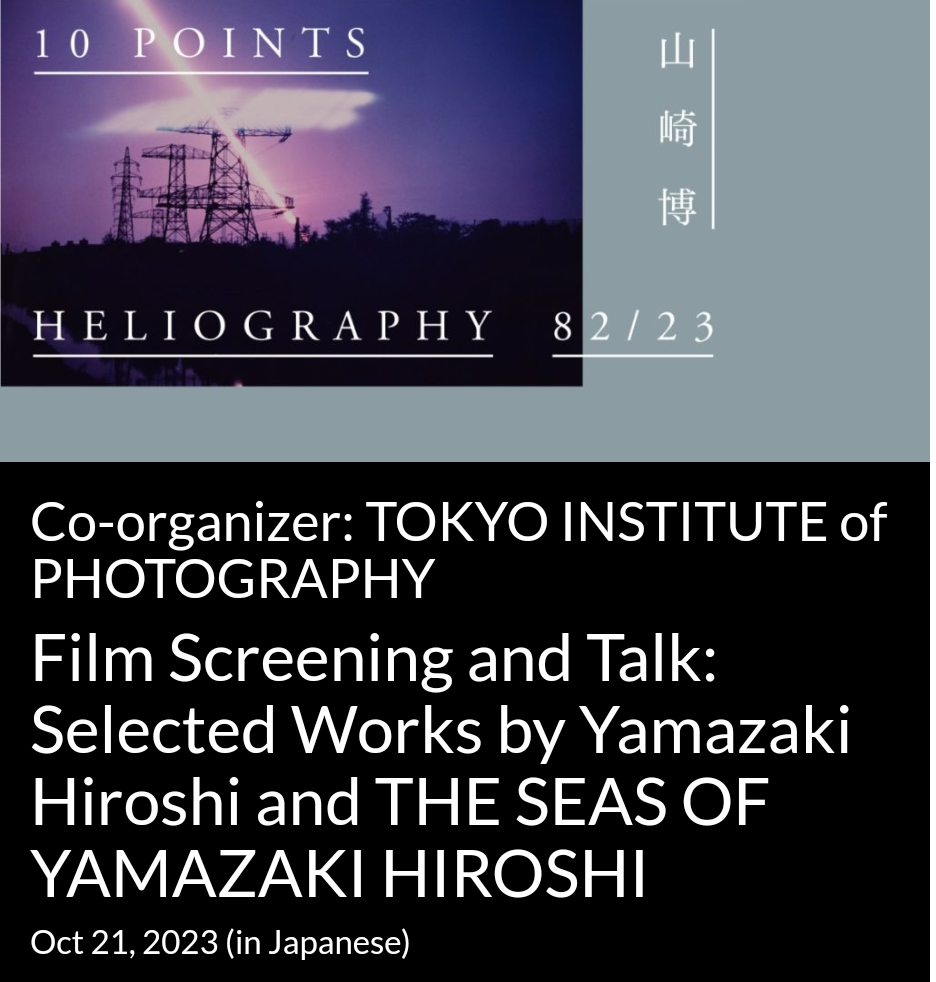
Today, October 21st, the National Film Archive of Japan organized a special screening of four films by Yamazaki Hiroshi, and 山崎博の海 The Seas of Yamazaki Hiroshi (2018), a short movie about the filmmaker and photographer, made by his friend and colleague Hagiwara Sakumi.
The screening was part of the series of exhibitions and events connected to the T3 PHOTO FESTIVAL TOKYO 2023.

In addition to the screening, a series of panels, reproductions of Yamazaki’s photos discovered only after his death in 2017, were displayed in the Film Archive’s entrance hall.

I had already seen all of the films of the program years back, when the Image Forum Festival organized a bigger retrospective on the filmmaker. I also had the chance to write about Yamazaki’s masterpiece, Heliography (1979), and about his other experimental films he made during his career for this site. Moreover, a longer piece, where I draw connections between Heliography, Ogawa Pro’s Magino Village, and Matsumoto Toshio’s Ātman (1975), was recently published on Chute Film-Coop.

All of this to say that I went to Tokyo to revisit and rewatch Yamazaki’s films on a bigger screen, and possibly to experience them in a better quality. I had read, before attending the event, that the works would be screened digitally (ProRes), but I was a bit disappointed and sad to learn about the story of their condition and preservation.
Of the four, a print exists only of Heliography, prints or negatives of the other three, Vision Take 1, Observation, and Motion are regrettably lost. To my surprise, the digital copies screened at the event were made from VHS tapes (!) Yamazaki used to show in the university where he worked.

the event

The after talk between Ishida Tetsurō, curator for the Tokyo Photographic Art Museum, and organizer of Yamazaki’s last exhibition, and the aforementioned Hagiwara was casual, but interesting. Some anecdotes about Yamazaki’s life were shared, but most importantly for me, the two revealed some technical and conceptual aspects about Yamazaki’s filmmaking process.

Vision Take 1 (1973, 8mm, 4′) presents the viewer with the images of the sea, a constant in Yamazaki’s career, and a beach were a television stands. As soon as the landscape gets darker the TV set starts to light up with images of the same sea. This is probably the weakest of the bunch.


観測概念 Observation (1975, 16mm, 10′) is a film that starts with a fixed and very dark image of the filmmaker’s neighborhood. Slowly and gradually the scene, a couple of roofs, antennae and the sky, with students and a small truck passing on the street at the bottom of the frame, turns whiter and whiter. The screen turns dark again, and from the upper left side of the screen, accompanied by a pulsating sound, one after another, many small bright “suns” appear drawing an arc of sorts in the dark sky above a house. However, as emerged from the discussion, probably this is not the arc drawn by the Sun in the sky captured in time-lapse, like in Isobe Shinya’s 13 for instance, but something different that Yamazaki created to make it look like the real thing. “It’s fiction” as said by one of the two people on stage.

Yamazaki himself was interested in photography and filmmaking in that “the world created through media is different from what humans see with their eyes”. For instance, the two half of Heliography, first the Sun filmed in time-lapse setting over the sea, and then, after a couple of seconds of darkness, the star resurfacing from a city seen upside down, were shot from two very different locations. If we think about it from a technical point of view, it is quite obvious. However, in the film it feels like the point of view is conceptually the same.

The after talk revealed also how Motion (1980, 16mm, 10′) was made, or better, how the two speakers think it was made, because Yamazaki was quite secretive about his methodology. According to Hagiwara, the film was made by shooting in a shower with a strobe lens. Motion is a fascinating film, without sound, composed of a series of tiny specks of liquid reflecting light, superimposed with layers and layers of more lights, sometimes edited slowly, sometimes faster. Besides Heliography, this was the film that impressed me the most. For the way it is constructed, but also for its trance-inducing quality, it felt like an experiment by Makino Takashi.

The event was interesting, but I wish there were more films screened, because to understand what Yamazaki was trying to do with images and light, one needs to be immersed longer and deeper in his world, photographic or filmic (also, I’d really like to see Sakura, his film about “dark” cherry blossoms again).

On Yamazaki Hiroshi, Heliography, Magino Village, and Ātman

I’ve been fascinated and captivated by Yamazaki Hiroshi’s works, both still and moving images, since the first time I discovered them in 2018, at the Image Forum Festival.

Reading about his approach to photography in the catalogue of one of his exhibitions, and finding ‘Ugoku shashin! tomaru eiga!‘(Moving photos! Still movies!), the book where he recounts part of his life and career, made me appreciate his artistic output even more.

Moreover, it a was a revelation to discover (how did I miss it!?) that Yamazaki was behind the time-lapse sequences shot for Magino Village – A Tale / The Sundial Carved with a Thousand Years of Notches (1986) by Ogawa Production, and that he worked as a cameraman in Matsumoto Toshio’s Ātman (1975).

Chute, an experimental film cooperative based in Istanbul and The Hague, offered me the chance to gather my thoughts on Yamazaki, Heliography (1979), and what I’ve called “the solar connection”.

The piece is available here.

In the article I’ve only scratched the surface of what could, and frankly should, be written about Yamazaki. His engagement with moving images, the relation between his films and his work in photography, his method, and his position in the history of experimental cinema in Japan.

Soon after the article was posted, more thoughts started to coagulate in my head, and I was also told that Matsumoto wrote a piece on some pre-Heliography experimental films by Yamazaki. The journey has just started.

Kobe Discovery Film Festival 2022 – dispatch 3: Koike Teruo’s screen memorial

Third and final dispatch from this year’s Kobe Discovery Film Festival (first and second here and here)

My last day at the festival coincided with the screening of four programs: the state of film preservation today, actor Hayakawa Sessue, the 100th anniversary of Pathé Baby, and a selection of works by Koike Teruo, experimental filmmaker who passed away last March.

Film, the Living Record of Our Memory (2021) is a documentary directed by Inés Toharia, where film archivists, curators, technicians and filmmakers reflect on the current state of film preservation, why it is a vital part of our culture, and how film archives in different countries are facing a set of very different problems. The second screening of the day was Where Lights Are Low, a silent drama directed by Colin Campbell in 1921, with protagonist the Japanese Hollywood star Hayakawa Sessue. I had already watched the movie before, on the streaming edition of the Pordenone Silent Film Festival during the pandemic I believe, but to experience it on the big screen with a live accompaniment was a delight. 2022 marks the 100th birthday of Pathé Baby, to celebrate it, a group of people, lead by Anna Briggs, Michele Manzolini, and Mirco Santi, in conjunction with the association INEDITS Amateur Films / Memory of Europe, assembled a montage of amateur films shot in 9.5mm from around the globe, 9 1⁄2 the title. The work is a visual symphony of everyday life, as it is called in the introduction, that, for its moments of unexpected poetry, reminded me of Liu Na’ou’s The Man Who Has a Camera.

Experimental filmmaker and visual artist Koike Teruo passed away on March 18th, KDFF 2022 dedicated to the director a special program comprised of four of his works, three of which are part of his life-long series Ecosystem, which Koike himself described as something that “has grown as a sort of giant tree for me”: 生態系 -5- 微動石 (1988), 生態系 -20- ストーン (2013), and 生態系 -27- 密度1(2018). One of the four, 衝 (1995), is a short piece, a sort of documentary, shot in Kobe in the aftermath of the earthquake that hit the area on January 17th 1995. Besides the works themselves, a wave of materiality that inundates the viewer with their rhythm and editing speed, especially when experienced on a big screen, what turned out to be particularly interesting for me, was the talk after the screening. Researcher Tanaka Shimpei talked about the importance of Koike in establishing the experimental scene in the Kansai area through events and independent screenings (自主上映会). As Tanaka writes in the catalogue ECOSYSTEM Teruo Koike Visual Works 1974 – 2020:

The career of a prominent visual artist Teruo Koike must be reconsidered through not only his film making which includes collaborations with various modern dances and his improvisational music performances, but also his aggressive independent screening activities which have been maintained since as far back as around 1980’s. And not only should we look back on his rich filmography centering on the “Ecosystem” series, but also by reviewing Koike’s screening activities engaged around Kobe.

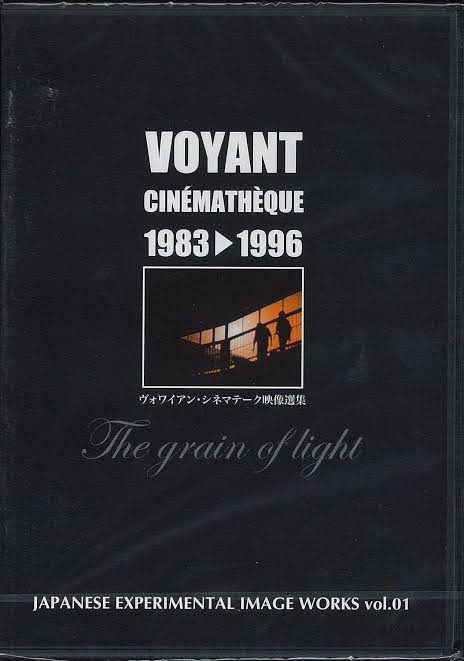
Born in Ichinomiya city, he graduated in Kobe, and after his experience in Iran at the end of the 1970s, where he worked in a petroleum complex, and where he experienced first hand the Iranian Revolution, Koike returned to Japan, started again to make films, and began to organize screening events. In 1980, together with Okuda Osamu founded Cosmic Caravan (1980-1982), a group engaged in showing and making experimental movies. After this experience, Koike and others, among whom Zeze Takahisa, formed Voyant Cinémathéque (1983-1996), a group active for more than a decade in Kyoto, Osaka, and Kobe, that promoted experimental cinema, and helped new artists by providing them venues for showing their work. Koike continued to be very active in showing and organizing events (installations, visual performances) in the new millennium as well, he learned to play the Japanese flute in the mid-1990s, and often accompanied the screenings of his works, not only with his live improvised performances, but also with professional dancers.

Image Forum Festival 2022: Silver Cave, Humoresque, A Short Story, and The Cleaning Lady After 100 Years: Spectre.

Yesterday I had the chance to attend one of the programs of this year Image Forum Festival, in Nagoya. Every year the event is held first in Tokyo, and later in the year, in a scale-down format, in other cities in Japan: Yokohama, Kyoto, and Nagoya.

In the past decade I went to the festival in Tokyo a couple of times, once in Kyoto if I remember correctly, and recently just in Nagoya, since it’s for me, a closer location. The event is dedicated mainly to experimental cinema and video, produced all over the world, with a particular attention of what is going on in Japan and Asia. The festival has been for me a source of wonderful discoveries, here I wrote about the 2018’s edition, here about Stop-Motion Slow-Motion, and here about Heliography by Yamazaki Hiroshi. Unfortunately this year I could just see a tiny fraction of what I planned and wanted to, just four works of the East Asian Experimental Film Competition.

Silver Cave

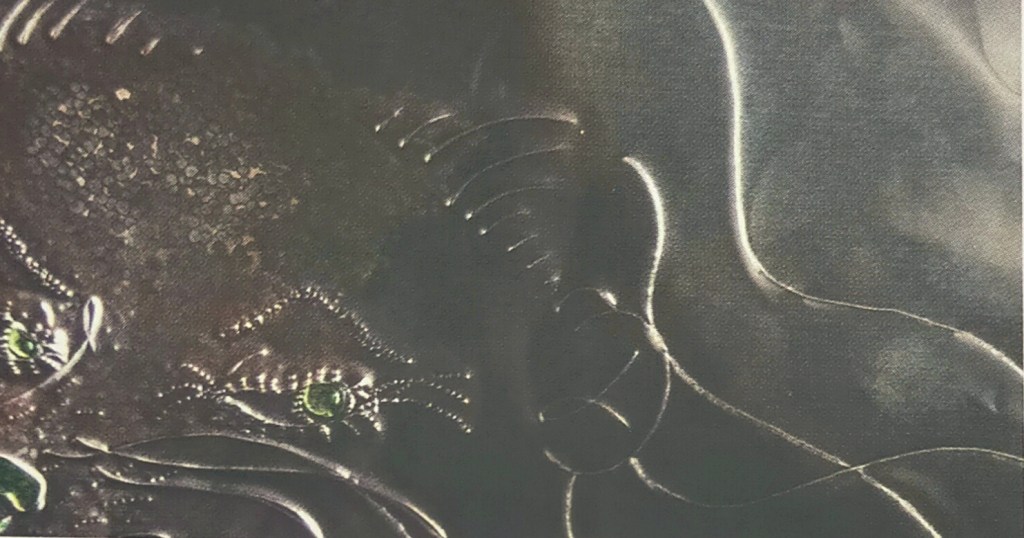
Silver Cave (2022) by Cai Caibei is an interesting piece that plays with surfaces, and the flat metallic substance that animates and “moves” for most of the work. For its focus on abstractions, rhythm, and its quasi meta-filmic quality, it reminded me of the works of some pioneer animators of the beginning of last century, such as Walter Ruttmann. Silver Cave won the Award for Excellence at the festival.

A Short Story

Filmmaker and artist Bi Gan’s latest work, A Short Story (2022) tells about a black cat that embarks on a bizarre journey to meet three curious characters. Presented in the short competition at Cannes last spring, the work is populated with dream-like images, visual inventiveness, and poetry, but I could not really connect with it.

ユーモレスクHumoresque

I was really looking forward to checking ユーモレスク Humoresque (2022) by Isobe Shinya, who in 2020 made 13, one of my favourite films of that year. I had already read that this work was something very different from what he had done before, Humoresque is 46 minutes long and was shot digitally, so I was somehow prepared. As the description in the official catalog reports the work is

an abrupt turn from “13”, this film employs the technique of home movies to tell the story of the lives of a mother and child across four seasons. Day after day, water drawn from a lake is filtered and bartered for food. One day, a man visits with a portable gramophone. The song it plays is Dvorak’s “Humoresque.” What does he think about this music?

and according to Isobe

I created a fictional world by converting and extending home movie shooting as a filmmaking technique. Many of the scenes in the film were inspired by their real-life counterparts. The small story in front of us, the big story far away, and the story that is no longer here. This film is an attempt to assimilate them in fiction and reality.

Some images are really mesmerising, the way sound is used is remarkable, and while very different from the time-lapse experiments Isobe is known for, Humoresque is still a movie about time, the thickness of it, and the passage of it. That being said, I definitely need to watch it again to give it a proper assessment. Humoresque was awarded the Grand Prize at the festival.

The Cleaning Lady After 100 Years: Spectre

The Cleaning Lady After 100 Years: Spectre (Shichiri Kei, 2022) is a reimagining of the filmmaker’s own multimedia stage drama The Cleaning Lady, where the ghost of her mother appears to an old woman. This was probably the most powerful work among the four I saw, in a completely digitised world the human presence is not even a memory, even the words uttered are just part of the cacophonous soundscape presented in the film. No straightforward meanings emerge from the work, but images and sounds slowly and aggressively point towards and put the viewer through a sensorial and exhilarating experience. The film loses part of this power towards the end when the spoken words try to enunciate philosophical ideas.

Leafing through the catalogue made me realised how many interesting and possibly wonderful works I missed: a retrospective on contemporary Chinese independent cinema, Qingnian Express: New Voices and Visions of Chinese Independent Cinema Today (curated by Tong Shan and Ma Ran), TUNOHAZU, the latest by Tezka Macoto, a retrospective on artist and graphic designer Tanaami Keiichi, and much more.