
Tanaka Min is one of the contemporary Japanese artists I admire the most, both for his past as a butoh performer—a definition he has openly and vehemently refused to used in recent years—and for his connection with Gilles Deleuze and especially Felix Guattari, an encounter that resulted, in 1985, in the volume 光速と禅炎 Agencement ’85. Last but not least, I’ve always been fascinated by the turn that Tanaka’s career took around two decades ago, a change that made him a movie actor appreciated for his powerful and magnetic presence on screen. Not only a performing body in service of documentaries with an experimental touch, such as the beautiful ほかいびと 伊那の井月 Hokaibito: Ina no Seigetsu (Kitamura Minao, 2012), and the delirious piece of performance that is 始まりも終わりもない No Beginning, No End, directed in 2013 by Itō Shunya of 女囚701号/さそりFemale Prisoner #701: Scorpion fame. But also for his presence in more mainstream movies, and his work in voice acting for feature animations.
名付けようのない踊りThe Unnameable Dance (2022) is a documentary that retells, using Tanaka’s own narration and words, and in an episodic and at times syncopated way, some of the events and encounters that guided his life as a performer. Tanaka recalls, for instance, his meeting with Hijikata Tatsumi and the discovery of his revolutionary performances in the early 1970s. Or dancing in Paris in 1978, a trip that de facto launched his career, not only internationally but also in Japan. During one of his trips to France, Tanaka had also the chance to meet Roger Caillois, a writer and philosopher he strongly admired, and for whom he insisted to dance. The title of the movie, The Unnameable Dance, is, as a matter of fact, taken from a sentence Caillois used to describe Tanaka’s performance.
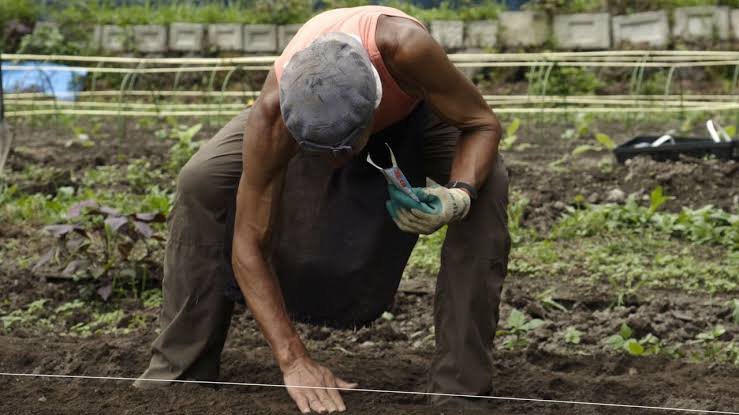
The documentary, directed by Inudō Isshin, covers also Tanaka’s debut as an actor in Yamada Yōji’s Twilight Samurai, an event that kicked off, at age 57, his career on the big, and small, screen. A part of the documentary is also dedicated to Tanaka’s work as a farmer, an activity very important for his philosophy, because, as he famously stated, “In agriculture one can find the anti-modern coming from the past. There you find the concreteness of the present.”
The recalling of all these experiences is interspersed with some of his more recent performances, always awe-inspiring, even when mediated through the camera. These performances were recorded in Japan and abroad, Paris and Portugal play a big role in the work, the latter is not only the place where the documentary begins and ends, but its music (Fado?) accompanies the whole documentary.
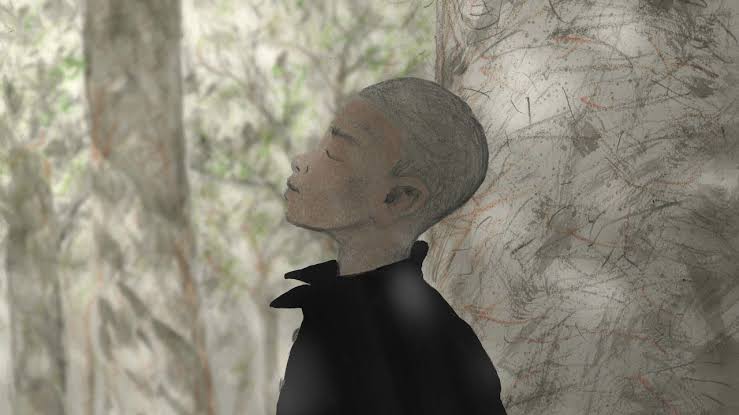
Another fascinating quality of the film is that the performances and scenes with Tanaka on screen are interspersed with Yamamura Kōji ‘s beautiful and effective animation, used mainly to depict Tanaka’s memories and dreams as a child.
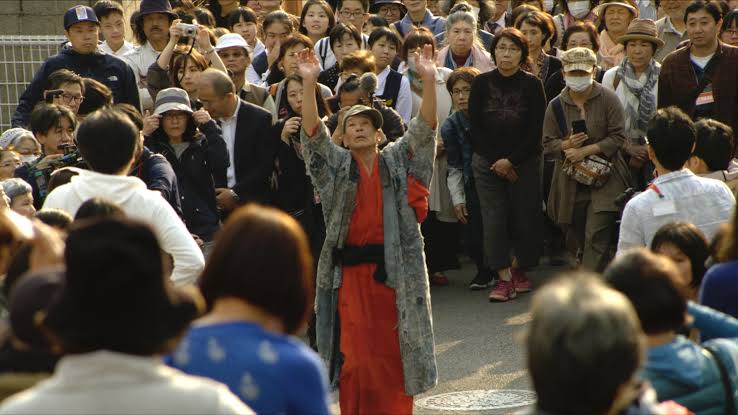
Particularly significant is also how the documentary includes purposely the audience, their faces and their reactions, when filming Tanaka’s performances in public spaces. There’s not attempt to hide or cut out the people watching and taking videos and photos with their smartphones, since for the Japanese performer “dance cannot be owned; dance is born in the space between; the viewers become dancers too”.
 Asian Docs