This is the first report from this year Yebisu International Festival for Art & Alternative Visions
Founded in 2009, this year’s edition of the Yebisu International Festival for Art & Alternative Visions is dedicated to exploring the possibilities and problems posed by the changing nature of moving images in our time. Titled Docs: Images and Records, the event, currently taking place at the Tokyo Photography Art Museum, features a variety of works (films, installations, photography, performances and talks) that reflect on the meaning of representation through the visual medium and, in particular, question the meaning of the word ‘documentary’, a term that has become increasingly ossified (both on the big and small screen) and synonymous with the word ‘factual’. Or, as stated on the web page of the festival:
A document is a record of fact-based information, traditionally in the form of words but more recently also as images such as photographs and moving images. The word “documentary,” meanwhile, has come to be used not only as an adjective meaning “factual” or “consisting of documents,” but also as a noun referring to a film expressing facts.
The Lumière brothers’ Exiting the Factory (1895), which is a record of people leaving a factory, is widely recognized as the starting point of the history of motion pictures. People at the time were astonished to see scenes from their everyday lives being recorded and replayed before their eyes as if the events were actually happening right there. Today, 130 years after the invention of moving images, it is entirely unexceptional for people to record and share their daily lives through photographs and videos. Meanwhile, the definition of a photograph has been expanded to include digital images and that of moving images now encompasses digital video; in digital form, these media can be manipulated more freely than before, resulting in a more complex and ambiguous relationship between facts and the images that represent them. Held on the occasion of the 30th anniversary of the Tokyo Photographic Art Museum, the Yebisu International Festival for Art & Alternative Visions 2025 will focus on the transformation of these media. By examining a wide range of works through the lens of images and words, the festival will pursue a reconsideration of documents and documentary.
I was able to attend a couple of screenings last week, a special dedicated to discovering Japanese television documentaries and independent works that inhabit documentary and experimental cinema called Japanese Post-Documentary, and two of the four Commission Projects created specifically for this year’s event.
Japanese Post-Documentay Special 2: “I Want to Go Far Away” brings together four episodes of the popular TV programme Tooku e ikitai (literally, I want to go far away), produced by TV Man Union and Yomiuri Telecasting Corporation between 1970 and 1974, a period when the small screen in Japan offered artistic freedom and space for experimentation. It is worth noting that it was in this milieu that Sasaki Shōichirō produced some stunning works such as Dream Island Girl (1974) or Four Seasons: Utopiano (1980), films for television that influenced a generation of filmmakers, including Kore’eda Hirokazu, who speaks highly of him in his book of memoirs.
Rokusuke sasurai no tabi Iwatesan uta to chichi to (六輔さすらいの旅・岩手山・歌と乳と, 1970, Konno Tsutomu) is a journey to Iwate Prefecture led by Ei Rokusuke, a musician, essayist and television personality. Mōhitotsu no tabi`- Yamashita Kiyoshi-ga bunshū yori (もう一つの旅「山下清画文集」より, Tanikawa Shuntarō, 1971), the host here is Itami Jūzō, who was a famous actor before he became a director (Tampopo, A Taxing Woman) He follows in the footsteps of the artist Yamashita Kiyoshi, famous for his chigiri-e works and his wanderings around Japan. Both works echo the trend of programmes dedicated to the discovery of the Japanese countryside that were so popular on television at the time, but deconstruct them through the use of irony and comic sketches.
I had seen it before, but it was nice to revisit Ore no Shimokita (おれの下北, 1972) a 26-minute programme (like all the others) directed by and starring Imamura Shōhei, who travels to the Shimokita Peninsula in Aomori Prefecture to pay homage to his mentor, director Kawashima Yūzō, who was born in the area. As with the other two episodes, there are also some funny bits, such as Imamura stopping his journey to visit a snack bar or relax in a hot spring. The 1970s, especially the first and middle part, was a decade in which Imamura, like other filmmakers of his generation, was not very active in cinema, after the collapse of the big studios in the early 1970s, but devoted himself to making documentaries for the small screen (Following the Unreturned Soldiers: Malaysia, Karayuki-san,etc.). The almost meta approach to documentary and the use of his own persona in front of the camera was not new to the Japanese director, who in 1967 made one of the most famous works bridging and questioning non-fiction and fiction cinema, A Man Vanishes.
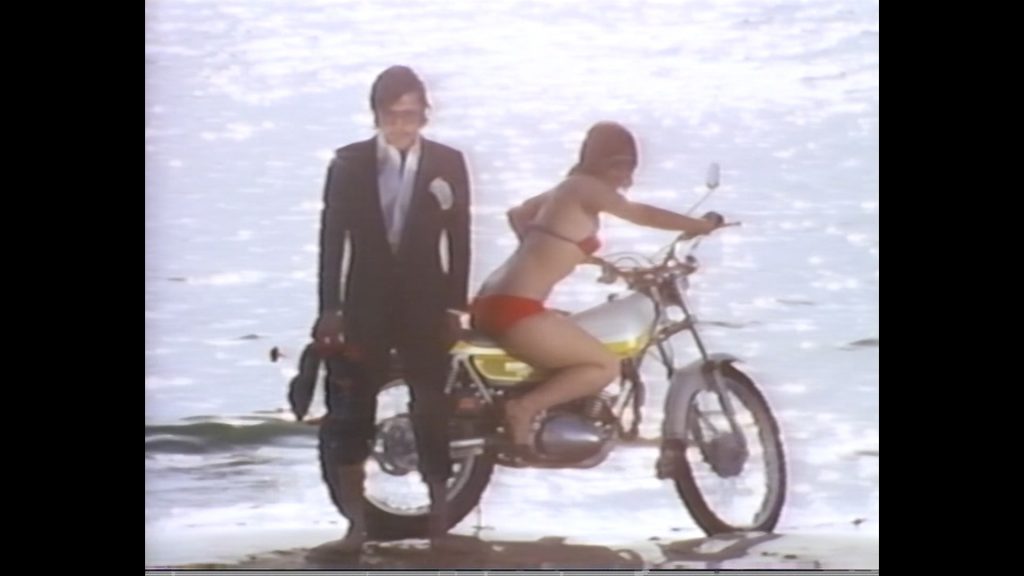
The last episode was the rarest and by far the wildest of the four: Fuji Tatsuya no wan uei chiketto – Yokohama, Hayama, Tsuruga (藤竜也のワン・ウェイ・チケット-横浜・葉山・敦賀, Sato Teru, 1974). Director Satō Teru uses Fuji Tatsuya’s life (born in Beijing, and raised in Tsuruga and Yokohama) to compose a surrealistic collage of images of the famous actor travelling around the places where he grew up: ipercinetic, flashy, colourful and mixing different styles, this is a joyful experiment similar to the works produced by ATG Theatre at the time, and was never broadcast on television because of its boldness.
 Asian Docs
3 thoughts on “Docs: Images and Records – Yebisu International Festival for Art & Alternative Visions 2025 – report 1”