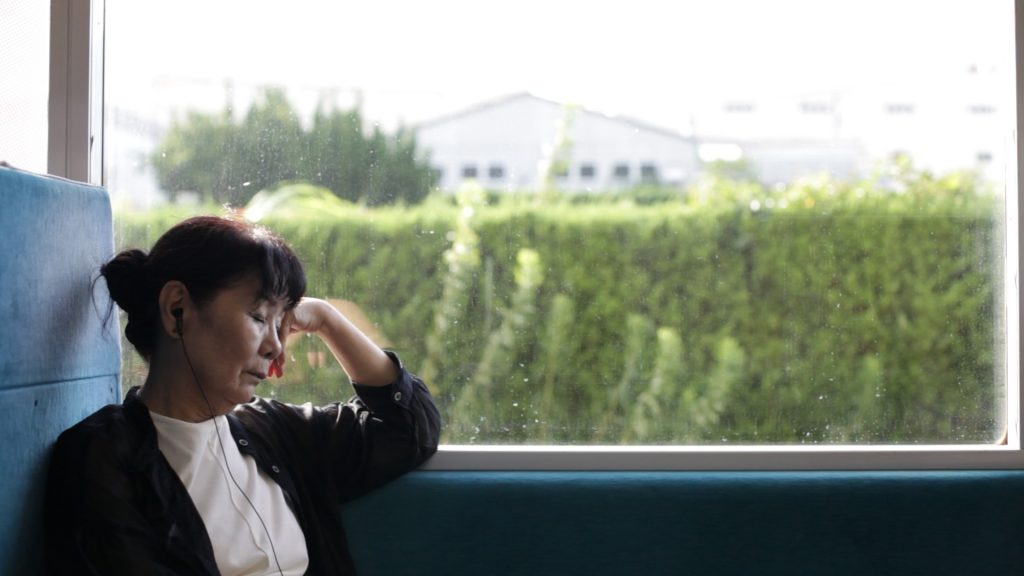
This is the third dispatch from this year’s Yebisu International Festival for Art & Alternative Visions. You can read the first two here and here.
Founded in 2009, this year’s edition of the Yebisu International Festival for Art & Alternative Visions is dedicated to exploring the possibilities and problems posed by the changing nature of moving images in our time. Titled Docs: Images and Records, the event, currently taking place at the Tokyo Photography Art Museum, features a variety of works (films, installations, photography, performances and talks) that reflect on the meaning of representation through the visual medium and, in particular, question the meaning of the word ‘documentary’, a term that has become increasingly ossified (both on the big and small screen) and synonymous with the word ‘factual’. Or, as stated on the web page of the festival:
A document is a record of fact-based information, traditionally in the form of words but more recently also as images such as photographs and moving images. The word “documentary,” meanwhile, has come to be used not only as an adjective meaning “factual” or “consisting of documents,” but also as a noun referring to a film expressing facts.
The Lumière brothers’ Exiting the Factory (1895), which is a record of people leaving a factory, is widely recognized as the starting point of the history of motion pictures. People at the time were astonished to see scenes from their everyday lives being recorded and replayed before their eyes as if the events were actually happening right there. Today, 130 years after the invention of moving images, it is entirely unexceptional for people to record and share their daily lives through photographs and videos. Meanwhile, the definition of a photograph has been expanded to include digital images and that of moving images now encompasses digital video; in digital form, these media can be manipulated more freely than before, resulting in a more complex and ambiguous relationship between facts and the images that represent them. Held on the occasion of the 30th anniversary of the Tokyo Photographic Art Museum, the Yebisu International Festival for Art & Alternative Visions 2025 will focus on the transformation of these media. By examining a wide range of works through the lens of images and words, the festival will pursue a reconsideration of documents and documentary.
After presenting アンダーグラウンドUnderground, her latest work concluding a trilogy of sorts dedicated to the exploration of subterranean spaces, at the last Tokyo International Film Festival, a film which will be screened at this year’s Berlinale, Oda Kaori returns to focus on a more personal and private story with Recording with Mother “Working Hands” (母との記録「働く手」).
This medium-length (41′) work was one of the four projects commissioned by this year’s festival and continues to document the artist’s engagement with her mother, a relationship that gave rise to the short film Karaoke Cafe BOSA in 2022 and launched her career as a filmmaker with 2012’s Thus a Noise Speaks, a film in which Oda expressed and documented her coming out to her family.
Oda’s approach seems to come from a place of curiosity about her mother’s life; the artist herself has said that there was a lot about her mother’s life that she didn’t know, such as the fact that she was the second youngest of ten siblings and that she lost her father when she was five. The film begins with images of domesticity, her mother working in the house, making some sort of wooden craft, while singing and talking to her daughter. Actually, there is no conversation, but the woman’s words are superimposed on the images as a kind of narration, a narration that from the very beginning conveys her confusion about Kaori’s gender: “I don’t know if I should call them son or daughter”.
The work is structured to mirror the story of her mother’s life, but backwards, from the closure of the small karaoke café she ran for a few years before and during the pandemic, through the various jobs she went through during her life, back to her childhood’s places.
We learn that at the age of 15 she went to work in a wool mill in Aichi Prefecture, and after graduating while working in Kyoto, she became a telephone operator in Osaka. Returning to her hometown of Takashima in Nagasaki Prefecture, she became pregnant with her first child at the age of 23 and subsequently married.
The seeming simplicity and rigour with which the images tell the story once again reveals Oda’s visual talent; the framing is never improvised but always purposeful, as is the use of natural light, shadows and shots of the sky and clouds that open the film. Moreover, there is almost no camera movement throughout the film, leaving room for a static camera filming her mother working in the kitchen, moving around the house, or travelling by train to her hometown and the house where she grew up, now covered by vegetation.
The film ends with her mother back at home carving a small wooden figurine, an object that seems to reflect Oda’s own effort: a heartfelt message made to thank and celebrate her mother.
The film was screened in the museum’s theatre on the day I visited, but it is currently being shown as an installation until 23 March. The exhibition space also features a vibrant oil painting by Oda herself.
 Asian Docs
One thought on “Oda Kaori, Recording with Mother “Working Hands” 母との記録「働く手」(2025)”