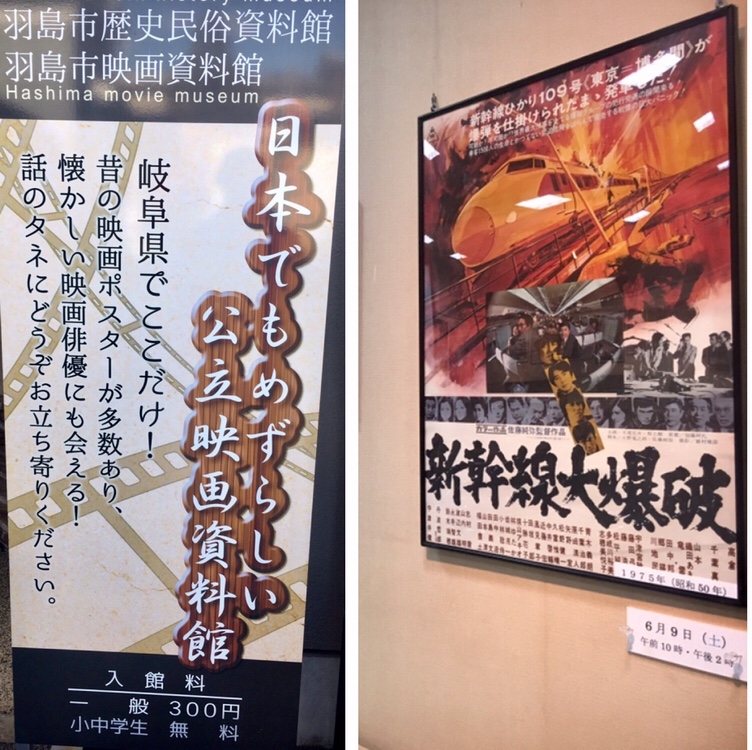
Upon discovering the Japan Community Cinema Center and its annual reports on film culture and its diffusion throughout the country, I was inspired to republish this old post. I hope this is the start of a series of articles about “The Places of Film Culture in Japan,” exploring the various cinema archives (big or small, independent or state-funded), film museums, and community cinema centers that foster a love for cinema and emphasize the importance of preserving and studying the history of audiovisual production.
Originally posted in 2018 and re-edited in September 2023 (further re-editing: 2025, June).
There’s a place I’ve wanted to visit since moving to Gifu Prefecture that I discovered by chance while surfing the Internet. It’s a small, movie-related museum located in Hashima City: the Hashima Eiga Shiryō-kan 羽島市映画資料館
Movie museums, archives, and places devoted to preserving and documenting the history of cinema and movies (big spectacles, home movies, and video art alike) are becoming an increasingly interesting field for me to explore. Therefore, even though it is, strictly speaking, not about documentaries, but rather about documenting films and their history, I have decided to start a series of posts about Japan’s few but active film museums and film centers (2025 correction: I was wrong, there are in Japan more facilities dedicated to cinema than I thought. Also I have not continued the series…shame on me).
The most famous are the National Film Archive in Tokyo and the Kobe Planet Film Archive in Hyogo. The latter is a place that has been featured many times on this blog. It is a mini-theater and archive—perhaps an exemple of counter archival practices in the archipelago?—that I have visited many times, and through which I have discovered many important movies. Another museum I visited a couple of years ago is the Toy Film Museum in Kyoto. It was recently in the international news because of the discovery of a film by Ozu Yasujirō that was once believed to be lost, Tokkan Kozo.

The Hashima Eiga Shiryō-kan, located on the outskirts of the “empire” in an old area of the city of Hashima, is housed in a small, two-story building.
Established in 1996, the museum shares the building with the Folk History Museum. However, its appearance (at least from the inside) is more reminiscent of a cinema museum than an ethnographic museum. For instance, at the ground floor entrance, visitors are welcomed by dozens of film posters from different eras.
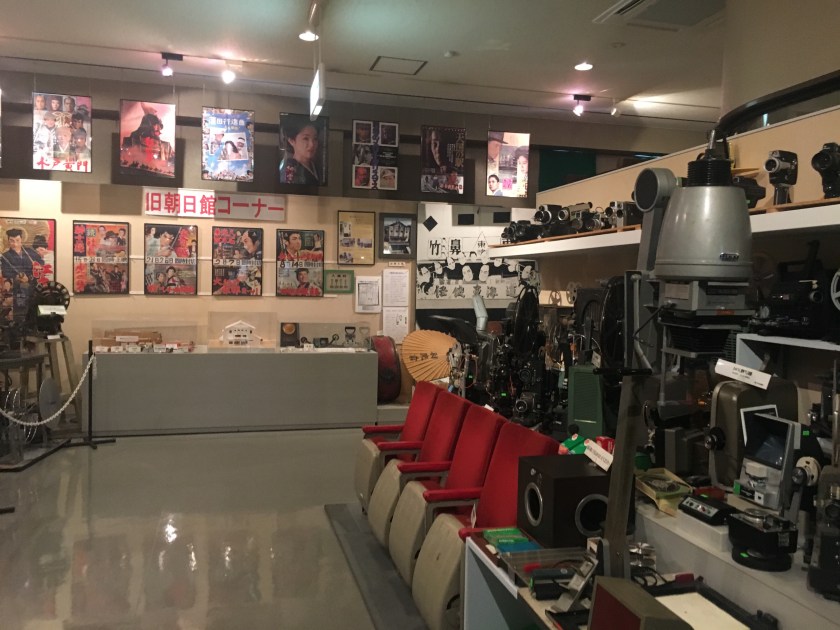
The main exhibition space is located on the second floor, where one room is filled with old movie cameras, some of which are bulky machines dating back to the 1940s. There are also flatbed editors, speakers, and posters—a real feast for the eyes. As you can see in the photo below, there are even some seats from an old theater. The seats probably belonged to the Takehana Asahi Cinema, a beloved theater that was an important part of the local community. The theater was active between 1934 and 1971, and the museum stands in the same spot as the Takehana Asahi Cinema.
Even after its closure, the old building remained intact and untouched until the end of the 1980s. Around that time, the people of Hashima started pressuring the city to bring a cinema back to their neighborhood. The interest was probably sparked by the advent of mini-theaters during the decade and fueled by the money flowing through the bubble period. Around 1992, an inspection revealed that the building was dilapidated and in danger of collapsing. However, hundreds of movie posters were discovered inside its vaults. This led to the decision to embark on a new project: the establishment of a movie museum. The new building was modeled after the old theater on its south facade and after Takegahana Castle on its west facade.
(the old Takehana Asahi Cinema and the South facade of the museum, source )
The other room is set up like a screening room, with rows of chairs in the center and a small screen at the far end. Film posters and other memorabilia adorn the walls, mainly from the golden age of Japanese cinema and jidai-geki movies.
For me, the highlights were two very old and beautiful long posters from the 1930s, but unfortunately, I could not take photos of them. According to its website, the museum stores over 50,000 items, including posters and other memorabilia. Only a small portion of these items were on display the day I visited.
On the second Saturday of every month, the main room turns into a screening room where people gather to watch and discuss movies chosen by the museum staff. Films screened this year included I Want to Be a Shellfish (1959), Nobuko Rides on a Cloud (1955), and The Bullet Train (1975).
The museum sets a good example of what local movie theaters outside big cities could become: a place to preserve and celebrate cinema and film culture. They could also function as small repertory theaters or community cinemas.

 Asian Docs
One thought on “Places of film culture in Japan: 1/ Hashima Eiga Shiryō-kan 羽島市映画資料館”