What Should We Have Done? was one of the most commercially successful independent documentaries released in Japanese theaters last year, earning more than 180 million yen after its initial release in December 2024, and remaining in cinemas for almost a year. The film directed by Fujino Tomoaki was also included in Kinema Junpo’s Best Bunka Eiga list for 2025, where it ranked second. Now What Should We Have Done? is again being screened in selected mini-theaters across the archipelago, giving me the chance to revisit it.
Produced by Fujino’s Zou-Shima, distributed in Japan by Tofoo Films, and completed with the support of Yamagata Dojo, a residency program for documentary filmmakers working on projects in progress, the film is built from video material—mostly shot digitally by the director himself over more than twenty years within his own family. These visual footage was recorded intermittently during his visits to the parents house, and traces the story of the director’s older sister, nicknamed Mako-chan or Mako, who suffered from mental illness, and of parents who, for almost her entire life, denied her condition and attempted to deal with it while almost never consulting a doctor.
Watching it for the second time gave me the chance to notice and appreciate things that, the first time around, were somewhat drowned out by the raw intensity of the experience. It was still a painful, heavy watch—perhaps even more piercing in some ways.
As Fujino has stated on various occasions, What Should We Have Done? is, from its very title, a document of a failure: the failure of an entire family—director included—toward his sister Mako, who began showing symptoms of schizophrenia in 1983, when she was 24. After allegedly consulting a specialist, the parents came to the conclusion that there was absolutely nothing wrong with her, and the family was discouraged from seeking psychiatric care for their daughter.
The film begins on a black screen, with the sister’s voice out of control, recorded by her brother on a Walkman in 1992. The video recordings started almost ten years later, in 2001, during the visits the director—now living in Kanagawa—made back home in Sapporo, Hokkaido. He began documenting his sister’s life and her relationship with their parents as a way of opposing and criticizing their treatment and decisions regarding her.
The use of low-resolution video feels absolutely right for conveying Mako’s miserable experience and, secondarily, that of the entire family. The rough texture of the images almost mirrors the emotional conditions in which everyone is trapped. On a filmmaking level, the documentary works largely thanks to the editing, which naturally shapes what the film ultimately becomes: a partial but real point of view on the tragic reality of the family. It must have been a near-Promethean task for Fujino and Asano Yumiko, who edited the film with the support of Hata Takeshi, to decide what to include, and especially when to cut away from some of the most distressing moments.
The structure, in this regard, is exemplary. The first part briefly sketches Mako’s life and that of her parents using photographs and home movies shot by the father in the early 1960s during their trip, for business, around the world. The couple was highly educated, both were researchers, and made the whole situation even more astonishing.
The film then moves forward chronologically, covering more than a decade beginning in 2001 and documenting the steady deterioration of Mako’s condition—and, alongside it, that of her parents. One day the director returns home and finds a padlock on the front door, installed by the parents so that Mako cannot escape. We learn, together with an appalled brother, that his sister has not left the house for almost a year.
The emotional peak of the documentary—and what must have been the lowest point in the relationship between daughter and parents, at least the one kept in the film—comes in a nighttime scene in which we realize that the mother, too, is beginning to show signs of dementia, while Mako’s piercing, bone-chilling screams fill the house.
The following scene—a black screen with written text—tells us that the parents finally gave up, and that Mako was hospitalized and given the appropriate medication.
The contrast between those unbearable screams and the later scene in which she calmly speaks, cooks, and washes the dishes is both astonishing and heartbreaking. It points toward what might have been—and that makes it all the more painful.
The final part of the film is filled with tender, almost peaceful moments between the father, Mako, and her brother—and then with the inevitable ending, which I will not spoil.
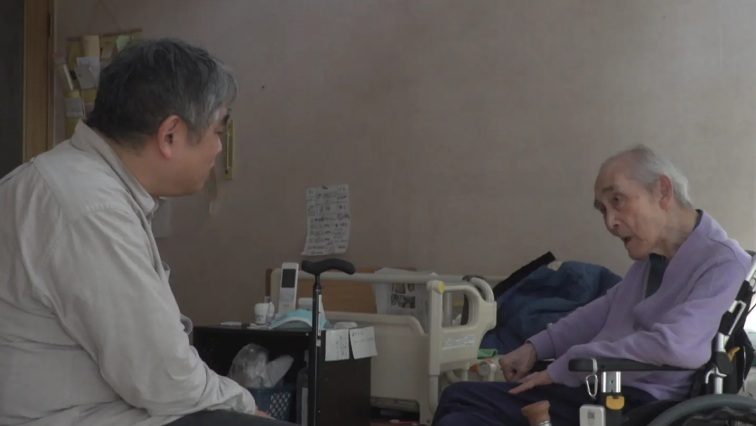
An interesting layer is added when Fujino speaks with his father—now frail and in a wheelchair in a hospital—telling him about his wish to assemble all the footage shot over the past two decades and essentially asking, on camera, for his consent to do so.
 Asian Docs