When I started this website, I thought of it as a space for documentary cinema in Japan, and later opened it up to include non-fiction films from Southeast Asia as well. Today though, I’m taking a bit of a detour to put together some scattered thoughts on the Italian collective Videobase, perhaps as a first step toward a longer, more in-depth essay one day…
“In order for the videos to be watched, videotape recorders had to be plugged into a television set. This enacted an occupation of the television screen that symbolically disrupted the state’s monopoly of the two television channels” Jacopo Galimberti, Images of Class
I came across Videobase while reading about Italian Operaismo and Autonomia, and at the same time while looking for examples of militant video works in 1970s Japan. Surprisingly not that many, even though it was the decade when the portable videotape recorders (Sony Portapak, Akai, etc. ironically almost all made in Japan) gave artists and collectives a new tool to experiment and explore with.
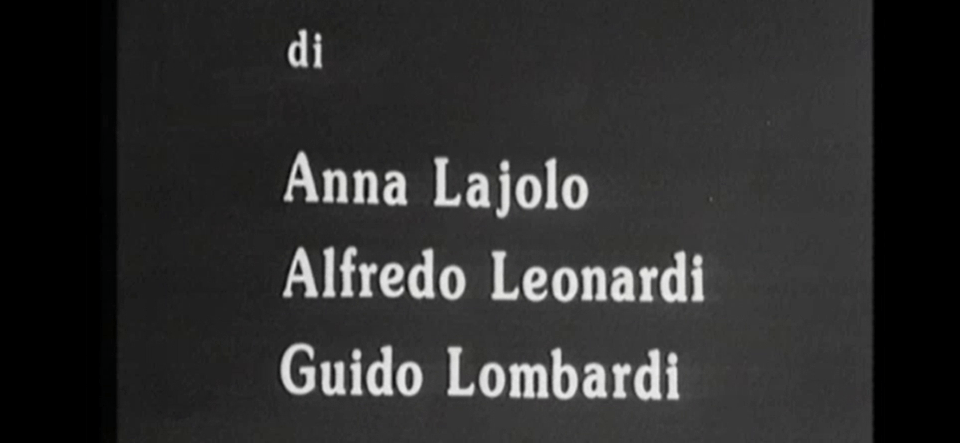
Videobase was formed in 1971 through the collaboration of Anna Lajolo and Guido Lombardi—already a duo active in experimental cinema in the past decade —together with Alfredo Leonardi, who likewise emerged from the Italian underground scene. As scholar Christian Uva has pointed out, the collective, while not the first to use videotape recorders, can be considered the first to have used the new technology for militant purposes in a systematic way, grounded in a clear theoretical understanding of the medium.
For the group, their collective activity was “an electronic extension of that form of interventionist and documentary cinema known as militant cinema” one that kept and intensified the difference with the mainstream output. As they recollect in the 1990s “that very sense of incompleteness and formal roughness created and defined a difference; they were reclaimed, through a widespread spontaneism, as qualities—a dirty, anti-bourgeois style set against a power that produced images—broadly speaking—polished and beautiful.”
A video(cinema) against the grain that aimed to choose a clear part on the barricades “to take sides for us, was a deliberate choice, a way of engaging with reality without distorting it—one defined by social figures that today appear blurred: the proletariat and the subproletariat. There was the risk of bias, but everything was laid out in the open. In contrast to a public television—and later a commercial one—that disguised, and still disguises, itself as impartial.”
I’ve seen some of their works, including those shot on film during the same period, which, in my view, remain in clear continuity with their video output. However, I haven’t been able to track down two of their most significant works from the late 1970s, Porto Marghera, il lavoro contro la vita (Porto Marghera, Work Against Life, 1979) and L’isola dell’isola (The Island’s Island, 1974–77). I’ve seen the second part of the latter, which is often regarded as the most complete embodiment of Videobase’s (video)philosophy, at least in regards to creating a new form of video and “television” that was more participatory and circular. Here, previously shot footage is, so to speak, reframed and presented again to the same participants—not only to elicit discussion and reactions, but also to foster a deeper awareness of the representational apparatus at work within the contemporary mediascape.
As I’ve done in the past, I’ve jotted down a series of scattered thoughts that may eventually coalesce into something more fluid and systematic, once I’ve had the chance to engage with the entirety of Videobase’s output.
La casa è un diritto non un privilegio (Housing is a Right, not a Privilege, 1970) “Our first work together was a 16 mm film about the slum dwellers and evictees of Rome, shot for Unitelefilm. It was a collective film, with group direction and discussion during the editing. Working this way, we had the opportunity to evaluate the work through discussion at all levels, including ideological ones.” (Anna Lajolo, Guido Lombardi, 1974)
Il fitto dei padroni non lo paghiamo più (We’re Not Paying the Owners’ Rent Anymore, 1972) the result of 10 months spent by Videobase’s members in the Magliana neighborhood and its committee is also their second work shot on video.
& Là il cielo e la terra si univano, là le stagioni si ricongiungevano, là il vento e la pioggia si univano (& There, sky and earth merged, there, seasons rejoined, there, wind and rain united, 1972) stands as a fascinating, radical, and rigorously constructed example of militant cinema. It weaves together interviews with social outsiders—exploited workers, former partisans, ex-prisoners, the disenfranchised—with passages of landscape filmmaking, all bound by a forceful Marxist critique of the city, capital, the state, trade unions, socialism, and the bourgeoisie. In its attention to the heterogeneous subjects it brings on screen, the work also operates as a compelling illustration of Mario Tronti’s concept of class composition, captured here in the very process of its formation.
Formally, the film is built largely around long-take interviews, staged either inside old houses or outdoors against the backdrop of an ancient urban landscape. As mentioned, it is shot on 16mm from an elevated vantage point—perhaps a hill or even a castle—from which the camera frequently pans laterally, gradually revealing the surrounding terrain and embedding the speakers within a broader spatial and historical context.
The interviews are framed—both opened and closed—by sequences in which the group stages discussions about their experiences and their vision of the future. These moments feel almost theatrical and re-enacted, yet they reinforce the collective dimension of the project: revolution and the seizure of power by the proletariat as a shared horizon.
The ending is especially striking. After a succession of politically charged statements, the group disperses, each person leaving the hill and returning to their own path—an image that resonates as both a fragmentation and a continuation of the collective struggle just articulated.
Carcere in Italia (Prisons in Italy, 1973, according to the description given by the authors themselves, is the “recording of the revolt of prisoners barricaded on the roofs of Regina Coeli during the five-hour assault on the prison by the police and Carabinieri on the afternoon of July 28, 1973.”
However, this work is much more than a document of an event, as it also includes long theoretical reflections on the countless difficulties awaiting prisoners once released (usually determined by class divide), a short segment featuring the wife of a detainee and her child speaking with him from outside the prison walls, and, above all, a deeply moving interview that opens and closes the work—20 minutes shot in a single long take in dim light—in which an inmate recalls how he has been incarcerated since the age of nineteen and recounts the brutal beatings he repeatedly suffered at the hands of prison guards. A powerful example of how video militancy gave space to subaltern voices.
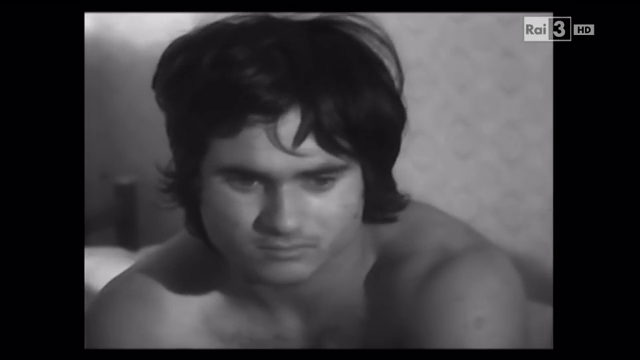
Lottando la vita – Lavoratori italiani a Berlino (Fighting life – Italian Workers in Berlin, 1975) was made during a three-month residency in Berlin in 1975 on a grant from the Artists-in-Berlin Program. The work is centered on the living and working conditions of Italian migrant laborers in Berlin in 1975. This is one of Videobase’s works which better embodies the shift from militant cinema to militant video, exploring the possibilities offered by the new medium. The two major advantages video recorders brought with their advent were the ability to shoot for longer periods of time, and the possibility of playing what was shot almost immediately.
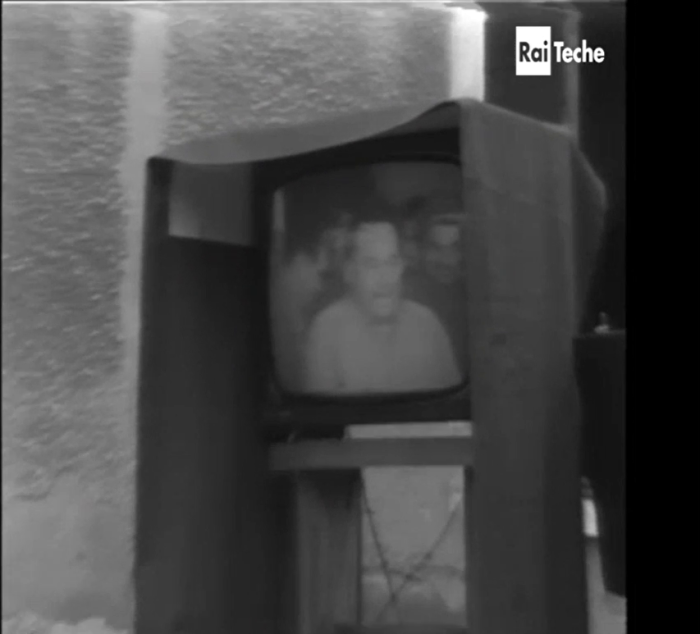
One exemplary moment encapsulates this transition and what it entails: we see and hear a worker describing the conditions faced by foreign laborers in Berlin and the role of the unions. In the following sequence, another comrade watches that testimony on a television set and comments on it. The image we have just seen is immediately re-mediated, reframed, and collectively discussed.
Not only it highlights the dialogical effect and power of the video within a video, but it points towards an epochal shift. The struggle moves from the cinema hall to the domestic screen: audiovisual militancy no longer relies on the theatrical space as its primary channel of expression; instead, it symbolically “occupies” what was then the medium of power par excellence—television. Videobase would push to the extreme this use of the remediated and reframed images through television sets in the aforementioned L’isola dell’isola (The island’s island) shot between 1974 and 1977 in the small island of San Pietro, Sardinia.
The extended recording time is put to striking use in Lavoratori italiani a Berlino in a fascinating scene where a group of young workers lounge around, half-asleep and half-dressed, chatting freely. The camera—as researcher Christian Uva notes “positioned as if it were one of them in the center of the room”—lingers on them allowing their conversation to unfold with an unusual sense of ease and intimacy.
Another important element that permeates this work is the dense layering of dialects and accents, which subtly reveals the diverse regions of Italy these migrant workers came from. At the same time, many of them lost the ability to speak fluently in their own language, and were not able to master the new one (German). A symbolic and real disorientation, expressing an identity in crisis when not in flux.
Bibliography:
Anna Lajolo, Alfredo Leonardi, Guido Lombardi. L’isola dell’isola – Videobase, in Bianco e Nero settembre/dicembre, 1979, Edizioni dell’ateneo & bizzarri, 1979.
Galimberti, Jacopo. Images of Class: Operaismo, Autonomia and the Visual Arts (1962-1988), Verso, 2022.
Christian Uva. L’immagine politica: Forme del contropotere tra cinema, video e fotografia nell’Italia degli anni Settanta, Mimesis, 2015.

