
This is an open space – open because it’s a work in progress – where I will attempt to collect and index articles, essays and discussions generated in Japan by the non-release (as of today, 10 March 2025) of Black Box Diaries, journalist Itō Shiori’s documentary about her 2015 sexual assault case. Since the discussion is mainly taking place in the Japanosphere, most of the articles are in Japanese, but I’ll try to provide a brief summary for each, even though here, more than ever, the details and nuances are of the utmost importance.
Updates:
– November 7, 2025: it has been announced that the film will be screened at T-Joy Prince Shinagawa in December.
– November 7, 2025: added a link to a piece by researcher Heidi Ka-Sin Lee published on Tokyo Review.
– October 29, 2025: Itō Shiori has reached a settlement with the taxi driver who was filmed without consent: a new version of the scene will be used in the documentary. The official apology and statement from Itō can be downloaded here.
– April 22 2025, added a discussion between filmmaker Yang Yonghi and location Coordinator Nishiyama Momoko (FRaU)
– April 1 2025, added the English version of the article written by Funahashi Atsushi and scholar Chelsea Szendi Schieder
– March 29 2025, added professor Markus Nornes comments
– March 23 2025, added Sōda Kazuhiro ‘s piece on Shūkan Kinyōbi
- The Mainichi Shimbun has an article (February 21, 2025), following Itō’s press conference on February 20th, that summarises the situation and explains the reasons the documentary has yet to be released in Japan:
The documentary, “Black Box Diaries,” has been screened in over 50 overseas countries and regions since its world premiere at a film festival in January last year but not yet in Japan due to legal concerns.
Lawyers, including those who represented Itō in a civil lawsuit over the case, have said that she broke a pledge to protect sources by using unauthorized footage and audio.
(…)Itō admitted that she used security camera footage at the hotel she was dragged into by the alleged assailant, a former television reporter, even though it was provided solely for use in the trial.
She also used a phone recording of a conversation with one of the former lawyers, as well as footage of conversations with a taxi driver and a detective, without getting approval from the relevant parties for the film.(…)
Itō said in the statement that in seeking to prioritize the public interest, she decided to go ahead with using part of the unauthorized material, believing it “essential” to conveying the reality of sexual violence and “the only visual proof.”
The incident occurred in April 2015 when Itō met the alleged assailant for dinner and she later filed a complaint with police, saying she had been sexually assaulted by him in the hotel room after losing consciousness.
The Tokyo District Public Prosecutors Office decided not to prosecute the reporter, but Itō won a damages suit against him, with the Supreme Court finalizing a ruling that found there had been sexual intercourse without consent.
source: https://mainichi.jp/english/articles/20250221/p2g/00m/0et/001000c
The journalist has announced that she will edit the film in order to hopefully have it released in Japan.
As I said, the revelation that some material was used in the documentary without consent has sparked a growing number of articles and discussions, most of them about ethics in documentary, informed consent and the difference between journalism and documentary. As far as I can tell, most of them are appreciative of what the documentary is trying to achieve and respectful of the struggles and trauma Itō has had to go through.
- One of the first articles on the subject was co-authored by filmmaker Funahashi Atsushi and scholar Chelsea Szendi Schieder (18 February 2025). Both believe that the film should be shown widely and that it would be an act of public interest to do so. The documentary is not just a visual record of an individual, but has a universality that makes the viewer think that to tolerate this injustice as a society is to ignore the long history of sexual abuse that Japan’s male-dominated society has imposed on women. I am paraphrasing here, please read the whole article for more details, if you can: https://note.com/bigriverfilms/n/nd58e6b238411
Now (March 29, 2025) there’s an English version of the article:
Through a brutally revealing account of how one individual woman’s bodily autonomy and reputation were violated, her film forces viewers to reflect on their complicity in perpetuating a culture of silence and male dominance.
(…)
We are hopeful that she can manage to adjust her film to address concerns about the ethics of her film around footage. (Reportedly, Ito made a new version, addressing some of the criticism.) Such adjustments could tighten the focus again on the important issue that Ito raises regarding the high price of speaking out about sexual violence.
So far, silence—keeping the black box tightly sealed—has served to create plausible deniability of endemic sexual violence. As a documentary that presents the evidence of this violence, “Black Box Diaries” is a film of public interest.(…)
To truly reach the Japanese public, Ito may need to not only adjust the film but also find a way to reconnect with her supporters. Still, the film deserves a chance to be taken to the Japanese public, and to be seen, discussed, and acted upon. Its message is too important to remain locked away.
The full piece is available here (on a very side note: I really appreciate that is not posted on social media, but on a different platform): https://note.com/brooklyn11211/n/n480dc1044bfe
- It’s interesting to me that two of the harshest criticisms of Itō Shiori’s approach in her film have come from two female documentary filmmakers, Mikami Chie (We Shall Overcome, The Targeted Village) and Yang Yonghi (Dear Pyongyang, Soup and Ideology). On their social media accounts, the two have repeatedly expressed their shock and disbelief at Itō’s unauthorised use of recorded material.
I don’t want to redirect the reader to X or Facebook, so I won’t provide links(I wish people would write on other platforms and then link to their social media accounts).
- Filmmaker Mori Tatsuya (A, Fake, I -Documentary of the Journalist-) has a long piece on Newsweek Japan (3 March 2025) that focuses on what are, according to him, the main differences between documentary and journalism:
Journalism and documentary are very different. Documentaries are self-expression. They reconstruct one’s own feelings and thoughts, that is, one’s own subjectivity, using fragments of reality.
(…)
Journalists are tasked with serving the public interest and realising social justice, monitoring power and helping the weak, and they impose many norms and rules on themselves, such as those that information providers must absolutely abide by. Double and triple-checking and fact-checking are also essential. They must also be as neutral and objective as possible.
One reason for this is that the process of reporting and publishing information (especially in the case of video media) can take on a highly abusive nature.Documentary filmmakers are free. It is about self-expression.
The norms and rules are up to the individual. So you have to be prepared to hurt others.
I don’t mean that we should be defiant, of course we want to minimise the damage. But as long as it is a documentary, the damage cannot be reduced to zero. You have to be prepared to be on the side of the perpetrator, but at the same time you have to bear the guilt and the blame.
(…)
This is the biggest problem with the documentary “Black Box Diaries”: not only the director Itō Shiori – who calls herself a journalist and claims that the unauthorised use of images and sound is in the “public interest” – but also those who defend the film and those who criticise it confuse documentary with journalism.Journalism is not art. It is important to raise issues and make them known to society. But documentaries are works of art. (…) Documentary filmmakers should not use things like public interest or fairness as indicators of what they are doing.
(..)
I must always put my ego first and not submit to social norms, organisational rules or anyone else’s common sense.Director Ito Shiori is free to call herself a journalist. But if she does, she must adhere to the principles and rules of journalism. She must protect informants thoroughly. She must minimise damage. She must prioritise objectivity and the public interest, and she must prioritise the realisation of social justice. These are the basic requirements. You can’t have the best of both journalism and documentary. It’s one or the other. If you’re making documentaries, you shouldn’t be using nice words like public interest and social justice.
What I fear most now is that in the aftermath of this incident, lines will be forcibly drawn in ambiguous areas about how documentaries should be made, that subjects must be shown the material in advance and that permission must be obtained in all cases.
(…)
The film is valuable. Not only does it have a strong perspective on the #MeToo issue, but it also strongly denounces the collusion between political and investigative powers, truly opening the black box. It should also be released in Japan. It would be really frustrating and unfortunate if it was not.
Source: https://www.newsweekjapan.jp/stories/culture/2025/03/539790_1.php
- A discussion of the issues raised by the documentary between three women who, to varying degrees, supported Itō in her battles. Published on the Japanese magazine FRaU’s website, 9 March 2025:
Why are those who have supported Itō for many years now expressing concern? What are the problems?
At a roundtable discussion, Hamada Keiko, who organised the Japanese preview in July 2024, Ogawa Tamaka, a journalist who attended all the trials, and Nakano Madoka, who studies gender, education and media issues, discussed the issues.First, we asked each of the three about their involvement with Itō Shiori.
Nakano Madoka: I was just a viewer, and I only exchanged business cards with Shiori once, when she was at a panel discussion. However, as an adjunct professor at a university, I have studied this incident in my “Media and Gender” class. At the moment, I am working on DEI (Diversity, Equity & Inclusion) at my university, and I am dealing with the fact that within an individual there is majority and minority status, power and vulnerability, so I am interested in this case.
Ogawa Tamaka: A few months before our first press conference in 2017, Shiori was covering the issue of harassment in Japan with an Al Jazeera journalist, and I interviewed her, which is how I first met her. She spoke about her experiences then, and I’ve been supporting her ever since, attending the trial between her and Yamaguchi, as well as several trials related to slander and defamation.
Hamada Keiko: Since interviewing Shiori in the autumn of 2017 at the online media where I was editor-in-chief, I have supported her behind the scenes at her trials and have had personal contact with her. In 2024, there was a screening of the film in New York, and my friend said it was “very good”, so I thought, “Why don’t they have a preview screening in Japan? I want to see it soon.” In May, I asked Star Sands, the distributor, and Shiori if I could hold a special preview for media people and researchers who cover gender issues in Japan. At the time, I just wanted to see a film that had such a good reputation overseas, and I felt it would also help support Shiori. We held a screening in July [2024, tn] to coincide with Shiori’s return to Japan and planned a discussion after the screening.
(…)
Hamada : When we were deciding who to invite to the preview screening, I heard that the legal team that supported Shiori hadn’t seen the film yet, so I asked them, “Why don’t you come?” The list of participants was shared with Star Sands, with consideration for Shiori’s security, and we had also told Shiori that the lawyers would be coming.
When I actually watched the film, there was security camera footage, so I thought, “They must have gotten permission from the hotel,” and I gave my talk on that premise. I watched the film thinking that permission had also been obtained from investigators and the taxi driver, but after the event I was told that the lawyers representing the couple had left the venue immediately after the screening without listening to the talk event. I wondered why the legal team was so shocked. Afterwards, they pointed out issues with the positioning of the security camera footage and whether permission had been obtained for the testimony. I was shocked to hear that too. When I watched the film without any information, I thought it was a good movie.
The article also provides a clear explanation and timeline of the issues at stake:
The former legal team, which had been fighting the civil lawsuit with Ito for eight and a half years, learned about the contents of the film at the preview and had an exchange with Ito’s side. Then, about three months later, at a press conference held in October 2024, they pointed out the “problems” of the film:1) The hotel security camera footage was used without permission.
2) Investigator A’s voice and image were used without permission.
3) The footage of the taxi driver was used without permission.
4) The content of the conversation with the lawyer was recorded without permission and edited to give a different impression from reality.
The discussion is really fascinating and worth reading in full, but I would like to highlight a few passages more where the three women talk about a journalist’s responsibility towards his or her sources, the case of Mommy (Nimura Masahiro, 2019), a documentary about the Wakayama curry poisoning case (1998) that was almost cancelled, and the role and responsibility of the producer in deciding the final cut of a film:
Hamada : I think this film could only have been made by Shiori, who is a survivor of sexual violence, a film director and a journalist, and I think that makes the film strong, but at the same time complicates the issues. When I first saw it without any information, I had the impression that it was a story about the rebirth of a survivor, in that there are several depictions of her mental state. However, she said that she made the film ‘as a journalist’, so I thought that she should have followed the minimum rules of ‘journalism’.
(…)
Shiori also said in a statement that she wanted to convey the state of society after reporting a sexual assault. I think this issue is very important. But if she wanted to convey it as a journalist, she could have done more to report objectively on the investigation and interviewed other survivors in addition to her own story. Why did she insist on using CCTV footage? It’s true that the inclusion of this footage has a powerful impact and adds to the strength of the work. But even in our interviews, we can’t use all the testimonies and footage we interview. When we think of the other person, we sometimes have to suppress our desire to inform society. I think many journalists, faced with this conflict, are still doing their job of conveying what needs to be conveyed, making the most of their limited resources.Nakano : This point is not being criticised because Ito is a woman, but I think that no matter what kind of director you are, if your collaborators or actors say “Please don’t use that”, you have no choice but to respond. Recently, “Mommy”, which deals with the Wakayama curry incident, was almost cancelled. The eldest son of Hayashi Masumi, who is currently on death row, appears in the film, but just before its release the slander was so severe on social media that many asked for the film to be cancelled. In the end, however, the distribution company said: “After discussions between the producers, the distributor and the family involved in the film, we have decided to show a version of the documentary with some edits”, and released the film after reaching a mutually satisfactory agreement.
Such a dialogue should take place between the producers and the participants, and because not everyone may be able to speak out in this way, the producers must take as much consideration as possible in advance. The question “You were in the film, but did you have permission?” can be a secondary casualty, and viewers want to be able to watch without wondering about such things. As a journalist, I don’t want to be unable to use the testimony and footage that I’ve worked so hard to get, but that’s why I think it’s necessary to get permission from the participants before the film is released, and to take a stance of absolute protection of sources.
Source: https://gendai.media/articles/-/148456?imp=0
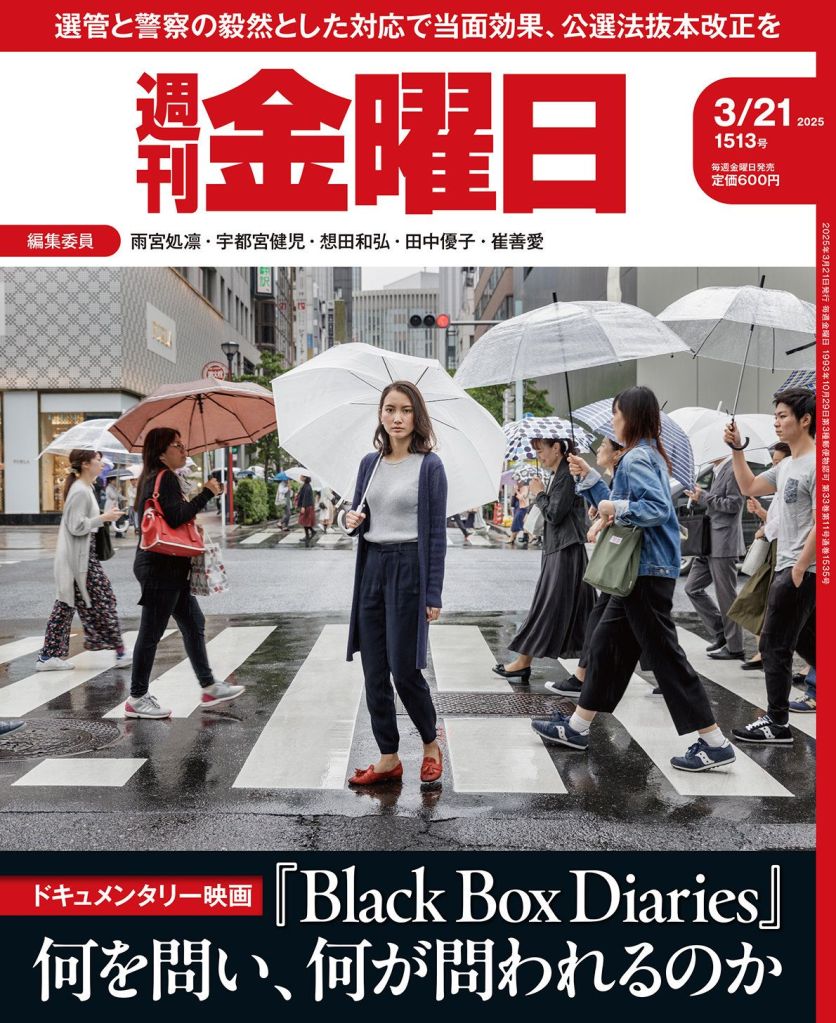
- The weekly magazine Shūkan Kinyōbi, published on 21 March, devotes a large section to the case of the Black Box Diaries. Among the contributors to the issue is Sōda Kazuhiro, who has written a long essay discussing the issues surrounding the film from the perspective of the ethical responsibility of documentary filmmakers.
According to Soda himself (on X, I’m not providing a link, sorry):
what complicates the discussion of this case is the unprecedented structure of the film, in which Ms Itō, a survivor of sexual assault, becomes the filmmaker and investigates and exposes her own case. However, it is necessary to make a clear distinction between Ms Itō as a survivor and Ms Itō as a filmmaker. Documentary filmmakers have a responsibility to their subjects and to their audiences, but because they wield considerable power, they bear a heavy responsibility and cannot be exempted from it simply because they are survivors of sexual assault.
Here are some extracts from the article (the introduction):
Most of the members [of the people who worked on Black Box Diaries, n.t.] are friends, so it’s difficult for me to talk about the film at all. The fact that I’m a man makes it even harder.
Documentaries should be something that every creator is free to make and release in their own way. That’s why I feel it’s presumptuous of me to comment on the way other people make their films. However, this film inadvertently raises important questions about the methods and ethics of documentary filmmaking. Even though it’s someone else’s work, it contains issues that a documentary filmmaker cannot overlook. In addition, because the methods and ethics of the work have generated controversy and the issue has become public beyond the scope of a single work, I feel that as someone in the documentary world I cannot shy away from discussing this issue.
But I am not a judge. I am not writing this article to condemn anyone, but rather in the hope of making the documentary world richer and fairer.
- Professor and scholar Markus Nornes shared his opinion on the Black Box Diaries case on the Kine Japan mailing list on 18 February. I’m adding it only now because his interview with NeoNeo Magazine “Ethics is an inevitable issue for documentaries – Six perspectives and the ‘ethics machine'” has been shared several times on Japanese social media in the last month. http://webneo.org/archives/11537
Make no mistake, the film is a real achievement. It’s extremely compelling, a righteous condemnation of sexual violence. Itō shows remarkable strength in the face of (mostly anonymous) powerful men, while revealing the wages the rape took upon her psyche. While she’s clearly damaged and delicate, her inner resources and determination and resilience is incredibly moving.
The film is extraordinary and precious in many ways. It will go down as an historically important documentary for being a MeToo film from the point of view of a victim who refuses to remain silent.
(…)
As I watched Black Box Diaries, I could not help thinking of Hara Kazuo’s Emperor’s Naked Army Marches On. Both Hara and Itō embark on a quest to provoke, record, and preserve testimony of atrocious wrongdoing. Both weaponize image and sound technologies that possess that special ontological status that captures the stuff of reality, which makes visual and aural evidence palpable, immediate, powerful and believable.
But actually, when you get right down to it, Itō is less like Hara and more like Okuzaki. Both are relentless. Okuzaki is, not surprisingly, the more brutal of the two. But both brazenly pursue their recordings with a fervor that drives their respective films.
But the differences are instructive.
First, Okuzaki is on an insane mission from God; his mission has a metaphysical dimension, as he is doing this not just for the correction of historical record but to sooth the souls of the dead. Itō is on a righteous quest for justice, both for herself as victim and for social justice in the broadest sense, even geographically since her story has spread the world over. And now.
More importantly, Okuzaki’s strategy is completely open and transparent. Not only does he command Hara to record his encounters, but when his victims call for help he calls the police. And when they arrive, he is completely honest in describing his deeds. What’s more, he ultimately went to prison for them.
In contrast, Itō is completely surreptitious and opaque. Her unethical lack of transparency is inscribed in the photography; when she starts non-consensual encounters, the aim of the camera is haphazard and random. In one scene, a friend who now takes on the burden of her dubious filmmaking practice, photographs Ito and Whistleblower A with a hidden camera. The graininess from the darkness and the distance from the subjects mark the shot as deeply problematic.
The full text, which I encourage you to read, can be found here: https://mailman.yale.edu/pipermail/kinejapan/2025-February/065598.html
- Another article published in the online magazine FRaU (17 April, 2025) delves, in its first part, into the ethics and practical requirements necessary when filming a documentary. It is particularly interesting in that it’s a discussion between two women who have been working and fighting against sexual harassment and misogyny in the industry for decades: filmmaker Yang Yonghi, and Nishiyama Momoko, a location coordinator.
An important fact highlighted by Nishiyama, which I personally think is crucial in all of this is the role of the producers:
It’s the job of the producers and production companies to deal with the practical aspects of rights clearance (…) so I wonder what the producers and production company have done this time.
in the second part of the discussion, the two women share their feelings about Itō, both as a victim of sexual violence and as a director. Yang painfully sums up why this case is so difficult and intricate:
I was torn between wanting to support Shiori Ito, a victim of sexual violence, and not hurt her, and being angry at her irresponsibility as a film director. Because I understand the pain of PTSD, I felt guilty about blaming her in my mind, asking myself, “Why didn’t you do your job as a film director honestly?
Going back to the topic of the filmmaker’s approach, in response to the opinions (for instance, those of Mori Tatsuya) that in same cases public interest should come before ethics and fair usage, Nishiyama shares an interesting and more general take about the state of non-fiction productions today:
Directors and filmmakers often want to create powerful images. But that’s not creativity. Isn’t it just sensationalism? If a documentary becomes popular, sponsors will come and it can be made again. But then it becomes a competition to produce something sensational instead of being honest and caring about the subject. Is it okay to leave ethics behind when something goes viral? It makes me sad that the world is moving in that direction.
The discussion between the two women is fascinating also because they are not necessarily opposing the release of the film.
However, we need to distinguish between the slander against Shiori Ito as a survivor and the criticism of Shiori Ito as a documentary director “.
Yang concludes:
I hope that discussion of “Black Box Diaries” will not be treated as a taboo subject, but will be openly discussed and unraveled, so that people from various positions can find their own perspective, and I would be delighted if this discussion can be one of those opportunities.
First part: https://gendai.media/articles/-/150748?imp=0
Second part: https://gendai.media/articles/-/150749?imp=0
- Film researcher Heidi Ka-Sin Lee has an interesting piece on the film and its destiny in the Japanese mediascape, published on Tokyo Review (November 2025):
(…) This rival rhetoric surrounding trust violation and privacy protection deflects the attention to Itō’s petition for justice and sympathy and instead serves symbolically as an act of character assassination. Most of all, it works to quash voices on sexual violence and societal complicity in its being a taboo subject, which indirectly perpetuates such violence. With the film’s limited domestic media exposure and her international success at foreign film festivals and university tours, Itō has been cast as an outsider in her home country, aligning with the dated perception of female victims yet proving her point in the documentary: (wo)men in power would do everything to name and shame those who displease or threaten them. But does this rhetoric really succeed in deflecting what was meant to be bypassed? The silence, marked by the lack of official explanation for the film’s yet-to-be-released status as well as a near-complete eschewal of domestic conversations about the subject, is deafening.
 Asian Docs
You must be logged in to post a comment.