Tanaka Min is one of the contemporary Japanese artists I admire the most, both for his past as a butoh performer—a definition he has openly and vehemently refused to used in recent years—and for his connection with Gilles Deleuze and especially Felix Guattari, an encounter that resulted, in 1985, in the volume 光速と禅炎 Agencement ’85. Last but not least, I’ve always been fascinated by the turn that Tanaka’s career took around two decades ago, a change that made him a movie actor appreciated for his powerful and magnetic presence on screen. Not only a performing body in service of documentaries with an experimental touch, such as the beautiful ほかいびと 伊那の井月 Hokaibito: Ina no Seigetsu (Kitamura Minao, 2012), and the delirious piece of performance that is 始まりも終わりもない No Beginning, No End, directed in 2013 by Itō Shunya of 女囚701号/さそりFemale Prisoner #701: Scorpion fame. But also for his presence in more mainstream movies, and his work in voice acting for feature animations.
名付けようのない踊りThe Unnameable Dance (2022) is a documentary that retells, using Tanaka’s own narration and words, and in an episodic and at times syncopated way, some of the events and encounters that guided his life as a performer. Tanaka recalls, for instance, his meeting with Hijikata Tatsumi and the discovery of his revolutionary performances in the early 1970s. Or dancing in Paris in 1978, a trip that de facto launched his career, not only internationally but also in Japan. During one of his trips to France, Tanaka had also the chance to meet Roger Caillois, a writer and philosopher he strongly admired, and for whom he insisted to dance. The title of the movie, The Unnameable Dance, is, as a matter of fact, taken from a sentence Caillois used to describe Tanaka’s performance.
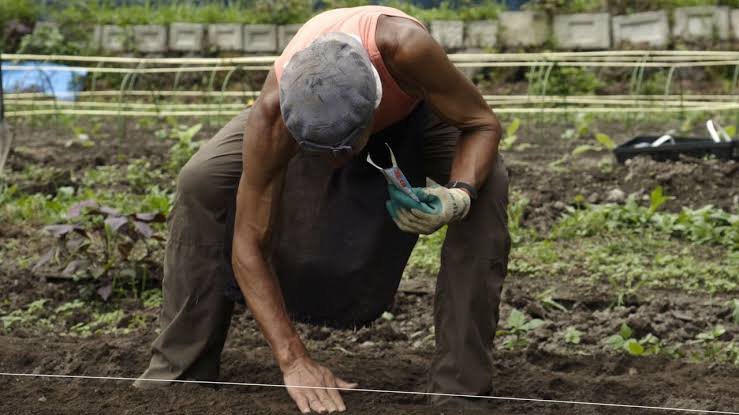
The documentary, directed by Inudō Isshin, covers also Tanaka’s debut as an actor in Yamada Yōji’s Twilight Samurai, an event that kicked off, at age 57, his career on the big, and small, screen. A part of the documentary is also dedicated to Tanaka’s work as a farmer, an activity very important for his philosophy, because, as he famously stated, “In agriculture one can find the anti-modern coming from the past. There you find the concreteness of the present.”
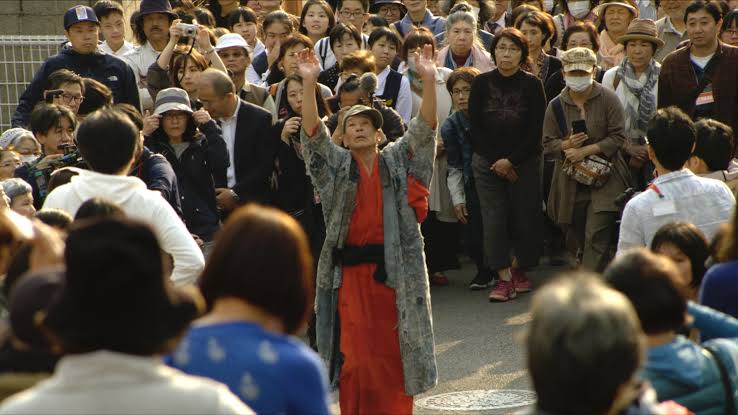
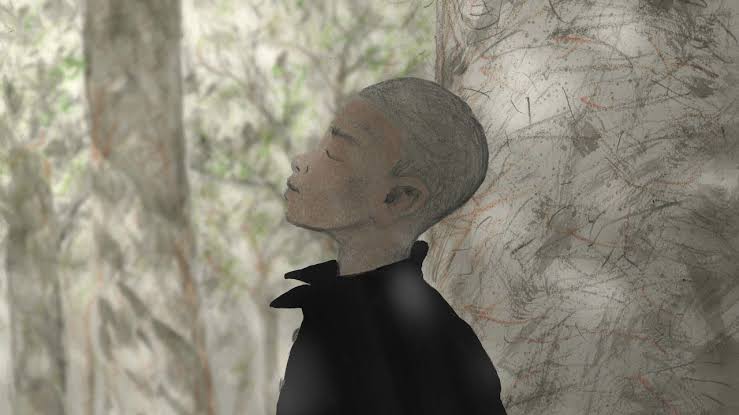
The recalling of all these experiences is interspersed with some of his more recent performances, always awe-inspiring, even when mediated through the camera. These performances were recorded in Japan and abroad, Paris and Portugal play a big role in the work, the latter is not only the place where the documentary begins and ends, but its music (Fado?) accompanies the whole documentary. Another fascinating quality of the film is that the performances and scenes with Tanaka on screen are interspersed with Yamamura Kōji ‘s beautiful and effective animation, used mainly to depict Tanaka’s memories and dreams as a child. Particularly significant is also how the documentary includes purposely the audience, their faces and their reactions, when filming Tanaka’s performances in public spaces. There’s not attempt to hide or cut out the people watching and taking videos and photos with their smartphones, since for the Japanese performer “dance cannot be owned; dance is born in the space between; the viewers become dancers too”.
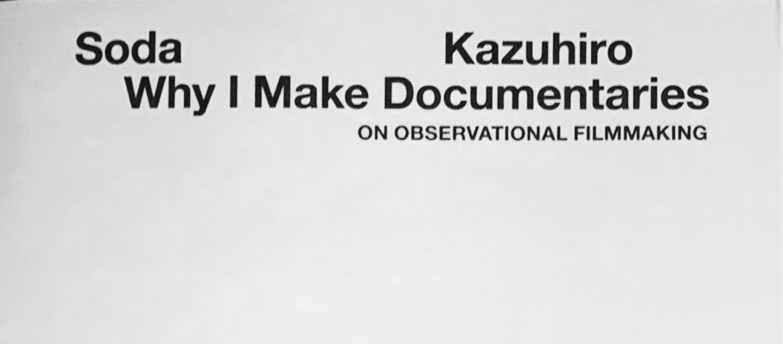
Sōda Kazuhiro has become, in the last decades, one of the most distinct voices working in the contemporary documentary scene. Based in New York, a city where he moved for studying and eventually work for the Japanese public broadcasting NHK in the second half of the 1990s, Sōda has been directing, shooting, and editing (with his wife Kashiwagi Kiyoko as a producer) his independent documentaries for almost two decades. Sōda has also been writing, in Japanese, about filming, and social and political issues for quite some time, on his blog, but also in articles and in books. なぜ僕はドキュメンタリーを撮るのか Naze boku wa dokyumentarii wo toru no ka is a volume published in 2011 dealing with the process, issues, theory, and discoveries of making non-fiction movies, and was recently translated into English as Sōda Kazuhiro – Why I Make Documentaries (208 pages, Viaindustriae, Milan 2023, edited by Silvio Grasselli, translated by Matt Schley).
This publication is a reflexive diary on his own work in pursuit of answers to many crucial questions which have arisen along his extensive research path. It is the first curated English version of Kazuhiro’s most enlightening and complete writings, enriched with a new iconographic apparatus derived from his films and an updated introduction by the author himself. Discover why seeking answers to such basic things as ‘What is a documentary?’ and ‘Why do I make documentaries?’ turns out to be essential practice for one of the most prominent Japanese filmmakers today.
As written above, the volume originally was published in Japan in 2011, after the Tōhoku earthquake and tsunami, a tragedy that almost pushed Sōda to halt and cancel the project, and it is structured around Peace (2010), the third documentary directed independently by the Japanese. In the book Sōda recalls how the film came into existence, through the invitation to make a short movie by the DMZ International Documentary Film Festival in South Korea, but also the unexpected encounters while filming, and the difficulties in shaping a work centered around a community of people and cats in Okayama city, Japan. Describing the process of making Peace is for Sōda a chance to reflect on his working method, his belief in what documentary cinema can do, and other important issues related to the ethics and philosophy of filming. Famously, Sōda describes his method and style as observational filmmaking, and when making independent documentaries always tries to follow a series of rules he has himself established:
1 No research.
2 No scripts.
3 No meetings with subjects.
4 Roll the camera yourself.
5 Shoot for as long as possible.
6 Cover small areas deeply.
7 Do not set up a theme or goal before editing.
8 No narration, superimposed titles, or music.
9 Use long takes.
10 Pay for the production yourself.
The volume covers a lot of fascinating themes and topics significant for those who are interested in nonfiction filmmaking. First of all, citing also the writings of Satō Makoto, the power and responsibility that holding and pointing a camera at someone entails. “A documentary camera (especially in the hands of a skilled filmmaker) mercilessly gouges out and lays bare its subject’s subconscious; their inner soul, or what I call people’s ‘soft spots’” writes Sōda. “Depending on how things go, it can leave a subject deeply hurt. In that sense, there’s a possibility for a documentarist to become an assailant, and a very real risk for the camera to become a tool of violence.”
Some beautiful pages are also dedicated to the filmmakers Sōda considers his main influences, the American direct cinema of the 1960s, and especially Frederick Wiseman, who remains for the Japanese author to this day a guiding star in the world of documentary. As the technical innovations helped to shape nonfiction cinema at the end of the 1950s and beginning of the 1960s, so did the digital revolution that occurred at the beginning of this century. “The biggest impact this technology had was in freeing documentaries from the production and exhibition format of film” writes Sōda, “Up until then, if you wanted to exhibit your work on a big screen with any semblance of quality, you had no choice but to shoot, edit and project on either 16 or 35mm film. But using this new camera and the DV format allowed you to shoot on digital, edit on a computer, and even show your film using a digital projector. It opened up a whole new path.”
These new tools allowed Sōda to embark in a career of independent filmmaking, a path that was also kindled and forged in contrast to what he had experienced in the world of documentaries made for TV during the 1990s. There are strong echoes here with what Kore’eda Hirokazu has to say about working for TV, although with some major differences, Kore’eda was lucky to work in a different period, with more freedom, and with some enlightened colleagues and producers, Sasaki Shōichirō in primis. Everything on TV, according to Sōda, is often scripted, and once the director or the producers set a theme or a goal for the program, the reality captured is distorted, biased, and without anything left to chance, the latter being one of the most powerful elements in a documentary. As an example of this modus operandi, Sōda brings his personal experience of working with NHK after the terrorist attacks on 9/11 2001. In the aftermath of the tragedy, the Japanese broadcaster was looking for images of tears and cooperation, while Sōda often witnessed in New York scenes of normal daily life and quarrels. Being open to chance and randomness is a key point for Sōda’s approach to documentary, and it is fascinating to read that he was influenced and inspired in this by the art and the creative method used by Jackson Pollock, and by the way dance was conceptualised by Merce Cunningham, a performer Sōda was able to know and meet through his wife, a professional trained dancer.
Some of the most inspiring pages are the ones dedicated to the art of editing, and a paragraph titled “Changing Yourself Through Observation”, where Soda associated the act of observing through documentary with vipassana meditation, a subject he ended up writing a book about in 2021. “Many people may think of ‘observation’ as something done in a cool and distant way. But that couldn’t be further from the truth. The act of observation is almost always accompanied by a change in the observer’s way of seeing the world. One loses one’s sense of tranquility, and, before long, is compelled to observe one’s own self as well.”
In conclusion, it is fair to say that beyond the pleasure of reading the reflections of one of the most prominent documentarians working today, this volume is also important in that it is an essential addition to expanding literature, available in English, on film theory produced in Asia.
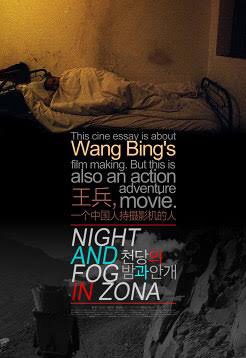
I’m reposting a slightly edited version of a piece I wrote 8 years ago, an article about Night and Fog in Zona, directed by South Korean film critic, Jung Sung-il.
It’s always fascinating when cinema reflects on cinema, and even more so when a documentary’s subject is director Wang Bing filming one of his movies. Night and Fog in Zona is a documentary, or better yet a cine-essay as it is called by its author: South Korean critic turned director Jeong Sung-il, who follows the renowned Chinese filmmaker throughout a whole winter while working on two of his projects, ‘Til Madness Do Us Part and a sequel to his Three Sisters.
The “coming” of Wang Bing has been, and still is, one of the most important events that occurred in the world of cinema in the last 15 years: not only did he contribute asserting the aesthetic value of digital filmmaking, but with his documentaries he also brought an auroral and liberating gaze upon the world.
Jung Sung-il had the same kind of dawning experience watching West of the Tracks in 2001.
“When I was at the Rotterdam Film Festival I bought a ticket for a movie 9 hours and 10 minutes long, I was surprised by its length but went anyway. It begins with a train in movement and it reminded me of the first movie ever made by the Lumière brothers in 1895. Watching Wang Bing’s work I had the feeling of witnessing the cinema of 21st Century just like the audience in 1895 witnessed its birth.”
There’s no narration in Night and Fog in Zona, everything is explained with intertitles: geographical coordinates, places where Wang Bing is headed to, his plans. Sometimes these intertitles also work as a poetic comment to the following scene.
The only time when Wang speaks directly to the camera is in an interview-like fashion at the very beginning of the film, a sequence that works as a brief introduction to his world and his filmmaking style. A few minutes where, among other things, he talks about his filmmaking process, truth in cinema, the impossibility of conveying the totality, his projects, Chinese history and peasants, and the similar cultural background his generation shares with Andrei Tarkovsky.
In 235 minutes Night and Fog in Zona illuminates a great deal about Wang Bing’s approach to filmmaking. Among other things, we learn about his habit of taking photos of the people he films, his relationship with them, and, most fascinating of all, about his “interview technique”: it’s compelling to see how he is able to seamlessly switch from “chatting with” to “shooting at” his subjects, as if there was no real break between the two actions.
It’s also interesting to witness how “Wang searches for the ‘strategic point’, the single position from which all of the actions in the scene can be recorded”. This is a fundamental feature of his filmmaking, as the relationship between the camera and the people and things around it determines both the movie’s sense of space and how space itself is conveyed in his works. And space, together with time/duration, is one of the most crucial elements of his cinema.
Another revelation of Night and Fog in Zona is to discover how Wang Bing is a director whose involvement with the subjects of his movies is deeper than we might think from just watching his works: when the camera is off, he’s often seen giving practical help and advices to his “protagonists”.
Particularly fascinating, from a movie making point of view, is a scene where the director and his two collaborators have an evening meeting to watch the footage shot during the day at the Asylum — footage that would eventually become ‘Til Madness Do Us Part. A few but meaningful minutes where he explains the reasons behind his use of long takes, why avoiding telephoto lens, and other rules to follow while shooting, so that the final work can gain a certain consistency, a certain style.
However, the best quality of Night and Fog in Zona is that it’s not only a documentary about Wang Bing shooting his movies, but it’s also shot and conceived — with all the due differences – just like one of Wang’s documentaries. In terms of style, it mirrors Wang Bing’s filmmaking: long takes, no narration, abstract landscapes and experimental music, everything put together to explore his filmmaking and, in a broader sense, contemporary China, a country gazed upon, as in most of Wang Bing’s works themselves, from a peripheral and rural point of view.
One of the best examples of this mirroring process is to be found towards the beginning of the film, when the Chinese director and his collaborators move to the Yunnan province.
A very long sequence shot from the car everyone is on, that shows us streets, mountains, plains, lights and tunnels almost melting together. A scene almost 10 minute long, matched with a hypnotic and minimalistic music interacting with the abstract landscape captured by the camera.
We encounter these sort of sequences a couple of times during the movie: another powerful one, shown in slow motion, is inside the asylum. Bing is sleeping and ten or so patients are sitting and moving around him. What gives Night and Fog in Zona a further experimental and even meta-filmic touch are two scenes, placed at the beginning and at the end of the movie, that show a Korean girl dressed in red sitting in a theater and making a phone call.
The only flaws to be found in this documentary, an otherwise almost perfect work, are some editing choices, in some cases too abrupt, and the pace of the intertitles, definitely too fast. But that’s just splitting hairs, Night and Fog in Zona is definitely one of the best non-fiction movies seen this year, not only for its fascinating subject, but also for its ability to resonate with Wang Bing’s own style at a deep and aesthetic level.
At the end of last January, I had the pleasure of attending a special screening of Gama, the latest project by Oda Kaori, a talented filmmaker and artist whose previous works I covered in the past for this blog, and for various other outlets (review of Aragane, interview with Oda, review of Cenote).
The work was screened in the city of Toyonaka on January 27th, and was commissioned by the Toyonaka Arts Project 2022. From Oda’s perspective Gama is also a second chapter of sorts, or a “trace” so to speak, of an ongoing project, a movie that will come out next year, Oda is developing about underground areas in Japan, underground both in its literal and figurative sense. The first chapter of this project is a visual installation produced by the Sapporo Cultural Arts Community Center, and projected on an ultra-wide horizontal screen in a underground pedestrian passageway in the city of Sapporo, Hokkaido. The work, also titled Underground, is being screened until the end of March, alternated with works by artists such as Apichatpong Weerasethakul (The Longing Field) or Rika Noguchi (Insects/ Leaves/ Songs of Birds), as part of a project called Nishi 2-Chome Chikahodo Video Creation. Here the official description of Oda’s installation:
Kaori Oda “Underground” 2022 | 09’37” Kaori Oda consistently seeks for human memories―Where are we coming from and where are we going to―. In this piece, she dives into the underground paths in Sapporo beneath its enormous landscape aboveground. She projects everyday lives and sound footages of Sapporo in the past decades, as well as repetitive caves and holes, or images of the universe. The locations where she projects these moving images are normally closed to public. This film shot in 16mm considers layers of the time lived by the people, redefining them as multi-track timeframe. It invites us to imagine the space where we exist now as well as the very beginning of time.
Back to Gama, the work screened in Toyonaka. The film takes place entirely in Okinawa, and the connection between Toyonaka, a city located in Osaka prefecture, and the Ryūkyū archipelago has a history that goes back after the war, when in 1964 the city of Koza, now Okinawa city, started to send sacred stones and hibiscus flowers to the families, living in Toyonaka, of people who died during the war in Okinawa. The film is shot mainly in natural caves (gama), where civilians took shelter during the early stages of the Battle of Okinawa (April-June, 1945). One of these though, the so-called Chibichiri Gama, tragically ended up becoming the site of a mass suicide, when people were told that American soldiers would eventually kill them all. If I’m not wrong, there’s another cave also mentioned in Gama, one where the Okinawans who took refuge surrendered, because they were told by people who lived in Hawaii that U.S. Army would spare civilians.
I think it is fair to say that Gama is, formally, a slight departure from Oda’s previous works, at least the feature-length documentaries, and for a couple of different reasons. The first and major one is that the movie has a strong performative element to it, one that was almost absent in Aragane, Cenote or Towards a Common Tenderness. In the film, the caves are used as a set for the stories told by a local guide, who specializes in the history and stories connected to the caves, and who is very passionate about his “job” to the extent he considers it a mission. Engulfed in the darkness of the cave, with just some blades of light cutting the frame, these tragic stories about women, children and old people fearing for their life are declaimed as in a recital. There’s a certain singsong rhythm to the way the man tells his stories, that gives the movie almost a hypnotic sonic quality. On the visual aspect, the play between darkness and light—it is worth mentioning that the work was shot on film—and the balance/imbalance of artificial and natural elements in the frame, make the movie fascinating to look at, and at times looking like a painting. Going back to the performative element, an important and central part of the work is the presence of Yoshigai Nao, a dancer and filmmaker (Grand Bouquet, Shari) who, according to what was said in the talk after the screening by herself and Oda, is for the movie not only an actor or a performer serving the director, but more a member of the staff, she actively participated in some filming decisions as well. Interesting and connected to what we wrote above about Gama being a work that signals a divergence from her previous modus operandi, is also the fact that the movie is the first work Oda did not film herself, it was shot by another female filmmaker and cinematographer, Takano Yoshiko, she was, among other things, the cinematographer for Saudade by Tomita Katsuya (2011).
While the guide is reciting his stories, Yoshigai, in the film dressed in blue, moves, crawls, and almost dances throughout the cave, a phantasmatic figure, she plays the role, in Oda’s own words, of the “shadow”, possibly conveying presences from the past, human or non-human. The compresence of human histories, in this case tragic war memories, with the geologic time, millennia that here shaped the caves, while not directly expressed, is one of the themes that lies at the core of Gama (and is prominent in Cenote as well). The cave has at its bottom, and is itself composed of, layers of minerals, micro-organisms, animals’ bones, and human bones. Traces of historical and geologic time that are here overlapping. “Traces” is an important concept for approaching Gama and more broadly Oda’s works, not only because of what we just wrote, but also because of a certain scene in the movie. While the guide is telling his stories, the screen goes completely black, Oda explained that she just turned off all the lights leaving the cave in its natural darkness with the man speaking. As an after effects—this was discussed in the talk after the screening and Oda said she did not notice it at first—the shape of the man and the outlines of the rocks stay for a couple of second on the black screen, giving a sense of a phantasmatic presence, of something that manifest itself while not being there. As a common thread running through her films, it is fascinating to notice how Cenote explores something similar, not formally, but thematically, the presence of the dead both in the sinkholes, and in the Maya ceremonies shot in 8mm.
One of the formal choices that have become a sort of signature of Oda’s style, an abrupt cut from darkness to light and from noise to silence, moves the focus of Gama from the cave, where the guide and his group are searching for and separating human and animal bones, to the outside, where the screen is filled with the blue of the sea and the sky, and the white of the coral beach. Here Yoshigai is playing with pieces of coral, themselves remnants of past lives, making a light and soothing sound with them. The peace of the scene is interrupted, by pure chance according to the director, when the deafening sound of an American aircraft passing nearby transforms the scene into a scream, reminding us, the viewers not the people of Okinawa, about the reality of the physically oppressive presence of the American Army in the archipelago.
As in her previous works, but in Gama is something more prominent, the underground space with its darkness and depth seems to be the perfect locus solus where different times, and different (hi)stories intermingle and intersect. It will be fascinating to see how Oda will be able to organize and infuse these ideas in her next feature-length work.
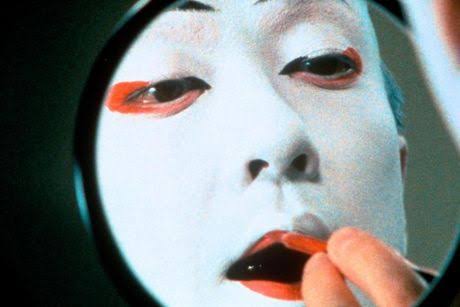
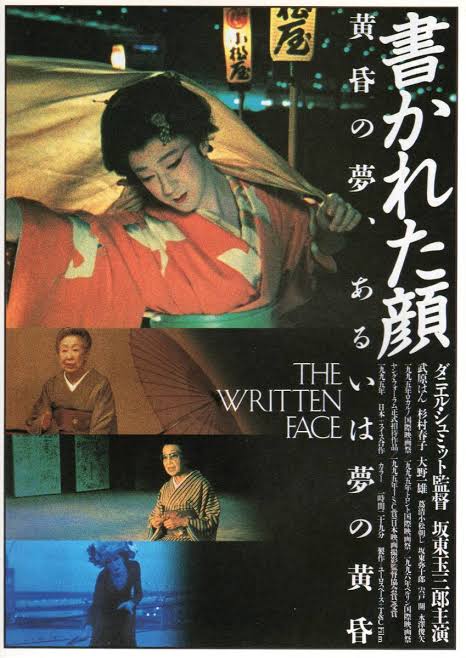
Presented in its 4K restored version last summer at the Locarno Festival, 書かれた顔 The Written Face (1995) offers a fascinating and at times experimental portrait of Bandō Tamasaburō, kabuki actor known in Japan especially for being one of the most talented onnagata ever, a man who plays the role of a woman in traditional Japanese theatre. Bandō has also directed a couple of movies, and appeared as an actor in a number of films, among which I would like to highlight at least 夜叉ヶ池 Demon Pond (1979), an excellent movie by Shinoda Masahiro, with an outstanding performance by Bandō in the double role of a girl and a mythical princess. The Written Face is a Japanese-Swiss coproduction directed by Swiss filmmaker Daniel Schmid, who assembled together Bandō’s on-stage performances, which make up the bulk of the film, with interviews of artists he was inspired by, such as actress Sugimura Haruko, the face of many works by Ozu and Naruse, dancer Takehara Han, the elderly geisha Tsutakiyokomatsu Asaji, and Ohno Kazuo, the great butoh dancer, subject of another movie directed by Schmid and also released in the same year, Kazuo Ohno (1995). The movie is also punctuated by short interviews with Bandō himself, and wrapped up with a film within a film, Twilight Geisha Story, a short movie without spoken words starring the actor himself in the role of a geisha at the end of her career.
The Written Face opens with Bandō on stage, his performance, however, is filmed from the side and not frontally as seen by the audience. These scenes are alternated with brief passages in which the actor strolls through the streets, or explores the stage and the areas surrounding it, as if he were watching the performance he himself is acting in. Once the show is over, after the roaring applause of the off-camera audience, the film shows Bandō removing his make-up, the white patina covering the face, the wig, the heavy dress, and profusely thanking the musicians. At this point we cut to the actor in plain clothes chatting with a child, probably his young son, who is playing with a portable video game. While the scene itself is very brief and not too significant in itself, when considered in the context of the movie, so far made mainly of acting on stage, ritual gestures and traditional music, it represents a counterpoint that zooms us out of the stage performances, and anchors the film to the time it was filmed, the 1990s. While most of the movie, as written above, is made by the beautifully choreographed performances of Bandō, everything else that surrounds them— interviews, words, and “pillow shots”— functions as an indirect explanation of his artistic approach, and partly as a deconstruction of what is happening on stage. One of the crucial points of the movie is when we first hear Bandō’s voice reflecting on his art and approach. He is sitting in a hotel facing what is probably Osaka Castle at sunset, and explaining to the interviewer what he is trying to express when he takes the stage as onnagata: “I do not represent a woman, but I suggest the essence of women. That is the nature of the onnagata, isn’t?”.
In order to do so, Bandō has often seeked inspiration, throughout his career, from the art of the four aforementioned figures, each of them representing a different and unique type of femininity. A clip from Naruse Mikio’s 晩菊 Late Chrysanthemums (1954) suggests the particular type of femininity, strong and direct, Sugimura often represented in her long and glorious film career. At the other end of the spectrum, the dancing body of Ohno, 88 years old at the time, immersed in the blue of dawn, and surrounded by water, captures and expresses something more ethereal and dreamlike. Ingrained in the nihon-buyō‘s tradition are the dance movements that Takehara performs for the film, delicate, elegant, and almost imperceptible, while the voice of Tsutakiyokomatsu, trembling but still full of life, is a sign of a fierce vitality, she was 101 years old at the time of the shooting.
After the short Twilight Geisha Story, a segment about twenty minutes long, which perhaps represents the weakest part of the work, in the last ten minutes, the movie returns to a kabuki play with Bandō protagonist. The performance is Sagi Musume (1762), also the opening performance of the documentary, one of the most famous and celebrated kabuki play in Japan. It is the story of a girl, abandoned by her lover, who is transformed into a heron and dies on a snowy night. Bandō’s performance is here breathtaking in its beauty.
Fifth part of an ongoing series of translations dedicated to the writings of Haneda Sumiko (4th here, 3rd here, first and second here and here)
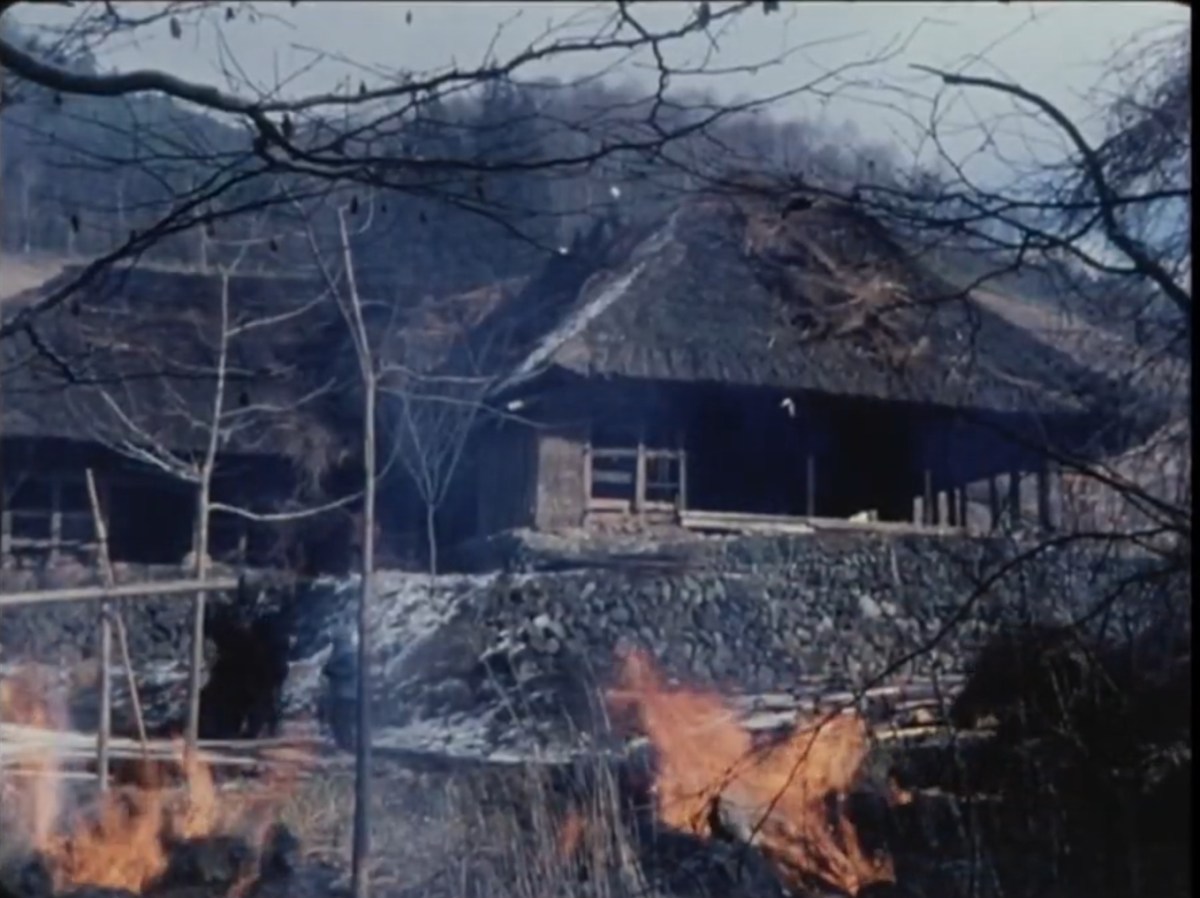
The short passages translated below—from 早池峰の賦 published in 1984—are very important and central to properly understand Ode to Mt. Hayachine, and more broadly, Haneda’s approach to documentary filmmaking. Just to provide a bit of background: Haneda discovered yamabushi kagura in 1964 in Tokyo, and the following year, the beauty of the performances and their connection with Tōhōku, when she visited Ōtsugunai, where she attended a kagura performed in an old magariya, an L-shaped farmhouse typical of the area. When she went back to the town in 1977, she noticed how the magariya and the culture associated with them were slowly disappearing from the scenery. She really wanted to start her documentary from a performance held in one of these old houses, an image that had stayed in her mind for decades, but instead she decided to go the opposite direction and started the movie by filming the demolition of one of these old farmhouses. It is interesting to note that, the first and shorter version of the documentary, 早池峰神楽の里 Hayachine kagura no sato, opens with kagura performed in the entrance of an old house, not a magariya, if I’m not wrong, and that the demolition scene is absent.
NOTE: This is by no means a professional translation, but I hope the readers can get the gist of it:
I first became aware of the Tōhoku region when I was in primary school, and read about a famine in the area in a children’s book. I think this was probably about the great famine of 1934. I had completely forgotten what it was about, but the tragic impression stayed with me for a long time. So when I think of the Tōhoku region, the first thing that comes to mind is a dark and impoverished image.
When I thought about making a movie about Hayachine kagura, I thought that Kagura is like a flower that blossoms and has its roots in the soil, that is, the harsh living conditions of the Tōhoku region. The true value of the flower cannot be understood unless it is depicted together with its soil. But how should this soil be expressed? In 1979, this was quite difficult.
When I first visited Ōtsugunai in 1965, the old farmhouses were still there, and the atmosphere of the old times was still strong. However, the rural landscape has now completely changed. Wide paved roads. Large concrete buildings. Houses just like in the city. Colourful tin roofs reflect the sunlight, and there is no longer any sense of history, poverty or darkness. I was at loss in front of this rural landscape.
The image of kagura I had in my mind was the one I saw during my first trip to Ōtsugunai [in 1965 when Haneda attended a kagura performed at the entrance of an old magariya, t/n]. I tried to find a place that somehow came close to that image, and in my mind I was constantly trying to recreate a scene like that. However, I soon began to feel that there was something wrong with obsessing over only old things. I realised that in order to depict the life of kagura, which has continued to live until today, even when the houses are new and the roofs are red, first of all it was important to accurately capture the present life of the farmers, and I also realised it would be a mistake to go too far in pursuing the perfect form, and thus to lose the vitality of the present. I was forced to change my methodology.
I thought that starting the shooting with the destruction of the magariya was quite symbolic. I filmed the demolition of the magariya as a symbol of the transfiguration of the rural areas in the Tōhoku region, but it also became the “demolition” of my own way of thinking. It doesn’t matter if the magariya are no more. It doesn’t matter if the roofs are blue or red. I wanted to make this work as an expression of the spirit of the farmers in Tōhoku, beyond what is visible to the eye, and as an expression of the ever-changing flow of history.
Second report from the Kobe Discovery Film Festival 2022 (you can read this first one here).
On October 15th, the festival held a couple of screenings of home movies from the Kobe area, on the occasion of Home Movie day 2022. It was a very pleasant and eye-opening experience for me, the audience had the chance to see a couple of short films (from the 1960s, 1970s and 1980s, if I’m not wrong), projected on screen with the person who filmed it, or a family member, in attendance. It was like opening a treasure chest, a personal one, in front of a bunch of strangers, a way to share personal memories, often forgotten, with other people. The home movie day, held since 2002 all over the world, it’s a fascinating event situated at the intersection between personal history, History with a capital “H”, and film studies. It is an exploration of the possibility of building an alternative video history from the bottom up, almost a micro history as it were, excavating personal memories to document social changes, and also an occasion to celebrate a dying format (8mm, super 8, etc.). Besides the specific places and experiences captured on the films projected—a trip to the zoo, scenes of a countryside house, a family vacation, a day at the Osaka Expo 1970—it was interesting to learn how home movies from the 60s generally retain even today a better visual quality and colours (especially the reds), compared to those shot in the following decades. As the film and film equipment got more affordable, the quality of the celluloid also dropped, causing the films to deteriorate easily with the passing of time. Insightful was also to learn, from a live commentary done by a scholar of the subject, that, because of the cost of the film, home movies made in the 50s or 60s were usually edited faster, with shorter cuts that is, while later on the cuts tended to be longer.
In September 1939, after the Nazi invasion of Poland, Maria Kamm and her brother Marcel Weyland were forced to leave their hometown and to start an endless journey around the globe to survive. After fifteen months in a refugee camp in Lithuania, they arrived in Tsuruga, a port city in Fukui prefecture, and from there they moved to Kobe, later to Shanghai, where the family was separated, and finally they reached, at different times, their final destination, Melbourne in Australia.
海でなくてどこに Where But Into The Sea (2021) is a film documenting their odyssey around the world, constructed by interweaving interviews, poetry, letters, and a historical investigation by scholar Kanno Kenji. The film is directed by Ōsawa Mirai, but the idea of the project came about when Kanno met Maria in Melbourne in 2016, and later decided to shape his research also into a visual work. The documentary is a delicate portrait of two people, their family, their past, and how their personal experiences intersected the large historical events of the last century. It is also about a less known and studied fact, how the asylum process for Jewish people worked in wartime Japan and in the Japanese occupied territories.
The movie has a beautiful and poetic ending, made in collaboration with artist Miyamoto Keiko, it was a discovery for me to learn that this scene was inspired, as the director himself confirmed in the talk after the screening, by the films of Satō Makoto—specifically Memories of Agano (2005) and the movie in the movie screened on a tarp, but also Out of Place: Memories of Edward Said (2006). Ōsawa was Satō’s student when he was teaching at The Film School of Tokyo (Eiga bigakko), and he is also the director of 廻り神楽 Mawari Kagura (2018), a documentary that has been on my radar for some time.
A week ago, I had the pleasure of attending the opening weekend of this year’s Kobe Discovery Film Festival (October 15-16, 21-23), as always held at and organized by the Kobe Planet Film Archive. Now in its sixth edition, the event started in 2009 as Kobe Documentary Film Festival, and later changed its name and guiding philosophy (2017), when it broadened its scope to include programs about home movies, film preservation, film restoration, and the (re)discovery of less known movies from the past. I will write, time permitting, about some of the other films I saw at a different time (second dispatch is here), but today I’d like to focus on what, for me, was the highlight of the festival, a short program dedicated to two documentaries made by NDU (Nihon Documentary Union).
2022 has been a sad year for NDU’s former members, but a fruitful one in establishing its legacy in the history of Japanese cinema and beyond. Inoue Osamu, one of the key members of the group, passed away last June, and this year marks also the tenth anniversary of the passing of Nunokawa Tetsurō, one of the main figures of the collective. On the positive side of things, 2022 was the year NDU received its first official international exposure, when last spring the Japan Society in New York organized a special (online) screening of two of their best works, 沖縄エロス外伝 モトシンカカランヌー Motoshinkakarannu (1971) and アジアはひとつ Asia is One (1973). I’ve written about NDU and Nunokawa in more than one occasion (check the links below), and for a more in-depth and better written piece, check Alexander Zahlten’s The archipelagic thought of Asia is One (1973).
The two films shown in Kobe, Tokyo ’69 – One Day Blue Crayons… (1969) and Public Order Project: Martial Law at Noon (1981) – have only recently been (re)discovered or identified as works by the collective and have rarely been screened before (the latter has actually never been shown publicly). Neither is more than half an hour long, but I believe they represent two essential pieces of the fascinating mosaic that was NDU, not least because they encapsulate a certain era of social dissent, and consequently documentary making, in Japan between the late 1960s and early 1980s. After the screenings, Nakamura Yoko, a film scholar specialising in NDU, spoke briefly about the films in the context of NDU and Nunokawa’s career, which was very helpful in understanding the two films, especially Public Order Project: Martial Law at Noon.
東京’69 – 青いクレヨンのいつかは . . . Tokyo ’69 – One Day Blue Crayons . . . (1969) Shot on 16mm between 1967-68, this documentary is a propaganda film funded by the Tokyo headquarters of the Japanese Socialist Party to support Governor Minobe Ryōkichi, who was elected in 1967. While on the surface a piece of political advertising, Tokyo ’69 – one day blue crayons . . . reflects on and depicts various problems facing the capital and its citizens in the late 1960s, a time when urban sprawl was increasingly and dramatically changing. Expropriation and exploitation seem to be two of the main threads running through the film: we learn that 95% of Tokyo’s land was in the hands of 5% of the population, as redistributed after the war. The film also shows how truck drivers carry and deliver goods they don’t use or own, or how workers who come to the city from other areas live in precarious conditions. For example, we see a man from Hokkaido working almost 14 hours a day while living and sleeping in an extremely small rented room.
It is also interesting to note the focus on the lack of crèches for working women to leave their children in, a problem that still seems to be unresolved, and the criticism of the new stadium built for the 1964 Olympics, a structure that, as NDU points out, was of no use to the people of Tokyo after the games. An uncanny resemblance to what is happening now after the 2021 Games. The title of the documentary seems to refer to the final scene, in which we see a young boy drawing pictures with crayons in a sketchbook. At one point he is asked a series of questions, including “What colour is the sky?”, and his annoyed answer is always “shiran” (I don’t know). The hope is that one day the sky will be blue.
According to the festival leaflet, this film has never appeared in Nunokawa’s statements, but it is credited as an NDU production at the very end, in the bottom right-hand corner of the screen, a fact confirmed by Inoue before his death. The film was made at the same time as 鬼ッ子 闘う青年労働者の記録 Onikko-A Record of the Struggle of Youth Labourers (1969), also funded by the Socialist Party, a work that shares not only the general tone but also some famous shots. The freight train carrying petrol for American planes to Vietnam passing through Shinjuku station, and a tank parade in the middle of the city.
In its critique of Tokyo and its exploration of the dark side of the 1960s economic miracle, the documentary reminded me very much of Tsuchimoto Noriaki’s 東京部 Tokyo Metropolis (1962), a short documentary made for television that was never broadcast because it was considered too dark and pessimistic (you can watch it, in Japanese and legally, here, here)
治安出動草稿 お昼の戒厳令 Public Order Project: Martial Law at Noon (source)
治安出動草稿 お昼の戒厳令 Public Order Project: Martial Law at Noon (1981). Shot in Super 8 by a group of NDU members in one day – though credited at the end as a Nunokawa production – the film documents the second Six Cities Joint Disaster Prevention Drill, organised in Shinjuku on 1 September 1981. When it was announced that some twelve million people were expected to take part, an astonishing and frightening number, Date Masayasu, a former Shinjuku city official turned cultural critic and writer, declared alarmingly: “We will be moved under the command of the Self-Defence Forces! “. Inspired by this comment, Nunokawa and seven other members of the collective began filming people marching and gathering in Shinjuku, protests in the streets, and military manoeuvres in Tokyo and the surrounding area on 1 September.
As is often the case with NDU’s films, especially the later ones, there is no great explanation of what is happening on screen, or the reasons for what we are seeing. As the film progresses, however, a sense, if not a meaning, slowly begins to emerge. In a country regularly hit by natural disasters such as earthquakes, typhoons and floods, emergency drills are a normal part of life, but this one felt and was very different. The connection made by Date and Nunokawa and NDU with the documentary is a subtle but deep and powerful one, at least for me. Disaster drills of this scale are deeply connected to public order and the idea of a strong and unified nation/state imposing its will from above. Self-Defence Forces landing in Shizuoka from the sea, helicopters flying constantly over the city, the sheer mass of people moving in the streets – it is worth repeating, almost 12 million people! – and the effort to coordinate six cities within the megalopolis, all this is seen and understood in the film as something dangerously close to an act of military mobilisation. The documentary is very effective in capturing and expressing this massive sense of potential fear. A past – the narration mentions, for example, the lynchings of Koreans and other minorities that continued after the great Kantō earthquake in 1923 – that could resurface at any time in the future.
Formally, the film alternates between scenes of helicopters flying over the city – the sound here is distorted and becomes almost hypnotic – and scenes of the Self-Defence Forces, sometimes in slow motion, with scenes of clashes between demonstrators and the police. It is worth noting how different the scale of the protests were from those of a decade earlier. Japanese people continued to protest and demonstrate even after the end of the so-called political season, Narita docet, but the number of people involved and the motivations changed dramatically, for reasons that cannot be explored in this piece. What stood out for me aesthetically, compared to other NDU works, was the extensive use of electronic music throughout the documentary, especially in the final part, when activists and police clash and march to the sound of electronic drums. As a mere curiosity and possible coincidence, it is interesting to note that on the same day, 1 September 1981, Kraftwerk, the German group that more than anyone else pioneered electronic music in popular culture, were also in Tokyo, ready to embark on their first Japanese tour.
The film has not been included in any of NDU’s special features to date and, as the flyer suggests, this special screening in Kobe was made possible thanks to the efforts of Mitsui Mineo, a former collaborator of Nunokawa’s and probably a former member of NDU, who worked with him on his documentaries in Palestine.
An overdue return to my movie journal entries, with some interesting documentaries—as always the definition here is quite broad— I’ve watched in the last couple of months.
Oral History (Koizumi Meiro, 2013-2015). Comprised of interviews with people of different ages, Oral History is a fascinating exploration of memory, or the lack of it, through different generations of Japanese. The work starts by highlighting the lack of historical knowledge in young, and not so young, people, and how this disinformation is shaping their opinions about Japan—a process that felt a bit annoying and patronising, especially in the first interviews, if I have to be completely honest. What makes this experimental work interesting though, is the progression that moves it from presenting various and very shorts interviews to focusing, in its last part, solely on a deep conversation about war and personal memories, expatriation, and grief with an old lady of Korean descent. Besides the fascinating interweaving of personal history with macro-history, and the touching stories told by the woman, what I found also interesting is that here is the interviewer who shows the apparent lack of knowledge about history, the history of Koreans in Japan, Osaka to be precise, and the Repatriation Project established at the end of the 1950s by the North Korean government. Everything is made more powerful, at least in 2022, by the aesthetic choice used, filming only the mouths of the people speaking, a decision that after three years of pandemic and masks (here in Japan at least), feels freshly disorienting. (Part of the e-flux online program curated by Julian Ross)
Before the Flood (By Yifan Li, Yu Yan, 2005). The documentary depicts the final weeks of Fengjie, an old city famous because of Li Bai, one of the most renowned poet in Chinese history. Located on the Yangtze River, the city, at the time of filming, was about to be reduced to dust, and its inhabitants were forced to relocate, in order to make way to the new Three Gorges Dam that would eventually flood the entire valley. The film documents the slow death of a city, or better, the execution of a city and its people, some of them are fighting to stay until the end, by the state and for the so called progress. The lo-fi aesthetics of DV cameras so fundamental in the development of independent documentary in Asia in the 1990s and 2000s, are here used at their best. An ideal sequel, Before the Flood II – Gong Tan, a documentary about another city soon to be destroyed by the construction of a dam, was completed by Yu Yan in 2009.
Filmmaking and the Way to the Village (Fukuda Katsuhiko, 1973). A relatively short documentary, just less than an hour, directed by a member of the Ogawa collective, about the making of the group’s masterpiece, Sanrizuka: Heta Village (1973). Fukuda left the collective after completing this film, decided to stay in the area, and kept making documentaries, for instance A Grasscutter’s Tale (1985). I revisited the documentary after long time, and it was even better than I remembered, years spent watching the films of Ogawa and reading about them, gave me a different perspective on them. The movie offers a glimpse behind the curtain, so to speak, of course you need to be familiar with Ogawa Pro’s filmography and its story, but it’s nonetheless an invaluable document to understand how Heta Village came into existence. The scenes when the collective discusses how the old people of the village enjoy long takes are priceless. It was fascinating also to see how important and integral to the success and reception of the Sanrizuka Series were the screenings. In a pre mini-theaters/independent cinemas era, all the screenings throughout Japan were organized through a network of activists, unions, supporters, people as important for the movies, as the crew that made them.
Last June, Kobe Planet Film Archive organised a special programme dedicated to the works of filmmaker Takahashi Ichirō and producer-director Ukumori Noritae, two key figures in the development of independent film culture in the Kansai region over the past fifty years. Both passed away in 2021, and many of their works were donated to the Kobe Planet Film Archive. The memorial event focused on the films produced by Eiga seisaku iinkai, a film production committee formed by a group of citizens in 1985, and those made by 8 no kai, a collective formed in 1970 by a diverse group of people, amateur filmmakers and industry professionals, who set up an office in Sakuranomiya, Osaka. Both Takahashi and Ukumori were two important members of these groups.
Both Takahashi and Ukumori were two important members of these groups. As far as I could tell from the few films I was able to see and the leaflet I was given, 8 no kai and Eiga seisaku iinkai – the latter of which seems to be still still active – mainly produced films dealing with environmental and social issues, with a strong focus on grassroots activism in Kansai and the surrounding areas.
The first film I saw was 原発はいま Genpatsu wa ima (Nuclear Power Now), directed in 1982 by Ōmi Michihiro and scripted by Takahashi. The movie exposes not only the myth of the nuclear power’s safety, shattered by the nuclear accident at Three Mile Island in 1979, and the release of radioactivity, at first denied and covered up, at the Tsuruga Nuclear Plant in 1981, but more importantly represents an exposure of how labor work in the nuclear facilities was, and still is, exploited. The film, produced by 8 no kai, covers the struggles and protests of workers at a couple of nuclear power plants, active at the time of filming, in areas such as Mihama, Ōi and Takahama in Fukui Prefecture—the area with the highest concentration of nuclear reactors in the world, producing energy mainly for Kansai and its urban sprawl— Kubokawa in Kochi Prefecture, and Onagawa in Miyagi Prefecture. Examining the reality of the subcontracted workers and their horrific working conditions, the documentary could be paired, in an ideal double bill, with Morisaki Azuma’s 生きてるうちが花なのよ 死んだらそれまでよ党宣言 Nuclear Gypsies (1985), an incredible piece of fiction revolving, among other things, around the life of nuclear gypsies, or with the less known documentary いま原子力発電は Nuclear Power Plants Now directed by Haneda Sumiko in 1976.
My second film was 生命ある限り As long as there is life (1988), a work directed by Takahashi and produced by 8 no kai, about the tragedy of the atomic bombing and the hope for peace, as told by people gathered annually at the meeting of the Hyogo Prefectural Council of Atomic Bomb Survivors. The movie is made of a collection of testimonies and interviews of the people living in Hyogo, people who were affected directly or indirectly by the two bombs dropped on Hiroshima and Nagasaki.
The last movie at the screening event for me was 風ものがたり 食と農と環境 The Wind Story: Food, Farming and the Environment (1995), directed by Takahashi, produced by Ukumori Noritate, and backed by Eiga seisaku iinkai. This is the final film in an environmental-themed trilogy directed by Takahashi between the mid-eighties and the mid-nineties, started with 24000年の方舟 24000 Years of the Ark in 1986, continued in 1991 with 奇妙な出来事アトピー The Strange Event of Atopy, and completed with The Wind Story. The movie is narrated by famous actor Yūsuke Kawazu, who passed away last February and who has been a very popular face in films and TV in the last sixty years, and features and focuses on three similar environmental experiences. A young couple of full-time farmers living and working in Ikeda, a small mountain village in Fukui prefecture, a joint group of producers and consumers in Takefu, again a city in Fukui, and a group of consumers and activists living in Osaka. All these people share a sensibility towards a life lived with a strong awareness of the interconnection existing between the humans and the elements around them, such as soil, water, mountains, plants, other animals, and so on. The common thread running throughout the short documentary, it is less than an hour long, is the relationship between the soil and the food grown on it and consumed by the inhabitants, a philosophy encapsulated in the motto, often seen and heard in the documentary, “Soil is Life”. Filmed with an interesting visual flair and with a joyful, and sometime loud, soundtrack that almost recalls the folk singers of the 1970s, the most interesting part of the documentary was for me the one about the family in Ikeda. By cultivating rice in a narrow space of land between two mountains and adapting to the physical conditions of the territory, it reminded me of Satoyama, an important concept in Japanese culture, famously and overtly present in two works of Studio Ghibli, Totoro (1988) and Only Yesterday (1991), but also in other documentaries made in the archipelago.
Discovering these two groups was a refreshing experience for me, one that intensified my interest in filmmaking conceptualized and done on a local level, in connection with the territory. A type of documentary that often flies under the radar, because it embodies a different idea of filmmaking and documentary, not always lavish, spectacular, and without high production values. At the same time I don’t think it can be called pure video activism, there is a political message at its core of course, but at least in the three films I’ve seen, there’s also a special care towards creating a story, an alternative narrative, to capture the viewers and make them part of a community. I don’t know for sure how these documentaries were screened in the 1980s or 1990s, probably in city halls, community centers, other kind of public or private spaces, or even in few selected mini-theaters, but it’s fascinating, and this is my opinion and personal reading of it, how this exhibition through alternative venues, while minor in scale and numbers, gave them an enhanced resonance and different type of reception. The relationship between documentary filmmaking and its exhibition practices, in the past, but also nowadays, in Japan, but also in the rest of Asia, is a very interesting topic worth a research and an in-depth analysis.






 Asian Docs
You must be logged in to post a comment.