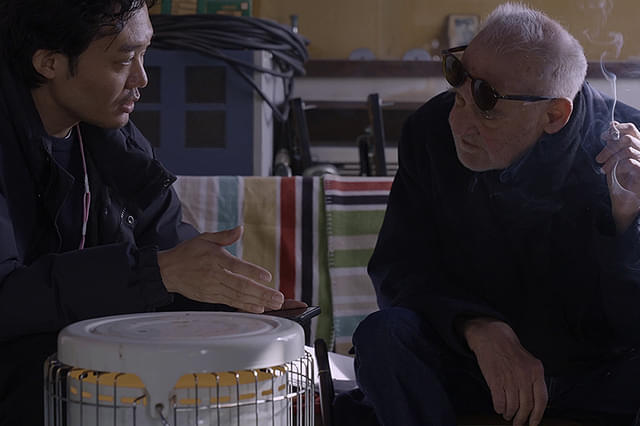
Fukushima with BÉLA TARR (Oda Kaori, 2024)

Fukushima with Béla Tarr documents a two-week workshop held by the Hungarian filmmaker in February 2024 in the Japanese area hit by the 2011 Tōhoku earthquake and tsunami. The documentary is directed by Oda Kaori, who studied with Tarr at film.factory, his film school in Sarajevo, more than a decade ago, a period that led to Oda’s debut film Aragane (2015).

I found Fukushima with Béla Tarr fascinating on so many levels, not least the director’s abrasive personality, which – as some reviewers have pointed out – at first seems almost like a caricature of the artistic persona he has developed over the years. What also struck me was his varied interactions with each filmmaker; there is a sense, at least from what we can gather from the documentary, that he likes some of the participants’ approach to filming more than others. Tarr’s comments, suggestions and conversations with the filmmakers also reveal how he sees cinema and the filmmaking process, at least in the limited conditions of the workshop: only two weeks, no familiarity with the area and the language for many of the participants. Perhaps it’s because of the limited time available that Tarr pushes everyone, sometimes almost aggressively, to visualise the ideas they have in mind in images, rather than just talking about them or explaining the context of what’s happening.
Some of the most interesting technical tips he gives the workshop participants are also prime examples of his idea of cinema, such as holding a shot longer than one would normally do, it’s always possible to shorten it later, or how paying attention to the interplay of light and darkness enhances the visual impact and the meanings conveyed by the work.

The best quality of the documentary, in my opinion, is the time it spends and stays with the group of people involved in the workshop, allowing the camera to capture the distinctive personality of each filmmaker and how each of their projects progresses, or in some cases crumbles, towards the deadline. It is this familiarity with the subjects that makes the work more organic and meaningful as it unfolds, and leads the viewer to care about, or at least become more familiar with, all the people involved, not just the filmmakers and Tarr, but also the interpreters, drivers and ordinary people filmed here. All this takes place against the backdrop of the lives of the people of Fukushima affected by the triple disaster, the subject of the works produced in the workshop, of which we, the viewers, get only a glimpse. Among the most fascinating of these stories is that of a kamishibai performed by two women in an abandoned cow shed, now in ruins, and told from the animals’ point of view (Tale of Cows directed by Fukunaga Takeshi).

On a technical level, Oda’s decision to use mostly static shots with very little camera movement is very effective in creating a restrained cinematic space centred around the people portrayed and their interactions. But perhaps the Japanese filmmaker’s greatest effort, as is often the case with this type of documentary, was in the editing room, deciding what to include, how to include it, how to structure it, and what to leave on the cutting room floor.
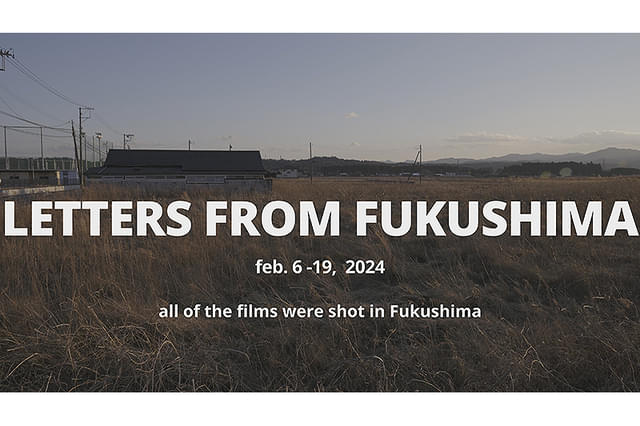
The short films made by the 7 filmmakers have been compiled into an omnibus film, Letters From Fukushima. Below is the description of each short film (from the Tokyo International Film Festival’s webpage):

“Nappo” After 13 years of silence, the instruments are played again. Nappo gathers Fukushima children at Odaka Church. Singing and dancing, they breathe new life into the land. Director: Lin Po-Yu 2024/Color/9min/Japanese

“Wall” A man from Namie Town had to relocate his landscaping business after the disaster. One day, he begins working on a garden in the office, which has been untouched. Director: Ooura Miran 2024/Color/28min/Japanese

“Long Long Hair” In a Fukushima hair salon, daily interactions unveil personal stories, resilience, and the beauty of life after the Great East Japan Earthquake and the nuclear accident. Director: Iizuka Minami 2024/Color/23min/Japanese

“From F” Fukushima, Family, Female, and Future. A story about various Fs, starring 17-year-old-girl who wants to be a dancer while attending an evening school in Fukushima. Director: Shimizu Shumpei 2024/Color/10min/Japanese

“Letters from Fukushima” “Woman, Life, Freedom” is a social movement seeking gender equality. Through three scenes of Fukushima, the film honors the women who gave their lives for dignity. Director: Roya Eshraghi 2024/Color/27min/Japanese, Persian

“The Guests” After a nuclear radiation leak at the Fukushima power plant in 2011, a group of Southeast Asian auto mechanics is dispatched to work in this land… Director: Xu Zhien 2024/Color/28min/Filipino, Japanese

“Tale of Cows” Two women who survived the 2011 Tohoku Earthquake, perform a Kamishibai picturebook about the abandoned cows during the Fukushima nuclear power plant accident. Director: Fukunaga Takeshi 2024/Color/29min/Japanese
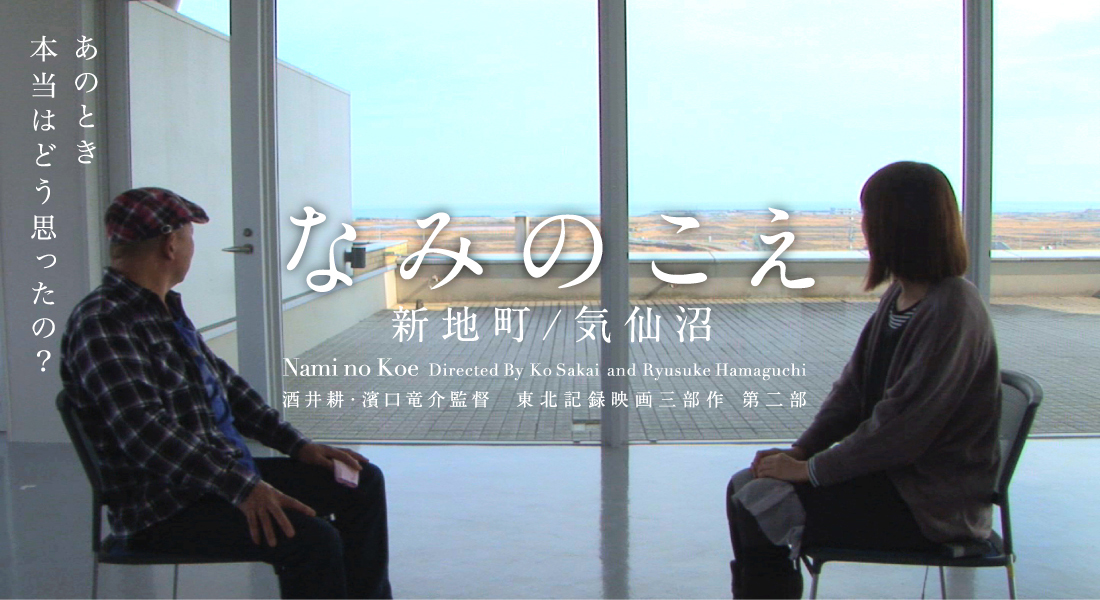
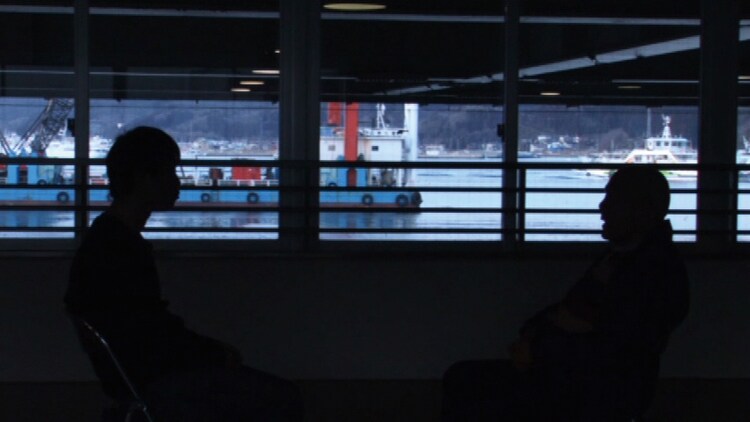
なみのこえ 気仙沼/新地町 Voices From the Waves: Shinchi-machi and Kesennuma (Sakai Kō and Hamaguchi Ryūsuke, 2013)

This is the translation of an article I originally wrote in Italian about two years ago for Sonatine.it, a contemporary Japanese cinema portal I often collaborate with.

Voices from the Waves is the second part of a trilogy of documentaries directed by Sakai Kō and Hamaguchi Ryūsuke about the disaster that struck northeastern Japan in March 2011. This second part consists of two documentaries, Voices of the Waves Kesennuma and Voices of the Waves Shinchi-machi. The only difference between the two works is that they were filmed in two different locations and are about the people who lived and experienced the disaster in two different but geographically very close areas. Both documentaries consist mainly of conversations between two people, often family members or colleagues, who survived the earthquake and tsunami.

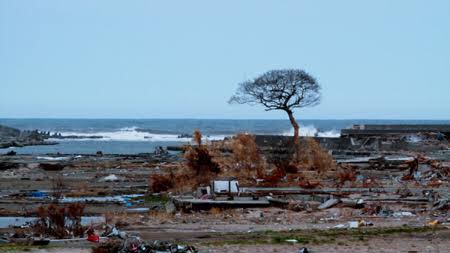
Both films begin with images of the silent landscape of the areas, the sea and the waves, houses under construction and the remains of buildings that no longer exist. The idea around which the conversations take place is very simple: each person begins by telling where they were and what they were doing on the day of the earthquake and subsequent tsunami, and from there memories and reflections unfold.

In the first conversation of the Shinchi-machi film, a father and his grown-up daughter sit across from each other. As they recall the arrival of the tsunami and the size of the waves, their conversation is briefly interrupted by the father’s tears as he remembers friends and acquaintances who have disappeared, swept away by the tsunami. From the very first scenes, one of the trilogy’s strengths becomes clear: the moving stories of people who remember become something much more empathetic for the viewer than the flood of images of the disaster. In today’s mediascape, and the Japanese triple disaster of 2011 has become a striking case in point, spectacular images often fade from view in the few moments they are seen, leaving no trace. It is then that words, tone and intonation – in this case the man’s pronounced northeastern accent – manage to convey something much deeper and more affecting than the visual element alone.

Among the various couples we hear and see, whether friends, spouses or colleagues, some recall the difficulty of communicating with their loved ones in the moments immediately after the earthquake and the fact that they turned to images broadcast on television or circulated on the Internet. One of the most interesting parts of the first documentary is when we listen to two fishermen, both of whom were no longer fishermen at the time of the interview, but were doing other things to survive. This conversation, which is more edgy and direct and touches on the issue of radiation in the sea, reflects the character and occupation of the two and provides an interesting but painful variation on the people and personalities affected by the tragedy. The same problems that gripped the area in the aftermath of the disaster are perceived differently depending on people’s social class and economic background. It should be noted that some of these conversations are between a resident of the area and one of the two filmmakers, who then stands in for the second interviewee, but we will return to this important point later.

The second documentary, as the title suggests, was shot in Kesennuma, one of the towns hardest hit by the tsunami. It begins with a night-time view of the town’s harbour and then moves to the first conversation, probably recorded in the evening, between two colleagues working in a bar-restaurant. They share the memory and the feeling of despair and fear when they heard the sound of cars and houses colliding and destroying each other on that tragic day. A middle-aged couple does not want to remember the day of the tsunami because it is still so fresh, even though a year has passed since the tragedy. What emerges here is the willingness of the local people to forget, not to not remember, but to move on and not to base their future lives on the disaster. This is a sentiment that has emerged more and more in recent years, especially in Fukushima, and is often found in many communities affected by natural or man-made disasters, such as mercury poisoning and the resulting Minamata Syndrome, which Tsuchimoto Noriaki has explored in his documentaries.
Tsuchimoto, one of Japan’s greatest documentary filmmakers, who has devoted much of his career to following the lives of the victims of Minamata Syndrome, has often commented on how, after decades of documentaries on the subject, many of the victims’ relatives began to treat him coldly. It is therefore important to emphasise one more time that the conversations in Hamaguchi e Ko’s documentaries were filmed just over a year after the triple disaster, when the pain and memories were still fresh, but also when the perspective of those affected by the earthquake and tsunami was slowly but surely changing.

The talking pairs are often in an airy space, especially in the first documentary, where the conversations take place inside buildings, but with large windows looking out. The chosen setting therefore gives a sense of spaciousness and grandeur that an enclosed space would not allow. Between one conversation and the next, there are short ‘pillow shots’, scenes showing the area being rebuilt, the sea, the waves, the excavators and cranes that are still constantly at work. Although these images often capture the landscape filmed by a horizontally moving camera, the entire trilogy differs from most documentaries made about the earthquake and tsunami in that it is composed of mostly static shots. Many of the works that have attempted to document the plight of the local population and the triple disaster over the years have in fact done so through shots taken from a moving vehicle, partly because the vastness of the area affected by the tsunami requires it, but this choice of filming also ended up becoming almost a documentary style in itself and a cliché of how to film the disaster.

It is also significant that the two documentaries are not constructed with interviews, a practice used and abused in the aftermath of the triple disaster, which establishes a relationship of power and impartiality between interviewee and interviewer. Conversations between two people, even though they take place in a staged and constructed space, with at least two cameras and two directors in the room, achieve something different. No one intervenes from outside, of course there is editing, but a kind of horizontal and equal dialogue is created, because these are people who have experienced the tragedy first hand. In this sense, the fact that the two directors intervene in some of the conversations is interesting, almost revealing the “artificiality” of the work, but in the long run it reduces the impact of the two films. The same could be said of the different angles and techniques used to film the two interlocutors (this insightful essay by Markus Nornes is illuminating); while in some cases this works almost perfectly, in others it exacerbates a sense of artificiality that detracts from what is being said.
There is, however, one part where all these techniques are used to the full, and that is the final conversation of Voices From the Waves Kesennuma, when a young couple, a man and a woman aged 26 and 23, amid silences, awkwardness, nervous smiles, ringing mobile phones and yawns, bring out the cinematic power of the unspoken, of gestures and pauses, making this scene perhaps the most touching and at the same time amusing of all those seen in both works.

Movie journal (Dec. 2019): Man Who Has a Camera, Many Undulating Things, Nuclear Power Plants Now

Three short takes on some of the most interesting documentaries I’ve seen recently.

The Man Who Has a Camera (Liu Na’ou, 1935)

One the the discoveries of the year for me. Clearly inspired by Dziga Vertov, filmmaker, poet and writer Liu Na’ou shot this movie in four cities across national boundaries: Tainan, Canton, Shenyang, and Tokyo. A beautiful film that is in equal part amateur cinema, a city symphony film, and an experiment in poetic filmmaking, less a work about landscapes of certain areas, and more an actuality film depicting faces and people’ feelings across and beyond borders. Incredibly charming, fresh and well constructed, a feverish dream of transculturality that is much deeper and complex than its simplicity on the surface level might suggest. I’m planning to write a longer piece about the fascinating figure that was Lui Na’ou and this film in the near future.

Many Undulating Things (Wang Bo, Lu Pan, 2019)

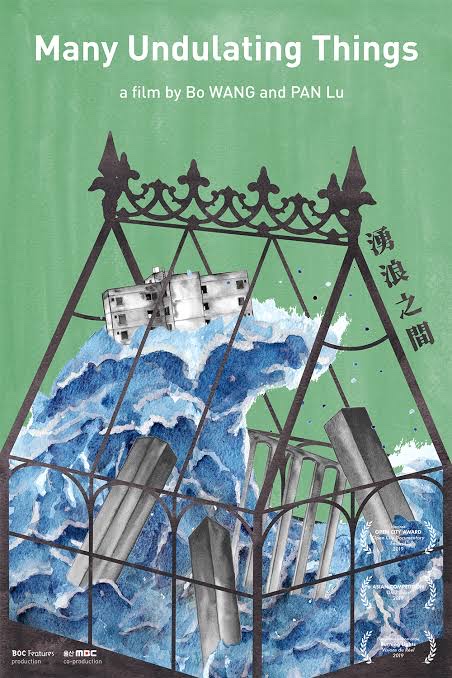
The film begins and ends in a shopping centre in Hong Kong. We carefully observe the smooth movement of the escalators, the constant flow of people that never stops, the musical fountain that presides over the centre of the internal courtyard, as if this gigantic complex could concentrate the circulation of the entire city, or even, the entire country. From there, it will be more a tale about concrete, enormous port warehouses, glazed galleries built for the 2010 universal exhibition, overpopulated tower blocks, the fragments of still recent colonialism… Through the history of urban changes, we witness the profound social transformation of this territory that is constantly swinging between the East and the West. Hong Kong thus emerges, like an archetypal space of many other cities of globalised capitalism. MANY UNDULATING THINGS offers a complex reflection on the relationships between landscape, nature, urbanisation and society. Thanks to its exhaustive approach, the film questions the function of cities in the development of the capitalist system. A political poem.

I almost despised the first part, the visuals are fascinating, but the narration and the philosophical frame used didn’t really work for me. From the second chapter onward, the work elevates itself and gets definitely more interestingly nuanced and complex, exploring the historical layers that constitute contemporary Hong Kong, analyzed through cinema, photography and paintings. When it moves to the third chapter, the documentary also explores how colonization in the past centuries worked and was deeply linked to the alteration of the botanical realm, “the reorganization of ecosystems under imperial order (…) was actualised through the glass boxes” an important invention and crucial part of the conquering process pushed by imperialism. The glass box would later mutate and evolve into greenhouses, exhibitions, arcades, spectacles and finally into shopping malls. This section, and especially the second chapter of the movie, is an expansion of Miasma, Plants, Export Paintings, a short made in 2018 by Wang Bo, and definitely forms the strongest part of Many Undulating Things, in my opinion. When the movie moves from the historical perspective back to contemporary Hong Kong, moving also from a visual and hybrid approach that uses old movies and photos to convey its meaning, it loses its power, trying to be too many things at once and meandering in too many directions.
That being said and even though Many Undulating Things feels at times too randomly constructed, and a sort of patchwork of three or four short documentaries, it’s still a fascinating piece of work worth revisiting.

Nuclear Power Plants Now いま原子力発電は (Sumiko Haneda, 1976)

This is an obscure and short documentary made for TV by Haneda Sumiko in 1976, shortly before establishing her own company and releasing The Cherry Tree with Gray Blossoms, if I’m not mistaken. Haneda and her troupe visit the Fukushima Daiichi Nuclear Power Plant to explore the state of atomic energy in Japan, and its lights and shadows. The short is mainly composed of interviews, but the most fascinating part is when doubts about safety concerns start to emerge in the talks. While some people from the Tokyo Electric Power Company, the company that owns the plant, compare the possibility of an incident at the power plant to that of a meteor hitting the earth, there’s a professor from Waseda, if I remember correctly, who says that there have not been enough cases to delineate or guess the consequences, or even to calculate the possibility, of a nuclear incident. The style is that of a TV documentary, and there’s a lot of explanation about how nuclear energy is produced, however, the doubts that the film raises, especially knowing what would happen 35 years later, are chillingly prescient and make it an interesting viewing. Even essential if you consider Haneda, like I do, one of the most important female directors in the history of Japanese cinema.

Interview with Toshi Fujiwara about No Man’s Zone (無人地帯, 2011)

I’m reposting here and Interview I did in 2011 with Fujiwara Toshi, author of No Man’s Zone (無人地帯, 2011), to this day and in my opinion the best documentary about the March 11th’s triple disaster.
The interview was originally posted on the Italian blog Sonatine. You can purchase the DVD of the movie here (with English subtitles). 


Matteo Boscarol I’ve watched a couple of documentaries dealing with the disaster that hit Japan on March 11th, but in my opinion, your work stands apart from them. I think you adopted a broader perspective. Among other things, I felt No Man’s Zone was a visual essay on the impact that images of destruction have on our society.
Toshi Fujiwara Yes, you’re right but obviously it was something that was inside me from before the disaster and grew up over the years.
M.B. It was also like watching two documentaries, one with the row images and interviews from the area hit by the tragedy, the other one more reflective, with the narration and the editing giving a philosophical frame.
T.F. We’ve tried to create two separate layers very deliberately. One of the reasons is that it is a French-Japanese co-production. The cameraman and director are Japanese, and the editor is French…so why not have two layers to incorporate a certain distance within the contest. Originally, we thought of a French voice and the narration was different from the final one. It was more like a fictional story. The idea was that of a French woman and a Japanese director corresponding through the Internet. We collaborated with some French writers, but they didn’t get the right ideas because it was also supposed to be quite critical of the French culture itself. It turned into something rather awfully colonialist. So it didn’t work and I rewrote the whole narration.
M.B. In this way, it should be able to reach a foreign audience. The Japanese media didn’t do a good job, but at the same time, the international media excelled in misinformation, especially the Italian media.
T.F. Even here in Japan, it’s turning this way. Now the Japanese anti-nuclear movements are paradoxically against the people of Fukushima.
M.B. There’s a scene that particularly impressed me and even reminded me of some parts of Ogawa Shinsuke’s Heta Buraku. It’s the one when the camera is following an old lady wandering and speaking in her garden.
T.F Thank you for the compliment. It is probably because my cameraman, Takanobu Kato, was working with Ogawa. He was one of the last people to leave the production. It was important that he was with me because, being trained under Ogawa when his production was in Yamagata, he literally lived there raising rice and so on. As such, he knew how to shoot rice fields, and other details of life in the countryside.
M.B. In the same scene through the memory of the old lady, there are also references to a wider sense of time, historical and natural cycles, reaching as far as the period after the Second World War.
T.F. I would say that it goes even farther back in time; in fact, she recalls her father having been a silk worms teacher. It was before the war when Japan biggest export was silk itself.The images of movies of this kind focus usually on destruction, but we tried to suggest what was there before the destruction. What was destroyed and also what the people of these areas have lost is much more important.


M.B. What triggered you to go to Fukushima a month after the Earthquake to start to shoot?
T.F. I was disgusted by the way the images were shown on TV. The live footage didn’t show us how the people used to live, and didn’t give people a chance to communicate. Their lives up there were so different from the lives of journalists in Tokyo; moreover, the images are just raw material without any good editing. My intention was to make a film that would look distinctly different from what we watched on television, which was usually shot very hastily with a hand-held camera. One of my first commitments was to shoot as beautifully as we could. That’s why, when possible, we used a tripod. Already, I’d hated lots of contemporary documentaries because their shots aren’t beautiful. They shoot them too easily. Even though we did it in 10 days, we tried to do it as well as we could. Beautiful editing also was important.
M.B. And the voice of Khanjian Arsinée for the narration is very beautiful indeed.
T.F. Her voice is incredible. She’ s Armenian, but she grew up in Lebanon so her native tongues are Arabic and French. She moved to Canada when she was 17, in French-speaking Quebec. I liked her voice because she is not totally native in English [the narration is in English] and so we cannot clearly identify the nationality of her voice.


M.B. You went to Fukushima with your cameraman and one assistant—is that right?
T.F. Yes, it’s better to have a small crew also knowing that the TV people often annoy them…
M.B. How did the people there react to you and your crew?
T.F. Again, we were only three and we were not wearing any protective gear or masks, so they were extremely polite to us as they usually are to everybody else. You know, the people of Tohoku have a tradition for hospitality. Also, we were not asking abrupt and stupid questions like “what do you think of that and that…?”.
M.B. The problem of how to approach and relate to the people affected by disasters is a crucial one for the art of documentary. At the last Yamagata Documentary International Film Festival, there was a debate on this topic.
T.F. I was there myself, and I think the largest problem of these documentaries is that they’re more about the filmmakers going there and not necessarily about the places and the people living there. The general problem is that many filmmakers went to Tohoku, but they made films about their own confusion and panicked state of minds, while they forgot to make documentaries about the damages of the quake and the people who were directly touched by the tragedies. They are too self-centered and unconsciously self-obsessed. An even larger problem that I observe is that the audience in Tokyo takes comfort in seeing these movies, being reassured that the filmmakers are also confused. I find this tendency very problematic for being too masturbatory. They are forgetting the original function of cinema, which must be something open to create links and communications; under such circumstances, we should be mediums to make a bridge between those who experienced the tragedies and us who didn’t. That is one of the reasons why we tried to make “No Man’s Zone” an open film text, instead of sharing the personal experiences (if not self-excuses) of filmmakers. We wanted it to ask direct questions to the audience. Of course, my cameraman worked with Ogawa and I made a film about Tsuchimoto. Thus, I was influenced by others and different generations of documentary’s filmmakers, I’ve kind of skipped the generation of the so-called private documentaries.
M.B. Like Kawase Naomi?
I like Kawase and what she does; she is of my generation, but we do different things and that’s ok with me. I could say that I do documentaries like in the 60s, except that there is no more politics involved. Japanese leftist politics disintegrated in a very rapid way after the 70s.
M.B. Do you think March 11th will change something in filmmaking?
T.F. In my opinion, it should. But I haven’t seen the change yet. After all, only 9 months have passed. One thing for sure is that we have to try to do something different, different from what we were doing before. Actually, before the quake, I was working on a movie but now I’m not sure if it’s worthwhile to complete it. It’s about Japan before March 11th.
It’s a different period, it’s like being after a war in a way.
M.B. We should consider March 11th almost as important as August 15th, 1945.
A few months ago, I talked to Sono Sion, and he said that the tragedy was paradoxically “good” because it suddenly uncovered many problems affecting the Japanese society. For instance the relationship between urban centers and countryside, that is Tokyo-Tohoku…
T.F. I totally agree with him. We (in Tokyo) are just parasites, which is repeatedly stated in No Man’s Zone. The nuclear plants have been there for almost 40 years, and what is awful is that even now after 9 months in Tokyo, people don’t want to admit that we’re responsible.
And even now [this interview was conducted during the Christmas period], it’s like nothing has happened at all.At the Tokyo FilmEx this year, a lady in the audience from Fukushima was quite surprised after watching the movie. She walked outside and found the streets in full illumination for Christmas.
M.B. Can you tell us something about the music used in the film?
T.F. It was composed and performed by a free jazz American musician who’s been living in France for many years. His name is Barre Phillips and we’ve worked together before [Independence, 2002]. Again, we decided on a non-Japanese composer, one of the best that you can get, and also one that was not so expensive and not too commercial. The funny thing is that he recorded the music in a chapel of an ancient monastery in the south of France. In No Man’s Zone, there are a lot of Japanese traditional views with images of Buddhas and small gods, so I thought it would be interesting to have the music recorded in a Catholic chapel. In this way, the music and the narration can maybe suggest something universal. That’s why I wanted someone else and not myself to do the narration in English. It would otherwise have become just a documentary about my experience. This nuclear accident is asking tremendous and huge questions to all of us, to our civilization and how we have related ourselves to nature and to the universe, how we perceive our lives. We actually have to think about the philosophical and even the religious aspects of it all, I would say, and it’s stated at the end of the film, that Japan, embracing western civilization, has accepted its idea of a nature existing for us, to serve humans. It’s actually a very Christian concept. It is not even Jewish or Islamic; it’s a particular belief of Christianity to say that God created everything for us.

Three documentaries by Matsubayashi Yoju out on DVD (with Eng sub)

  
ZakkaFilms, a label specialised in Japanese movies, has announced three new releases to be included in its Filmmakers’ Market, Flowers and Troops (花の兵隊, 2009), Fukushima: Memories of the Lost Landscape (相馬看花, 2012) and The Horses of Fukushima (祭の馬, 2013) all of them by Matsubayashi Yoju. According to ZakkaFilms homepage Filmmakers’ Market is “a new marketplace for documentaries that tears down the walls separating Japanese filmmakers and foreign viewers and allows filmmakers to bring their English-subtitled works in for direct sale (..) All of the DVDs are packaged by the directors and producers themselves, so some may have only Japanese on the package or in the booklet (we note as such below), but and all of them have English subtitles.” 
I had the chance to see two of the three documentaries, those about Fukushima, here in Japan on the big screen. While I liked Fukushima: Memories of the Lost Landscape – it’s in fact one of my favourite movies about Japan’s 3.11 triple disaster together with Fujiwara Toshi’s No Man’s Zone (無人地帯, 2012) – I couldn’t really connect with The Horses of Fukushima.

Here the synopsis of Fukushima: Memories of the Lost Landscape taken from ZakkaFilms homepage

The Enei district of Minami Soma town lies within the 20 km exclusion zone around the Fukushima Daiichi Nuclear Power Plant. In early April 2011, immediately after the devastating tsunami and nuclear meltdown forced people to evacuate the area, filmmaker Yoju Matsubayashi rushed here with relief goods. From a chance meeting with city councilor Kyoko Tanaka, he began making this film. Living together with the evacuees in school classrooms designated as temporary refuge centers, he captured an extraordinary period in the lives of the local people. Interspersed with humorous episodes and deep emotions, the film delves into memories of a local culture that has been taken away by the tragedy.

More the focusing on the place and the ruins, avoiding whenever possible a kind of disaster porn that was very present on TV and in many movies soon after the earthquake, Matsubayashi turns his camera towards the people, their memories and their stories. The more the documentary approaches its center and core, the more the shaky images and those shot from moving cars disappear, the pace of the movie itself becoming slow and more contemplative.  The landscape, the lost landscape, is recreated in the film by the words and recollections of the people to whom Matsubayashi talked, or better by the conversations between them. It’s also a time-landscape, the memories of the elderly have the power to convey and embrace larger historical cycles, the conditions before the war, the poverty of the post-bellic period and the resulting process of industrialisation that forever changed the face and the balance of forces in the area, the devil pact with the nuclear industry being the most prominent one.

Flowers and Troops seems to be an interesting piece of work as well, a movie that explores the lives of Japanese soldiers who refused to come back to Japan from Thailand and Burma after the Pacific War, a theme that Imamura Shōhei, Matsubayashi studied with him, delved into during the 70s with several made-for-TV documentaries (they’re included in this box-set). 

You can order and purchase the three DVDs by Matsubayashi directly on ZakkaFilms homepage

Dissenting Japan – A History of Japanese Radicalism and Counterculture 

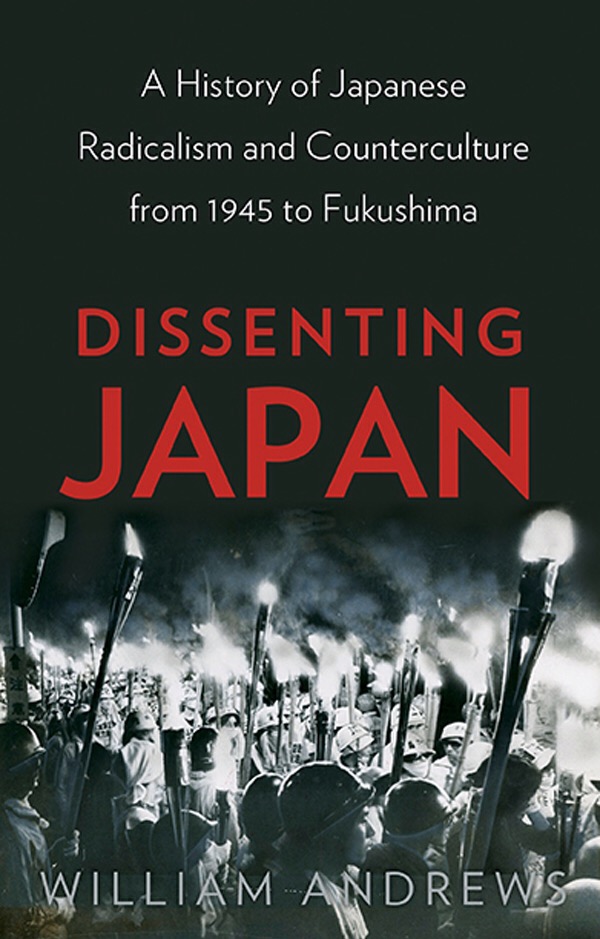
Just a quick post to draw your attention on a significant book that the London-based Hurst will publish next September. The volume is titled Dissenting Japan – A History of Japanese Radicalism and Counterculture and is written by the Tokyo-based writer and translator William Andrews, who by the way runs an excellent blog on the same topic here


Here’s the description from the publisher’s homepage: 

Following the March 2011 Tsunami and Fukushima nuclear crisis, the media remarked with surprise on how thousands of demonstrators had flocked to the streets of Tokyo. But mass protest movements are nothing new in Japan. The post-war period experienced years of unrest and violence on both sides of the political spectrum: from demos to riots, strikes, campus occupations, factional infighting, assassinations and even international terrorism.
This is the first comprehensive history in English of political radicalism and counterculture in Japan, as well as of the artistic developments during this turbulent time. It chronicles the major events and movements from 1945 to the new flowering of protests and civil dissent in the wake of Fukushima. Introducing readers to often ignored aspects of Japanese society, it explores the fascinating ideologies and personalities on the Right and the Left, including the student movement, militant groups and communes. While some elements parallel developments in Europe and America, much of Japan’s radical recent past (and present) is unique and offers valuable lessons for understanding the context to the new waves of anti-government protests the nation is currently witnessing.

Who’s is familiar with documentary cinema (and cinema in general) knows very well that radicalism, dissenting, resistance and counterculture are a very important part of the vocabulary that defines the post war Japanese non-fiction landscape, and the fiction as well, especially during the 60s and 70s. Ogawa Production and Sanrizuka, Tsuchimoto Noriaki and Minamata, NDU and Okinawa and the borders, but also Kamei Fumio and his Sunagawa Trilogy, maybe the first Japanese works to fully embody this “philosophy” of resistance and struggle on film (excluding the Prokino before the war of course). 

For all these reasons, Dissenting Japan will probably be (I haven’t read it yet) a very important read not only for historians but also for film scholars interested in Japanese cinema and in documentary in general. I’ll certainly write more about it when the book is out. 

Yamagata: un archivio dei documentari sul terremoto, tsunami e crisi nucleare dell’ 11 marzo 2011

311_yamagata_film_archive_opt

Yamagata è una cittadina ed una prefettura situata nella zona nord occidentale del Giappone, per intenderci dall’altro lato dell’arcipelago rispetto a dove l’11 marzo del 2011 il terremoto prima e lo tsunami poi colpirono e si scagliarono con una forza inaudita tanto da portare a quella crisi nucleare nelle centrali nucleari di Fukushima che ancora oggi non vede vie d’uscita. Ma Yamagata è anche la zona dove ogni due anni si tiene il più importante festival del cinema documentario asiatico, e aggiungerei anche un dei più importanti a livello internazionale, il Yamagata Internatinal Documentary Film Festival, fondato nel 1989 anche per volere di Ogawa Shinsuke, colui che forse più di chiunque altro ha plasmato la storia del documentario dell’arcipelago. Un festival che soprattutto nei primi anni della sua esistenza ha funzionato anche da volano per la comunità documentaristica asiatica (cinese e coreana, ma non solo) che molto si è ispirata in un momento particolare per il continente asiatico all’opera di Ogawa e del suo collettivo.

yidff2013poster_rgb-2

Ebbene, nell’edizione del festival del 2011 molto del programma fu dedicato inevitabilmente alle produzioni non-fiction scaturite dalla tragedia del terremoto e da quella conseguente di Fukushima, una crisi quella nucleare che colpì e che continua a colpire ancora oggi la prefettura di Yamagata in quanto la distanza dalle centrali nucleari non è poi così vasta. Soprattutto a livello umano poi il legame fra le due zone è molto forte in quanto molti dei rifugiati che sono scappati dalle zone colpite dallo tsunami o dal fallout nucleare hanno trovato ospitalità e riparo proprio a Yamagata. Il festival grazie anche alla collaborazione di Markus Abè Nornes, lo studioso occidentale che sta più di tutti aiutando a (ri)portare il documentario giapponese sulla mappa cinematografica internazionale, ha deciso di costituire un archivio con i film indipendenti sulla triplice tragedia, realizzati sia da giapponesi che da non giapponesi. L’archivio si propone quindi come una memoria collettiva dove poter vedere e studiare, anche a distanza di decenni, ciò che fu prodotto come conseguenza del terremoto e dello tsunami del 2011, al di là dei prodotti documentari televisivi che comunque hanno già un archivio tutto loro.
Per ora l’archivio consta di circa una sessantina di documentari, la lista la potete trovare qui. Come detto, ciò che piace e sembra importante di questa iniziativa è il suo puntare su tempi lunghi se non lunghissimi, in una contemporaneità in cui siamo continuamente soffocati da un presente che sembra allargarsi sempre di più senza portare da nessuna parte, iniziative di questo genere, che nella loro vastità temporale e concettuale si rivolgono a tempi storici lenti ma più profondi, risulta come una vera e propria boccata di aria fresca.