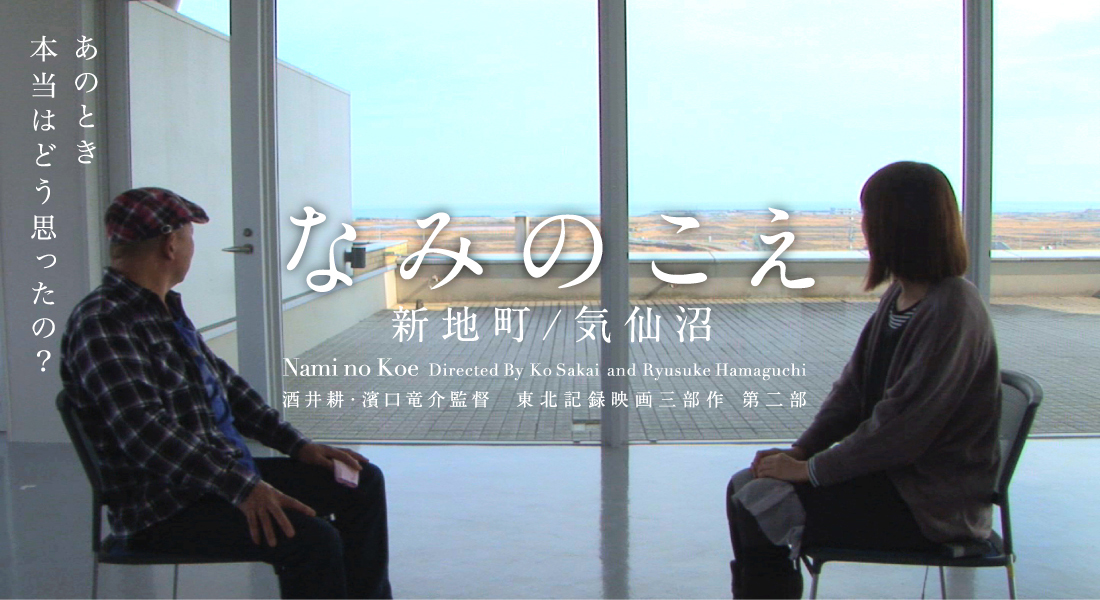
なみのこえ 気仙沼/新地町 Voices From the Waves: Shinchi-machi and Kesennuma (Sakai Kō and Hamaguchi Ryūsuke, 2013)

This is the translation of an article I originally wrote in Italian about two years ago for Sonatine.it, a contemporary Japanese cinema portal I often collaborate with.

Voices from the Waves is the second part of a trilogy of documentaries directed by Sakai Kō and Hamaguchi Ryūsuke about the disaster that struck northeastern Japan in March 2011. This second part consists of two documentaries, Voices of the Waves Kesennuma and Voices of the Waves Shinchi-machi. The only difference between the two works is that they were filmed in two different locations and are about the people who lived and experienced the disaster in two different but geographically very close areas. Both documentaries consist mainly of conversations between two people, often family members or colleagues, who survived the earthquake and tsunami.

Both films begin with images of the silent landscape of the areas, the sea and the waves, houses under construction and the remains of buildings that no longer exist. The idea around which the conversations take place is very simple: each person begins by telling where they were and what they were doing on the day of the earthquake and subsequent tsunami, and from there memories and reflections unfold.

In the first conversation of the Shinchi-machi film, a father and his grown-up daughter sit across from each other. As they recall the arrival of the tsunami and the size of the waves, their conversation is briefly interrupted by the father’s tears as he remembers friends and acquaintances who have disappeared, swept away by the tsunami. From the very first scenes, one of the trilogy’s strengths becomes clear: the moving stories of people who remember become something much more empathetic for the viewer than the flood of images of the disaster. In today’s mediascape, and the Japanese triple disaster of 2011 has become a striking case in point, spectacular images often fade from view in the few moments they are seen, leaving no trace. It is then that words, tone and intonation – in this case the man’s pronounced northeastern accent – manage to convey something much deeper and more affecting than the visual element alone.

Among the various couples we hear and see, whether friends, spouses or colleagues, some recall the difficulty of communicating with their loved ones in the moments immediately after the earthquake and the fact that they turned to images broadcast on television or circulated on the Internet. One of the most interesting parts of the first documentary is when we listen to two fishermen, both of whom were no longer fishermen at the time of the interview, but were doing other things to survive. This conversation, which is more edgy and direct and touches on the issue of radiation in the sea, reflects the character and occupation of the two and provides an interesting but painful variation on the people and personalities affected by the tragedy. The same problems that gripped the area in the aftermath of the disaster are perceived differently depending on people’s social class and economic background. It should be noted that some of these conversations are between a resident of the area and one of the two filmmakers, who then stands in for the second interviewee, but we will return to this important point later.
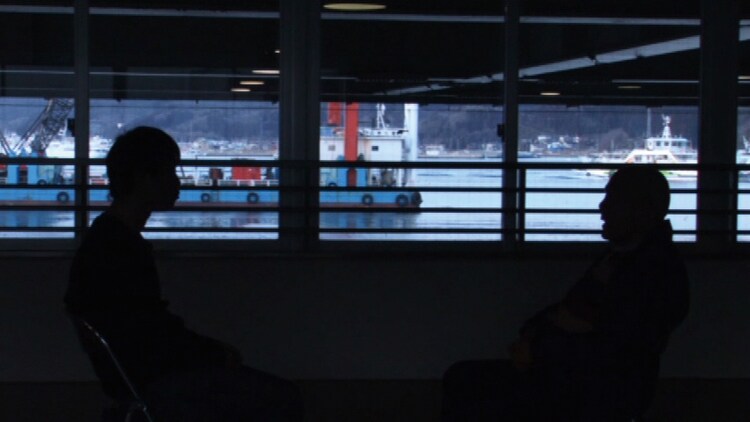
The second documentary, as the title suggests, was shot in Kesennuma, one of the towns hardest hit by the tsunami. It begins with a night-time view of the town’s harbour and then moves to the first conversation, probably recorded in the evening, between two colleagues working in a bar-restaurant. They share the memory and the feeling of despair and fear when they heard the sound of cars and houses colliding and destroying each other on that tragic day. A middle-aged couple does not want to remember the day of the tsunami because it is still so fresh, even though a year has passed since the tragedy. What emerges here is the willingness of the local people to forget, not to not remember, but to move on and not to base their future lives on the disaster. This is a sentiment that has emerged more and more in recent years, especially in Fukushima, and is often found in many communities affected by natural or man-made disasters, such as mercury poisoning and the resulting Minamata Syndrome, which Tsuchimoto Noriaki has explored in his documentaries.
Tsuchimoto, one of Japan’s greatest documentary filmmakers, who has devoted much of his career to following the lives of the victims of Minamata Syndrome, has often commented on how, after decades of documentaries on the subject, many of the victims’ relatives began to treat him coldly. It is therefore important to emphasise one more time that the conversations in Hamaguchi e Ko’s documentaries were filmed just over a year after the triple disaster, when the pain and memories were still fresh, but also when the perspective of those affected by the earthquake and tsunami was slowly but surely changing.

The talking pairs are often in an airy space, especially in the first documentary, where the conversations take place inside buildings, but with large windows looking out. The chosen setting therefore gives a sense of spaciousness and grandeur that an enclosed space would not allow. Between one conversation and the next, there are short ‘pillow shots’, scenes showing the area being rebuilt, the sea, the waves, the excavators and cranes that are still constantly at work. Although these images often capture the landscape filmed by a horizontally moving camera, the entire trilogy differs from most documentaries made about the earthquake and tsunami in that it is composed of mostly static shots. Many of the works that have attempted to document the plight of the local population and the triple disaster over the years have in fact done so through shots taken from a moving vehicle, partly because the vastness of the area affected by the tsunami requires it, but this choice of filming also ended up becoming almost a documentary style in itself and a cliché of how to film the disaster.

It is also significant that the two documentaries are not constructed with interviews, a practice used and abused in the aftermath of the triple disaster, which establishes a relationship of power and impartiality between interviewee and interviewer. Conversations between two people, even though they take place in a staged and constructed space, with at least two cameras and two directors in the room, achieve something different. No one intervenes from outside, of course there is editing, but a kind of horizontal and equal dialogue is created, because these are people who have experienced the tragedy first hand. In this sense, the fact that the two directors intervene in some of the conversations is interesting, almost revealing the “artificiality” of the work, but in the long run it reduces the impact of the two films. The same could be said of the different angles and techniques used to film the two interlocutors (this insightful essay by Markus Nornes is illuminating); while in some cases this works almost perfectly, in others it exacerbates a sense of artificiality that detracts from what is being said.
There is, however, one part where all these techniques are used to the full, and that is the final conversation of Voices From the Waves Kesennuma, when a young couple, a man and a woman aged 26 and 23, amid silences, awkwardness, nervous smiles, ringing mobile phones and yawns, bring out the cinematic power of the unspoken, of gestures and pauses, making this scene perhaps the most touching and at the same time amusing of all those seen in both works.
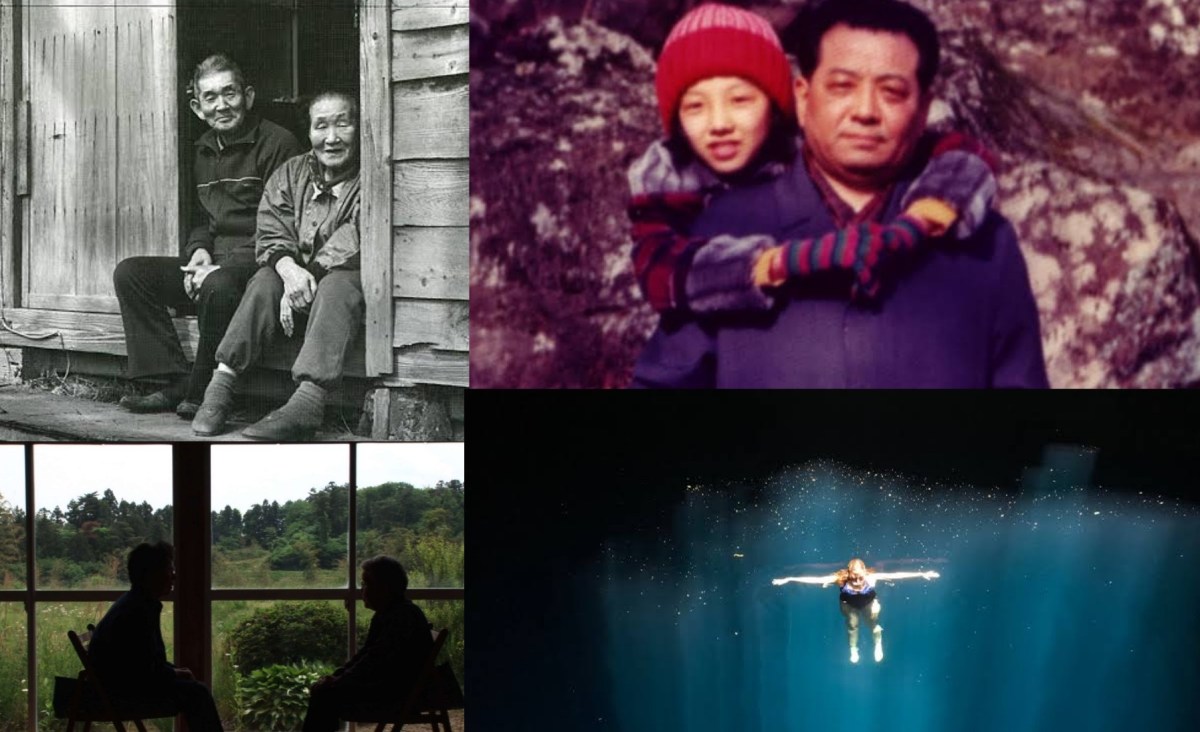
MADE IN JAPAN, YAMAGATA 1989 -2021 10 documentaries streaming on DAfilms

A mini retrospective on the streaming platform DAfilms.com, from 17 January to 6 February (free of charge until 24 January) introduces 10 Japanese documentaries presented at the Yamagata International Film Festival from 1989 to 2021. A fascinating path through the cinema of the real produced in Japan in the last three decades.

In 1973 when the Ogawa Production collective made Narita: Heta Village, the sixth documentary on the struggle and resistance of the peasants in Sanrizuka against the construction of the new Narita airport, they not only created one of the most important documentaries in the history of Japanese cinema, but also captured and foreshadowed a series of shifts that would take place in the archipelago in the following years. By moving the attention and the camera from the clashes, a “civil war” as it has been described by many, to focus more on the life of the peasants, their customs and their sense of time, the collective anticipated the interest that cinema and literature would later show towards rural and provincial areas. From a cinema more linked to contingent events taking place in the political and social sphere, towards one more interested in macrohistory and its large movements and cycles. This interest of the group, led by Ogawa Shinsuke, is reflected in their decision to move to the north of Japan, to the Yamagata prefecture, where the collective lived for 14 years, from the second half of the 1970s until the end of the following decade. As it was revealed later, after Ogawa’s death, this period was not without internal conflicts, and within itself it had many of the problems that had already poisoned many of the New Left groups during the 1970s, such as a marked authoritarianism, and an absolute lack of female presence in crucial positions. If the cinematic peak of this long period spent in Yamagata is Magino Village – A Tale / The Sundial Carved with a Thousand Years of Notches (1986), an unidentified filmic object that constructs a mythological and epic mapping of the area and its inhabitants, perhaps it can be said that the most important legacy of the collective and of Ogawa himself is the creation, in 1989, of the Yamagata International Documentary Film Festival (YIDFF).

Held once every two years in the Japanese city, the festival has become, in its three decades of existence, an important event for those who love the cinema of real and its infinite expressive possibilities. The festival has always stood out to me for the way it is experienced, horizontally so to speak, after the screenings: professionals and filmmakers mingle and interact with enthusiasts, cinema lovers or even just the curious, who come to enjoy the almost party and rock concert-like atmosphere of the event. At the same time, however, Yamagata has also been, since its very beginning, an important launching pad for many Asian authors and for the creation, especially in the 1990s, of a transnational documentary film culture. The first of its kind in Asia, the event contributed to the birth of other festivals, the Taiwan International Documentary Festival for instance, and it also functioned as a pole of attraction for the new wave of Asian filmmakers who came to the fore during a crucial period for the area, the period of democratisation of art with the advent of digital, in China but also in Hong Kong and other parts of South East Asia more generally.

The online retrospective organised by the YIDFF in cooperation with DAfilms is an excellent opportunity to discover some of the most important Japanese films presented at the festival since its foundation. Two works ideally open and close the retrospective, A Movie Capital, a documentary on the first edition of the festival made in 1991 by Iizuka Toshio, one of the members of Ogawa Production, beautifully captures that sense of collaboration and artistic brotherhood between Asian directors mentioned above. While Komian and Pickles by Satō Koichi— presented during the 2021 edition, moved online due to the pandemic— gives an idea of the sense of commonality in Yamagata during the event. The closure of Komian, a popular venue for post-screening discussions and meetings, follows to the closure of a local tsukemono (pickled food) business, Maruhachi Yatarazuke pickling company, the owner of Komian. The film is an occasion to remember and treasure the experiences offered at the venue, but also an example of how the gentrification process, magnified by the economic damage caused by COVID-19, is active and reshaping the urban texture even in small Japanese cities.

The most artistically accomplished works presented in the retrospective are, however, others. All of them are worth watching of course, but I would personally recommend Living on the River Agano by Satō Makoto (I wrote about three of his movies here), Yang Yonghee’s 2005 film Dear Pyongyang, Storytellers by Hamaguchi Ryūsuke and Sakai Kō, and Cenote (2019) by Oda Kaori (here an interview with the artist and a piece on the movie). Here the complete line-up:

A Movie Capital // Toshio IIZUKA // 1991

Living on the River Agano // Makoto SATO // 1992

The Weald // Naomi KAWASE // 1997

The New God // Yutaka TSUCHIYA // 1999

A2 // Tatsuya MORI // 2001

The Cheese and the Worms // Haruyo KATO // 2005

Dear Pyongyang // Yong-hi YANG // 2005

Storytellers // Ko SAKAI, Ryusuke HAMAGUCHI // 2013

Cenote // Kaori ODA // 2019

Pickles and Komian Club // Koichi SATO // 2021

The complete selection will be available entirely for free on DAFilms.com from January 17 – 23 at this link: https://dafilms.com/program/1126-made-in-japan-yamagata-1989-2021

Interview with Hamaguchi Ryūsuke

At the end of last February, I had the pleasure of interviewing Hamaguchi Ryūsuke about his Wheel of Fortune and Fantasy, a movie that would debut at the Berlinale. The short interview was conducted on zoom and it was published in the Italian newspaper I usually write for, Il Manifesto.

In recent months, with the release and success of Drive My Car, many long and more in-depth interview with the Japanese director have been published around the world, but I decided nonetheless to translate my interview in English and post it here on the blog (even if it’s not really related to documentary). As said, the conversation was about Wheel of Fortune and Fantasy and before the release of Drive My Car. In recent months, with the release and success of Drive My Car, many long and more in-depth interview with the Japanese director have been published around the world, but I decided nonetheless to translate my interview in English and post it here on the blog (even if it’s not really related to documentary). As said, the conversation was about Wheel of Fortune and Fantasy and before the release of Drive My Car.

Interview with Hamaguchi Ryūsuke (February 27th, 2021)

Although you had already made short and medium length films in the past, this is the first time you have tackled the anthology film format, could you tell us more about this choice?

A few years ago, I made the medium length film Heaven Is Still Far Away, a project also born out of a collaboration with actresses and actors that for me worked partly as a sort of review of Happy Hour, and partly as preparation for my next film, Asako I & II. This experience was also very useful to me because I was able to find my own rhythm, so to speak, in alternating feature films and short or medium length films, something that I think I will continue to do in the future. However, one of the problems with short films is not having a real exhibition outlet, that is, it is very difficult to find a proper distribution for these kinds of works. The solution I tried this time was to combine three shorts into an anthology, making them into a feature film that thus could be distributed. 

Compared to feature films, do you think the format you worked on this time opens up different expressive possibilities?

Of course. All works, whether long or short, must have an end, a point at which they stop and leave the viewer with a strong feeling of having seen a world. Having said that, short films have the possibility, in my opinion, to leave a more intense and vivid impression as they only offer a brief glimpse into a certain world. A shorter film can also show something rare, events whose existence is not certain, leaving everything in suspense and without going too deep into it.

In each of the three episodes that make up the film there are at least three scenes of strong aesthetic and emotional impact. In Magic (or Something Less Assuring), the first episode, the long initial part with the two women in a taxi, in Door Wide Open the scene where the female protagonist visits the professor and in the last episode, Once Again, the final part with the two women embracing. Each of these scenes uses very different acting styles, yet there are parts in them where the characters, within the narrative, are acting, and where the boundary between what is real in the story and what is acted is ambiguous and fluid. Could you tell us how you worked with the actors to create this ambiguous feeling?

I wanted to create this ambiguity, but I also tried to create a clear sense of ambiguity, so to speak. That is, I wanted to create something defined, but something that can be interpreted in different ways. The fascinating thing for me is that the act of acting itself is ambiguous, and in the three scenes you mentioned, the actresses themselves in the midst of their performances must surely have noticed the ambiguity of the question “what is real?”. One strategy I used to create this ambiguity was, first of all, to write it into the scenes themselves, by inserting the act of acting into the narrative. I could not ask the actors to emphasise the fact that they were acting, it was rather a matter of achieving a very light and thin performance that, as in the case of the two women in the taxi, could later be read differently in the continuation of the story, when more information is revealed to us. In addition, it is important that there is something hidden in the performance, as happens for example in the second episode where even the main character, Nao, realises that she does not know exactly why she is doing what she is doing, thus generating a sense of displacement in the scene.

The third episode is set in a world where a computer virus has made the internet unusable. Could you tell us more about the reasons for this choice?

I shot the first two segments in 2019 and the last one in 2020. I originally planned to shoot it in spring, but the pandemic disrupted all the plans and we ended up shooting it in summer. The script was already completed, but an event as big as the pandemic made me tweak it. I couldn’t avoid taking into account the effect the Corona virus had on all of us, so I decided to set it in a kind of parallel world where the internet is no longer usable, a world disrupted by a different kind of calamity. 

One last question about the situation of independent cinemas (mini-theaters) in Japan at the time of the pandemic, a culture that is very close to your heart and for which you are fighting with various initiatives, such as Mini-Theater Aid (crowdfunding that helped these small cinemas survive last year and that is still active with various support initiatives). What is your relationship with these independent theatres?

For me, they have been an important place to discover films that are completely different from the Hollywood films or TV series I was used to, films that were “boring” compared to the ones I used to see.  Seeing these “boring” films in the space of these small independent theatres, I discovered a new kind of feeling, my body changed and I learned to appreciate a different kind of cinema. Now my films are shown here in Japan, mainly in these independent theatres, and I am in contact with all the people working there, it is for these reasons that I have been actively participating and supporting projects like Mini-Theater Aid.