
Something not related to the world of documentary today: I translated my June 2024 interview with the talented stop-motion artist Soejima Shinobu. I met her at an exhibition in Kanazawa, where her latest short, 私の横たわる内臓 My Organs Lying on the Ground, was screened for a week or so.
The piece was originally published in Italian in Alias on August 17, 2024.
On a different note, she is pitching her new project, 彼女の話をしよう Talking About Her (currently in production), at the ongoing Annecy International Animation Film Festival, on June 10.
Soejima Shinobu is a Japanese artist who has been active in the world of stop motion animation for the last decade. She creates fascinating short films that blend her interest in Asian and Japanese folklore and religious practices with her passion for sculpture. In these experimental works, which have been presented at various international events, Soejima prioritizes the materiality of the puppets and their environments over the narrative elements.
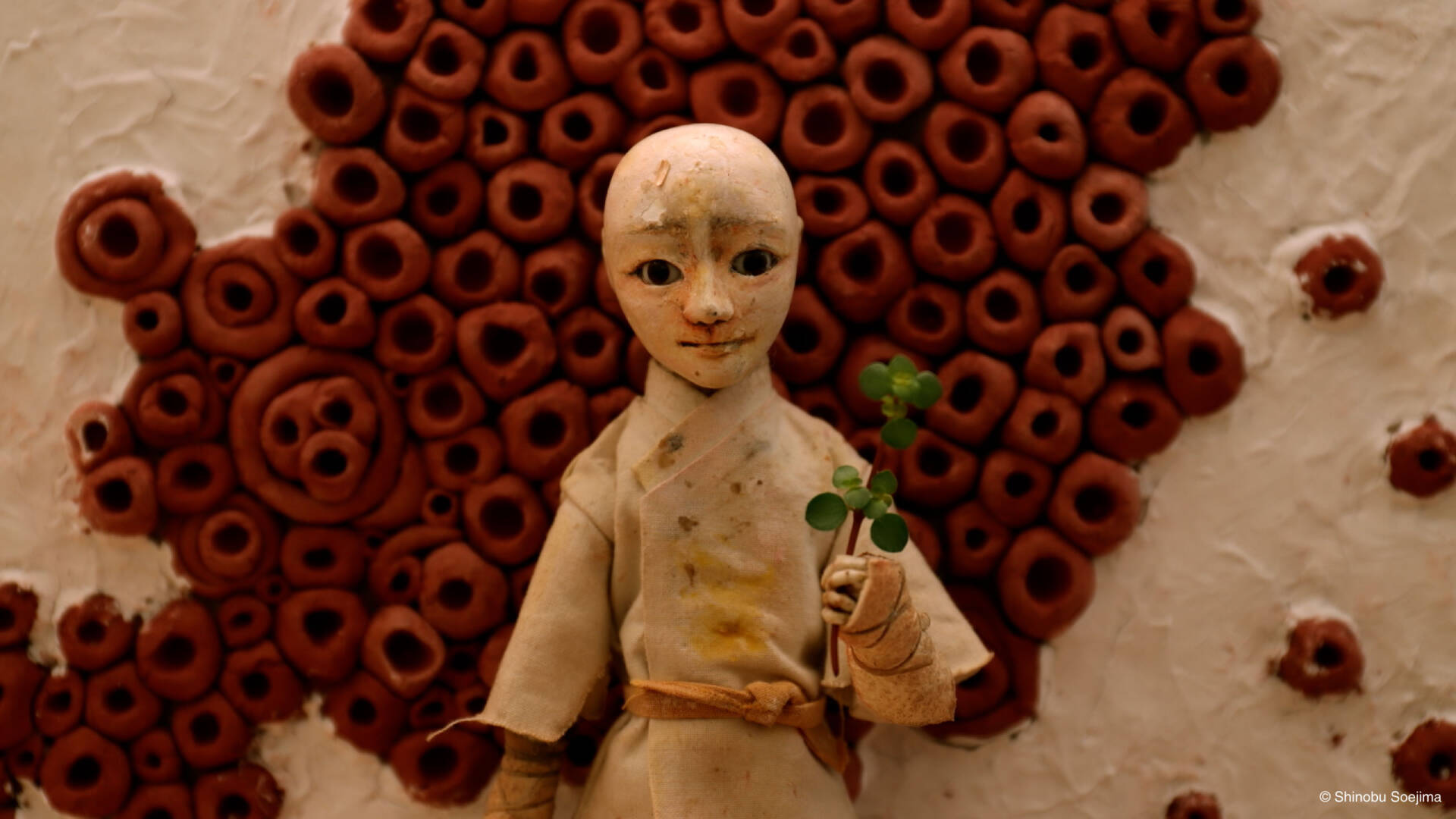
In 2018, Soejima created The Spirits of Cairn, a story in which a guardian must contend with heads of birds appearing and disappearing in a cemetery. The following year, in House Rattler, she brought the spirits of an old house to life as imagined in Japanese folklore. Her most successful and accomplished work to date is perhaps Blink in the Desert (2021), a short film in which a boy/monk is overcome with guilt after killing a moth.
Her latest work, My Organs Lying on the Ground, was presented last June [2024] in Kanazawa, in a small exhibition that displayed also some of her sculptures. It is a short film that reinterprets a Japanese spiritual practice known as tainai kuguri, a purifying journey through the bowels of the earth. In this piece, which makes extensive use of organic materials such as meat, insects and cereals, Soejima creates a space where the boundaries between earthly life and the afterlife, between organism and inorganic matter, and between inside and outside dissolve
I had the opportunity to speak with the artist at the exhibition.
How did you get into stop motion animation?
I have always been interested in sculpture ever since I was a child. I continued making sculptures until the end of my bachelor’s program when my professor realized I had a talent to creating stories, then he suggested I combine the two.
Very soon, I quickly realized that I loved stop motion animation. With sculpture, I usually had to keep all my work in my studio, which took up a lot of space. With film, however, I was able to edit and distort my work and film the whole process, which I really enjoy. I am also interested in the idea that, by filming materials decompose and transform into different forms, I can preserve the essence of the sculpture.
Could you talk about your creative process? On your website, you have collected images from your research journeys. Do you start from places, or do you start from a story you want to tell? Or, do the images guide you?
I usually think about the setting first. The environment in which the events take place is crucial to me. For example, in my first film, The Spirits of Cairn, I wanted to depict the story of someone who died very young and I tried to think of the best way to represent a place between life and death. I started with an image of dozens of bird heads in a place with many cavities that must be kept empty by a guardian of some kind.
For my second film, House Rattler, which is set in my grandmother’s old house, I also started with the setting. For my latest work, My Organs Lying on the Ground, I wanted the characters to be even more connected to the environment to reflect ideas from ecology and animism. To bring this concept to life, I decided to use organic materials because, when we consume something, it goes back to the earth. Plants grow back, and we eat again. It’s a repeating cycle.
Since the puppets are literally empty bodies that resemble human beings but have no soul, I thought these organic materials could connect them to their surroundings. This concept is also similar to a Buddhist view of reality: a fish does not exist in and of itself; we call something a fish because it is in the water.
Sticking with the religious theme, your latest work, My Organs Lying on the Ground, but also The Spirits of Cairn is based on the ritual and spiritual practice known as “tainai kuguri” (passing through the womb). What role do religious practices play in your work?
I come from a religious family and so from the time I was born I have something I can believe in, so I think it’s something very real to me, although I’m not very sure I’m as religious as my parents. I was also influenced by my time in Malaysia, where I lived from the time I was twelve years old until I was twenty, I remember for example that there were tropical fruits rotting on the ground and when no one touched them, they would dissolve into. But the Malaysians don’t think this is wasteful because they believe in this cycle, sometimes you eat the fruits, sometimes you let them rot on the ground and from there plants and new fruits grow back. I remember this image very clearly, partly because it goes against what the Japanese usually think, if you see something rotting on the ground, you immediately think of waste and a sense of dirtiness. Hindu culture also influenced me a lot, in my years in Malaysia of course, but also later when I went to Nepal to do research.
The puppets’ eyes in many of your works, especially in Blink in the Desert, have an uncommon expressiveness. Could you talk about how you achieve this effect?
I usually use glass eyes like the ones used for stuffed animals. When light hits them, they seem to move and take on an almost watery appearance. This technique comes from Buddhist and Japanese sculptures, as well as Asian sculptures in general. Special crystals were used for the eyes when making these statues. Long ago, Buddhist temples had no artificial lights, so candles were used. When the flickering candlelight hit the statues’ eyes, they looked very watery and almost alive.
In My Organs Lying on the Ground, the expressions and eyes of your puppets seem kinder to me, and the colors seem warmer and less cold than in your previous short film. Is this just my impression?
In my penultimate work, Blink in the Desert, I tried to portray the main character’s inner confusion and negative feelings, so the film ended up being rather emotionally intense. For this latest work, however, I tried something different, something more related to sculpture that could only be realized through stop motion. I thought a lot about how to make the puppets because combining them with organic material might shock viewers. In the past, dolls were used in Japan to expel sins or evil spirits from people, and then they were thrown into rivers. Perhaps all of this influenced the look of the puppets I used in my short film, as well as my decision to use positive, almost party-like music to accompany it.
It seems to me that your work tends to emphasize the symbolic and allegorical over the purely narrative. There is a story, but it is not linear.
When I create my work, I feel as if I am documenting sculptures and their changes over time. In this sense, I have been influenced by postminimalism, especially Richard Serra’s approach. Stop motion animation and the puppets I use are very real to me. Through them, I can show reality in a tactile way, so to speak, which is what interests me. This approach was also influenced by the pandemic, especially in my last short film. While working on Blink in the Desert, I was confined to my small room for nearly a year. I felt disconnected from the world, communicating solely through screens, and it seemed as if my body and feelings were detached. I needed physical interaction with the environment and to return to a tactile and material level.


 Asian Docs
You must be logged in to post a comment.