2017: Kinema Junpo Best 10 – documentary

Awaited every year with trepidation by cinephiles and the community of Japanese film-lovers, and a perfect occasion for discussing the state of the art in the archipelago and agree or disagree with it, last month the prestigious film magazine Kinema Junpo announced its 2017 Best Ten Lists . Launched in 1924 with only non-Japanese films, and from 1926 including Japanese movies as well, the poll includes, in its present form, four categories: Japanese movies, non-Japanese movies, bunka eiga and a section awarding individual prizes such as best director, best actor, best actress, best screenplay, etc.
You can check the results for all the categories here. Given the nature of this space, I want to focus my attention (with the slowness that characterizes this blog, apologies) on the bunka eiga list, that is to say, the best 10 Japanese documentaries released in 2017 according to Kinema Junpo (as far as I know only three have been released outside of Japan and thus have international titles):

1 人生フルーツ Life is Fruity

2 標的の島 風(かじ)かたか The Targeted Island: A Shield Against Storms

3 やさしくなあに 奈緒ちゃんと家族の35年

4 ウォーナーの謎のリスト

5 谺雄二 ハンセン病とともに生きる

6 沈黙 立ち上がる慰安婦 The Silence

7 米軍が最も恐れた男 その名は、カメジロー

8 笑う101歳×2 笹本恒子 むのたけじ

9 まなぶ 通信制中学 60年の空白を越えて

10 廻り神楽

With the term bunka eiga (cultural film), for a comprehensive analysis of the word and its usage in relation with other definitions, read here, the magazine awards non-fiction movies that explore social, cultural and political themes, often focusing more on the subjects tackled than on the formal aspects of the films themselves.
It is almost a fact that we’re living in a new golden age for documentaries, an era when every year, in theaters or on streaming platforms alike, there’s at least one film that push the boundaries of non-fiction cinema towards new territories. Unfortunately Japan, with all the exceptions of the case, seems to have stayed or have left behind. This is not the right place to discuss and deep dive into the reasons for this impasse, suffice to say that it is a problem affecting Japanese cinema in general and not only nonfiction movies.

That being said, it is nice to see at the top of the list Life is Fruity, a movie directed by Fushihara Kenshi and produced by Tokai TV, a production company based in Nagoya that in the last twenty years or so has been releasing a bunch of interesting and insightful documentaries. Again, all of them have quasi-TV aesthetics, nonetheless the topics explored and, in the best cases, the touch used, make them worth watching. Of the 21 documentaries produced by Tokai TV I’ve had the chance to watch five, among these my favorite is 青空どろぼう (Sky’s Thieves, 2010), a movie on the Yokkaichi Asthma, one of Japan’s four major diseases caused by pollution.
Life is Fruity tells the story of 90-years-old architect Shuichi Tsubata and his wife Hideko living in Aichi prefecture in a house surrounded by vegetables and fruits. Almost half a century ago Tsubata was asked to plan a new town in the area, but his idea of building houses that could coexist with woods and blend with the natural environment was rejected, and a project more in tune with the fast growing Japanese economy of the time was chosen. Tsubata left his job, purchased a piece of land and built his dream-house in a manner of his master,  Czech-American architect Antonin Raymond.

You can see an English subtitled trailer by clicking on the Vimeo button:

Number two in the list is A targeted Village, the second documentary directed by Mikami Chie about the ongoing protests and resistance of Okinawa people against the American military presence and expansion in the island.
In 1983 director Ise Shinichi started to record the daily life of his 8-year-old niece Nao, a girl with intellectual disability who also suffers epilepsy, and her interaction with her family and society. After 12 years of shooting he edited the material into Nao-chan, a movie released in theaters in 1995, followed by 「ぴぐれっと」in 2002 and ありがとう 『奈緒ちゃん』自立への25 in 2006. やさしくなあに 奈緒ちゃんと家族の35年, number 3 in the Kinema Junpo list, is the fourth installment in this ongoing series and documents the ups and downs in the daily life of Nao and his family. I haven’t seen the movie yet, but it seems to perfectly continue the tradition of Japanese documentaries dealing with disability, from Tsuchimoto Noriaki to Yanagisawa Hisao (a retrospective of his works is happening now in Tokyo) and, in more recent years, Soda Kazuhiro with Mental.

Nao_chan.jpg

ウォーナーの謎のリスト is a documentary about American archeologist Langdon Warner and his list of culturally valuable Japanese sites that, allegedly, saved the most important temples and monuments from destruction during the American bombing of Japan in World War II. 谺雄二 ハンセン病とともに生きる tells the story of poet, activist and writer Kodama Yōji, who suffered from leprosy and fought against isolation and discrimination during his entire life, while with The Silence, second generation Japanese-Korean Park Soonam, records the struggle carried on by the victims of sexual slavery during the invasion of Korea by imperial Japan. In 米軍が最も恐れた男 その名は、カメジロー, his debut behind the camera, newscaster Sako Tadahiko explores the life of Senaga Kamejirō, an outspoken politician and communist who fought the American occupation of Okinawa until his death in 2001.
The list does not represent Japanese documentary landscape in its variety and complexity of course, by design the more experimental works are ruled out, nonetheless besides few titles, the films here selected don’t seem to hold any particular appeal to an international audience, again at the risk of becoming trite, it’s not because of the themes explored, but more because of what to me appears to be the lack of a distinctive style and vision.

Yamagata International Documentary Film Festival 2017

The Yamagata International Documentary Film Festival, one of the most awaited film-related events of the Japanese archipelago, will kick off its fifteenth edition next week on October 5th. For eight days the city of Yamagata will be the capital of documentary cinema, hosting not only an international competition with movies from all over the globe, but also a plethora of  more or less known documentaries presented in other sections, special screenings and retrospectives. For the cinephiles and the film lovers visiting the northern Japanese city, the festival will be an occasion to discover hidden gems of historical importance and an unmissable chance to meet directors, scholars and documentary-obsessed people.
Festival opens on the 5th with a special screening commemorating the passing of Matsumoto Toshio, one of the true giants of Japanese cinema. Two of his best known documentaries, Nishijin (1961) and Ginrin / Bicycle in Dreams (1955) will be presented for the occasion in their original format (35mm), while For My Crushed Right Eye (1968) will be screened as it was originally conceived, that is in 16mm and with 3 projectors. Funeral Parade of Roses (1969) and other experimental works made by Matsumoto during the 1970s and 1980s will also be shown during the festival, including one of my favourite, Atman (1975), a kaleidoscopic trip to the philosophical source of movement and image.
Among the titles presented in the International Competition a must-see for me is Ex Libris—The New York Public Library, the latest work by Frederick Wiseman, but I’m also looking forward to I Am Not Your Negro by Raoul Peck and the long-awaited new work by Hara Kazuo, Sennan Asbestos Disaster, the first feature documentary the director of The Emperor’s Naked Army Marches On made in more than a decade. The movie follows the victims who suffered asbestos-related damages in the city of Sennan in Osaka, during their eight years fight for compensation.
Also in competition the beautiful Machines by Rahul Jain (I wrote about it here), Donkeyote, a subtle reflection on dreams and hopes through the eyes of a donkey and its ageing owner, directed by Chico Pereira, and Another Year by Zhu Shengze, a movie that has received much praise in the international festival circuit. Wake (Subic) by John Gianvito, about the pollution afflicting the residents of a former US naval base in Luzon Island, the Philippines, looks interesting and so does Tremoring of Hope, the difficult recovery of the people of Hadenya in Miyagi, six years after the Great East Japan Earthquake.
Here the complete line-up.
A promising section that will probably sparkle heated post-screening debates is Politics and Film: Palestine and Lebanon 70s–80s, a selection of films made in Palestine and Lebanon during the Lebanon civil war (1975-1990) and in recent years, movies that show and reflect on the struggles and politics of the area. Among them the (in)famous Red Army / PFLP: Declaration of World War, filmed by Wakamatsu Koji and Adachi Masao in 1971, and Genet in Shatila (1999), about the French writer and his relation with the Palestinian revolution as he witnessed the aftermath of the Shatila’s massacre in September of 1982.

Introducing Asian documentary filmmakers, New Asian Currents is usually one of my favorite section for its scope and the variety of films shown, this year 21 works from the continent will be presented, giving us a glimpse of the life, difficulties and struggles the people inhabiting the huge and diversified area have to cope with in their daily life. A Yangtze Landscape by Xu Xin is an interesting movie (more here) that deserves to be seen on the big screen, exploring the geographical and social landscape surrounding the Yangtze River in its long course of more than thousands kilometers. While the works of Yamashiro Chikako are a rare example, rare in Japan at least, of how to tackle a series of thorny historical issues, Okinawa and its relation with mainland Japan and with its past, merging documentary with the experimental.
Here the section’s complete line-up.
I’m ashamed to admit, but I know almost nothing of African documentary. Africa Views will thus be my entrance gate to it, “a program that introduces over 20 films created since the year 2000—with a particular focus on the Sub-Saharan region—depicting a contemporary Africa that lets off a considerable racket as it creaks toward progress, and introducing us to the people who live there.” What caught my attention in Perspective Japan are the new films by Murakami Kenji and Onishi Kenji, two short experiments in 8mm whose screening promises to be, like two years ago, a real cinema-event.
The Festival will also hold a retrospective on Fredi M. Murer, a Swiss director that the program describes as “a leader of the internationally-acclaimed Swiss Nouveau Cinema movement that was active from the late 1960s through the 1980s, together with Daniel Schmid and Alain Tanner. (…) Depending on the period in which they were made, Murer’s works may be classified variously as experimental film, documentary, or narrative film.” The retrospective that interest me the most though is Ten Trips Around the Sun: Sato Makoto’s Documentary Horizon Today, a tribute to Sato Makoto on the 10th anniversary of his death, that will include screenings of his major works accompanied by discussions and panels.

North Korean missiles permitting, I’ll be in Yamagata from October 6 to 11, and, as I did two years ago, I will try to keep a diary of my viewings experiences, here or more likely on my Twitter account.

P.S. I’ve also created a list on Letterboxd with most of the movies that will be in Yamagata.

This slideshow requires JavaScript.

From the archives: Kamei Fumio, Hani Susumu, and Ogawa Production in two Italian publications (1967, 1970)

The Centro sperimentale di cinematografia (Experimental film centre) in Rome is one of the oldest cinema schools in the world and the oldest in Europe. Founded in 1935, the centre nourished and helped establishing, in different degrees, the career of many important filmmakers, photographers and actors. Japanese director Masumura Yasuzō famously studied at the school for about two years at the beginning of the 1950s under luminaries such as Michelangelo Antonioni, Federico Fellini and Luchino Visconti, an experience that without doubt helped shaping his approach to cinema and his views as a filmmaker.
In 1937 the centre started to publish its own film journal, Bianco e Nero, a monthly magazine that is still been published to this day. A couple of years back I bought a copy from 1967 (February) that has an article, penned by film critic Claudio Bertieri, on the documentaries of Hani Susumu and Kamei Fumio. In November of the previous year the Festival dei Popoli in Florence, an event dedicated to non-fiction still running today, presented a mini-retrospective on Japanese documentary, and Bertieri discusses in the short article, titled Susumu Hani, Fumio Kamei ed il documentario giapponese (Susumu Hani, Fumio Kamei and Japanese documentary), the movies he was able to see at the festival. He devotes most of the article on Hani, Yuki Matsuri (1953), Children in the Classroom (1954), Children Who Draw (1955), Twins in the Class (1956) and Hōryū-ji (1958) are the documentaries here analysed, while the rest of the piece is spent examining Kamei’s It’s Good to Live (1956) and The World of Yukara (1964), a trilogy about Ainu’s traditions. Although written in 1967 — a period when Japanese documentaries certainly were not known or available to watch as they are today (well, they are not that discussed even today…)— and with few dated observations here and there, most of the analysis remain solid to this day. Documentary as opposed to mainstream cinema ‘the man in the street here [in Europe] has not seen Louisiana Story, in Japan he does not know Hani or Kamei’, Hani’s ability to capture moments of pure innocence in children, or Kamei sensibility when portraying human suffering are spot-on insights.

Even more interesting, but for different reasons, is Cinema: Giappone e Zengakuren (Cinema: Japan and Zengakuren) a short book published in 1970 by Samonà e Savelli, later Savelli – La Nuova Sinistra, a publisher established in 1963 and the first to directly represent the extra-parliamentary left-wing in the Italian publishing world. Over the next decade the books printed by Savelli – La Nuova Sinistra, also fueled by political and social unrest in the peninsula, would gain momentum and become a cultural reference point for left-wing groups such as Potere Operaio and Lotta Continua , and for the newspaper Il Manifesto.

The book is devoted to Ogawa Shinsuke’s The Battle Front for the Liberation of Japan – Summer in Narita (1968), the first movie in the Narita/Sanrizuka Series. A brief introduction that outlines the Japanese political situation and the fierce resistance by the peasants and the students, is followed by a translation of some writings by members of Ogawa Production, just a couple of paragraphs nothing more, while the main part of the volume is a transcription of the dialogues spoken in the film. It was a period where revolutionary cinema(s) of the globe were connecting to each other and were trying to build a common front against capitalism, the people in power and the establishment. The back cover is in this regard illuminating: Comitato di Cinema e Rivoluzione: Baldelli, Filippi, Ivens, Ogawa, Rocha, Solanas, Straub (Cinema and Revolution’s committee: Baldelli, Filippi, Ivens, Ogawa, Rocha, Solanas, Straub).

Reading these two publications after almost 50 years since they were originally printed was a very fascinating discovery, Ogawa and Kamei are two of the most important documentarists in the history of world cinema and essentially the reason this blog exists. Cinema: Japan and Zengakuren in particular is revelatory not as much for the information it contains, there are some mistakes of course—in the pre-internet age Japan was still a land far away and often misrepresented—but more as an artifact of an era long gone but still able to resonate with our present. An era when the arts were explicitly politicized, in a state of never-ending struggle and ready to change the world.

This slideshow requires JavaScript.

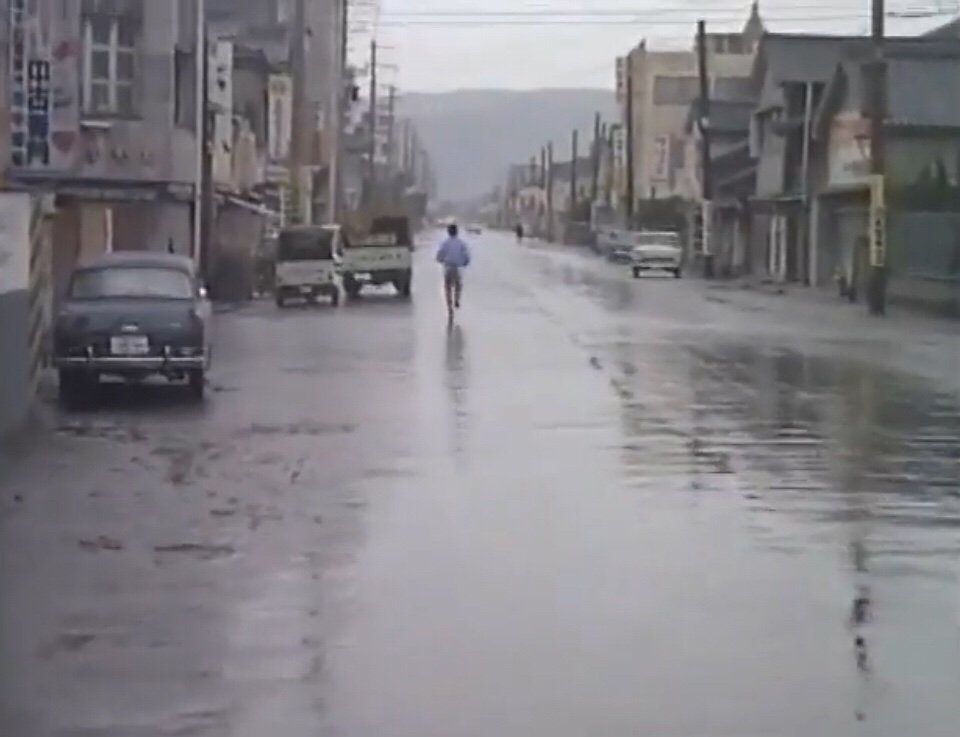
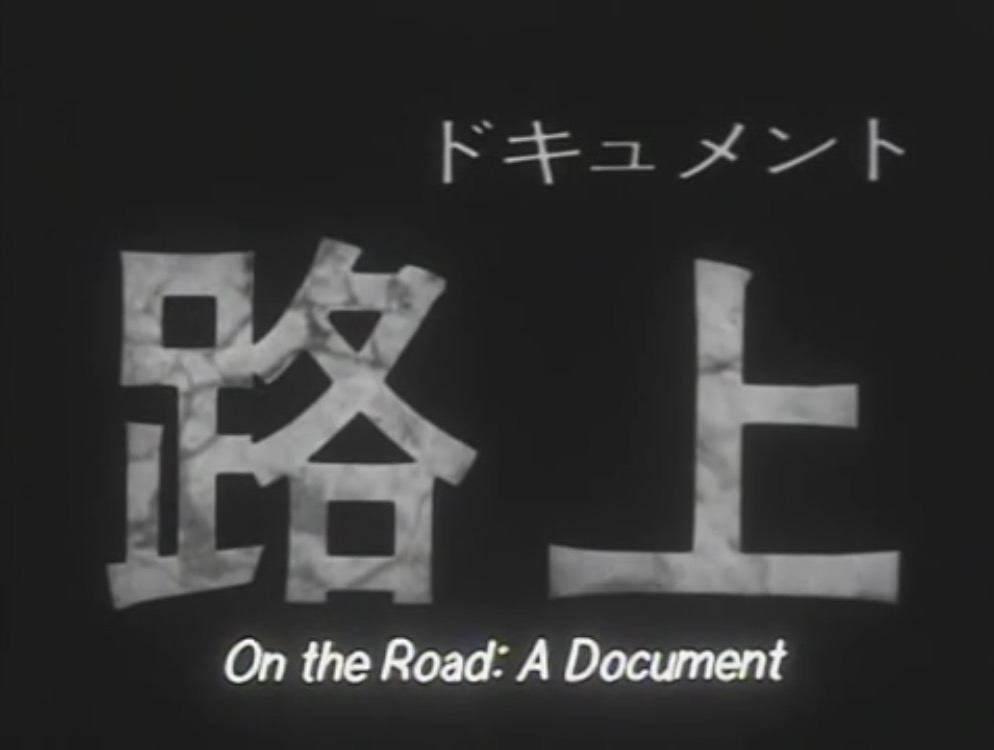
On the Road: A Document ドキュメント 路上(Tsuchimoto Noriaki, 1964)

One of the towering figures in Japanese documentary, Tsuchimoto Noriaki began his career as a documentarist, like many of his generation, at Iwanami Production in 1956. Tsuchimoto was since his university years a very active student, involved in the establishment of Zengakuren, member of the Japanese Communist Party and eventually expelled from Waseda University in 1953 for political activities. Mostly known in Japan and in the rest of the world, and rightly so, for his life-long series on Minamata and the mercury poisoning caused by Chisso Corporation, a total of 15 films in more than 40 years, Tsuchimoto in his long career tackled with his movies many different issues. Another Afghanistan: Kabul Diary 1985 and Traces: the Kabul Museum 1988, two movies set and about Afghanistan in a crucial time for the country, Nuclear Scrapbook (1982) on the danger of Japan’s nuclear policies, and On the Road: A Document, are some of his best non-Minamata works. It’s on this last one that I’d like to focus my attention today.
At the Beginning of the 60s Tokyo, and Japan in general, was in turmoil and experiencing huge changes, on the one hand the country was trying to leave behind and “forget” the tragedies of war, the consequent American occupation and more than 20 years of militarization and nationalism, on the other hand Japan was projecting itself and its people at maximum speed towards the future and a new phase. This “double” movement implied, among other things, starting a series of infrastructure projects that would completely alter the landscape of urban and suburban areas of the country, especially in preparation for the big international showcase of 1964, the Tokyo Olympics: streets, highways, the launch of the Shinkansen (the famous bullet train), and the devil’s pact with atomic energy. All changes that would shape, for better or for worse, the country’s future and made it what it is today.
On the Road was made in this whirl of structural, social and political changes, let’s not forget the huge demonstrations against the ANPO treaty in 1960 and those that would shake the country in the following years, a period of turmoil that is reflected in the film’s production history, as Zakka Films site puts it:

On the Road was originally commissioned as a traffic safety film with the Metropolitan Police as one of the sponsors. But it actually had a double existence: in reality Tsuchimoto was also working with the drivers’ union. When a police official finally saw the film, he dismissed it as “useless—the plaything of a cinephile,” and so it was never used for its original purpose. While winning numerous awards abroad, including at Venice, it was shelved in Japan for nearly 40 years.

The production is also a strong statement of Tsuchimoto’s artistic independence and creativity as a filmmaker, “The film was conceived as an experimental dramatized documentary” and “Tsuchimoto had amateur actors play the principal roles and, because the sound and image were recorder separately, asked drivers to reenact their duties, meeting and conversations”*. For all these reasons On the Road turned into a formally and highly creative documentary and a very different one, in style and concept, from those of the Minamata series that would follow in five years. Alienating music, fast editing and a cacophonic cityscape rendered through a jazz-like rhythm bring to mind the city symphony movies of the beginning of the 20th century, reimagined for and in the 60s. A snap-shot of an era of change for Japanese society framing a mutating urbanscape with a free-style touch that makes it highly watchable and fresh even for today’s viewers.

While it’s important to praise and introduce all the movies of the Minamata series to the broadest audience possible, it’s also vital not to overlook some of Tsuchimoto’s works made outside of his life-long series and by doing so affirming his importance and role in the history of Japanese documentary.

On the Road: A Document is available on DVD (with English subtitles) at Zakka Films, of course!

* from the DVD booklet

Autumn madness: Kobe Doc Fest, Ogawa Production in London and much more


It’s again Autumn madness, that time of the year when there are more cinema-related events around the world than stars in the sky: festivals, special screenings, symposia, festivals, home-movie days and again festivals, festivals and festivals. For cinephiles around the globe it is at the same time a period of blessing and curse, which festival to go to? which screenings to attend? and how not to spend all the money saved during the year…
Let’s take a look of what the Autumn madness has to offer this year in terms of Asian non-fiction cinema.

By far the biggest festival in the region, the Busan International Film Festival, kicks off on October 6th and this year is a special one for BIFF, following the problems the event has been facing in the recent 12 months (you can read more here and here).
The line-up is as always huge and varied, and if we include the market, trying to follow even only a small portion of the screenings offered is an almost impossible task. Anyway, as South and Southeast Asian documentary is concern, these are some movies that will be shown and worth seeing if you’re in Busan:

Documentary Competition

Diamond Island (Davy Chou, 2016) Cambodia/France/Germany/Thailand/Qatar

Sunday Beauty Queen (Baby Ruth Villarama, 2016) Philippines/Hong Kong, China/Japan/United Kingdon

Time to Read Poems (Lee Soojung, 2016) South Korea

A Whale of a Tale (Sasaki Megumi, 2016) Japan/United States

Absent Without Leave (Lau Kek-Huat Chen Jing-Lian, 2016) Taiwan/Malaysia

Burmese on the Roof (Oh Hyunjin, 2016) South Korea

Farming Boys (Jang Sejung Byun Siyeon, 2016) South Korea

Neighborhood (Sung Seungtaek, 2016) South Korea

Railways Sleepers (Sompot CHIDGASORNPONGSE, 2016) Thailand

SUN (Won Hoyeon, 2016) South Korea

The Crescent Rising (Sheron Dayoc, 2016) Philippines

Documentary Showcase

Becoming Who I Was (Moon Changyong Jeon Jin, 2016) South Korea

Fake (Mori Tatsuya, 2016) Japan

In Exile (Tin Win Naing, 2016) Germany/Myanmar

Ta’ang (Wang Bing, 2016) Hong Kong, China/France

The Remnants (Lee Hyuk-sang KIM Il-rhan, 2016) South Korea

WEEKENDS  (Lee Dongh, 2016) South Korea

If you want to know more and read each movie’s synopsys, do please visit BIFF’s homepage: Documentary Competition and Documentary Showcase.

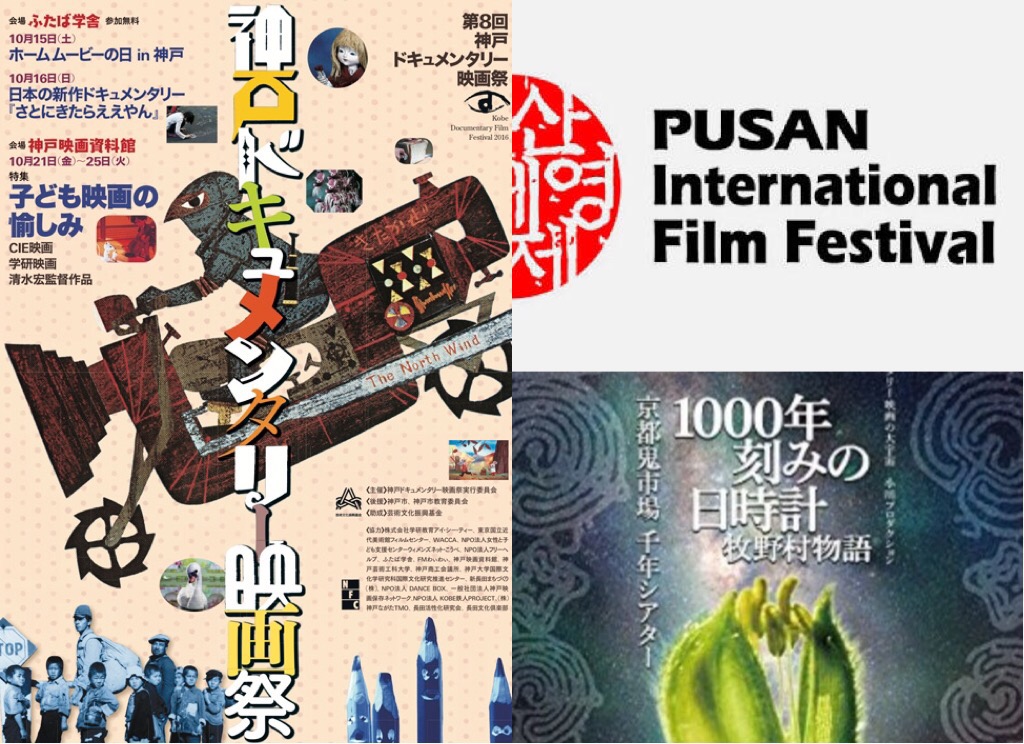
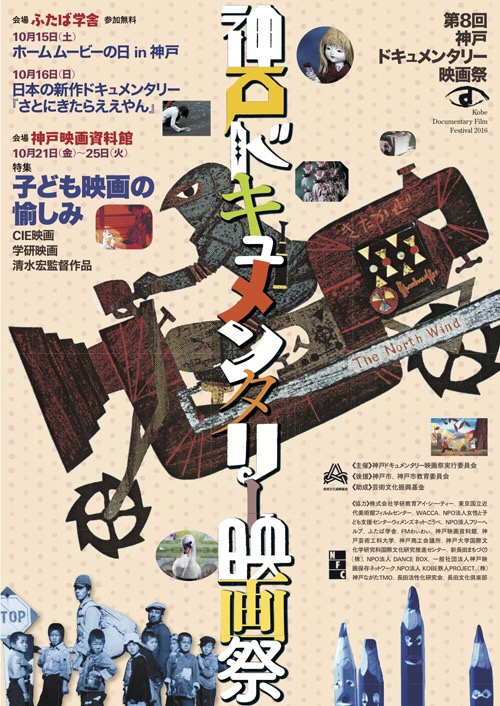
One of the most interesting festivals of the season, at least for me, is the Kobe Documentary Film Festival, a small and minor event organized every year since 2009 at the Kobe Planet Film Archive. This year the main theme will be “The pleasure of children movies” and as usual a wide range of movies will be screened, a fascinating program goes under the title of CIE Films (CIE 映画) where CIE stands for “Civil Information and Education Section”. Established by the Allied Powers soon after the end of World War II as a special section of the General Headquarters (GHQ), its task was to advise the Supreme Commander for the Allied Powers (SCAP) on policies relating to “public information, education, religion, and other sociological and cultural problems of Japan.” CIE donated about 1300 Natco 16mm projectors to the Japanese Ministry of Education to be distributed around the country, and with them short educational movies from United States, Canada and other countries in hopes of implementing the process of democratization in the country through cinema. This part of history of Japanese cinema is an important one if we want to grasp and understand the subsequent development of educational film, and by extension documentary, in the archipelago. A first part of the program is thus dedicated to foreign movies introduced in Japan by CIE, Everyone’s School (1948), Near Home (1948), Beautiful Dreamer (1949), Freedom of the Press (1951), Experimental Elementary School (1949) and Nanook of the North (1922),  with other programs continuing on the same trail and presenting Japanese educational films produced from the late 50’s to the 70’s, science, art, environment and big events (like the Expo in Osaka in 1970) are some of the themes tackled in the short movies, including 5 works created in different style of animation (puppet and stop motion paper animation).
It is worth mentioning that a program is also dedicated to the less known works (about and with children) of Shimizu Hiroshi, on of the finest Japanese filmmakers of the last century, but one who definitely deserve more space and consideration in the world cinema community. A good starting point is this DVD box set put out by Criterion, and two sets from Shochiku (the first is the same as the Criterion one) and “amazingly” both come with English subtitles.
The Festival will take place from October 21st to the 25th and will be preceded by the Home-Movie Day on October 15th, if you read Japanese the festival home page has the complete line-up.

tiff2016-yoko

From Kobe to Tokyo, where the 29th Tokyo International Film Festival will open its gates on October 25th, South and Southeast Asian non-fiction cinema will be represented by a bunch of works, to keep on the radar the new endeavor by  Matsue Tetsuaki (Live Tape, Flash Back Memories), DDT: Dramatic Dream Team!! -We are Japanese Wrestlers!, a year in the life of a pro-wrestling group, Welcome to SATO, about a children’s center in the day laborers’ town of Kamagasaki, and Mamoru Hosoda’s Job: Animation Film Director“A Soulful Film Illuminating Hope”, a documentary made for TV (part of NHK’s The Professionals series) about director Mamoru Hosoda.

vlcsnap-2016-10-02-16h00m26s750
Let’s leave Asia and move to Europe, and more precisely to London, where from November 17th to Dec 11th the Institute of Contemporary Arts is organizing a retrospective on Ogawa Shinsuke‘s (or better Ogawa Production) works. I’ve written many times on this blog about Ogawa and the importance of his movies for the history and development of documentary in Asia (although not yet a long and more in-depth piece), and of course a must is Forest of Pressure written by Abe Markus Nornes. This is the schedule:

Thu 17 Nov: The Oppressed Students (1967)

Sat 19 Nov: The Battle Front for the Liberation of Japan – Summer in Narita (1968) +Sanrizuka – The Three Day War (1970)

Tue 22 Nov: Sanrizuka – Peasants of the Second Fortress (1971)

Thu 24 Nov: The Wages of Resistance: The Narita Stories (Otsu Koshiro and Daishima Haruhiko, 2015)

Sat 26 Nov: Heta Village: Rending Village Time | A lecture by Markus Nornes +Sanrizuka – Heta Village (1973)

Sun 27 Nov: Filmmaking and the Way to the Village (Fukuda Katsuhiko, 1973) +Devotion: A Film About the Ogawa Productions (Barbara Hammer, 2000)

Wed 30 Nov: Dokkoi! Songs from the Bottom (1975)

Sat 10 Dec: “Nippon”: Furuyashiki Village (1982)

Sun 11: The Sundial Carved with a Thousand Years of Notches – The Magino Village Story (1986)

If you’re in London, it’s really a chance not to be missed.

Memories of Agano (阿賀の記憶 Satō Makoto, 2004)

This is an unfinished draft for an essay on Satō Makoto’s Memories of Agano 「阿賀の記憶」, a work in progress, at this stage no more than a series of random thoughts about one of my favorite movies.


last update: 26 September 2017


“…the habit of imposing a meaning to every single sign”

Trinh Minh-Ha


Satō Makoto’s documentaries seem to be (again) part of the filmic discourse in Japan, or at least on the rise in some cinematic circles, and deservedly so. Nine years have passed since his death, this year (2016) a book titled「日常と不在を見つめて ドキュメンタリー映画作家 佐藤真の哲学」(roughly rendered “Gazing at everyday and absence, the philosophy of documentarist Satō Makoto”) was published and a screening of all his documentaries, followed by discussions and talks, was held in Tokyo in March and later at the Kobe Planet Film Archive. I haven’t read the book yet, but the title summarizes and conveys perfectly the themes embodied in Satō’s last works: the dicothomy absence/presence and the presence of absence, that is to say the phantasmatic presence of cinema.

Sato’s final works, Self And Others, Memories of Agano and Out of Place: Memories of Edward Said witness and embody a shift in Satō’s approach, movies through which he was attacking and partly deconstructing the documentary form, to be fair with his works though, it’s a touch that was partly present in his films since the beginning, but in these three documentaries it becomes a very prominent characteristic. This publication seems to be timely and enlightening because is tackling Sato’s oeuvre not necessarily from a purely cinematic point of view, the book’s curator is by her own admission not a cinema expert, but it’s expanding the connections of Satō’s movies and writings towards the philosophical.

I hope the book will kindle and revive a new interest on his works, Satō is in my opinion one of the most important Japanese directors of the last 30 years, and sadly one of the most unknown in the West, I don’t really think there’s much out there in the internet or on paper about Satō, nor in English nor in other non-Japanese languages, and it’s a pity and a missed occasion because his movies, again, are more than “just” documentaries, or even better, are documentaries that have the power to question their own form and stretch in many differents areas. If you’re not familiar with his works, you can get a glimpse of Satō and his touch reading this beautiful and long interview, or you can buy them on DVD thanks to Siglo, it’s a rarity in Japan, but they come with English subtitles.

This year (2017) Yamagata International Documentary Film Festival will also hold a retrospective for the 10th anniversary of Satō’s death, commemorating and celebrating his works, his influence and his reception abroad.

One of Satō’s documentaries that resonates with me more than others, even after many viewings, is Memories of Agano (阿賀の記憶, 2004). As the YIDFF describes it:

Ten years after the acclaimed film Living on the River Agano, the film crew returns to Niigata. Personal memories reflect upon remnants of those who passed away as the camera observes abandoned rice fields and hearths that have lost their masters.

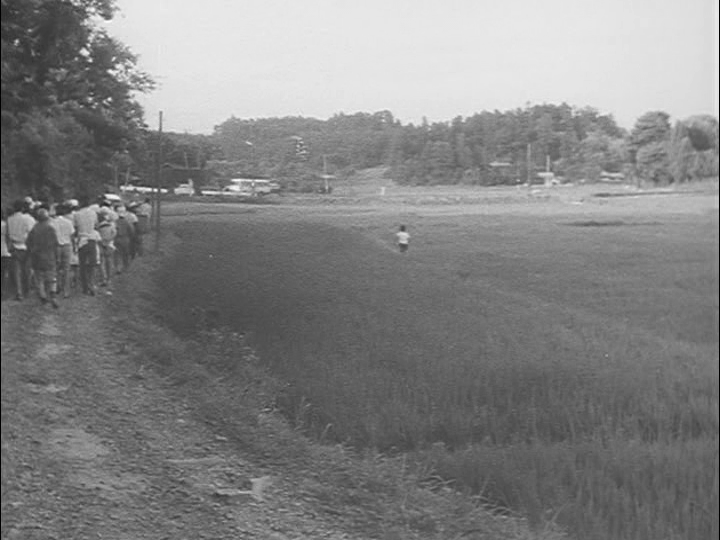
It is a relatively short but complex movie running only 55 minutes, an experiment in the form of a non-fiction film, splendidly shot on 16mm by cameraman Kobayashi Shigeru, the same cameraman who worked and lived together with Satō in Niigata for more than three years during the shooting of Living on the River Agano. The film is a poem on the passing of time and consequently on the objects that will outlive us, the persistence of things in time, including cinema itself. The original idea was in fact to make a film about the remnants of Meiji, that is “the glass photographic plates of the Niigata landscape from the late Meiji to early Taisho era (1910s) left behind by photographer Ishizuka Saburo. Using those old black and white photographs as a motif, we started out making the film with the same concept as Gocho Shigeo in Self and Others”. This quasi-obsession with objects is the thread that waves through the film’s fabric: boiling tea pots, old wooden houses, tools…

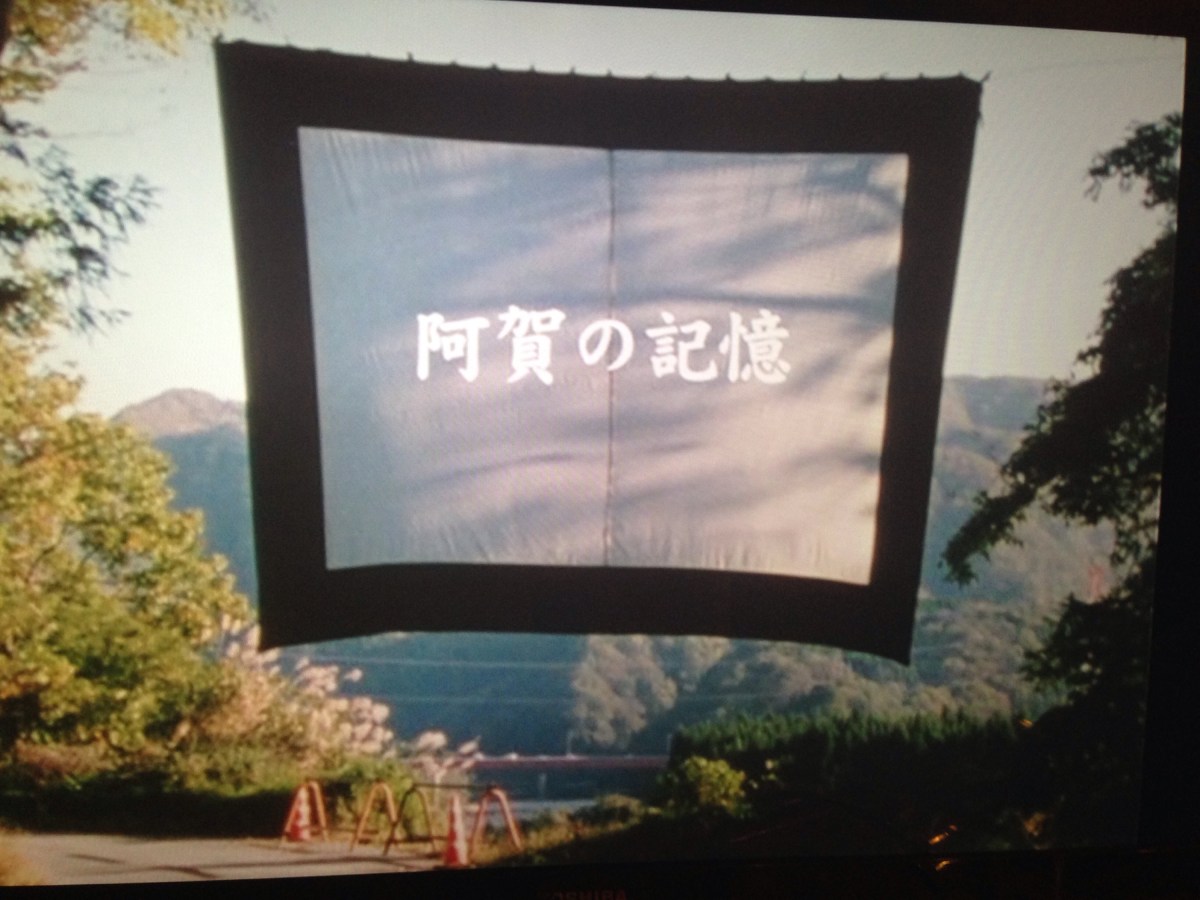
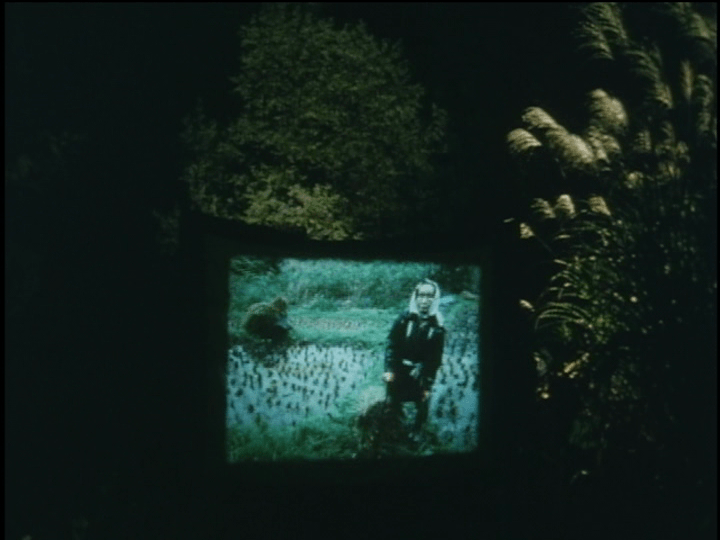
One of the most stunning scene of the movie and one that defines Memories of Agano is placed at the very beginning, when Satō and Kobayashi after returning to the area where the first movie was shot hang a big canvas tarp in the middle of a wood projecting on it the documentary they made 10 years before. The effect is profoundly disturbing and touching at the same time, images and thus memories are suddenly like tangible spectres.

On another level, Memories of Agano with its intertwining of past, present and landscapes ー the external ones with mountains, fields, rivers, and the interior landscapes of old and almost empty houses ー could also be read as an attempt to approach and partly re-elaborate the fūkeiron-cinema, the theory-of-landscape-oriented-cinema, 「footnote: “launched” almost five decades ago with A.K.A. Serial Killer (1969),  The Man Who Left His Will on Film (1970), Red Army/PLFP: Declaration of World War (1971) and The First Emperor (1973)」

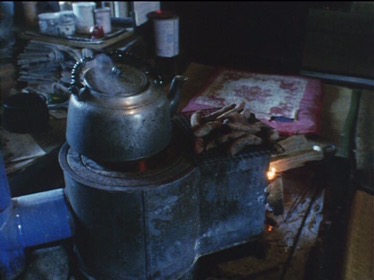
As for its aesthetics, one of the quality that strikes me every time I rewatch it, is the slow pace and the use of long takes that give the movie a dreamlike quality of lethargic torpor. The scene that embodies at most this aesthetic idea is an almost static shot of a teapot boiling on an old stove lasting about 10 minutes, on the background, sort of white noise, the words of an old lady spoken with a thick Niigata accent. She talks sparsly with Satō himself also about the fact she doesn’t wanna be filmed, half jokingly half seriously, a breaking of the fourth wall so to speak, a dialogue between camera and object filmed that was prominently present in Living on River Agano as well (“Are you filming me?” “Don’t shoot me!” are sentences that punctuate the course of this movie and the one made in 1992).

Memories of Agano also present itself as a documentary of opacity rather than one of transparency, the choice of not using the subtitles when people speak with their thick Niigata accent, a Japanese citizen from another area of the archipelago would probably understand 50% or 60% of what is said, a technical option that was used in Living on the River Agano – signals a major change in Satō’s approach to documentary and cinema in general. Feeding the viewer with limpid and clear messages and making a “comprehensible” movie is not what interests Satō here, but rather placing obstacles, visual riddles so to speak – the aforementioned tarp for instance, but also visually striking moments of pure experimentation – and thus presenting the opacity of the cinematic language seems to be the goals he had in mind when he conceived Memories of Agano. The images are thus escaping the organizing discourse tipical of so many Japanese documentaries, in contrast they open to new (cinematic) discoveries and keep resonating with the viewers and engage us on many different levels.

100 best Japanese labor films

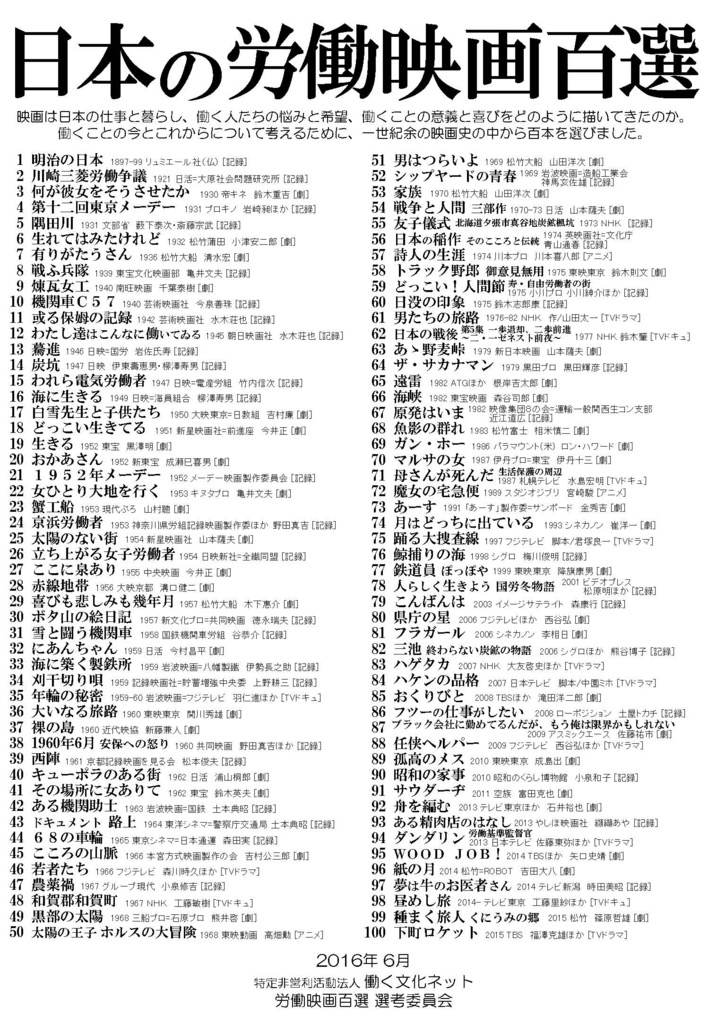
Last June the NPO organization “Hataraku Bunka Net” made and released a list of the 100 best Japanese labor films, a vast and varied list that besides documentaries includes also many classic movies and big names, TV series, indies and so on, from the beginning of cinema, with the actualities filmed by the Lumière company at the end of 19th century, to the present day. Below you can find the list in Japanese followed by my translation (feel free to correct me if you find any mistakes):

  1. 『明治の日本』(1897~1899, Lumière company )
  2. Kawasaki Mitsubishi Strike 「川崎・三菱造船所労働争議」(1921)
  3. What Made Her Do It? 「何が彼女をそうさせたか」(Suzuki Shigeyoshi, 1930)
  4.  Twelfth Annual Tokyo May Day 「第 12 回東京メーデー」(Prokino, 1931)
  5. Sumida River 「隅田川」(Yabushita Taiji, 1931)
  6. I Was Born, But… 「生れてはみたけれど」(Ozu Yasujirō, 1932)
  7. Mr. Thank You 「有りがたうさん」(Shimizu Hiroshi, 1936)
  8. Fighting Soldiers 「戦ふ兵隊」(Kamei Fumio, 1939)
  9.  Renga jokō 「煉瓦女工」(Chiba Yasuki, 1940)
  10. Kikansha C57 「機関車C57」 (Imaizumi Zenju, 1940)
  11. Record of a Kindergarten Teacher 「或る保姆の記録」(Mizuki Soya, 1942)
  12. We’re Working So So Hard 「私たちはこんなに働いている」(Mizuki Soya, 1945)
  13. Rushing Forward 「驀進」(Iwasa Ujitoshi, 1946)
  14. Coal Mine 「炭坑」(Itō Sueo, Yanagisawa Hisao, 1947)
  15. We Are Electric Industry Workers 「われら電気労働者」(1947)
  16. Living on the Sea 「海に生きる」 (Yanagisawa Hisao, Kabashima Seichi, 1949)
  17. Shirayuki-sensei to kodomo-tachi「白雪先生と子供たち」(Yoshimura Ren, 1950)
  18. Still We Live 「どっこい生きてる」(Imai Tadashi, 1951)
  19. Ikiru 「生きる」(Kurosawa Akira, 1952)
  20. Mother 「おかあさん」(Naruse Mikio, 1952)
  21. May Day 1952 [1952年メーデー」(Yoshimi Yutaka, 1952)
  22. Woman Walking Alone on the Earth「女ひとり大地を行く」(Kamei Fumio, 1953)
  23. The Crab Cannery Ship 「蟹工船」 (Yamamura Sō, 1953)
  24. The Wokers of Keihin 「京浜労働者」(Noda Shinkichi, 1953)
  25. The Street Without Sun 「太陽のない街」(Yamamoto Satsuo, 1954)
  26. Tachiagaru onnanoko rōdōsha (Zensen domei, 1954)
  27. Koko ni izumi ari 「ここに泉あり」(Imai Tadashi, 1955)
  28. Street of Shame 「赤線地帯」(Mizoguchi Kenji, 1956)
  29. The Lighthouse aka Times of Joy and Sorrow 「喜びも悲しみも幾歳月」(Kinoshita Keisuke, 1957)
  30. Bota san no enikki 「ボタ山の絵日記」(Tokunaga Mizuo, 1957)
  31. Yuki to tatakau kikansha 「雪と闘う機関車」(Tani Kyōsuke, 1958)
  32. My Second Brother「にあんちゃん」(Imamura Shōhei, 1959)
  33. Umi ni kizuku seitetsujo「海に築く製鉄所」(Ise Chōnosuke, 1959)
  34. 刈干切り唄(1959, Ueno Kōzō)
  35. The Secret of Tree Rings (TV series) 「年輪の秘密」(Hani Susumu, Noriaki Tsuchimoto, Nagano Shigeichi 1959-60)
  36. Ōinaru tabiji「大いなる旅路」(Sekigawa Hideo, 1960)
  37. The Naked Island 「裸の島」(Shindō Kaneto, 1960)
  38. 1960 nen  6 gatsu anpo e no ikari「1960年6月 安保への怒り」(Noda Shinkichi Noda, Tomizawa Yukio, 1960)
  39. The Weavers of Nishijin 「西陣」(Matsumoto Toshio, 1961)
  40. Foundry Town 「キューポラのある街」(Urayama Kirio, 1962)
  41. Woman of Design「その場所に女ありて」(Suzuki Hideo, 1962)
  42. An Engineer’s Assistant「ある機関助士」 (Tsuchimoto Noriaki, 1963)
  43. On the Road—A Document 「ドキュメント 路上」(Tsuchimoto Noriaki, 1964)
  44. 68 no sharin 「68の車輪」(Morita Minoru, 1965)
  45. Kokoro no sanmyaku「こころの山脈」(Yoshimura Kōzaburō, 1966)
  46. The Siblings 「若者たち」(Tokihisa Tokihisa Morikawa, 1966)
  47. Nōyaku ka「農薬禍」(Shūkichi Koizumi, 1967)
  48. Waga Town, Waga District in Summer 1967 「特集 和賀郡和賀町 1967年 夏」(Kudo Toshiki, 1967)
  49. The Sands of Kurobe 「黒部の太陽」(Kumai Kei, 1968)
  50. The Great Adventure of Horus, Prince of the Sun「太陽の王子 ホルスの大冒険」(Takahata Isao, 1968)
  51. It’s Tough Being a Man 「男はつらいよ」(Yamada Yōji, 1969)
  52. Shipyard no seishun 「シップヤードの青春」(Kamiuma Isao, 1969)
  53. Where Spring Comes Late 「家族」(Yamada Yōji, 1970)
  54. Men and War trilogy 「戦争と人間 三部作」(Yamamoto Satsuo, 1970-73)
  55. Yūko gishiki Hokkaido Yubari shi mayachi tankō kaede ana「友子儀式 北海道夕張市真谷地炭鉱 楓坑」(NHK archives, 1973)
  56. Nihon no inasaku sono kokoro to dentō「日本の稲作 そのこころと伝統」(Aoyama Michiharu, 1974)
  57. A Poet’s Life 「詩人の生涯」(Kawamoto Kihachirō, 1974)
  58. Torakku Yarō: goiken muyō 「トラック野郎 御意見無用」(Suzuki Norifumi, 1975)
  59. A Song of the Bottom「どっこい!人間節 寿・自由労働者 の街」(Ogawa Production, 1975)
  60. Impressions of a Sunset「日没の印象」(Suzuki Shiroyasu, 1975)
  61. Otokotachi no tabiji 「男たちの旅路」(NHK drama, 1976-1982)
  62. Nihon no sengo dai 5 「NHK特集 日本の戦後 第5集 一 歩退却 二歩前進 二・一ゼネスト前 夜」(NHK, 1977)
  63. Oh! The Nomugi Pass 「あゝ野麦峠」(Yamamoto Satsuo, 1979)
  64. The Sakana man 「ザ・サカナマン」(Kuroda Teruhiko, 1979)
  65. Enrai 「遠雷」(Negishi Kichitarō, 1981)
  66. Kaikyō 「海峡」(Minami Kōsetsu, 1982)
  67. Genpatsu wa ima 「原発はいま」(Ōmi Michihiro, 1982)
  68. The Catch 「魚影の群れ」 (Sōmai Shinji, 1983)
  69. Gung Ho (Ron Howard, 1986)
  70. A Taxing Woman 「マルサの女」(Itami Jūzō, 1987)
  71. Haha ga shinda – seikatsu hogo no shūhen  『母さんが死んだ―生活保護の周辺』(Mizushima Hiroaki, 1987)
  72. Kiki’s Delivery Service「魔女の宅急便」(Miyazaki Hayao, 1989)
  73. Earth 「あーす」(Kim Soo-Kil, 1991)
  74. All Under the Moon 「月はどっちに出ている」(Sai Yōichi, 1993)
  75. Bayside Shakedown 「踊る大捜査線」(Motohiro Katsuyuki, 1997)
  76. Whalers and the Sea 「鯨捕りの海」(Umekawa Toshiaki, 1998)
  77. Poppoya 「鉄道員/ ぽっぽや」(Furuhata Yasuo, 1999)
  78. Be More Human – Kokuro’s 15-year Struggle 「人らしく生きよう 国労冬物語」(Matsubara Akira, Sasaki Yumi
  79. Konbanwa「こんばんは」(Mori Yasuyuki, 2003)
  80. Genchō no hoshi「県庁の星」(Nishitani Hiroshi, 2003)
  81. Hula Girls 「フラガール」 (Lee Sang-il, 2006)
  82. Echoes From The Miike Mine「三池 終わらない炭鉱(やま)の物語」(Kumagai Hiroko, 2006)
  83. Hagetaka – TV drama 「土曜ドラマ ハゲタカ」 (Ōtomo Keishi, Inoue Go, Horikirizono Kentarō, 2006)
  84. Haken no Hinkaku – TV drama 「ハケンの品格」(Nagumo Seiichi, Satō Toya, 2007)
  85. Departures 「おくりびと」(Takita Yōjirō, 2008)
  86. A Normal Life, Please 「フツーの仕事がしたい」(Tsuchiya Tokachi, 2009)
  87. Genkai in a Black Company 「ブラック会社に勤めてるんだが、 もう俺は限界かもしれない」(Satō Yūichi, 2009)
  88. Ninkyō Helper 「任侠ヘルパー」(TV drama, 2009)
  89. A Lone Scalpel 「孤高のメス」(Narushima Izuru, 2010)
  90. Showa Housekeeping 「昭和の家事」(Koizumi Kazuko, 2010)
  91. Saudade 「サウダーヂ」(Tomita Katsuya, 2011)
  92. The Great Passage 「舟を編む」(Ishii Yuya, 2013)
  93. Tale of a Butcher Shop 「ある精肉店のはなし」(Hana usa Aya, 2013)
  94. Dandarin Rules 「ダンダリン 労働基準監督官」(Sato Tayō, Nakajima Satoru, 2013)
  95. Wood Job! 「ウッジョブ~神 去なあなあ日常」(Yaguchi Shinobu, 2014)
  96. Pale Moon 「紙の月」(Yoshida Daihachi, 2014)
  97. A Little Girl’s Dream 「夢は牛のお医者さん」(Tokita Yoshiyaki, 2014)
  98. Hirumeshi tabi: Anata no gohan misetekudasai! 「昼めし旅 ~あなたのご飯見せてく ださい」(TV drama, 2014)
  99. A Sower of Seeds 「種まく旅人 くにうみの郷」(Shinohara Tetsuo, 2015)
  100. Shitamachi Rocket 「下町ロケット」(TV drama, 2015)

Ogawa Production’s Sanrizuka Series – DVD Box set is out today

img_2206

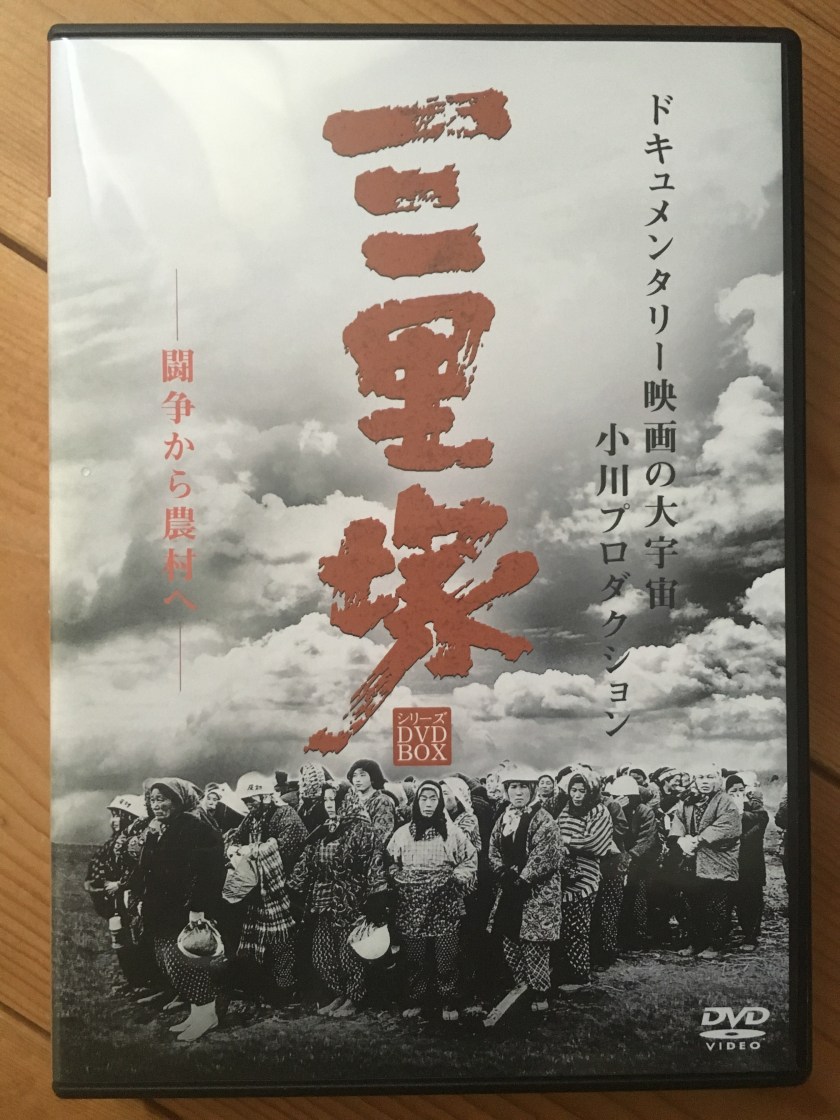
Known outside Japan as the Narita series, the works made by Ogawa Shinsuke and his collective from 1968 to 1973 (with a return to the area in 1977) filming the battle and resistance of farmers, students, activists against the building of Narita airport, are usually called in Japan the Sanrizuka series, from the name of the area where the main struggle and land expropriation took place (an ongiing battle that is not over, by the way). As written briefly in a previous post, the Japanese label DIG is putting out on DVD all the documentaries of Ogawa Production, the first 3 films were released in June, and today (July 2nd) DIG is also releasing a DVD box set of the Sanrizuka/Narita series. Here’s the list of the works included in the box set:

  1.  Summer in Narita『日本解放戦線 三里塚の夏』(1968)
  2. Winter in Narita 『日本解放戦線 三里塚』(1970)
  3.  Three Day War in Narita『三里塚 第三次強制測量阻止斗争』(1970)
  4.  Narita: Peasants of the Second Fortress『三里塚 第二砦の人々』(1971)
  5. Narita: The Building of Iwayama Tower  『三里塚 岩山に鉄塔が出来た』(1972)
  6. Narita: Heta Village 『三里塚 辺田部落』(1973)
  7. Narita: The Sky of May  『三里塚 五月の空 里のかよい路』(1977)
  8. as an extra work, available only in the box set: Fimmaking and the Way to the Village (1973, Fukuda Katsuhiko)『映画作りとむらへの道』(1973)

The box set comes with a booklet where each movie is introduced and a final note by renown documentarist Hara Kazuo. I haven’t had the chance to watch them yet, so I can’t say anything about the transfer*.
All the DVDs don’t have English subtitles, but that fact that finally these important documentaries are available on home-video basically for the first time, the only Summer in Narita was released with a book a couple of years ago, is something to rejoice. My hope is that some label outside Japan (maybe Zakka Films or even Icarus Films, why not?) will one day in the near future put together an international edition.

* July 4th addendum: I’ve watched some minutes of Heta Village, The Building of Iwayama Tower and Narita: Peasants of the Second Fortress just to get an idea of the transfer’s quality. As I expected the DVDs mirror the quality of the original prints – I’ve seen them all on the big screen, but many times on quite battered DVD samples, so my memory might trick me here. Be that as it may, the movies are not in a good state, lots of scratches, flecks and dirt, in a perfect world they would have had a restoration first and they would have been transferred on DVD only later. But we don’t live in a perfect world and the huge debt left by the group is still hindering any “normal” process of preserving and presenting the works in a pristine state. That being said,  this release is an important step anyway, because it will help to introduce Owaga Pro and its documentaries to a wider and younger audience, and just for this reason it’s a project that should be praised.

Land of the Dawn 「夜明けの国」(Tokieda Toshie, 1967)

The Chinese Cultural Revolution began 50 years ago, and newspapers, websites, magazines, blogs and books have recently taken the opportunity of this anniversary to write about, discuss and analyse the huge and still controversial historical event that shaped the Asian country and whose ripples were felt all over the world.
In 1966, a group of filmmakers from Japan were allowed to enter the country, or rather, they were lucky enough, almost by chance, to be in China just after the revolution was proclaimed (in August 1966) to film and record, almost without knowing what was happening, the changes brought about by the event. This was something of a “miracle”, as there were no formal diplomatic relations between the two countries at the time. The documentary is by no means a critical view of the revolution, as it was still in its infancy, and also because there were areas the group was not allowed to film, but it works as a visual and unique document of the early period of the revolution. The group spent seven months filming landscapes, factories, cities, farms and people across China, and the resulting documentary was compiled the following year under the title Land of the Dawn 夜明けの国.

The film was directed by Tokieda Toshie, a filmmaker who worked for and was associated with Iwanami Production for over 30 years. Among her extensive filmography, at least worth mentioning is Town Politics-Mothers Who Study 町の政治 – 勉強するおかあさん」 (1957), a depiction of a group of mothers-turned-activists in the town of Kunitachi, Tokyo (the short documentary is part of the films featured in this edition box set).

There’s an interesting interview with Tokieda on the Yamagata International Documentary Film Festival website, in which she recalls her experiences of filming in China. The film is also discussed in a chapter of Nakajima Takahirō’s The Chinese Turn in Philosophy (2007):

「The film」opens with a scene showing young Red Guards arriving from throughout China and gathering in Tian’an men Square. In the following scene a train appears with a plate indicating “Wansui Maozhuxi [long live Chairman Mao];” it is an express train traveling from Beijing to Shanhai Guan. The narrator of the film tells us that the young people clustering around Shanhai Guan station are tourists going to see the Great Wall. However, Tsuchiya Masaaki suggests that
these young people teeming around the station are not tourists, but are going to Tian’an men Square to see Mao Zedong.
It must be easy to reach such an understanding if we could comprehend the meaning of August 1966, or at least if we could grasp the meaning of the opening scene of the young Red Guards gathering in Tian’an men Square. However, the film presents the opening scene like a picnic or a school excursion, when they take souvenir photos and write their names in Mao notebooks and exchange them. It is “daily life” in the New China, which is regarded as being similar to daily life in Japan where people enjoy having fun. Following this line, the second scene at Shanghai Guan station is to be understood as showing tourists going to the Great Wall. Likewise, if we go to the third scene, it shows people bathing in the Songhua River in Ha’erbin City. In short, “Country of the Dawn” is edited to make the unusual event of the Cultural Revolution become normal and understandable to a Japanese audience.

This is just an excerpt from a chapter in which the author analyses the documentary in relation to Soseki Natsume’s Travels in Manchuria and Korea (here if you want to read more).
A final note on the availability of the film. In 2008 the movie was released on DVD, together with a book about the Cultural Revolution, it’s in Japanese without English subtitles, but if you’re interested you can buy it here.

Aragane 「鉱」by Oda Kaori

Aragane is the first full-length movie by Oda Kaori, a talented Japanese director who had her debut in 2012 at the Nara International Film Festival with the short Thus A Noise Speaks, a meta self-documentary that unflinchingly explored her coming out as a female gay and the subsequent reactions from her family. Aragane is a completely different work though, an experimental documentary that Oda directed, photographed and edited herself, but also a “product” of Bela Tarr‘s film.factory, the film school based in Sarajevo and established by the Hungarian director few years ago, a place where the Japanese director studied for three years. Aragane, the Japanese title means “ore” or small pieces of stone, was shot in a Bosnian coal mine and it’s an immersive and hypnotic sensorial experience, a very special and rewarding one that was presented last year at the Yamagata International Documentary Film Festival and later at the DocLisboa in Portugal.

I had the pleasure of meeting Oda in Yamagata and later on she was kind enough to answer my questions by email, you can read the interview here.

Aragane

Bosnia and Herzegovina, Japan              2015, 68’                                                Director: Kaori Oda, Cinematographer: Kaori Oda, Editor: Kaori Oda, Producers: Shinji Kitagawa – FieldRain, Emina Ganic – film.factory.

The movie starts overground with the camera gazing at some busy workers preparing and checking the machines before going deep down into the mine, the camera then ride on a cart and with a very long tracking shot slowly starts its descent into the inner part of earth. Once inside, we’re introduced and enveloped in  a world of darkness, a pitch black curtain broken only by sudden and random flashes of lights revealing a segment of a machine here and a face smeared with coal there. There are really few spoken words, we hear some random sentences uttered every now and then by the workers, but that’s all, much more important is the wall of noise created by movie, the soundscape being a crucial element of it. In the 68 minutes of deep immersion into the chthonian and dissonant world of the mine, we are almost constantly submerged by the cacophonous noise of the machinery, although the movie is also punctuated by sparse but significant and sudden moments of deafening silence. At the end of the movie for instance, when we emerge from the bowels of the earth, the peace and the vivid colors of the changing rooms and the stillness of the hanging clothes have an almost soothing quality for our eyes and ears.
As stated by the director herself, Aragane is not a direct inquiry into the harsh conditions of the people working in the mine, although it’s something that eventually and necessarily emerges, but more an attempt to convey on screen the time and the space of the coal mine as experienced by the workers, or, I would add, as experience by the mine itself. It takes some time to get used to the alien space and almost abstract geographies of the mine, for most of the time we don’t really know what’s going on and who is doing what, it’s more like being thrown into a cubistic landscape in the middle of its making. Once we get accustomed to the time and the space presented on screen though, everything slowly begins to make sense, what starts to surface from the images and sounds, and through the tracking shots and the slow and hypnotic camera movements, is the time of the mine – time experienced as duration – and the materiality of the space depicted. On this point Aragane is a documentary very akin to the works of the the Harvard Sensory Ethnography Lab, Aragane reminded me – albeit with some distinctions of course- of Leviatahn, Single Stream and The Iron Ministry, just to name a few.             
Aragane is a compelling viewing experience, not a cinematic revolution or a masterpiece of course, but nonetheless a very significant work for Japanese documentary – it’s only partly Japanese to be honest, since it was produced and shot outside the archipelago.  What particularly interests me here is that finally Japanese cinema has an important work of non-fiction able to emancipate itself from the imprint of social and political documentary that usually dominates the contemporary non-fiction scene in Japan, and a work that in doing so liberate and explore the experimental qualities of documentary. I might exaggerate, but to find something similar in the history of Japanese cinema we have to go back to the great Matsumoto Toshio and his Ishi no uta (The Song of Stone, 1963).

img_1304