This is an initial exploration of the works and activities of the Your Bros. Filmmaking Group, with a special focus on one of their films. I hope to expand it into a more developed and articulate study once I’ve watched the other films produced by the collective.
“We wanted to get away from theater, from spectacle, to enter into direct contact with life. But life is also theater, life is also spectacle.” Edgar Morin
Your Bros. Filmmaking Group is a Taiwan-based collective made by artist So Yo-hen, architect Tien Zong-yuan, and art historian Liao Hsiu-hui. Founded in 2017, the group has since created a number of fascinating works situated at the intersection of documentary, fiction, ethnographic research, and performative art.
Their work primarily centers on the experiences of contemporary migrant workers from Southeast Asia living in Taiwan—Thai, Vietnamese, Indonesian—and history and representation of indigenous people of the island. Together with these communities, the group has produced several experimental documentaries that have been screened at film festivals around the world. Although So Yo-hen is often credited as the director on most of the group’s works, my understanding is that their films are largely collective endeavors, created not only with the other members of the group, but also with significant participation from the subjects of their documentaries. An open-ended approach that often embrace and include fieldwork, creative workshops, and unforeseen events occurring during the filmmaking process, resulting in a multilayered and sometimes opaque narrative structure.
This participatory approach is particularly evident in their latest endeavour, Park (2024), their first feature-length work, which over the past year has been screened and awarded at multiple festivals around the world. The film follows two Indonesian men who, under the starlit sky of a park in Tainan, converse and recite poems reflecting the experiences of fellow migrant workers.
I had the opportunity to see Park in Yamagata, and I only later realized that the group was also behind several other films I had encountered in recent years. Landscape Hunters for instance, is a fascinating short dealing with an indigenous man of the Bunun people who, around 70 years ago, was a passionate amateur mountain photographer. A work that is at the same time a reflection on the act of representing and capturing reality, as well as an interrogation on the absence of indigenous peoples in the history of photography, and, more broadly, audiovisual representation.
I had seen Dorm (2021), which focuses on a staged dormitory for Vietnamese female workers, a few years back. Park (2024), Dorm (2021) and Hut (2019), while different in the stories brought to the screen, are three works in dialogue with one another that explore similar themes and adopt a comparable structure. In all of them the performative act of the protagonists—migrant workers from different countries—convey stories, situations and feelings workshopped together with the filmmaking collective.
Having recently watched Hut, a work I found more relatable than the more celebrated Park, I will focus on this film here—although much of what I write could also apply to the other two titles, especially Dorm.
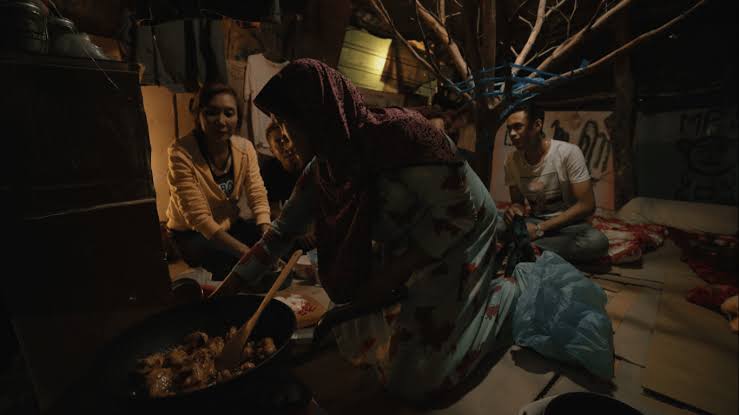
Released in 2019, Hut is a medium-length film set entirely in a single location—a tent-like structure. The people on screen are Indonesian migrant workers who portray fictional characters based on real situations: workers escaping from harsh and exploitative jobs in search of help and a refuge in the hut. While the stories are fictional they were developed by the people we see on screen in workshops, collaboratively with the director and the production team. They thus reflect the workers’ lived experiences and their perspectives on life accumulated during their time spent in Taiwan.
The documentary aspect of this visual experiment lies in the fact that the workers themselves are participating in a performative experiment, staging a kind of theatrical play for the camera.
The film begins with just a few people in the tent, but as time passes, the hut fills up, occasionally exposing tensions among individuals who have casually met in this safe space. As the number of occupants grows, conversations start to overlap, the atmosphere becomes increasingly chaotic, and the dialogues turns difficult to follow—a cacophony of voices in which nothing can be clearly discerned. This “white noise” continues for several minutes, perhaps ten or fifteen, until a cameraman enters the frame. From this point onward, the film’s perspective shifts: what was previously a distant—but still internal—view of the hut moves into the midst of the crowd, bringing the camera up close to the faces of those speaking. The editing, which until this point had favored long takes, becomes faster and at times almost aggressive, echoing the volume and intensity of the passionate discussions.
Towards the end of the 54-minute film, the screen goes black for a few seconds and when the images return, the sound is muffled bordering to silence. The scene then shifts to the hut, now nearly empty, as the camera slowly pans out to reveal the setting: the interior of a large factory, where a group of people is playing rock music, initially inaudible. After a couple of minutes, the rock music fills the screen, leading into the end credits.
There is a scene that, in my view, perfectly exemplifies both the film’s approach and the Chinese box—almost mise en abyme— structure adopted by Your Bros. group. We are in the first half of the film, the hut is not packed with people yet, and some of the workers enact an incident with the police. This scene is filmed and presented to the audience through the small screen of a smartphone, adding a layer of metatextual complexity to the work. For all we know, this story within the story—described by one of the young men as something that happened to a friend—could very well have happened to him personally in the real life.
Fictional or real, these stories—and the project as a whole—function as an externalisation of the fears and anxieties experienced by the migrants, operating ultimately as a kind of artistic therapeutic process. Truth conveyed through a double layer of fiction.
Yesterday, the Yamagata International Documentary Film Festival announced the prize winners for this year’s edition. In the International Competition, the main award, the Robert and Frances Flaherty Prize (Grand Prize), went to Direct Action (2024) by Guillaume Cailleau and Ben Russell, a documentary about the eco-activism of the so-called ZAD (zone à défendre). I haven’t seen the film yet, but I found it fascinating that it received the top award in Yamagata. According to reviews and people I spoke to during the festival, Direct Action devotes much of its time to the group’s everyday life and self-organizing routines — qualities that seem to echo Ogawa Pro’s Heta Village. Or perhaps I’m reading too much into it.
The Mayor’s Prize went to With Hasan in Gaza (2025), directed by Kamal Aljafari, with whom I had the pleasure of having a long and fascinating conversation on my last day at the festival. Some reviewers have described the film as a work of “personal archaeology,” and I couldn’t agree more. Aljafari discovered an old videotape in his camera—footage of himself traveling through Gaza in 2001 with a friend—and decided to turn it into an archival or found-footage documentary. Perhaps less experimental and opaque than his previous work, AFidai Film (2024), With Hasan in Gaza nonetheless manages to disorient the viewer. As the director explained after one of the screenings in Yamagata, the footage is presented exactly as it was shot, in chronological order, and in its entirety, with nothing edited out—not even the blurred, imperfect, or amateurish images. According to Aljafari, removing the poorly filmed segments would have been equivalent to erasing the memories of the people and the places filmed —especially when viewed from today’s perspective. That’s why he chose to keep everything. The only editing and intervention, he explained, was limited to the addition of sound and text.
Park by So Yo-Hen won the Denroku Award (Award of Excellence). The documentary follows two Indonesian men conversing under the stars in a park in Tainan. Poems about fellow migrants are read, but soon the film shifts into a more self-reflective mode. Park presents many interesting ideas—as is often the case with works emerging from the Your Bros. Filmmaking Group (see Dorm or Landscape Hunter, for instance)—yet I found it perhaps a bit stretched and meandering.
The other three awards in the International Competition went to Malqueridas (2023) by Tana Gilbert (Flex International Award, Award of Excellence); L’Homme-Vertige: Tales of a City (2024), directed by Malaury Eloi Paisley (Special Mention)—a film I really wanted to see but, unfortunately, couldn’t catch—and Ignacio Agüero’s Letters to My Dead Parents (2025). This was the first film I saw in Yamagata, a documentary composed of old footage of the director’s father and family, interwoven with interviews and images suspended like fragments of a dream to evoke life under the Pinochet regime in Chile. It feels more like a dreamlike patchwork of memories than a linear recollection of the past. Parts of the film are incredibly compelling—the conversation with an elderly union leader recalling his experiences during the military coup is especially powerful.
In the New Asian Currents program, the main prize (Ogawa Shinsuke Prize) was awarded to What Did You Dream Last Night, Parajanov? (2024) by Faraz Fesharaki, which unfortunately I didn’t have the chance to see. The Yamagata Shimbun and YBC Award (Award of Excellence) went to When the Trees Sway, the Heart Stirs (2025) by Lee Jiyoon. The camera moves through Jeongneung Valley in Seoul, an area slated for urban redevelopment where residents are being asked to leave. Elegiac in tone, the film alternates still shots of the neighborhood with conversations with its inhabitants, conveying a striking sense of spatial specificity. As these elements gradually take shape, the work becomes increasingly engaging; in fact, it is one of those rare cases where I felt the documentary could have benefited from a longer running time (it’s only 40′). In the same program, The Tales of the Tale by Song Cheng-ying and Hu Chin-ya received the Tohoku Denka Kogyo Award (Award of Excellence). It is a beautifully photographed—perhaps a bit too polished?—documentary about an old mine, evoking a ghostly atmosphere by weaving together images of ruins and the memories of miners. In its final minutes, the film reveals that the mine is slated for demolition, and a small group of former workers is opposing it. The relationship between the dead, the living, and the places they inhabit—a theme I mentioned en passant in my previous report—resurfaces here with particular force.
Lastly, the Citizen’s Prize went to Najiba Noori and Rasul (Ali) Noori for their documentary Writing Hawa (2024), which tells the story of a woman who learned to read and write later in life, only to see her dreams shattered by the return of the Taliban regime in 2021.
Read the YIDFF 2025 preview here, and report 2 here
Let’s start from the end. This is a short review of the last movie I saw in Yamagata, SPI by Sayun Simung, whose Millets Back Home I saw at the festival almost exactly 10 years ago.
The film explores what it means to be part of the Tayal Indigenous people in Taiwan in the 2020s. Director Simung approaches this through a first-person documentary, turning the camera toward her own family—as she did in Millets Back Home—crafting both a tribute to her late grandfather and an intimate portrayal of everyday life in the small mountain village of Sqoyaw.
At the center of the film lies the concept of Gaga, a term apparently difficult to translate, but that has been rendered as Tayal law and cosmology in academic papers. Simung embarks on a search for what Gaga means for her and her relatives, depicting the everyday life of her family while interspersing scenes of natural landscapes—shot in a different aspect ratio—during which she addresses the spirit of her late grandfather. The world of dreams—SPI means “dream” in the Tayal language—as well as that of the ancestors and spirits is a constant but subtle presence throughout the documentary. It unfolds as a sort of hidden dialog between the living and the dead—a theme, once again not in the foreground, that I noticed in many of the documentaries I saw in Yamagata this year.
Unlike many of the works presented in this year’s New Asian Currents, SPI avoids formal experimentation, its apparent simplicity, however, becomes a strength, allowing the film to convey on screen the small joys and struggles the director’s family has to face.
After a meandering opening, the film gains momentum, shifting gears when we discover that the director’s younger sister is pregnant at just seventeen. This development opens up one of the most fascinating sections of the work. At first, the grandmother cannot accept her granddaughter’s pregnancy—because she is too young and also because, possibly, the future husband belongs to a different indigenous group, the Paiwan. One of the most memorable sequences depicts the meeting between the two families: different languages are spoken, and Mandarin becomes the bridge of communication. They discuss how the wedding customs of each group—all of which involve the slaughter of an animal, slightly differ. During these long conversations, the camera often cuts to the faces of the young couple, silent and visibly lost.
As is often the case in documentaries about Taiwan’s indigenous peoples, it is striking to see how traditions and beliefs evolve while seemingly remaining the same. A particularly significant moment comes during a Tayal year-end ceremony, where fireworks light up the night sky. The following shot shows the village from afar, with a church and bell tower standing out—echoing an earlier scene where the grandmother visits the church.
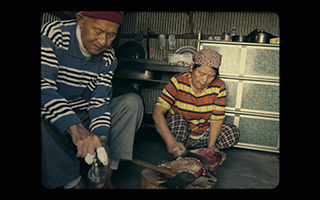
Yet this ongoing search for what defines a Tayal way of life in contemporary Taiwan is only one layer of the film. SPI concludes with a brief, tender scene filmed while the grandfather was still alive, showing him cutting pork—an emblematic choice that underscores how the documentary also serves as a heartfelt farewell from the director to her beloved grandfather, intertwining the personal loss with the broader meditation on tradition and identity.
Just a final note on the title, I would have preferred to keep a translation more faithful to the original which is, I believe, something like Dreams in the Fire Room.
This is a translation and a partial rewriting of a piece I wrote for Alias (Saturday supplement of the Italian newspaper Il Manifesto) in 2021.
In 2003, Māori director and theorist Barry Barclay proposed the idea of a “Fourth Cinema.” Building on and expanding the concept of “Third Cinema” as theorized by Fernando Solanas and Octavio Getino in the late 1960s, Fourth Cinema designates a practice centered on the Indigenous gaze and Indigenous viewers. Rooted in Barclay’s background in documentary, the concept was initially conceived as an audiovisual practice in non-fiction—works created by Indigenous authors, within Indigenous communities, and for Indigenous audiences.
Paying homage to Barclay’s reflections, the twelfth edition of the Taiwan International Documentary Festival devoted a section of its official program to works by Indigenous filmmakers from the island, produced in the final years of the twentieth century (1994-2000). This was a period when long-standing questions of indigenous identity, resistance, and decolonisation converged with—and were amplified by—the revolutionary arrival of small, portable digital video cameras.
This technological shift, coupled with a transformed socio-political landscape, opened new avenues of self-expression for ethnic groups who, until then, had been confined to the roles of mere actors or spectators in their own representation. It is worth noting that this followed the profound transformations of the last two decades of the 20th century—a period of seismic historical change for Taiwan, beginning with the lifting of martial law in 1987 and the subsequent democratisation of the country. On a cinematic level, this era also witnessed the rise of the Taiwanese New Wave and, on a smaller scale, the emergence of a grassroots documentary movement exemplified by the Green Team.
The history of Taiwan is one of centuries-long colonial domination. Its arts, customs, traditions, land, language, and landscape all bear traces of the successive layers of a history that, accumulating over time, have shaped the island as we know it today. The various Indigenous peoples who inhabited Taiwan for millennia first faced invasions by the Dutch and the Spanish, followed by the arrival of Han Chinese settlers from the mainland, and later domination under the Qing dynasty and the Japanese Empire.
Today, the island officially recognizes sixteen Indigenous groups, each with its own language and distinct culture. In most cases, these communities—despite enduring countless challenges—continue to strive to keep their rituals, languages, and traditions alive and meaningful, upholding alternative ways of life in resistance to the cultural homogenization brought by modernity.
By the late 1990s, the advent of digital cinema and the spread of small, affordable video cameras—“a theology of liberation,” to borrow a striking expression from Filipino director Lav Diaz—offered Taiwan’s Indigenous groups the possibility, finally and for the first time, of becoming active agents in their own visual representation, adding their voices to the island’s rich mediascape.
C’roh Is Our Name
Indigenous with a Capital ‘I’: Indigenous Documentaries from 1994 to 2000 brings together seventeen works—each between thirty and fifty minutes in length—made by Indigenous filmmakers, focusing on the lives, struggles, and resilience of their communities in contemporary Taiwan. In New Paradise (1999) by Laway Talay, members of the Pangcah ethnic group leave their ancestral lands to seek work in other parts of the island, only to encounter exploitation and a profound sense of non-belonging—perhaps the most recurrent theme running through the works featured in this special program. This feeling of displacement is often subtle, but at times it emerges openly and even defiantly, as in C’roh Is Our Name (1997) by Mayaw Biho, a short documentary that follows a regatta annually organized by Taiwan’s Han population—the ethnic majority of Chinese origin that constitutes most of the island’s inhabitants. For the first time in the competition’s history, a group of Pangcah—who had traditionally lent their nautical skills to other teams—chose instead to form a team composed entirely of their own members.
For members of these communities, holding a camera also means gaining the ability to recount and preserve ancestral traditions and forms of knowledge that might otherwise vanish with the passing of time. This is the case in several works devoted to capturing the memories of elders—such as former tribal chiefs or weavers—who embody the living memory of their people.
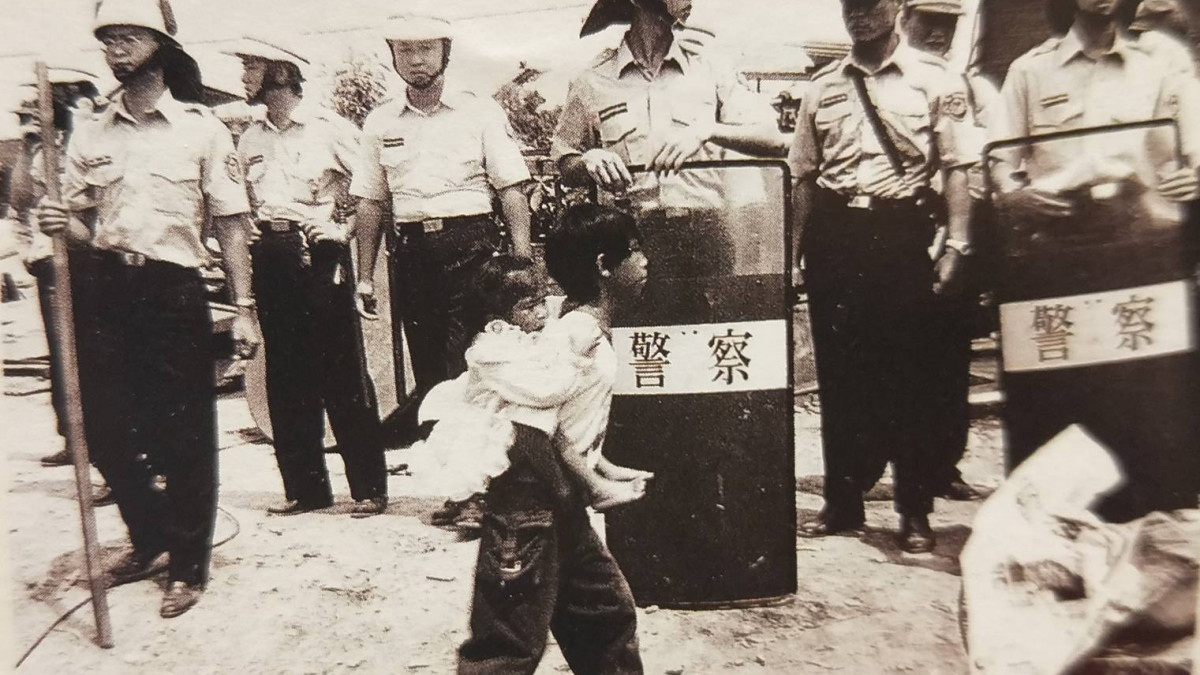
One of the most compelling works presented at the festival is Children in Heaven (1997), also by Mayaw Biho. Although it focuses on a specific ethnic group, the situation it portrays is, sadly, all too familiar in contexts marked by stark economic inequality. For a time, a small Pangcah community was forced to watch, year after year, as the government demolished the shacks they called home, deemed illegal structures. Surrounded by garbage and ruins, the children who grew up amid this Sisyphean cycle of demolition and rebuilding came to transform the recurring tragedy into a kind of game.
In this film, as in all the others in the program, the camera’s perspective is never detached or neutral. Aesthetically and narratively, it knows—and shows—from the very first scenes where it stands. The images are often low-resolution and deliberately anti-spectacular—what Hito Steyerl would call a “poor image.” It is a gaze that, precisely because it comes from within, does not judge—even when, as in Song of the Wanderer (1996) by Yang Ming-hui, it exposes the problems, contradictions, and even the violence that many of these communities face. Instead, it offers both a perspective and a means of expression to those who, until now, have had none.
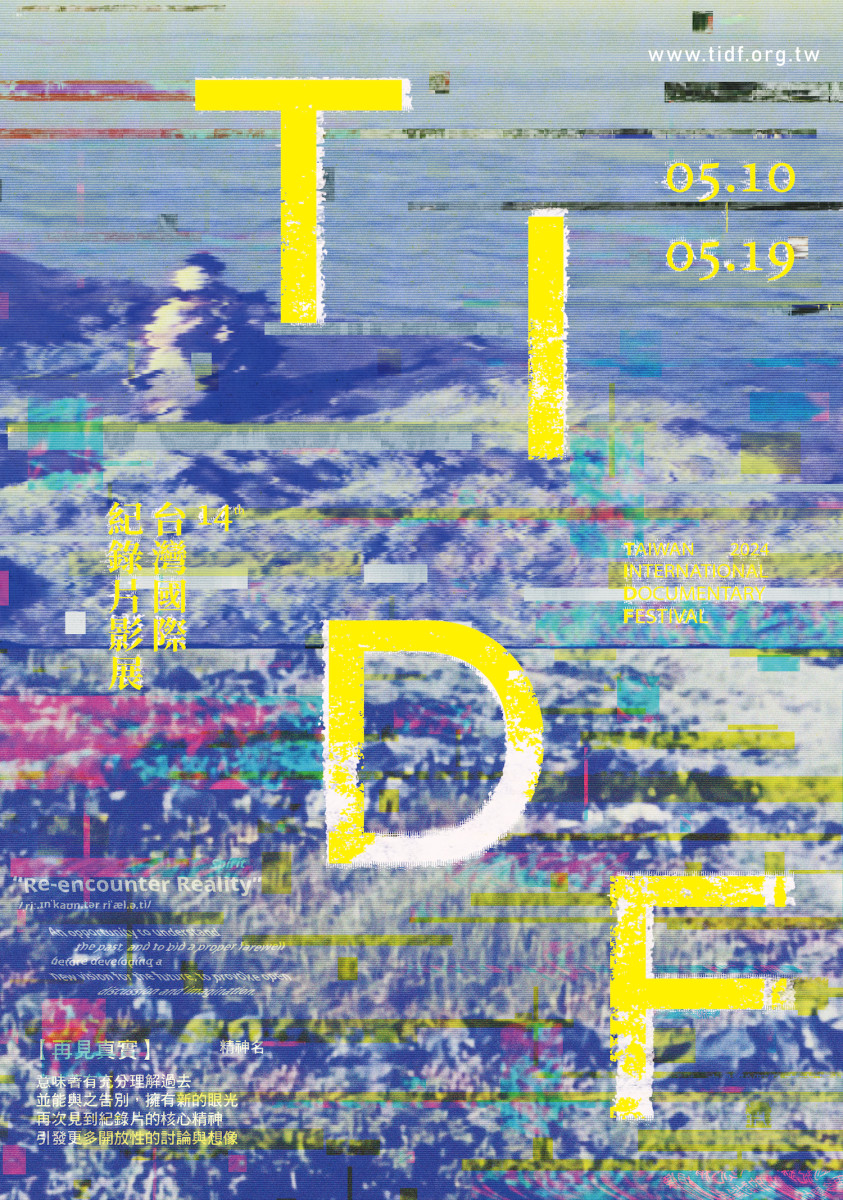
In the past days, the Taiwan International Documentary Festival (TIDF) has announced the official line-up for its 14th edition. Launched in 1998, the TIDF has slowly but surely become one of the most important festivals dedicated to documentary cinema in Asia. Held in various venues in the capital city of Taipei, the event will take place from May 10 to the 19, and will showcase the best non-fiction cinema produced in recent years —with a special attention and focus towards Asia, but also other parts of the world— through its four sections: the Asian Vision Competition, International Competition, Taiwan Competition, and TIDF Visionary Award.
This year, the festival will also commemorate two key figures in the development of documentary in Taiwan, Chang Chao-tang, author of works that are widely considered the first poetic and experimental documentaries in the island (The Boat-Burning Festival, Homage to Chen-Da), and ethnographic filmmaker pioneer Hu Tai-li (Voices of Orchid Island), who passed away in 2022. Unfortunately I will not be able to attend, one day though, one day…anyway these are the sections and the films.
Taiwan Competition A Holy Family Elvis LU|Taiwan, France
A Performance in the Church (World Premiere) HSU Chia-wei|Taiwan
All and Nothing (World Premiere) LIAO I-ling, CHU Po-ying|Taiwan
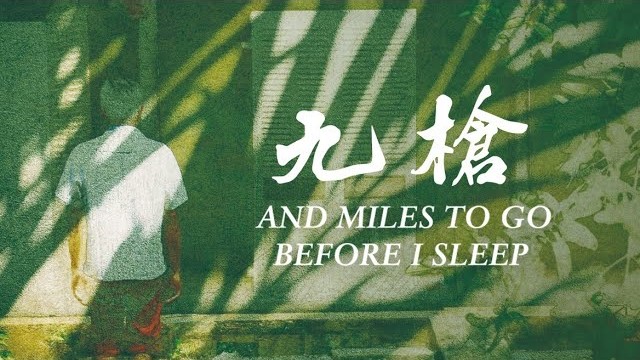
And Miles to Go Before I Sleep TSAI Tsung-lung|Taiwan
Come Home, My Child (Asian Premiere) Jasmine Chinghui LEE|Taiwan
Diamond Marine World HUANG Hsiu-yi|Taiwan
From Island to Island (World Premiere) LAU Kek-huat|Taiwan
I Must Keep Singing LIN Chih-wen, LIAO Ching-wen, CHUNG Hyeuh-ming|Taiwan
Lauchabo TSAI Yann-shan|Taiwan
Parallel World HSIAO Mei-ling|Taiwan
Taman-taman (Park) (World Premiere) SO Yo-hen|Taiwan
Pongso no Tao〜 Island of People TSAO Wen-chieh, LIN Wan-yu|Taiwan
The Clinic Midi Z|Taiwan、Myanmar
When Airplanes Fly Across LEE Li-shao|Taiwan
Worn Away CHEN Chieh-jen|Taiwan
Asian Vision Competition Atirkül in the Land of Real Men (Asian Premiere) Janyl JUSUPJAN|Czech Republic
A couple of interesting documentaries I’ve watched recently, besides those I saw at the Yamagata International Documentary Film Festival.
Shot in four years, 越後奥三面 山に生かされた日々 Echigo Okumiomote: A Traditional Mountain Village (1984) follows the everyday life of Okumiomote, a mountain village in Niigata prefecture, near the border with Yamagata prefecture. The village, its inhabitants, the mountains, the forest and the rivers, form a fascinating ecosystem and microcosm of a life (1980-1984) dependent upon and regulated by natural elements and the cycle of seasons. This lifestyle and the specific traditions, customs and habits—performed, changed and improved throughout centuries by the inhabitants—would eventually disappear years after the documentary was filmed, due to the construction of the Okumiomote Dam (the area would be submerged).
The documentary has been recently digitally remastered and screened, together with other works by director and video ethnographer Himeda Tadayoshi, at a special retrospective organized at Athénée Français Culture Center in Tokyo.
While the film opens with one of the villagers talking about the anti-dam movement active since 1971, the entirety of the documentary depicts matter-of-factly the various customs and jobs done in the mountains and in the fields (hunting, gathering, harvesting). Only the last 30 minutes are more a direct reflection on the disappearance of the village, and on the act of documenting its existence and preserving its memory on film. The documentary is narrated, or better, commented, in a very friendly manner, so to speak, by Himeda himself. The presence of the director and his troupe is never hidden, once we even see a special meeting, requested by Himeda himself, when the village’s hunters are strongly opposing the presence of the camera during their upcoming bear-hunting trip. This film pairs very well, thematically but not stylistically, with Haneda Sumiko’s 早池峰の賦 Ode to Mt. Hayachine, filmed almost during the same years in the mountains of Iwate prefecture.
Echigo Okumiomote was accompanied by a publication of a huge volume about the life of the village, an ethnographic study and document of the area (I own it, I might return to the movie and the book in the future). Himeda would return to Okumiomote in 1996 to film a new work, 越後奥三面 第二部 ふるさとは消えたか Echigo Okumiomote dai ni bu furusato wa kieta ka, about the situation after the people of the village were forced to relocate. One of the discoveries of 2023 for me.
Nguyen Quoc Phi was a Vietnamese migrant worker, who on 31 August 2017 was reported for a car theft in Hsinchu County, near Taipei. On the same day, he was shot nine times by police officer Chen Chung-wen. He was left bleeding on the ground, and tragically died on his way to the hospital. A part of the public in Taiwan supported Chen’s use of firearms against the runaway immigrant who resisted arrest.
And Miles to Go Before I Sleep (Tsai Tsung-lung, 2022) is a documentary that asks the viewer uncomfortable questions, first by sketching the situation of immigrant workers in Taiwan (regular and irregular), and then by using images filmed by the body cameras of the policeman who shot Nguyen to death. These are very tough scenes to watch: after being shot, the young man lies down completely naked, slowly dying, with the officers observing and walking around him. It could be said that these scenes are exploitative, but as some viewers have commented, they also could function as a sort of “visual moral report”. I’m not sure I agree with the statement.
While as a document of a shocking and tragic event, the work has its merits, I think it meanders too much from the scene of the death, to others with the family of the deceased or where the conditions of immigrants are explained, losing in the end its focus.
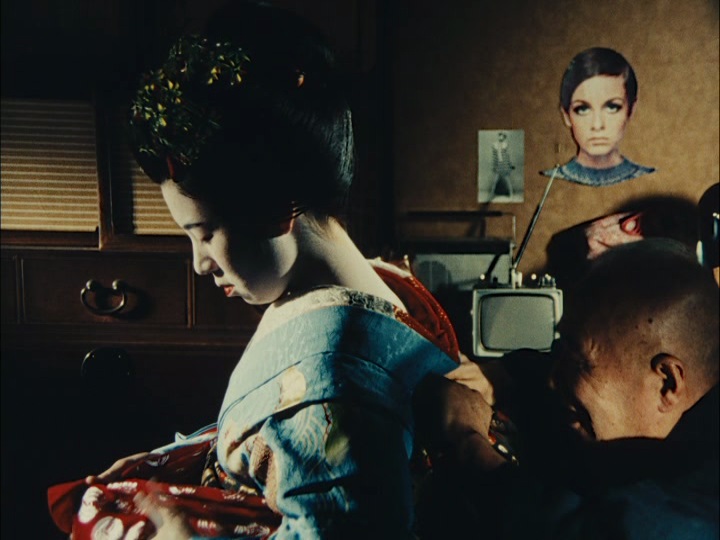
While as an experimental film made of and about things, rocks, textiles, roof tiles, wood, and houses, Kyoto by Ichikawa Kon (1969) is extraordinary, also because of the experimental music by Takemitsu Tōru. As a documentary about Kyoto (or Japan more broadly ), the narration and the film itself are orientalist at best, even if it was written by a Japanese. In this respect, it should be noted that the film was commissioned by the Italian company Olivetti, so there’s the usual “I’m giving you what your image of me is” typical of some cultural products made for export in Japan. Ichikawa’s editing here starts (or perhaps it had already started before) to become almost subliminal. For more extreme examples, see his post Inugami Family’s production.
I watched the version with English and Italian narration. I would need to check out the Japanese version as well to properly assess the film.
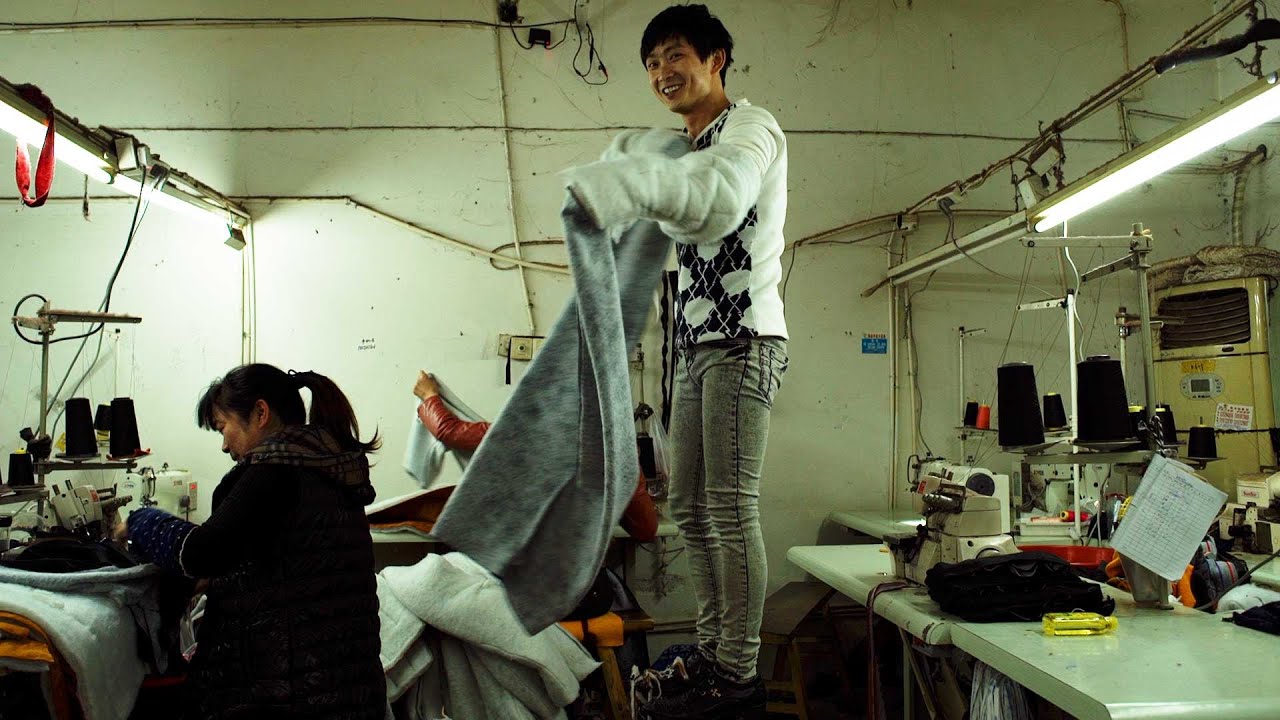
Wang Bing’s Youth (Spring) was a fascinating viewing experience, for me also because of the long time it took to be completed: it was shot between 2014-2019 and edited/released in 2023. At the same time, I share some of the doubts expressed in this review, points that are not really about how the work is constructed or filmed, but more about the very meaning of the project itself (it’s only the first installment of a trilogy, apparently).
Sometimes the documentary felt like a Big Brother shot in a factory, that is to say, very performative in some of its parts. In the age of YouTube and tik-tok the young generations know very well how to behave when a camera is in front of them, thus, even though it goes against Wang Bing’s style, a certain dialogue with the camera (I’m sure there was, but was cut) would have made the documentary more “authentic”, so to speak. After watching the film, I had the distinct feeling that something was missing and had been cut out.
Having been filmed almost 10 years ago and for 5 years, I also would have liked to see the year of filming for each segment.
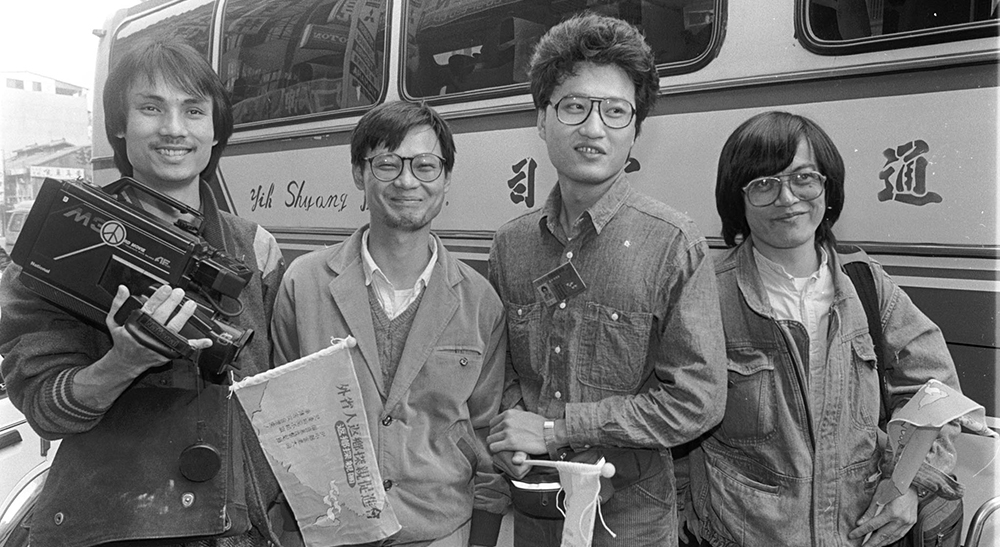
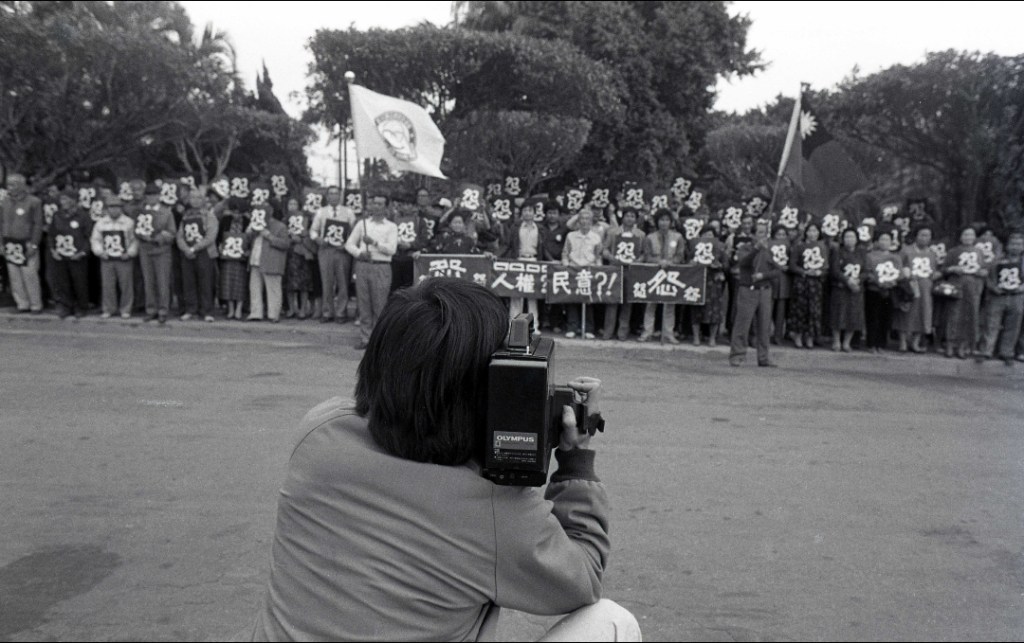
In 1979, after the Formosa Incident, Taiwanese politician Hsu Hsin-liang was forced to leave the country for his opposition to the ruling party, the Kuomintang (KMT), he would spend the following ten years in exile in the US. In 1986, after the first opposition party in Taiwan, the Democratic Progressive Party (DPP), was created, and while the campaign for the upcoming election was getting to the heart, Hsu tried to return to Taiwan, flying back to his country via Japan. On November 30th 1986, thousands of supporters gathered at Taoyuan Airport to welcome back the politician. Not only was Hsu not allowed to repatriate, but the central government sent a large number of police and military personnel to the airport, attacking his supporters with water cannons and tear gas. The three national and pro-government television stations used the images of the clashes to craft a narrative in which the supporters were depicted as a violent mob attacking the police. A completely different narrative emerged from a series of videos that were shot on the ground, in the midst of the clashes, by a group of DPP supporters and activists. Images that clearly showed how it was the police that provoked and attacked the people, and not vice versa. These videos were edited together to create The Taoyuan Airport Incident (1986), the first documentary made by the Green Team, a group active between 1986 and 1990 in Taiwan. The collective was originally formed by “Mazi” Wang Zhizhang, Li Sanchong and Fu Dao, and later added members such as Lin Xinyi, Zheng Wentang, and Lin Hongjun. In these four years, the collective made more than 300 works, all of them shot using video camcorders. In their works the group documented the various movements and protests that swept and destabilized the social and political fabric of the Island, in the years soon before and after the lifting of the Martial Law (July 15th 1987).
In 1998, the Green Team handed over their videos to the National Tainan University of the Arts, and 2006 saw the creation of the Taiwan Green Group Image Record Sustainability Association (literal translation). This was done in order to digitize and preserve the original video tapes (more than 3000 hours), and to set up an archive and a searchable website. Moreover, in more recent years, the works of the Green Team have been presented internationally, circulating at different film festivals around the globe. The starting point could be considered the retrospective organized at the Taiwan International Documentary Festival in 2016, where 21 works of the collective were screened on the occasion of the 30th anniversary of The Taoyuan Airport Incident. Screenings at festivals around the world soon followed, in 2017 at the Ji.hlava International Documentary Film Festival, in the Czech Republic, and two years ago in Rome during Flowers of Taiwan, an event organized to promote the cinema of the island. Furthermore, in the past years, the online platform DaFilms has made them available on streaming a couple of times in collaboration with Taiwan Docs.
Green Team’s videos mark a pivotal moment in the history of documentary and in the evolution of alternative media in Taiwan. During the forty years of Martial Law, documentaries were still produced in the country and enjoyed some success—the Fragrant Formosa TV series, for instance—however, practically none of them, even those produced independently, depicted and commented overtly on the social, let alone the political, situation in the country.
By documenting protests and fights related to environmental issues, indigenous self determination, and women rights, Green Team’s output opened a path that many Taiwanese documentaries would follow in the next decades. Another important novelty brought in the field by the group was the use of portable and low-cost video cameras, a technology that had become affordable and mass-produced in the mid 1980s.
The intersection of this technological shift and a mutated socio-political situation, made possible a novel documentary practice and an alternative media approach that was unthinkable only a few years before. At the same time, Green Team’s activity represented also an evolution of what had been happening since the beginning of the decade, when the media control exerted by the state started to show its cracks as a consequence of the Formosa Incident in 1979. In the aftermath of the event, political magazines critical of the government began to flourish, and in the second half of the 1980s, thanks to the aforementioned technological shift, this radical dissent took the shape of independent videos. To be in the trenches criticizing the government you needed now to bring your videocamera.
One of the VHS camcorders used by the Green Team (source)
On a purely aesthetic level, this approach resulted in works of low image quality and an almost amateurish look. After all, Green Team’s videos were never meant to be shown on huge screens and in cinemas, and by the members own admission, they never tried to make cinematic works in the first place. The group was more interested in using their videos ‘to break the barrier of media control and fulfil the concept of social practice” (Chuan 2014). This “video revolution” was made possible and successful also because of the adoption of underground distribution and exhibition practices, a clear break with what was done in the past and what was going on, at the time, in the mainstream media. I will return to this point at the end of this piece.
Labor battles and environmental protests
I have watched only a small fraction of the videos made by the collective, but two of them stood out for me, both for the topics covered, labor disputes and environmental issues, and for their construction as visual expressions. While I have touched on other videos as well, I have spent more ink, so to speak, on those two.
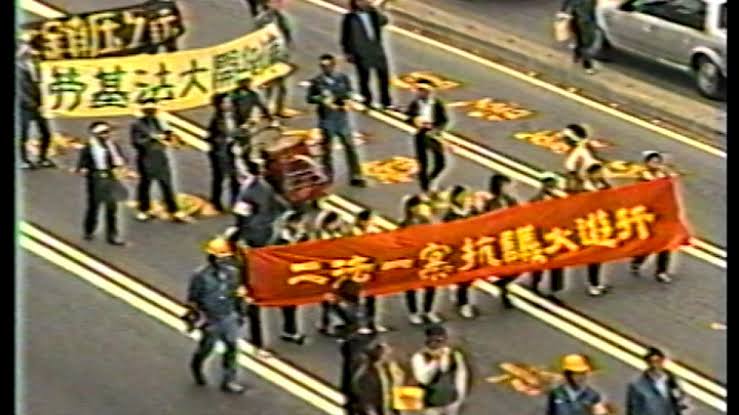
In 1987 alone, Taiwan saw as many as 1835 protests erupting in different parts of the island. Demonstrations and acts of civil resistance sprung up in all areas of social life: from environmental to labor issues, from student movements to indigenous rights, and from feminist fights to peasants protests. Farmers resistance is at the core of The 20th May Incident (1988), a work that documents the demonstrations of thousands of peasants in the city of Taipei, protesting against the government’s indifference to their rights and requests. It was the first farmers’ demonstration after the abolition of the Martial Law. The protest turned into an urban battle when the police stopped some farmers from using the bathrooms. Led by the Yunlin Farmers’ Rights Association and supported by a group of university students, the protesters fought back and some of them were arrested. At night, peasants and students marched to the police station, demanding the release of the people imprisoned. The police instead reacted by attacking them and arresting in total more than a hundred people.
Similar to the strategy employed during the events at The Taoyuan Airport two years prior, the national TV stations kept spreading lies through their channels, labelling the protesters as members of a conspiracy group. When the Green Team released the documentary with the images of what really happened, the government, fearing to be exposed, tried to seize the VHS cassettes of the video circulating around the country.
In 1985, the KMT government greenlighted the construction of a titanium dioxide plant, by American company DuPont, near Lukang, Changhua County. In the following months, the local residents organized a series of demonstrations that eventually caused the project to be cancelled. Lukang Residents’ Anti-DuPont Movement (1987) documents this historical victory through images of street protests, peaceful (and less peaceful) demonstrations, and discussions about broader environmental and civic issues. The work opens with a brief explanation of the situation, and interviews with the opinions of the people of Lukang. The work then moves on to show the march of the citizens in front of the presidential office to give the authorities a petition to stop the construction of the plant. Next, we see professors, poets and experts speaking at a special seminar organized in the city. This is the most insightful part of the video in my opinion, the points touched are very nuanced, complex, and more relevant than ever, even today more than 35 years later. Environment should be considered as a public asset and a collective right, says one of the speakers, and if the government is not able to protect it, it should be prosecuted. Environmental rights do not just belong to the people who are now alive, the current generation, the speaker continues, but to the citizens of the future as well. A professor of law adds that environmental rights are part of the right to life, basic human rights, and constitutional rights. In the same seminar another speaker touches on the division of labor on the global scale, that is, the exploitative nature of multinationals, in this case DuPont coming to Taiwan to use the resources of the land, without giving back anything but pollution and empty promises of “progress”.
These words provide a perfect philosophical background and set the table for what is coming on screen in the second part of the video, when we see the protests and clashes between the police and the citizens, as the distrust of the people towards the institutions has increased. It is particularly impactful to see how these demonstrations are somehow reminiscent of local folklore festivals (plus the rage). A big drum is rhythmically struck and accompanies the protest on the streets, it is often heard and seen at the center of the action, and even used as a battering ram, as it were, to break the security cordon made by riot police. Ending the video with images of a religious festival, held to express the gratitude for the success of the protests to the goddess Mazu, is thus a natural continuation of what we saw before, and a conclusion that emphasizes a reinforced sense of identity and belonging for the people of the area.
In the work, we see an organization of university students being involved in supporting the protests and in helping to do environmental research in the area. One of the major traits emerging from the works made by the Green Team, at least the ones I was able to watch, is the almost constant presence and involvement of students from various universities, but especially from the capital, in most of the demonstrations and acts of resistance that shook Taiwan at the time. This is the case with Labour’s Battle Song (Laid-off Shinkong Textile Workers’ Protest) as well, a work shot by the collective in 1988.
The film opens with a brief overview of the events that happened in Shilin district, Taipei, in 1988, when the closure of the Shinkong Textile factory left hundreds of workers unemployed and without a place to live. Some workers decided to self-organize in groups and to occupy factory spaces to express their anger towards both the company and the government. From the very first sequence it is clear how this protest is not only aimed against the closure of the plant, but also against the exploitative nature of the job. Women seem to be the ones who were more affected by the demanding labor conditions in the factory: they had to work for long hours to provide an income for their families, but at the cost of neglecting their personal lives. The documentary also sheds light on the inherent dangers of the job done in the plant and on the conditions inside the factory. This is exemplified by a very young lady without a hand, shown and interviewed during a demonstration, and who painfully recalls the incident that left her disabled.
One of the major driving forces behind the movement is a group of aboriginal students from Taitung and Hualien. As the female narrator beautifully put it, their traditional war dances and songs—performed joyfully on the street, together with factory workers and as a form of protest—bring not only a sense of needed solidarity to the workers, but have the power to “challenge the discreteness of the middle class”. Singing and dancing become fundamental elements of the workers’ identity, class identity, both during the demonstrations and in their recreational time in the occupied spaces. A particularly creative move involves turning the repetitive movements of the assembly line in the factory into a choreographed dance to perform on the streets.
On November 12, 1988, the plant workers took part in a historical event, a demonstration joined by others labor groups from across Taiwan to protest the government’s proposed amendments to the Labor Standards Act and Labor Union Act. This event marked a pivotal moment in Taiwan’s independent labor movement, with Shinkong’s workers playing a crucial role in the fight. The class divide is a common thread permeating the whole work and that powerfully emerges when we see the workers camping on the cold streets in front of the company’s head office. It is winter and they are preparing food to share with their comrades, while life in the rest of the city goes on as usual, indifferent to their struggle.
As time passed, challenges started to surface. The company cut off water and electricity in the plant and dormitory, leading workers to question their strategy and methods of dissent. By December 23, after more than two months, many workers reluctantly started to give up the struggle as SWAT teams were deployed at the protest site. The video cut to scenes of empty factories and rooms where workers used to live, the sense of defeat brings with it also a feeling of personal loss, a period of 75 days of resistance and labor fights is ending, but with it are also fading the memories of lives lived together for years. As a counterpoint to this mood, the film concludes on a positive note, with a montage of black-and-white photos, primarily featuring female workers, set to a labor song. While this specific fight has ended, the broader message remains clear: “Oppose exploitation. Fight for equality. Keep Fighting. Tomorrow will be better!”
Underground distribution and exhibition practices
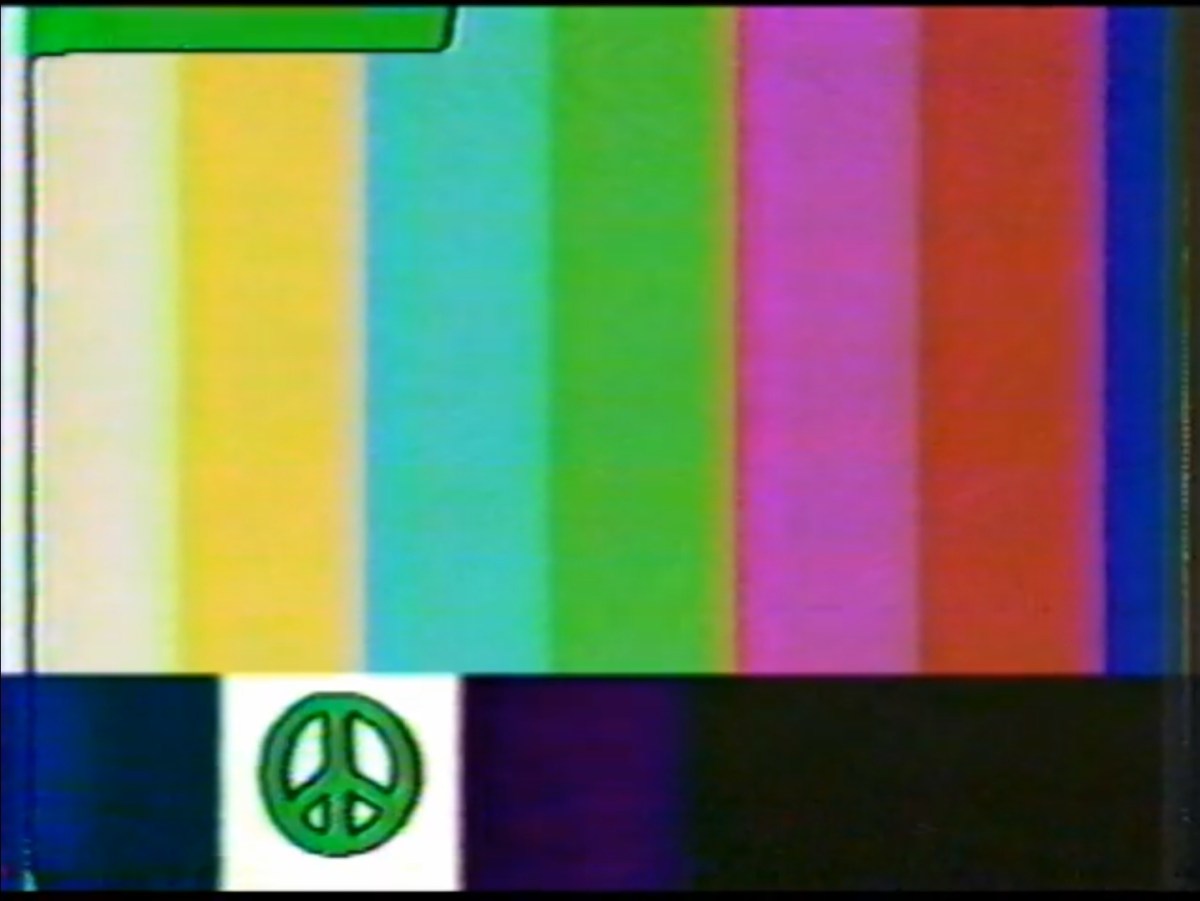
The Green Team was not the only group of video-activists operating in Taiwan at the end of the 1980s and at the beginning of the 1990s, but was the one that lasted longer, and whose works had a lasting impact on future generations of Taiwanese documentarians. The importance of the group and its activities is deeply intertwined with the manner their works were produced and distributed. The group released their works through video dealers—more than sixty at the height of their activities—selling their VHS cassettes at video rental shops and at night markets, but also through branches of the DPP, and by organizing screening tours in the countryside. Free copies were also made and dispatched for political movement purposes, for The Taoyuan Airport Incident, for instance, about 2000 cassettes were produced and distributed around the country. When the videos were about the peasants’ protests, such as The 20th May Incident, the collective formed a group in charge of screening them in rural villages to spread the knowledge, spark discussions, and as a vehicle for social and political participation. The production method behind these works is also very important, at first the funding came from donations (but not from political parties), and later mainly from the sales of their videocassettes. After shooting the footage, the members of the group edited all the material and made the cassettes, when possible on the same day, and on the following day the videos were already dispatched, by car, to the selling points. This was the case for the first years of their activities at least, and since they could not stay up to speed with the official media, later on, the collective tried to set its own underground TV station, an event documented in Green TV’s Inaugural Film (1989).
The reasons for the end of Green Team’s activities are multiple. On the one hand, the technological advance that made their success possible in the first place, brought about also a cheaper reproducibility. Piracy, that is to say, copying video cassettes illegally, became a problem, and selling videos through the channels described above became, thus, unsustainable. This happened also because other groups of video activists operating at the time in Taiwan were selling their videos at a cheaper price. On the other hand, the end of the Martial Law contributed to creating a freedom of speech that allowed the traditional media, TV and newspapers, to cover social and political issues considered taboo before, making the Green Team’s videos less exceptional. In truth, the issues affecting people living at the margins of society remained still very much ignored by mainstream media, and became a topic to explore for filmmakers and groups in the next two decades.
In this new cultural landscape and mediascape, the Green Team, their videos, and their distribution and exhibition practices partly lost their raison d’être. In the second half of the 1990s, cinemas and TV became the main release platforms for documentaries, and while maintaining their independence, documentaries started to be financed by the “system”, television channels or public institutions. The average documentary filmmaker changed as well, more directors came now from film studies and were naturally more interested in making documentaries as cinematic art—the 1980s saw also the ascent of the so-called Taiwan New Wave, capped by Hou Hsiao-Hsien winning the Golden Lion for City of Sadness at the Venice Film Festival in September 1989. Not to mention the advent of the digital revolution—smaller, cheaper and more portable cameras—an event that would radically change, in the following decades, the field of documentary, allowing filmmakers to shift their focus towards more personal and individual themes.
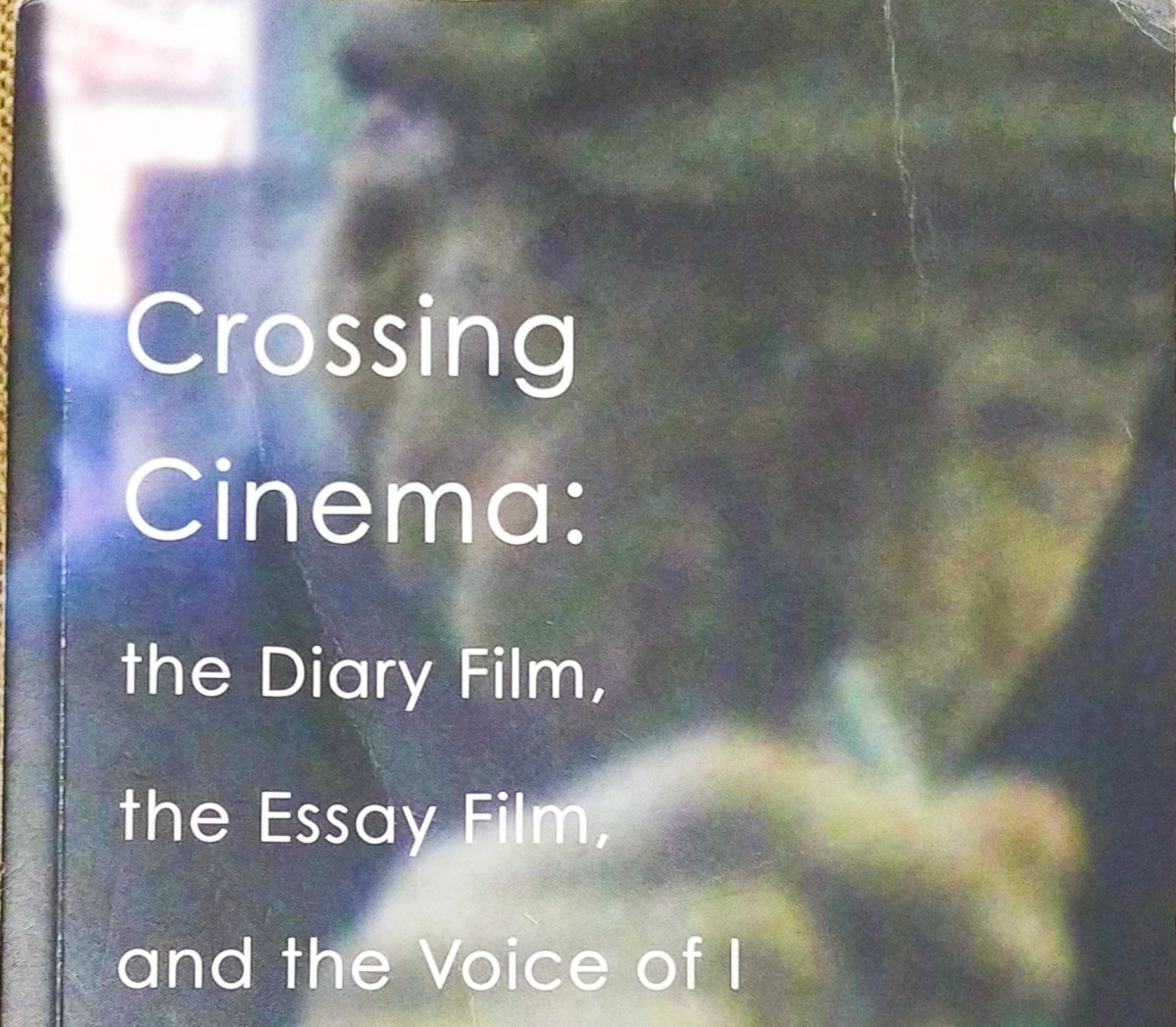
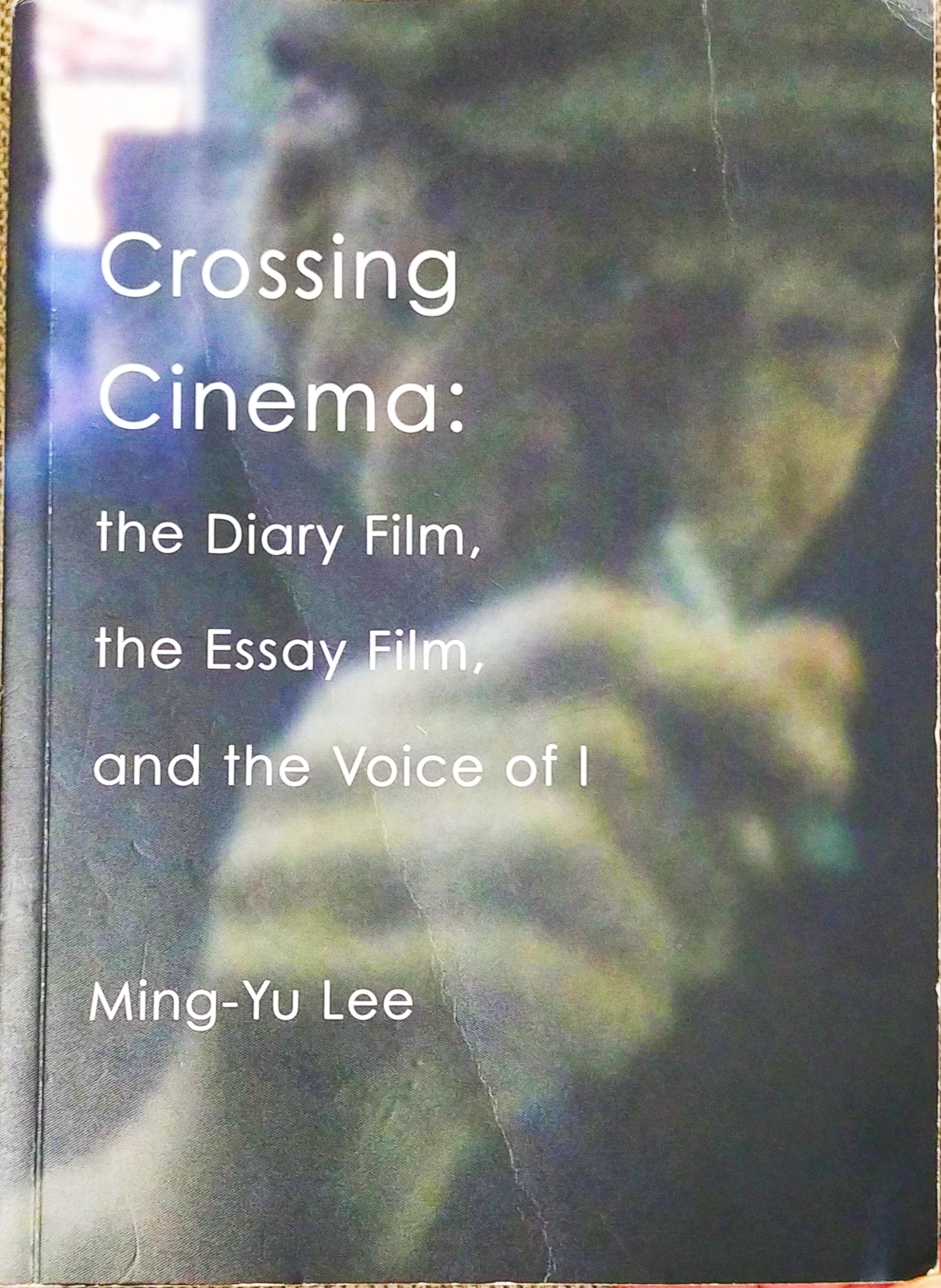
Crossing Cinema: the Diary Film, the Essay Film, and the Voice of I is a volume published by Bookman Books in 2022, and written by Taiwanese scholar and filmmaker Lee Ming-Yu on the possibilities and aesthetics of essay and diary films. I came to the author through my interest towards Taiwanese filmmaker Liu Na’Ou (discovering The Man Who Has a Camera was a revelation for me), to whom the first insightful essay in the volume is dedicated, but I discovered through the book a far richer cinematic landscape, one that explores the possibilities of the visual diary and the essay film. As stated by the author on the back cover:
This book focuses on the unique forms of expression of diary film and essay film, especially how authorship of filmmakers can be integrated in the voice-over as a narrative strategy in first-person cinema. The book is divided into two sections: the first section “essays” contains three chapters, and in these chapters I use films of Liu Na’Ou, Hollis Frampton, Jonas Mekas, and José Luis Guerín as cases for filmic textual analyses, to discuss the issues of authorial presence, the voice-over narration, and audiovisual structure. In the second section “interviews”, four important researchers and filmmakers contribute their thoughts and reflections on how the essay film and the diary film can be approached and understood.
The first part of the volume is very interesting and rich with insights, but here I’d like to focus more on the second section. The first conversation, a correspondence between Lee and scholar and professor Laura Rascaroli was the one that resonated with me the most. Rascaroli is known, among other things, for her research and publications on personal cinema and the essay film, reflections that are here mirrored in the style used, an exchange of emails she had with Lee over three months, between May and July 2016. What I found particularly fascinating in their exchange is the parallel drawn between diary films and the practice of microhistory, as Rascaroli writes:
Diary-making is a form of history from below, of microhistory: and this is so needed at a time when history from above continues to rewrite our everyday stories as a function of a political goal. Brexit, which you evoked at the end of your last entry, is a case in point, an abrupt and divisive contestation of just this kind of appropriation. I love the diary film not least because it is a channel through which our microhistory can interconnect and so too be a part of a living social fabric in a wider world.
The open-endedness of the diary form is also a remark I found very poignant:
As Lejeune says, ‘autobiography turns towards the past’, while the diary moves along, heading towards the future, which is unknown to anyone. (Lee)
Epistolarity is, like the diary, a form that is always open to the next ‘entry’. As Raymond Bellour has written, ‘The letter goes on and on. If it is a real letter, it never stops saying, wanting, wanting to say more’ (Rascaroli)
It goes without saying that the interview with Jonas Mekas is also a chest of treasures. Here on the use of voice-over in his works:
Lee:
When you record your voice-over…
Mekas:
It’s not really…maybe, I don’t know if I would call it voice-over. It’s just part of the film. It has the same function as images, which is not a voice-over, it’s just another element. Voice- over is like you make comments about the images that you see. I don’t make comments about the images. I add another level of content. So it’s not a comment, not a voice-over. You could say that the image-over, sometimes the sound is more important, sometimes images. Images illustrate the sound.
and about diary films and cinéma vérité:
Lee: Does the diary film have something to do with Cinéma vérité?
Mekas: No, no. Cinéma vérité was a variation of the documentary film. The documentary has forms, scripts. It is a scripted gene of cinema. Illustrated with footage. Scripted documentary film, they write a script and they find the footage to illustrate the script, Cinema vérité try to get rid of script scenario, the outcome [wasn’t] determined, there was always a different subject they chose or the theme was different. It was not scripted. They were collecting materials from real life, to illustrate a certain idea. The technique was more open, more real. (…) The diaristic kind of cinema does not have any idea, no predetermined scripts, because you cannot plan life…
To summarize, these are the chapters of the book:
Part one: Essays
1.Re-Discovering Liu Na’Ou and His Man with a Camera: Authorial I. Written Diary, and Cinematic Writing.
2.The Parenthetical Voice-over: Dialectical Audiovisual Structure in Hollis Frampton’s (nostalgia) and Jonas Mekas’s The Song of Avila
3. Film-Letter: The Beginning, Exchanging, and Narration in Jonas Mekas and José Luis Guerín’s Correspondence
Part two: Interviews
4. Correspondence: Ming-Yu Lee/Laura Rascaroli
5. Jonas Mekas: To My Dear Friends
7. Joseph Morder: I’d Like to Share This with Someone
6. Roger Odin: Home Movie. The Diary Film, and P-Cinema
Ming-Yu Lee (李明宇) is a filmmaker and Assistant Professor of Radio, Television and Film at Shih Hsin University (Taipei, Taiwan). Research Interests include the Diary Film, Experimental Film, Essay Film, First-Person Cinema, and Film-making. Independent Filmmaker, photographer and film editor having directed several experimental shorts including Time Variations, Going Home, Home Not Yet Arrived, Four Years of Miller. Works deal with the relationship between diary film, home movies, experimental film and questions of identity.
Hu Tai-Li (1950-2022) was one of the prominent ethnographic filmmakers active in Taiwan, a professor, an anthropologist, and also the president, for two decades, of Taiwan International Ethnographic Film Festival. Throughout her career, both as a documentarian and as a visual anthropologist, she tackled issues related to national and native identity, colonialism, and how the culture and traditional practices of the tribes inhabiting the island(s) are surviving in contemporary Taiwan.
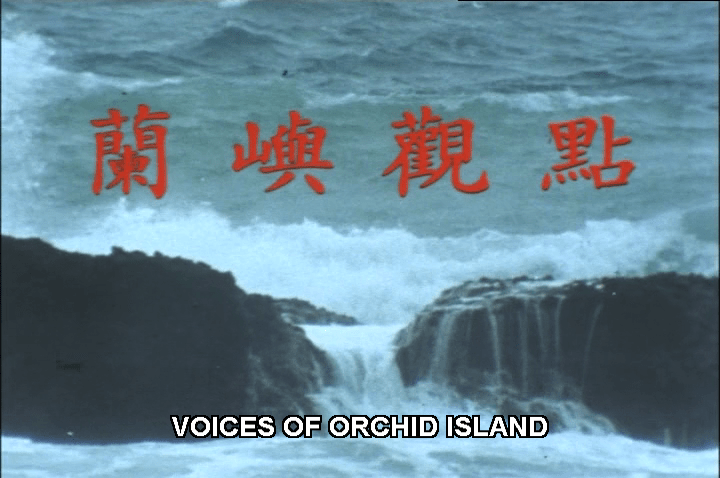
At the beginning of the 1990s Hu went to Orchid Island, 45 miles off the southeast coast of Taiwan in the Pacific Ocean and just 20 miles away from the Philippines, to explore how the native people, the Yami, were affected by the influence from outside: tourism, TV people, anthropologists, mass-media…
Voices of Orchid Island opens with a self-reflexive touch, we see director Hu discussing the documentary she is going to make with some of the people who are going to be filmed in a short, casual, but significant exchange of opinions on a beach. There she talks with three people (and a kid) from different ethnic groups, two of them are from the Yami tribe, while the third man is of the Bunun tribe, an ethnic group external to the island, and who, at the time of filming, had been living there for three years, working as a doctor. While two of the people are welcoming the director and her endeavor, the youngest among them (from the Yami tribe) has an interesting response:
I often feel that the more research anthropologists do on this island, the worse the island is harmed. I feel anthropologists come to Orchid Island just so they can advance to a certain social status. They just use Orchid Island as a tool, they don’t benefit the subject of their research.
In the next scene we hear the voice and see a guide on a bus full of tourist from mainland Taiwan, explaining about the Yami people while filming them (the tourists). We (the viewers) are already thrown on the side of the outsiders/tourists, and fed with information and data about the native people. After this “lecture”, it is unsettling to see the group getting off the bus and hoarding throughout the village like it was some sort of tourist spot or a zoo where to admire some sort of rare animals. Hu constructs a cynical mirror of sort where we cannot hide our own reflection, the tourists are “us” viewers, trapped in a cursed routine by which we experience places we’re not familiar with, and objectify people who live differently from us. It is really compelling how the director is able to hint at the problematics at work in the island just in a couple of minutes of well-edited images.
“They don’t regard us as human beings” “They called us barbarians in loincloths” complain two of the Yami people interviewed, but we also hear a deeper and more material complaint:
Recently some TV crews came here (…) sometimes we see ourselves on television, and we feel we’re being exploited for profit, we don’t benefit at all, but the people who film us do. They earn all the money, not us.
On the one side we have the villagers’ will not to be exploited or misrepresented, on the other, the bureaucrats and various heads of tourism, usually from mainland Taiwan, who welcome mass tourism as the sole industry in the island. The whole first part of the movie is dedicated to explore these power relations and how the Yami react and interact with Han Chinese while trying to preserve their way of life. Everything however is more complex and layered than it might appear at first sight, it is not a clash between two different and rigid worlds, but more a nuanced blending of the two parts. We discover, for instance, that the Yami are forced (or maybe they’re doing it willingly?) to stage their biggest festival and a very important ritual dance, mainly for attracting tourists, and in doing so keeping the flow of money that guarantees their survival.
In the second section of the movie, we meet again with the doctor we saw at the beginning, he’s running a clinic in the island and his experiences with patients are as difficult as they are fascinating. The shamanic healing practices they are accustomed to, and the refusal, but also their mediated and occasional acceptance, of a medicine practice alien to them, brought from mainland Taiwan, is an unsolvable dilemma that Hu is able to convey with empathy towards the subjects filmed. This is for me the most accomplished and most powerful part of the entire documentary.
For instance, if someone didn’t want to live, how was I to change that? He believed his injury was caused by an evil ghost entering his leg and I couldn’t change his mind.
In the last section, the film moves to the resistance of some island’s inhabitants against the big nuclear waste storage facility completed by Taipower at the beginning of the 1980s. The fight and civil resistance is promoted also by a group of Christians, creolized Christians to be precise, and it intertwines with another big problem affecting the island, that of young people leaving for Taiwan in search of jobs and opportunities.
First they told us they were building a military harbor, then a canning factory. They fooled us and kept us in the dark.
While the resistance against Taipower is a fascinating subject, amplified by the colonialist aspect of the question, an approach that disregard ethnic minorities and exploit their powerlessness, the movie just hints at it and does not explored fully its potential. It definitely would have benefited the documentary to stay a bit longer and delve deeper into the topic, or even better, to make a separate work about the nuclear waste site (it’s very possible that there are already other works out there on the subject that I’m not aware of).
In closing, Voices of Orchid Island is a captivating work, not only because it presents a complex, challenging, and multilayered glimpse at the situation of the place at a specific time in history, but also because it shades light on what it means to approach and confront oneself with “different” cultures, Eduardo Viveiro de Castro would say different natures, and what this encounter implies for “us” filming/viewing subjects, and for the people being filmed as well.
If you want to know more about the contemporary documentary scene in Taiwan, I’ve written a piece here.
Three short takes on some of the most interesting documentaries I’ve seen recently.
The Man Who Has a Camera (Liu Na’ou, 1935)
One the the discoveries of the year for me. Clearly inspired by Dziga Vertov, filmmaker, poet and writer Liu Na’ou shot this movie in four cities across national boundaries: Tainan, Canton, Shenyang, and Tokyo. A beautiful film that is in equal part amateur cinema, a city symphony film, and an experiment in poetic filmmaking, less a work about landscapes of certain areas, and more an actuality film depicting faces and people’ feelings across and beyond borders. Incredibly charming, fresh and well constructed, a feverish dream of transculturality that is much deeper and complex than its simplicity on the surface level might suggest. I’m planning to write a longer piece about the fascinating figure that was Lui Na’ou and this film in the near future.
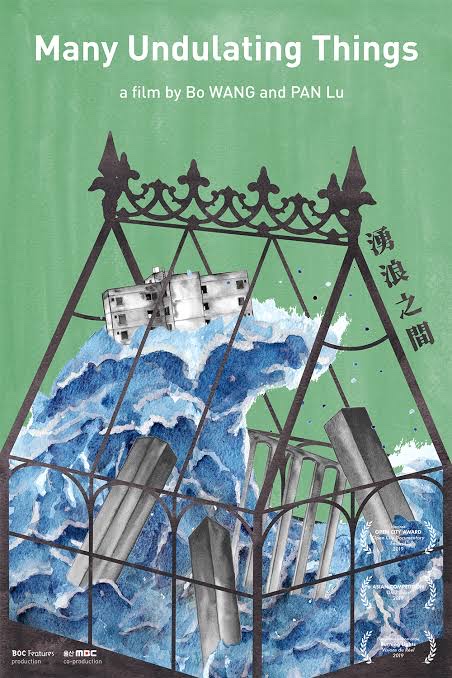
Many Undulating Things (Wang Bo, Lu Pan, 2019)
The film begins and ends in a shopping centre in Hong Kong. We carefully observe the smooth movement of the escalators, the constant flow of people that never stops, the musical fountain that presides over the centre of the internal courtyard, as if this gigantic complex could concentrate the circulation of the entire city, or even, the entire country. From there, it will be more a tale about concrete, enormous port warehouses, glazed galleries built for the 2010 universal exhibition, overpopulated tower blocks, the fragments of still recent colonialism… Through the history of urban changes, we witness the profound social transformation of this territory that is constantly swinging between the East and the West. Hong Kong thus emerges, like an archetypal space of many other cities of globalised capitalism. MANY UNDULATING THINGS offers a complex reflection on the relationships between landscape, nature, urbanisation and society. Thanks to its exhaustive approach, the film questions the function of cities in the development of the capitalist system. A political poem.
I almost despised the first part, the visuals are fascinating, but the narration and the philosophical frame used didn’t really work for me. From the second chapter onward, the work elevates itself and gets definitely more interestingly nuanced and complex, exploring the historical layers that constitute contemporary Hong Kong, analyzed through cinema, photography and paintings. When it moves to the third chapter, the documentary also explores how colonization in the past centuries worked and was deeply linked to the alteration of the botanical realm, “the reorganization of ecosystems under imperial order (…) was actualised through the glass boxes” an important invention and crucial part of the conquering process pushed by imperialism. The glass box would later mutate and evolve into greenhouses, exhibitions, arcades, spectacles and finally into shopping malls. This section, and especially the second chapter of the movie, is an expansion of Miasma, Plants, Export Paintings, a short made in 2018 by Wang Bo, and definitely forms the strongest part of Many Undulating Things, in my opinion. When the movie moves from the historical perspective back to contemporary Hong Kong, moving also from a visual and hybrid approach that uses old movies and photos to convey its meaning, it loses its power, trying to be too many things at once and meandering in too many directions.
That being said and even though Many Undulating Things feels at times too randomly constructed, and a sort of patchwork of three or four short documentaries, it’s still a fascinating piece of work worth revisiting.
Nuclear Power Plants Now いま原子力発電は (Sumiko Haneda, 1976)
This is an obscure and short documentary made for TV by Haneda Sumiko in 1976, shortly before establishing her own company and releasing The Cherry Tree with Gray Blossoms, if I’m not mistaken. Haneda and her troupe visit the Fukushima Daiichi Nuclear Power Plant to explore the state of atomic energy in Japan, and its lights and shadows. The short is mainly composed of interviews, but the most fascinating part is when doubts about safety concerns start to emerge in the talks. While some people from the Tokyo Electric Power Company, the company that owns the plant, compare the possibility of an incident at the power plant to that of a meteor hitting the earth, there’s a professor from Waseda, if I remember correctly, who says that there have not been enough cases to delineate or guess the consequences, or even to calculate the possibility, of a nuclear incident. The style is that of a TV documentary, and there’s a lot of explanation about how nuclear energy is produced, however, the doubts that the film raises, especially knowing what would happen 35 years later, are chillingly prescient and make it an interesting viewing. Even essential if you consider Haneda, like I do, one of the most important female directors in the history of Japanese cinema.







 Asian Docs
You must be logged in to post a comment.