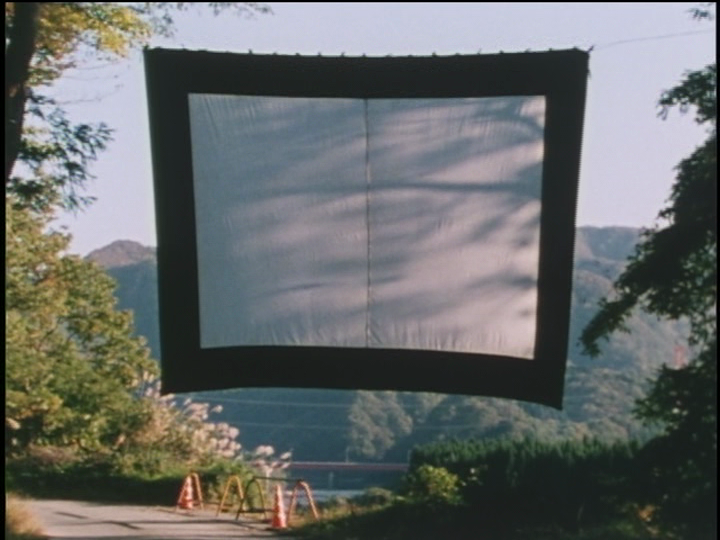
The Japanese Cinema Book – Ogawa Productions

We are currently navigating uncharted waters and I hope all you readers out there are safe and doing well, so today just a brief post to point to the release of an important volume: The Japanese Cinema Book, edited by Hideaki Fujiki and Alastair Phillips for Bloomsbury. As stated by the editors, the volume

provides a new and comprehensive survey of one of the world’s most fascinating and widely admired filmmaking regions. In terms of its historical coverage, broad thematic approach and the significant international range of its authors, it is the largest and most wide-ranging publication of its kind to date.

Ranging from renowned directors such as Akira Kurosawa to neglected popular genres such as the film musical and encompassing topics such as ecology, spectatorship, home-movies, colonial history and relations with Hollywood and Europe, The Japanese Cinema Book presents a set of new, and often surprising, perspectives on Japanese film.

With its plural range of interdisciplinary perspectives based on the expertise of established and emerging scholars and critics, The Japanese Cinema Bookprovides a groundbreaking picture of the different ways in which Japanese cinema may be understood as a local, regional, national, transnational and global phenomenon.

The book’s innovative structure combines general surveys of a particular historical topic or critical approach with various micro-level case studies. It argues there is no single fixed Japanese cinema, but instead a fluid and varied field of Japanese filmmaking cultures that continue to exist in a dynamic relationship with other cinemas, media and regions.


The Japanese Cinema Book is divided into seven inter-related sections:
· Theories and Approaches
· * Institutions and Industry
· * Film Style
· * Genre
· * Times and Spaces of Representation
· * Social Contexts
· * Flows and Interactions

There are a couple of chapters, or parts of them, that cover what is the main interest of this blog, the production and evolution of documentary cinema in the Japanese archipelago, experimental cinema, and amateur/home films. I was positively impressed by the scope of The Archive Screening locality: Japanese home movies and the politics of place by Oliver Dew, the ever-shifting boundaries between amateur/professional filmmaking, and everything that exceeds what we usually consider “cinema” are problematics that fascinate me. I might write something about Dew’s essay and Japanese home movies in general at another time, but today I want to briefly touch on the chapter written by Hata Ayumi. Filling Our Empty Hands’: Ogawa Productions and the Politics of Subjectivity is a dive into Ogawa Productions, with a special focus on how the collective changed their film-making identity, a process seen through the lens of three works made by the group at different times of their trajectory, Forest of Oppression (1967), Sanrizuka – Heta Village (1973), and The Magino Village Story – Raising Silkworms (1977). I will highlight some of the passages in the essay that more resonated with me, mainly those about the collective and their period in Yamagata,  disclaimer: the themes covered and analysed by Hata are much richer and deeper than what I’m about to write.

One of the most interesting issues tackled in the chapter is for me the connection the author draws between, on the one hand, the portrayal of farmers and farmers’ life created by the group throughout their career, and the rise of the minshūshi movement during the 1960s and 1970s in Japan, on the other. “The minshūshi, or ‘people’s history’ project, was part of a larger intellectual movement of the 1960s and 1970s that sought to construct new representations of the minshū, or non elite ‘people’ as political and historical agents, and overcome the view that they had been inert and passive objects of rule throughout history.”

The shift from a style of film-making more focused on the political struggle to a depiction, almost an ethnographic exploration, of the histories and cultures traversing villages and people in Sanrizuka, is one of the reasons Heta Village is a pivotal movie for Ogawa Productions. Hata argues that, what I call a tectonic shift for Japanese documentary, was possible also by the influence and the interaction of the collective with the minshūshi movement, thus repositioning the path of the collective in a much larger historical and political canvas.

One of the most astonishing artistic achievements in the long years spent by the collective in Yamagata filming and farming, was the ability to reach a degree of proximity, almost a merging and an identification, with the subject filmed, the taishō. Not only a proximity with people and their point of view, but also a quasi-fusion with the landscape and its non-human elements as it were, the plants, the seasonal changes, the weather, the geological time of the area, or the Sun perceived as a orbiting star. To read in the essay that Ogawa and his group “took this ideal subjectivity even further with the idea of ‘the human possessed by the rice plant’ (ine ningen), an imagined, metaphorical entity that they strove for in order to capture the essence of rice cultivation.” was for me a confirmation and a revelation. The beautiful poster of Magino Village: A Tale (1986)—some of the words on it are pure poetry, “a movie mandala”, “to carve the time of life into the body of film”—beautifully embodies this strive towards the becoming-rice plant of the collective, and it is in itself a work of art, in my opinion.

There are several scenes in Magino Village that encompass this love and obsession towards rice, farming, and all the human and non-human life that revolves around a plant so important for Japan and its people. Tamura Masaki patiently filming rice flowers bloom is one of the most famous, used also as the cover of the Japanese DVD, but my favourite is the one you can watch below, a scene Markus Nornes has described in his book on Ogawa Pro as “the most prominent haptic images” in the film.


Ogawa Production’s Sanrizuka Series – DVD Box set is out today

img_2206

Known outside Japan as the Narita series, the works made by Ogawa Shinsuke and his collective from 1968 to 1973 (with a return to the area in 1977) filming the battle and resistance of farmers, students, activists against the building of Narita airport, are usually called in Japan the Sanrizuka series, from the name of the area where the main struggle and land expropriation took place (an ongiing battle that is not over, by the way). As written briefly in a previous post, the Japanese label DIG is putting out on DVD all the documentaries of Ogawa Production, the first 3 films were released in June, and today (July 2nd) DIG is also releasing a DVD box set of the Sanrizuka/Narita series. Here’s the list of the works included in the box set:

  1.  Summer in Narita『日本解放戦線 三里塚の夏』(1968)
  2. Winter in Narita 『日本解放戦線 三里塚』(1970)
  3.  Three Day War in Narita『三里塚 第三次強制測量阻止斗争』(1970)
  4.  Narita: Peasants of the Second Fortress『三里塚 第二砦の人々』(1971)
  5. Narita: The Building of Iwayama Tower  『三里塚 岩山に鉄塔が出来た』(1972)
  6. Narita: Heta Village 『三里塚 辺田部落』(1973)
  7. Narita: The Sky of May  『三里塚 五月の空 里のかよい路』(1977)
  8. as an extra work, available only in the box set: Fimmaking and the Way to the Village (1973, Fukuda Katsuhiko)『映画作りとむらへの道』(1973)

The box set comes with a booklet where each movie is introduced and a final note by renown documentarist Hara Kazuo. I haven’t had the chance to watch them yet, so I can’t say anything about the transfer*.
All the DVDs don’t have English subtitles, but that fact that finally these important documentaries are available on home-video basically for the first time, the only Summer in Narita was released with a book a couple of years ago, is something to rejoice. My hope is that some label outside Japan (maybe Zakka Films or even Icarus Films, why not?) will one day in the near future put together an international edition.

* July 4th addendum: I’ve watched some minutes of Heta Village, The Building of Iwayama Tower and Narita: Peasants of the Second Fortress just to get an idea of the transfer’s quality. As I expected the DVDs mirror the quality of the original prints – I’ve seen them all on the big screen, but many times on quite battered DVD samples, so my memory might trick me here. Be that as it may, the movies are not in a good state, lots of scratches, flecks and dirt, in a perfect world they would have had a restoration first and they would have been transferred on DVD only later. But we don’t live in a perfect world and the huge debt left by the group is still hindering any “normal” process of preserving and presenting the works in a pristine state. That being said,  this release is an important step anyway, because it will help to introduce Owaga Pro and its documentaries to a wider and younger audience, and just for this reason it’s a project that should be praised.

Ogawa Production’s documentaries finally on DVD

 
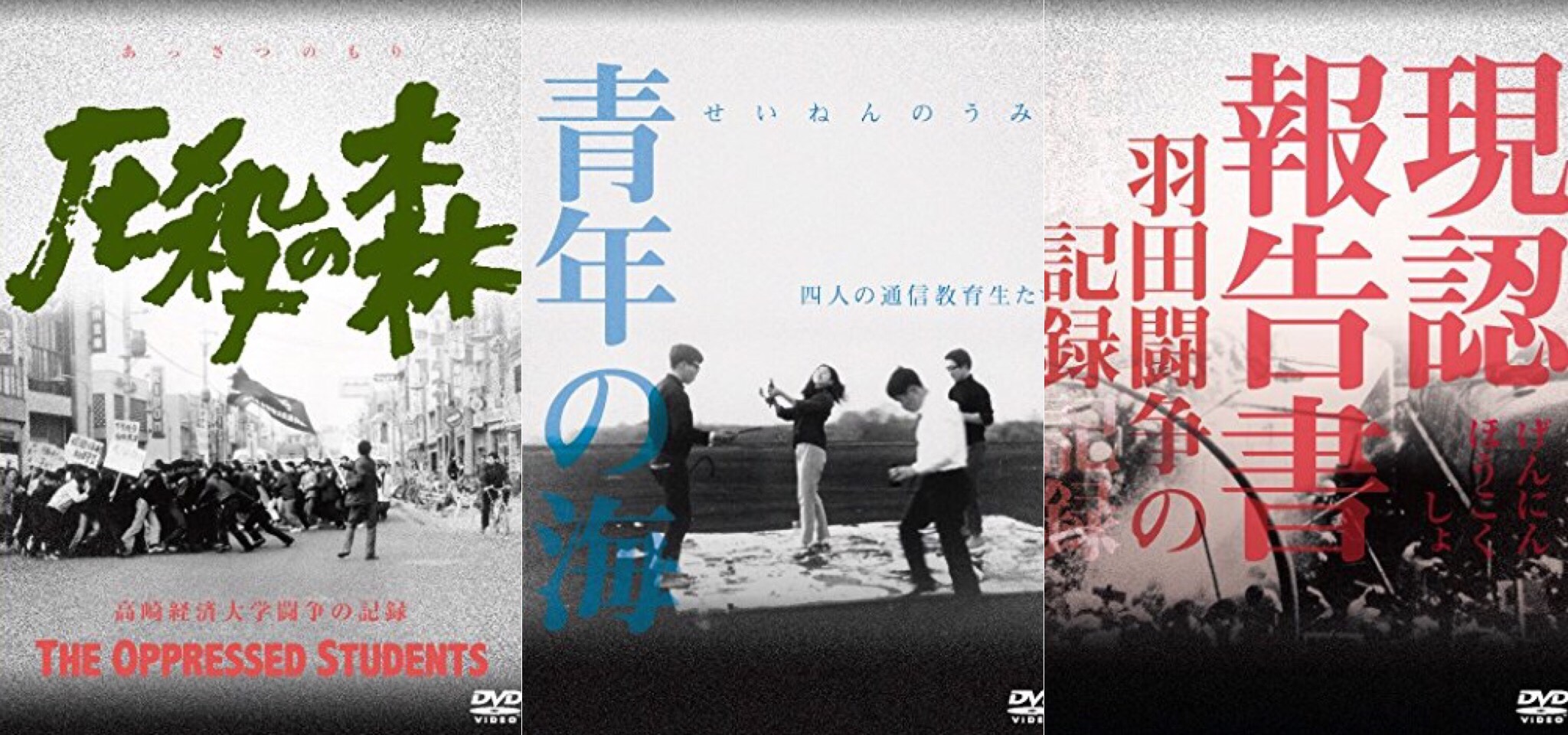
I’ve often written, here and elsewhere, about Ogawa Pro and the documentaries made by the collective, first in Sanrizuka – documenting the resistance of the peasants against the construction of Narita airport – and later in Yamagata. A couple of days ago through social networs I found out that finally all the works produced by the collective will see the light on DVD, a project by the Japanese label DIG. First, on June 2nd, we will get 3 of the early documentaries: A Sea of Youth (青年の海, 1966), The Oppressed Students (圧殺の森 高崎経済大学闘争の記録, 1967) and  A Report From Haneda 現認報告書 羽田闘争の記録, 1967) and later, presumably in one or two years, all the 20 documentaries made between 1966 and 1986 by the group. The news is big, at least for me, and although I have sample DVDs of many of the movies shot in Sanrizuka and Yamagata, copies kindly given to me by the festival people in Yamagata, it will be nice to have the films  “neatly transferred” on DVDs, the samples I have being a copy of a copy of a copy of a VHS. But here comes my biggest concern about this otherwise great news, will the transfer be really a proper one? Almost all the documentaries are shot in 16mm and I’m not really sure about the condition of the originals, in an ideal world we should see them first lovingly restored and then made them available for the home-video release. But the huge debt left by Ogawa complicates everything, what we’re likely to get is something close to the DVD of Kamei Fumio‘s Fighting Soldiers, a bare bones release, watchable of course but with a poor transfer, in the particular case probably due to the condition of the source material. The docs will not have English subtitles, adding them would have helped to “spread the word” of Ogawa Production to a wider international audience, but again, we don’t live in an ideal world and we should be happy and content with what we will get. Be that as it may, I’m pretty excited about this and I’ll write again about the project, the image quality, etc. when I get more information or in June, the time of the first releases. 

You can preorder the DVDs here

Japanese documentary-related catalogues

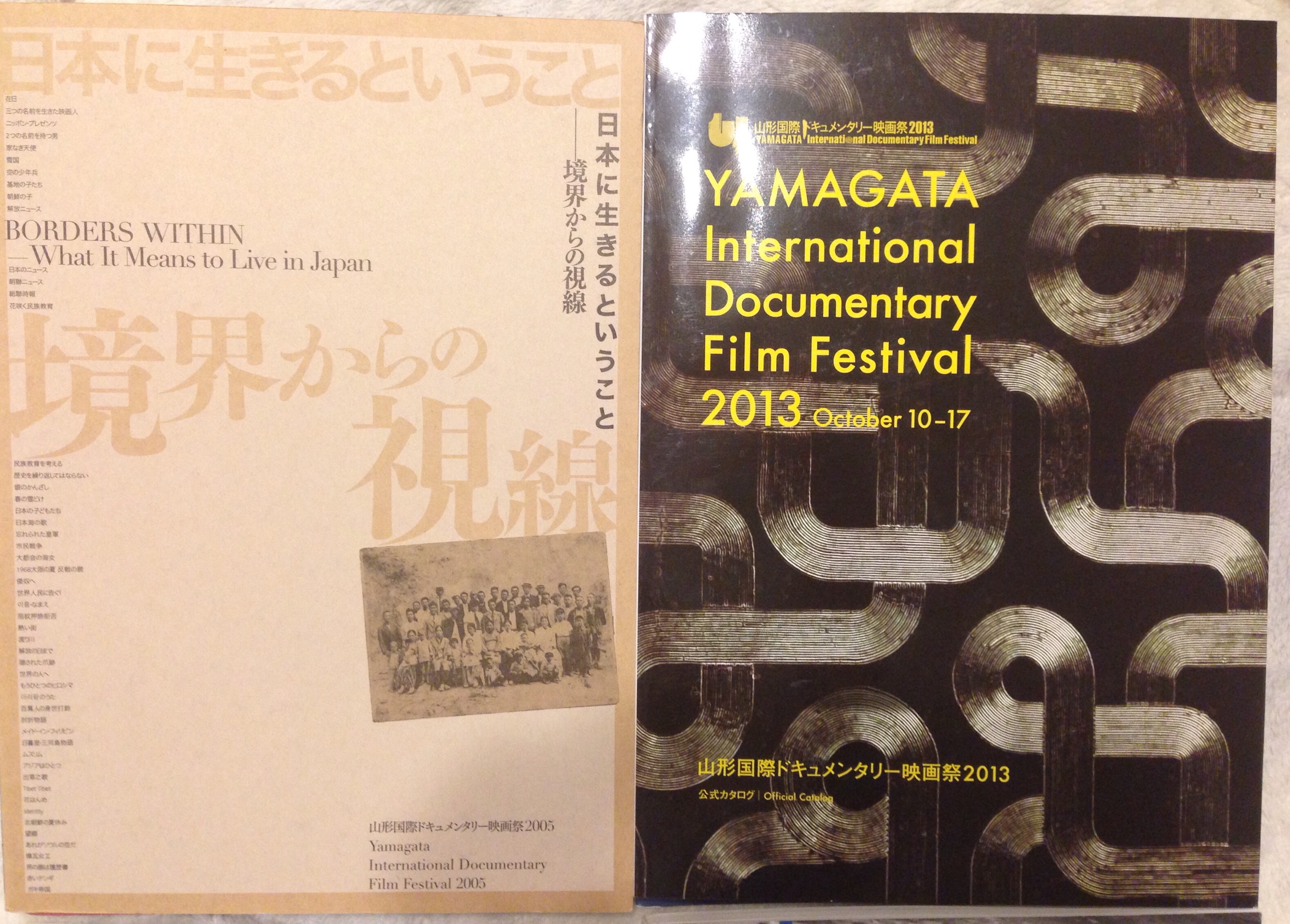
A lighter and more “visual” post today, some photos of the Yamagata International Documentary Film Festival’s catalogues I have at home:

2015/01/img_3378.jpg

YIDFF 1993 (Japanese documentaries of the 60s) and YIDFF 2003 (Ryūkyū Reflections Nexus of Borders)

2015/01/img_3377.jpg

YIDFF 1995 (Japanese documentaries of the 70s) and YIDFF 1997 (Japanese documentaries of the 80s and beyond)

2015/01/img_3379.jpg

YIDFF 2005 (Borders Within What It Means to Live in Japan) and YIDFF 2013

They’re in English and are an essential resource if you’re interested in Japanese cinema or documentary in general. For me personally “Ryūkyū Reflections Nexus of Borders” was a discovery: non-fiction films and the history of Okinawa, a place where all the contradictions and problematics arising from Japan-as-a-state and its relationship with other nations and its own inner borders are embodied and magnified. Or as Higashi Yoichi once said talking about his documentary Okinawa Islands (1969)
Continue reading “Japanese documentary-related catalogues”

Best 10 Japanese documentaries – my list

As a reminder that you still have a month to join the poll “Best 10 Japanese documentaries of a time” I’ve put together my list. I left out many good and inspiring documentaries made in recent years (Genpin, No Man’s Zone, Flashback Memories and others) and I’ve cheated twice, but anyway:

vlcsnap-2013-10-27-18h56m10s89
Fighting Soldiers (戦ふ兵隊, 1939 Kamei Fumio)

/home/wpcom/public_html/wp-content/blogs.dir/279/79975380/files/2015/01/img_3366.jpg
Children Who Draw (絵を描く子どもたち, 1956 Hani Susumu)

AKA-SerialKiller
A.K.A. Serial Killer (略称・連続射殺魔, 1969 Adachi Masao, Iwabuchi Susumu, Nonomura Masayuki, Yamazaki Yutaka, Sasaki Mamoru, Matsuda Masao)

motoshinkakarannu
Onikko (鬼ッ子 闘う青年労働者の記録, 1969) and
Motoshinkakarannu (沖縄エロス外伝 モトシンカカランヌー 1971) by NDU/Nunokawa Tetsurō

Minamata_Victims
Minamata: The Victims and Their World (水俣 患者さんとその世界, 1971 Tsuchimoto Noriaki)

hetaburaku083
Sanrizuka: Heta Village (三里塚 辺田部落,1973) and
Magino Village – A Tale / The Sundial Carved With A Thousand Years of Notches (1000年刻みの日時計 牧野村物語, 1986) by Ogawa Pro

akamata
Song of the Akamata–The life histories of the islanders, Komi, Iriomote Islands, Okinawa (海南小記序説・アカマタの歌-西表・古見, 1973 Kitamura Minao)

/home/wpcom/public_html/wp-content/blogs.dir/279/79975380/files/2015/01/img_3040.png
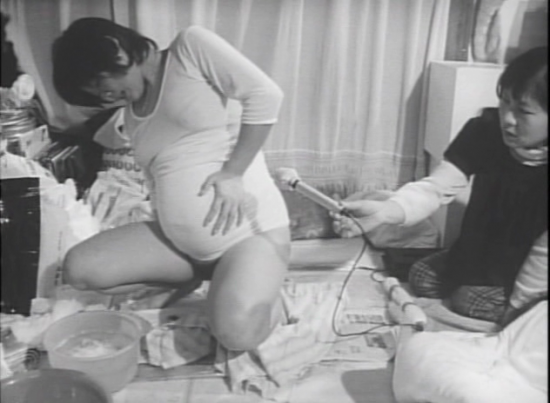
Extreme Private Eros 1974 Love Song (極私的エロス・恋歌1974, 1974 Hara Kazuo)

/home/wpcom/public_html/wp-content/blogs.dir/279/79975380/files/2015/01/img_3370.jpg
The Cherry Tree with Gray Blossoms (薄墨の桜, 1977 Haneda Sumiko)

Memories_Agano1
Memories of Agano (阿賀の記憶, 2004 Satō Makoto)