Unedited notes on the Noda Shinkichi’s retrospective (October 2023, Yamagata).  Day 4.

As a sort of work in progress, draft for a possible future research, or simply as a trace of a significant, and very rare viewing experience, I have decided to publish, unedited, the notes and reflections I took while attending the Noda Shinkichi’s retrospective, organized at the Yamagata International Documentary Film Festival, in October 2023.
A total of 38 films were screened in 5 days; you can read the synopsis of each film here.
Below you can find the notes I took on day 4 (my notes on the first two days, and the third one):

Day 4

The Mikagura Festival of Tomiyama Village 1985
Opens with 1970s folk music. Shots of mountains. Graphs. Photos in black & white explaining how part of the town was moved because of the construction of a Dam. 
Production of tea and shitake mushrooms.
Cut to new credits: 1985 January 3rd and 4th. Creative way to use multiple openings. In the following films, there are multiple endings. 
Describing step by step each phase of the festival. Preparing mochi. Purifying rooms, musical instruments, and people who will join the festival. Offerings to the tree. 
No direct sound. Music and images combined.
Small room. Dances start.
Men, men, men. No women for most of the time. We see some of them in the audience later. 
All the music is very similar, what changes is the dance. Ichi no mai, Shishi mai, Yubayashi no mai, Oni no mai.
Interesting: drunk (?) young people  interacting freely with the masked dancer. Masks are very expressive and feel very specific to the area.
Atmosphere is very “casual” (or better, popular?) from the very beginning. It’s a ritual, but not hyeratic. Everyone seems relaxed, joking, while others are performing, the singing and chanting themselves are not perfect, it’s all over the place. After all it’s a matsuri, not a ceremony or only a performance. 
Meaning of matsuri: giving new life to people and area, renewing life. 

The Procession of Weird and Wonderful Masks 1988
No narration, solemn music.
Shot of people wearing masks, all together on the stairs.
Panning on each mask slowly. Amazing colours and shapes. Again they feel very specific of the area. It’s a film about masks.
Parade. Close-ups of masks and people’s faces.
Like in the films about strikes/protests: images filmed on the street in the parade shaking-style, are alternated with shots from above, and low angles shots from street level. Fast editing. 
End: introducing each mask, explanation cards, mask on a black background. No sound in this part.

Sarushima-Island With a Fort: Ruins and Graffiti 1987
Music. No narration. Shots stay longer on soil, walls, stones. Panning. 
Concrete shelters. Holes in the walls (bullets). Graffiti and traces of war overlap. Different times. 
Sometimes there is no sound. Sometimes music (guitar).
Camera pans on walls, entrances, tunnels, corridors.
The ending is very beautiful (Noda master of ending in this period): black frame with a tiny bright square (entrance/exit out of tunnel) oscillating for a long time. Bright spot gets bigger. We’re out. Cut to the island (mirroring the beginning). Zoom out slightly. Stay on the image for long. End. Filmed between in 1968 and 1983 (really?!) edited together in 1987. 

Good Road for the Living and the Dead: Niino Bon Odori, Festival to Send Off the Gods 1991 

The Feast of the Gods on a Winter’s Night: Toyama’s Shimotsuki Festival 1970
B&W. Images of the area. Music. Images of fire. Images of shide (paper hanging from the ceiling). Images of hands. Close-ups of hands. Fire. Water boiling. 
Fire and smoke are often on the foreground.
Dancers are almost never shown from far away. Camera is in the middle, part of the constellation formed by people and objects. Performers shown in a fragmented way. Everything is continuously cut. Camera goes back to shide, fire and water many times. Kitamura explained in the after talk that fire and water come together in the ceremony. 
Chants, dances and images become monotonous like in a trance. Cinema-trance.
No narration or explanation. Just a card at the beginning.
As Kitamura Minao said: this is a festival captured without knowing almost anything about it. Sensorial. 
The most experimental of the folklore films.
Exceptional.

Good Road for the Living and the Dead: Niino Bon Odori, Festival to Send Off the Gods 1991 
People dancing for three days welcoming the dead during Obon. 
Again, shot from above, from street level and low angles. Colourful.
Impressive images of all the town dancing. Different times soak the images in different lights (twilight, dawn, etc.)
Singing and dancing together as in utagoe: identity making?
Young people make kind of a mess, but scenes are kept in the movie like in the first movie of the day. The film takes its time, slower rhythm, music and dances envelop the viewer slowly. Cinema-trance, but of a different sort from the previous.
People move toward the graveyard. Burning the small floats. The spirits of the dead. 
Fascinating and creative the ending, long time black screen, music. The dead. 

Personal note: there’s a similar festival in Gifu (Gujō Hachiman, 3 days in Obon) but it’s so packed with tourists that we can’t even enter the town (link to Hayachine and tourism). Impossible now to film a festival like Noda did. 

Snow as Flowers: Niino’s Snow Festival 1980
Opens with the deep blue of the sky and a beautiful map of the area. 
Constructed like Mikagura Festival: documenting each step of the festival. Shots and scenes are here much longer.
Again, Noda does not shy away to show the rough/popular side of the festival: two guys parading are drunk, people interacting quite directly and roughly with the performers, one guy is caught yawning.
Wondering is the presence of the camera enhanced or altered the behaviour of some participants. Less poetic and experimental compared to the two previous films. Noda getting more interested in folklore itself than in the representation of it?

to be continued

Unedited notes on the Noda Shinkichi’s retrospective (October 2023, Yamagata).  Day 3.

As a sort of work in progress, draft for a possible future research, or simply as a trace of a significant and very rare viewing experience, I have decided to publish, unedited, the notes and reflections I took while attending the Noda Shinkichi‘s retrospective, organized at the Yamagata International Documentary Film Festival, in October 2023.
A total of 38 films were screened in 5 days (you can read the synopsis of each film here).
Below the notes I took on day 3 (my thoughts on the first two days are here):


Day 3

Tying Land and Sea 1960
The film opens like a Shōchiku movie, but the colour palette is not very poppy.
Various ports in Japan: Yokohama, Toyama, Kobe, Niigata, Hiroshima, Hokkaido, Nagoya, Shikoku, etc.
Interesting how in the film, the narration uses the term ura nihon to describe cities on the West coast, nowadays it is considered offensive and it’s not used anymore. Noda uses it in other movies too, the geography ones, I think.
The editing’s rhythm mirrors the music, when it is fast the music also gets fast, or more “aggressive”. 
Focus is not on people but on the things (there are very few close-up shots of faces)

Carrying the Olympics 1964
If the previous was like a Shōchiku, this one felt like an action produced by Nikkatsu, although the focus on things is similar.
The music is louder, mainly classic, organ and baroque.
Starts from the empty pool and the national stadium, empty.
New monorail.
Trucks transporting materials for the Olympics.
Equipment arriving for the players from different countries.
Aeroplanes, luggage, horses.
Night scene with oblique shots and superimposition of the 5 rings (one of the most beautiful images of the film).
The editing is much faster than in the previous movie. 
Same scene is shot from different angles. Mirroring the subject of the movie, the images are continuously moving, rarely we get a static shot for more than 2 seconds.
The camera is always panning, zooming in or out, or the image is vibrating (telephoto lens), or the camera is moving because it is on a truck.
Shots from the perspective of the cones, of the pigeons, of the reels for TV.
While the subject is “simple”, formally it is a very sophisticated movie, very smartly constructed. 

Nitiray A La Carte 1963
From the very first shot to the last, the film is pure experimentation, visual and sonic. 
Music by Takahashi Yūji is hinting at a space age to come.
Abstract titles.
Stagy parade of models like in Suzuki’s Tokyo Drifter.
Felt like an installation sometimes.
The narration is comedic and almost surreal.
Slow motion, shots in the mirror, close-up of lips, 4 screens.
Shot of the meeting from above.
Kids parading.
Graphs/animation about the history of the company.
Pure art-house entertainment.
The music suggests a futuristic product (nylon) constantly evolving, the images are experimental as the company is experimenting with new chemicals. This sense of looking ahead and moving away from the past is also hinted at by alternating black and white scenes with the ones in popping colour.

A Town Not Yet Seen 1963
One view was not enough for me to fully appreciate it.
Street, water flowing, walls, stones, meat hanging.
A small stone bridge reflected on the water.
The film is in dialogue with Matsumoto Toshio’s The Song of Stones, and The Weavers of Nishijin (1962).
I found the music a bit too intrusive.

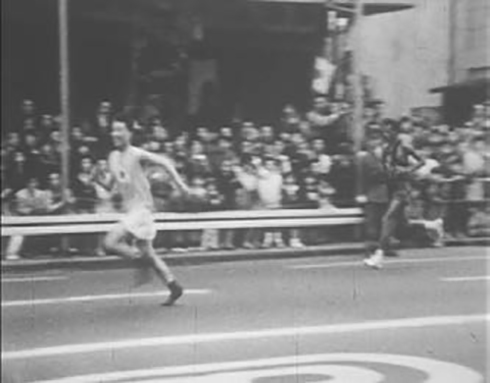
The Loneliness of Two Long Distance Runners 1966
Credits written on cardboard with ants.
Starts with a black screen and music (in English)
The scene is repeated 19 times.
Every time we notice something new, the police, the official cameraman, the audience, the smile on the face of the young Japanese.
The music matches ironically with what we see on screen: “c’mon” “you move me baby” “go go go go go” “oh yeah!”
The perception of what is on screen changes with repetition and music, the more we see it the more it gets funny.
Difference in repetition. 

Collapsed Swamp, or Painter Yamashita Kikuji 1976
Unfortunately, I haven’t taken so many notes on this, I’ll add some lines from the Osaka’s “phantom” retrospective organised in 2020.

Film opens with the artist’s face.
He was in the war, and so was his brother, all his art is about expressing what is almost impossible to express, the horror of war.
His paintings depict scenes where animals and spirits coexist with humans.
Noda and Yamashita were colleagues at Tōhō Studio, where they both experienced the Tōhō dispute.
It’s a very peculiar film about an artist, in that it’s in black & white, the words of the artist are prominent. 
Yamashita’s words were recorded in 1969, images were captured between 1970 and 1972. Work completed in 1976.
When the film moves to the Owls it becomes almost comedic, but a surreal comedy.
Scenes when Yamashita talks about being questioned by the police on images of him smashing birds head: Violence on the protesters in the late 60s?

Mizutani Isao’s Wanderings through Ten Spiritual Worlds  1984
Silent but originally was accompanied by the artist’s own narration, benshi-like.
Pouring paint on canvas at night.
Morning, Mount Fuji in the background. Frozen Yamanaka Lake.
When is pouring paint, his face is like a Noh mask. Performance for the camera?
Cut inside. Making the final touches. Close up of details. Insects.
Summertime. Finished paintings are placed in different parts of the city: stairs, middle of a street, etc.
Feels like performance art. A happening.

Carrying the Olympics 1964

Unedited notes on the Noda Shinkichi’s retrospective (October 2023, Yamagata). Days 1-2.

As a sort of work in progress, draft for a possible future research, or simply as a trace of a significant and very rare viewing experience, I have decided to publish, unedited, the notes and reflections I took while attending the Noda Shinkichi’s retrospective, organized at the Yamagata International Documentary Film Festival, in October 2023.
A total of 38 films were screened in 5 days, here are my notes on the first two days (you can read the synopsis of each film here, notes on the third day here).

Day 1

Renovating Farm Houses  (1941)
Festivals in Tohoku Part 1  (1956 )
Festivals in Tohoku Part 2 ( 1956 )
Festivals in Tohoku Part 3 (1957 )
Impressive use of colours, especially in the second film, where the parade reminded me of Rio’s carnival.

Forgotten Land: Record of Life Series II  (1958)
Impressive film, especially on a formal level.
Opening: the camera pans on the faces of students, who are telling their dreams, mainly to leave the village. The use of editing reminded me of soviet montage, for example: close-up of a fisherman, fast cut to the sea and wave, or when the woman is ploughing the soil, the editing is almost in rhythm with her actions.
The soundscape has also a big part in the film: the sounds of waves penetrate each image, and each individual’s life, we are reminded that the sea is always there with its harshness
On the Method of Avant Garde Documentary by Matsumoto Toshio was published in June 1958, in Kiroku Eiga, the journal founded by Noda, Matsumoto and others.

The Girl of the Valley  (1949)
Fiction with a heavy touch of realism.
Making of charcoal is a theme recurring in all his movies about or set in Tohoku, signifying an old and severe way of living,

The Locomotive Kid  (1950)
The scenes about the train are beautifully filmed, I liked the transition from the kid looking at a photo of a locomotive to images of it.
The tone of the movie is definitely lighter than the previous one. Of course the train is the kid’s dream but also, as always, symbolises progress, especially for a rural area.
Slow paced.
Noda is good at directing kids. The two movies and Work in Retail (1951) reminded me of the films of Shimizu Hiroshi, the kids of course but also the tone (a mixture of serious and funny).

Day 2

The Unforgivable Atom Bomb: The Singing Voice of 1954 Japan  (1954)
Impressive film that reminds us the importance of utagoe festivals, and utagoe culture more in general. As we’ll see in the next couple of movies, singing while protesting gives the people an identity, unifies them. Each union or group has a different song.
Formally the film alternates long shots, when we see the stage and groups performing on it, with images filmed close to the performers. As the movie progresses the images of the auditorium with all the people singing and moving together are used more often. Very impactful scenes.
Noda a couple of times cuts to images of strikes.
Chinese and Korean groups are also performing on stage, it is a very transnational movement, highlighting class struggle first, in this it reflects the political atmosphere of the 1950s. Women are very present and a very active part of the unions, at least it seems so from the film.
Utagoe as a convergence of popular and political is fascinating, it is popular before becoming pop (probably in the 60s)

On a side note, in the credits I’ve seen the name かんけまり Kanke Mari, she was a director of PR movies and documentaries active in the 60s and 70s (did a documentary on a railway workers strike screened at National Film Archive ), Noda writes about her in his book about documentary.

The Matsukawa Incident: Seeing the Truth Through the Wall  (1954)
Opens with images of a wall, silent, and then with organ music. From here we move to the court where we are explained about the incident, the official version.
The film is constructed as a counter story of the incident and does so in a very modern way that feels very fresh even today.
Interviews with the men wrongly accused, graphs and animation used to explain the movements of the suspects, scenes that feel almost reenactments (man walking along the railway).
The film takes its time in explaining the facts and in depicting the wrongly-accused men. It is strange to say, but it feels like a crime novel, there’s even suspense.

The Workers of Keihin 1953 (1953)
Film starts with the depiction of the workers on the way to their job place, bus, train and boat.
Use of photos.
During the demos, we often see the mothers with their kids.
Preparation for May Day, all the different unions and some new ones are formed (department stores, mainly women).
U.S. bases are considered responsible for the conditions of the workers, overworking, low salaries, etc.
This sentiment against the US is added to the one against the war in Korea.
As in the utagoe film, the events organised by the unions are horizontal in their scope, here we see a sports day organised for the Korean community in Japan. We also see support in China, Italy (just mentioned), and other countries.
Important: the unions/workers are reaching to the farmers to get their support against the use of Japanese land by the American bases (this predates the documentaries about the Sunagawa riots by Kamei Fumio and of course Ogawa Pro).
The farmer resistance of the 60s does not appear suddenly from nothing. 

June 1960: Rage Against the Security Treaty  (1960)
Dramatic music opens the film, from the very beginning it’s very noticeable how the style has evolved: fast cutting, shaky hand camera, many shots are from street levels and in the action (Sunagawa and Sanrizuka style), close-ups, direct sound…
Powerful scene: arrival in Japan of Ike, helicopter is landing among a sea of people protesting.
Farmers are more present here in the protests, Miike mine workers are also showing solidarity.
Spectacular images of protests in front of the American embassy and the National Diet Building.
Death of Kanba Michiko, killed in the protests. After the tragedy the movie goes silent for a couple of minutes showing mainly photos of people beaten laying on the street, powerful and violent images. Photos of prime minister Nishi are often used and stay on screen for quite a long period of time. 

The New Japanese Geography Film Series: Tone River  (1955)
The New Japanese Geography Film Series: The Roofs of Honshu  (1957 )
The New Japanese Geography Film Series: Tokaido, Yesterday and Today  (1958)
The New Japanese Geography Film Series: Villages of the Northeast  (1959)
What I remember of the four movies is that in one it is said that the modernisation of Japan, while obviously necessary, turns every city into something similar. The specificity is lost. 

Technique of Foundry: The Cupola Operation  (1954)
Experimental music used throughout. Images of melting metal are like abstract paintings, the camera stays on these images for long periods of time (considering it is a PR film).

Marine Snow: The Origin of Oil  (1960)
Well, a spectacle, the colours are amazing, the editing in a scene about the waves is almost  jump-cut.
Again, some images, are like abstract paintings, it’s science porn (like the rice ones in Magino).
Grandiose music. Commissioned by a oil company, thus partly celebrating the petroleum industry, and yet…

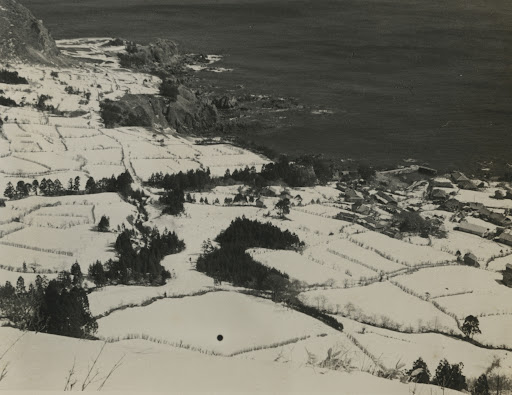
Country Life under Snow  (1956)
The colour palette is tone down here, what I remember is the music being similar to the one used in Godzilla.

Marine Snow: The Origin of Oil  (1960)

to be continued

Yamagata International Documentary Film Festival 2023 – dispatch 1: Losing Ground, Land of My Dreams, A Night of Knowing Nothing, and more.

Yamagata International Documentary Film Festival 2023 wrapped up two weeks or so ago. It was a nice and enriching experience to attend the festival in presence again (the 2021 edition was held online only), and to catch up with old and new friends.

Most of my viewing time was cannibalized (and I mean it in a good way) by Noda Shinkichi‘s huge retrospective, a deep dive into the works of a pivotal figure in the development of documentary filmmaking in post-war Japan. I’m planning to write about this fascinating and almost overwhelming viewing experience in the following weeks, but today I’m going to focus on some of the other films I saw in Yamagata.

Three documentaries about the current socio-political situation in Myanmar, films shot in the country, were screened in the always interesting New Asian Currents program. 

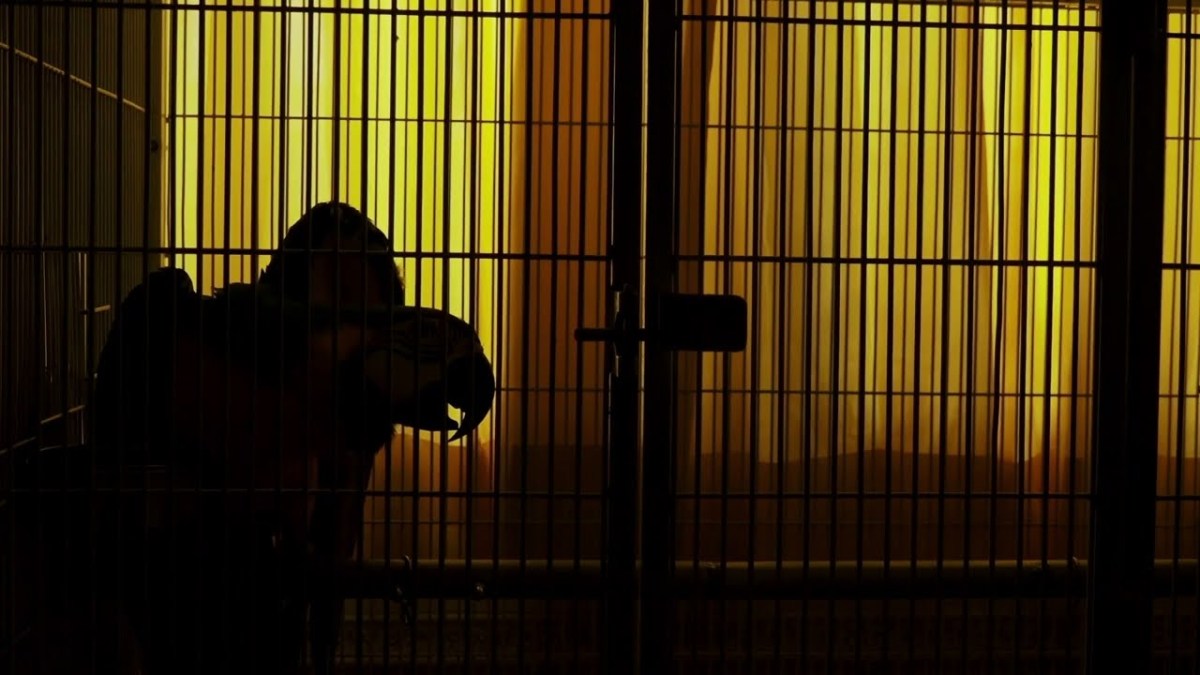
Losing Ground (anonymous, 2023) is a short film (23’ in the version presented in Yamagata) about the filmmaker’s own personal experiences in the protests that erupted in Myanmar, after the coup d’état brought chaos to the country, in February 2021. A somber, and beautifully shot, personal reflection on how the event altered his life and those of the people who joined the resistance. After actively participating in the demonstrations on the streets, the anonymous director was imprisoned for eight months, and once released, he was unable to return to his “normal” life. The film is a recollection of what happened in 2021 and a depiction of his current situation, trapped in his house, his dreams and those of his generation have been destroyed by the military regime. This sense of entrapment is expressed by images enveloped in darkness mainly shot in and from his home, also a way not to show the filmmaker’s face and thus guarantee his safety.  After the time spent in prison, the director’s house and the city where he lives, Yangon, have also become a prison, a metaphorical but inescapable one. As the filmmaker states in the film, the sense of dread experienced during his imprisonment now pervades every fiber of his body. Just seeing a police or army vehicle from his window makes him feel nauseous and shake with fear. The sense of defeat and existential paralysis emanating from the minimalistic images is extremely powerful, and the whole movie feels like a desperate scream for help. It is thus very important that Losing Ground was awarded with the Ogawa Shinsuke Prize, and I couldn’t agree more with the comment of the jury’s members: “We want to send a strong message to this as well as other filmmakers who are similarly trapped or imprisoned, physically or metaphorically, that we see you. We care, and we are in solidarity with each and everyone of you.”

Conceptually and stylistically very different, but equally interesting, is Journey of a Bird (anonymous, 2021). Filmed in the days and months following the coup d’état, the short work documents the daily life of a group of young people, all in their early twenties, facing the lack of freedom brought after the military seized power. Shot with smartphones and a small digital camera, the film chronicles the daily life of a group of friends: organizing and protesting in the streets, changing apartments to avoid being followed, drinking and singing together, and dealing with their parents and the world of adults. While on the opposite spectrum of Losing Ground—it is a less reflective work and it feels like the director and his friends were thrown into making a film almost by chance—the situation depicted on screen reveals, in all its complexity, the struggle to keep living in a country under a dictatorial regime. 

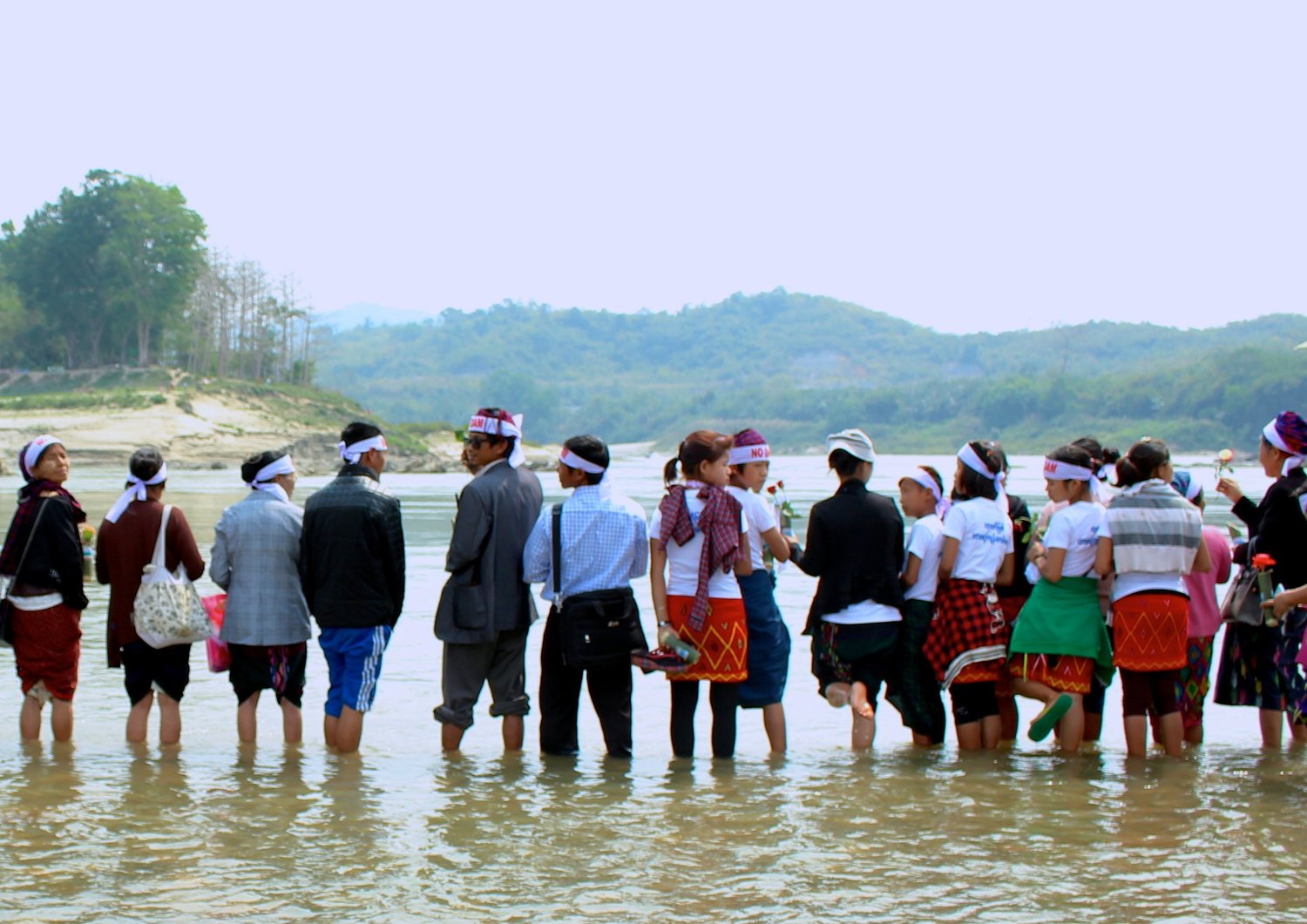
Also filmed in Myanmar, but not dealing directly with the consequences of the coup d’état, is Above and Below the Ground (Emile Hong, 2023). The work depicts events that happened before February 2021, and it is set in a peripheral area of the country, the Kachin region in the north of Myanmar, near the border with China. The life of a small community, the ethnic Christian minority that inhabits the area, is about to be disrupted by a soon-to-be-built dam, whose construction has been entrusted to a Chinese company. The resistance to the project and their fight for self-determination is described from the point of view of two of the women at the forefront of the protests, probably the better part of the documentary. To this storyline the film interweaves that of a local rock band invested in the demonstrations, a section too meandering and that lessens the impact of what the documentary is trying to say. 

Women’s voices are also featured in two documentaries filmed in India about the Citizenship Amendment Act (2019), and more broadly on the political and social situation since Narendra Modi’s far-right government was elected in 2014.  A Night of Knowing Nothing is an experimental documentary, screened and awarded at Cannes in 2021, directed by Payal Kapadia. The film has been critically praised internationally, a trend that continued in Yamagata, where it won the competition’s Grand Prize, The Robert and Frances Flaherty Prize. It was a very impactful viewing experience for me, the grainy black-and-white images perfectly convey the sense of horror and terror in which young generations of Indian students live in New Delhi, amid caste discrimination and police repression. However, it is a movie that I would like to watch again to better assess and appreciate the nuances and aesthetic choices made. I find the statement from the jury illuminating:

“A Night of Knowing Nothing adopts a fictional conceit in order to historicize the reality of a tumultuous present, crafting a portrait of a nation in crisis that is equally a story of love, friendship, memory, and youth. Marshaling a vast array of cinematographic techniques and technologies with skill and creativity, Payal Kapadia reflects on how and why images are made and what they can do. This enchanting and risk-taking film abandons all didacticism while retaining a political acuity that resonates intellectually and emotionally”.

Formally very different, Land of My Dreams (2023) addresses the same period and social tensions from a more feminist, more direct, and perhaps more articulate and critical point of view. Director Nausheen Khan, a university student, crafts a piece of resistance cinema that depicts, through interviews and images shot in the midst of the action, the story of the women who formed the non-violent movement against India’s Citizenship Amendment Act. Between 2019 and 2020, for over 100 days, the women of Shaheen Bagh in New Delhi, students, mothers and older women, protested the systematic repression against the Muslim minority, one of the pillars of nationalist propaganda set in motion by the government. Month after month these peaceful sit-ins spread to the rest of the capital, and eventually of the country, creating a broader movement that criticized the right-wing policies of Modi. In addition to providing a complex and dynamic picture of the socio-political situation in New Delhi, the film is also a painful reflection by the filmmaker herself on her identity. As a Muslim and as a woman, she finds herself at the center of personal tensions between the religious beliefs she grew up with, and her social experiences. The film (unsurprisingly, it’s Yamagata!), was awarded the Citizen’s Prize.

A special mention goes to Night Walk (Sohn Koo-yong, 2023), a work without sound, and with static images of night landscape accompanied with written poems on screen. An extreme visual experiment I could not completely connect with, but that still fascinates me. Predictably, many people walked out of the theater, but it was refreshing to hear, in the after talk, that many viewers were mesmerized by and could engaged with it. Again, the words of the jury come to rescue: “Night Walk might be called an anti-cinematic, anti-poetic, and anti-landscape-theory documentary.”

Yamagata International Documentary Film Festival 2023. Noda Shinkichi, Trinh T. Minh-ha, Miko Revereza, and more

After the special online edition of 2021 (the in-person event was canceled due to the pandemic), starting from today the Yamagata International Documentary Film Festival is back in its regular format. For a week, October 5-12, the city in Northern Japan will be the capital of non-fiction cinema, with screenings, events, workshops, and meetings on and around the varied landscape of international documentary, with a special focus on Asia. If you want to have a look at the program, check the official page of the festival.

This will be my 5th edition (6th counting the online one), and the main focus for me will be following, as much as possible—but as usual everything changes during the festival—the huge retrospective on the works of Noda Shinkichi (1913-1993). A poet, filmmaker, film theorist, and an important figure to understand the different evolutions and developments of documentary filmmaking in the archipelago during the 20th century. Some of his works (industrial, science, and folklore films) are available on the NPO Science Film Museum‘s official homepage for free; or for rental, on the platform Ethnos Cinema.

この雪の下に Country Life Under Snow (1956), for instance, is a fascinating depiction of the harsh life in a rural area in Yamagata prefecture, while オリンピックを運ぶ Transporting the Olympics (1964), co-directed with Matsumoto Toshio, focuses on the logistics and the behind the scene of the 1964 Tokyo Olympics. How things (boats, yachts, traffic cones, film reels, etc.) and animals (horses, pigeons) were transported from and to the capital.

One of the most relatively known works by Noda is マリン・スノー-石油の起源-Marine Snow – The Origin of Oil, co-directed by Ōnuma Tetsurō, a celebrated science film produced by Tokyo Cinema, sponsored by Maruzen Oil Co., and filmed using Eastmancolor. The short film describes the vertiginous span of time (millennia) in which sea plankton, through decomposition, turns into natural gas and oil. Commissioned by an oil company, and thus partly celebrating the petroleum industry— directly only in its last 5 minutes though—Marine Snow remains a visually astounding piece of science film, flawed by its own design and origin, but astounding nonetheless.
You can watch here the version with an English narration (I prefer the Japanese one, for what it’s worth).

These films are just a fraction of what will be shown in Yamagata, in total the Noda’s retrospective includes 38 works, produced between 1941 and 1991. A Japanese/English flyer with summaries for each film is available here.

I really look forward to learn more about this towering figure in Japanese documentary, also because his contribution to the art of cinema does not stop with filmmaking, but it encompasses also books on the subject. One I’m particularly interested in is 日本ドキュメンタリー映画全史 Nihon dokyumentarii eigashi (1984), a history compiled by listing and analyzing the individuals involved in making documentary films in Japan, from the beginning of cinema to the mid-1980s. Having leafed through the volume, I could see names I had never heard before. I’m excited to discover more.

If I’m not mistaken, this retrospective in Yamagata originates from a special program organized in 2020 at the National Museum of Art in Osaka, an event that was unfortunately canceled because of the pandemic. One of the positive outcomes of this phantom retrospective was the publication online of a series of essays (in Japanese) exploring Noda’s filmmaking and his role in Japanese non-fiction cinema.

Naturally, many more works will be screened in Yamagata, the international competition, for instance, will present Self-Portrait: 47 KM 2020 (2023) by Zhang Mengqi, a friend of the festival who is bringing the newest entry of her ongoing film series shot in her hometown, and What About China? (2022) by theorist and filmmaker Trinh T. Minh-ha. One of my most anticipated works of the festival, the film was assembled using Hi8 video footage shot by the artist about 30 years ago.

New Asian Currents is usually a section that does not disappoint, and in past editions, it was a chance for me to make some big discoveries. This year, one of the threads of the program seems to be a special attention towards Myanmar and the ongoing resistance to the current political situation in the country. Losing Ground (anonymous, 2023), Journey of a Bird (anonymous, 2021), and Above and Below the Ground (Emily Hong, 2023) are some of the titles dealing with the subject. Also in New Asian Currents, Gama by Oda Kaori (I’ve written about it here), and the always interesting Miko Revereza with Nowhere Near (2023).

Other programs of this year festival are Yamagata and Film, Cinema with Us 2023, Film Letter to the Future, Perspectives Japan, Double Shadows 3, and View People View Cities—The World of UNESCO Creative Cities.

Usually the most impactful viewings I had at the festival in the past—at any festival, to be honest—are those that came at me unexpected and that I discovered by chance or by word of mouth. Hopefully it will be the same this year.