Yamagata International Documentary Film Festival 2017

The Yamagata International Documentary Film Festival, one of the most awaited film-related events of the Japanese archipelago, will kick off its fifteenth edition next week on October 5th. For eight days the city of Yamagata will be the capital of documentary cinema, hosting not only an international competition with movies from all over the globe, but also a plethora of  more or less known documentaries presented in other sections, special screenings and retrospectives. For the cinephiles and the film lovers visiting the northern Japanese city, the festival will be an occasion to discover hidden gems of historical importance and an unmissable chance to meet directors, scholars and documentary-obsessed people.
Festival opens on the 5th with a special screening commemorating the passing of Matsumoto Toshio, one of the true giants of Japanese cinema. Two of his best known documentaries, Nishijin (1961) and Ginrin / Bicycle in Dreams (1955) will be presented for the occasion in their original format (35mm), while For My Crushed Right Eye (1968) will be screened as it was originally conceived, that is in 16mm and with 3 projectors. Funeral Parade of Roses (1969) and other experimental works made by Matsumoto during the 1970s and 1980s will also be shown during the festival, including one of my favourite, Atman (1975), a kaleidoscopic trip to the philosophical source of movement and image.
Among the titles presented in the International Competition a must-see for me is Ex Libris—The New York Public Library, the latest work by Frederick Wiseman, but I’m also looking forward to I Am Not Your Negro by Raoul Peck and the long-awaited new work by Hara Kazuo, Sennan Asbestos Disaster, the first feature documentary the director of The Emperor’s Naked Army Marches On made in more than a decade. The movie follows the victims who suffered asbestos-related damages in the city of Sennan in Osaka, during their eight years fight for compensation.
Also in competition the beautiful Machines by Rahul Jain (I wrote about it here), Donkeyote, a subtle reflection on dreams and hopes through the eyes of a donkey and its ageing owner, directed by Chico Pereira, and Another Year by Zhu Shengze, a movie that has received much praise in the international festival circuit. Wake (Subic) by John Gianvito, about the pollution afflicting the residents of a former US naval base in Luzon Island, the Philippines, looks interesting and so does Tremoring of Hope, the difficult recovery of the people of Hadenya in Miyagi, six years after the Great East Japan Earthquake.
Here the complete line-up.
A promising section that will probably sparkle heated post-screening debates is Politics and Film: Palestine and Lebanon 70s–80s, a selection of films made in Palestine and Lebanon during the Lebanon civil war (1975-1990) and in recent years, movies that show and reflect on the struggles and politics of the area. Among them the (in)famous Red Army / PFLP: Declaration of World War, filmed by Wakamatsu Koji and Adachi Masao in 1971, and Genet in Shatila (1999), about the French writer and his relation with the Palestinian revolution as he witnessed the aftermath of the Shatila’s massacre in September of 1982.

Introducing Asian documentary filmmakers, New Asian Currents is usually one of my favorite section for its scope and the variety of films shown, this year 21 works from the continent will be presented, giving us a glimpse of the life, difficulties and struggles the people inhabiting the huge and diversified area have to cope with in their daily life. A Yangtze Landscape by Xu Xin is an interesting movie (more here) that deserves to be seen on the big screen, exploring the geographical and social landscape surrounding the Yangtze River in its long course of more than thousands kilometers. While the works of Yamashiro Chikako are a rare example, rare in Japan at least, of how to tackle a series of thorny historical issues, Okinawa and its relation with mainland Japan and with its past, merging documentary with the experimental.
Here the section’s complete line-up.
I’m ashamed to admit, but I know almost nothing of African documentary. Africa Views will thus be my entrance gate to it, “a program that introduces over 20 films created since the year 2000—with a particular focus on the Sub-Saharan region—depicting a contemporary Africa that lets off a considerable racket as it creaks toward progress, and introducing us to the people who live there.” What caught my attention in Perspective Japan are the new films by Murakami Kenji and Onishi Kenji, two short experiments in 8mm whose screening promises to be, like two years ago, a real cinema-event.
The Festival will also hold a retrospective on Fredi M. Murer, a Swiss director that the program describes as “a leader of the internationally-acclaimed Swiss Nouveau Cinema movement that was active from the late 1960s through the 1980s, together with Daniel Schmid and Alain Tanner. (…) Depending on the period in which they were made, Murer’s works may be classified variously as experimental film, documentary, or narrative film.” The retrospective that interest me the most though is Ten Trips Around the Sun: Sato Makoto’s Documentary Horizon Today, a tribute to Sato Makoto on the 10th anniversary of his death, that will include screenings of his major works accompanied by discussions and panels.

North Korean missiles permitting, I’ll be in Yamagata from October 6 to 11, and, as I did two years ago, I will try to keep a diary of my viewings experiences, here or more likely on my Twitter account.

P.S. I’ve also created a list on Letterboxd with most of the movies that will be in Yamagata.
This slideshow requires JavaScript.

NDU and Asia is One (アジアはひとつ)

NDU (Nihon Documentary Union) was a Japanese collective established in 1968 by a group of Waseda University students, who would eventually drop out, one of the most prestigious universities in Japan. From 1968 to 1973, the year the group dismantled, this group of activists, they considered themselves first of all as a collective of activists,  made four documentaries, moving from the street of Tokyo – the first work was Onikko – A Record of the Struggle of Youth Laborers – to the far away islands in Micronesia passing through Okinawa, the archipelago where they shot two of the their most significant documentaries. Motoshinkakarannu (1971) was made and is about Okinawa before the reversion to Japan, the group went to the island in 1971 and captured on film a society in flux and in the middle of a shifting passage. The film show and focuses on the margins of society with illegal prostitution and life in the red districts, at the same time highlighting the historical and social fractures that were traversing the area: anti-establishment and anti-American riots, the Black Panthers visiting Okinawa, pollution of water and much more. I listed Motoshinkakarannu as one of my favorite Japanese documentaries in the poll I’ve organised a year ago, but today I want to shift my attention on the second movie made by the collective in Okinawa (and beyond): Asia is One (アジアはひとつ),  a work that I hadn’t seen at the time of the poll, and that would have certainly figured in my list paired with Motoshinkakarannu.

Asia is One was screened on June 26th at Kyoto Kambaikan, as part of the AAS in Asia, and it was screen with English subtitles for the first time, the movie was shelved for many many years, forgotten, and was (re)discovered only in 2005 when was screened at the Yamagata International Documentary Film Festival. The screening in Kyoto was followed by a fascinating Q&A with the only surviving member of NDU, Inoue Osamu, Nunokawa Tetsurō, who after the dismantling of the collective made other interesting solo documentaries in Palestine and US, passed away in 2012. As described by Roland Domenig (1), with Asia is One

NDU further explored the margins of Okinawan society and continued to break through borders by focusing on the Taiwanese minority. The film portrays Taiwanese migrant workers on the main island of Okinawa who substitute the Okinawa laborers who in turn are employed as migrant workers on Japan’s main islands. It traces the history of Taiwanese coal miners on Iriomote Island, follows legal and illegal workers to the westernmost island of Yonaguni and finally lands in Taiwan in a village of he Atayal tribe of Taiwanese aborigines, where still the Japanese naval anthem is played every noon.

Formally the documentary is composed of  landscapes and interviews, all of them out of sync, possibly due to the equipment used or maybe the lack of it. The uncanny space created by this displacement, but also by the use of music from radio broadcasts and kids voices, thrown here and there during the movie, gives the work  a peculiar aesthetic tone, a type of non-fiction cinema that I like to call “chaos cinema”. (2)
To explain and understand the “chaotic” trait of Asia is One, and Motoshinkakarannu, we have to delve deeper in the philosophy that laid behind NDU. What the collective has tried to convey through their cinema is extremely fascinating, in their writings (3), mainly published in the magazine Eiga Hihyo, the group was explicitly pushing towards a cinema/activism of anonymity, trying to reach an “impersonal space” and rejecting even the term “work” (sakuhin) because it was seen as the product of a single person in command and as a result of a dominating power structure. In this regard famous was their criticism of Ogawa Production, a collective that bore the name of a single person and that was basically structured hierarchically (4). To this kind of collectivism NDU tried to oppose a more fluid idea of group activism, where the structure was a flat and horizontal one,  and in doing so promoting a cinema made by amateurs (5) and not by professionals. “Everybody can push the button and shoot with a 16mm camera” said Inoue, and this is even more true today since the advent of the digital revolution. Whether this approach was successful or not, and more importantly, whether this horizontal structure and “amateur cinema” is possible at all, are questions without answers that are haunting scholars to this day.
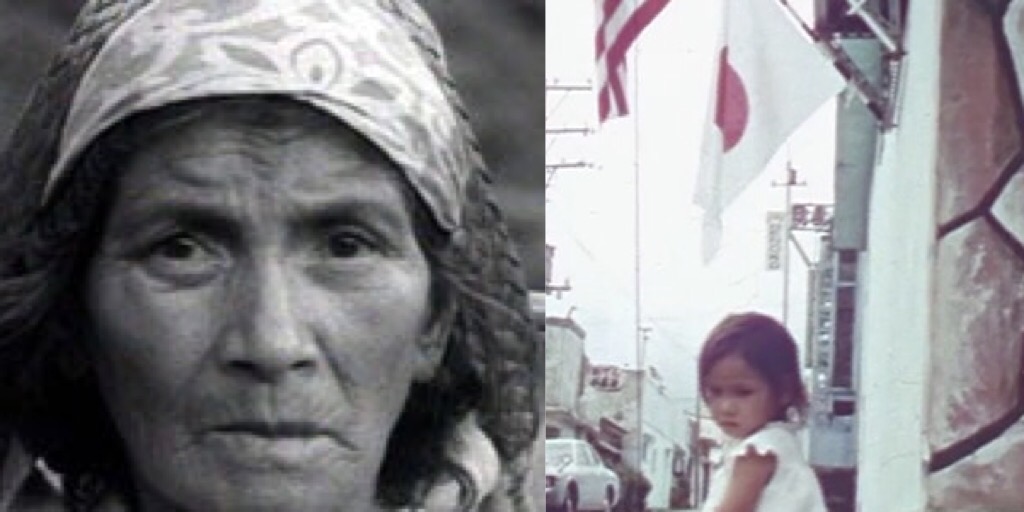
Going back to Asia is One, the part of the movie the resonates more with me is the last one, when the film moves to the Atayal village in Taiwan. There’s a quality in the close-ups of the tribe people, beautiful and ancient faces, that is very fascinating, also because it is in these scenes that the political discourse on identity, or the negation of it, reach its peak. From the 17th Century onward The Atayal people, like the rest of the tribes inhabiting the island,  had to face the colonization of the Dutch, the Spanish, the Chinese and later of the Japanese (1895 – 1945). Calling them “barbarians” the Japanese Empire tried to assimilate and annihilate their culture (6), the words from the tribe people in the movie add layers of complexity to the situation  : “Japan conquered us and abolished many of our ancient traditions and customs”, but at the same time “we were drafted and went to war with pride and ready to die” and “luckily the Japanese abolished some of our ancestral traditions like beheading”.
Asia is One ends with the militaristic song If I Go to Sea against an everyday scene with the aboriginal Taiwanese people isolated in the mountains singing “We want to go to war again.” Of course there is oppression and violence, physical and cultural, in every colonization, but things here are very layered. It seems to me that in this process of cultural and historical coring that the movie conveys, from Okinawa to Taiwan, two very significant points emerge. The first is the crisis of the identity concept, often a forced cultural and national superstructure imposed by the stronger part on a “highly fluid space of human life” (6), as Inoue explained “identity was one of the most hated words inside the NDU, identity is a choking concept”. The second point that struck me is the recurrence of a power and social structure that exploits the margins and the outsiders, in mainland Okinawa the illegal prostitutes and worst jobs are done from people from Miyako island, and in Miyako and other small islands the lower part of society is occupied by Koreans, Taiwanese and aboriginal people.
A final note on the title, the movie as a product of a collective that was thriving towards anonymity, has not film credits, nor it had originally a title, Asia is One was attached to it only later, and it’s a kind of a joke because as Inoue himself said “we all know that Asia is not one!”

notes:

1 Faraway, yet so close by Roland Domenig, in The Legendary Filmmaking Collective NDU and Nunokawa Tetsurō ed. Yasui Yoshio, Tanaka Noriko, Kobe Documentary Film Festival Committee, 2012.

2 This might not be the best way to describe the movie, but aesthetically it reminded me, maybe because of the out of sync, of Imamura Shōhei’s documentaries shot in South East Asia during the 70s.

3 Some of the writings are translated in The Legendary Filmmaking Collective NDU and Nunokawa Tetsurō, op. cit.

4 You can find more in  Forest of Pressure: Ogawa Shinsuke and Postwar Japanese Documentary, Abé Markus Nornes, Visible Evidence 2007.

5 Some interesting insights on amateurism in cinema can be found in The Flash of Capital: Film and Geopolitics in Japan, Eric Cazdyn, Duke University Press 2002.

6 In 1930 the village was the site of an anti-Japanese uprising, the so called Musha Incident, an event portrayed in Warriors of the Rainbow: Seediq Bale (Wei Te-Sheng, 2011)

7 Nunokawa Tetsurō in YIDFF 2005 Special Program, Borders Within – What it means to live in Japan.

Documentary film festivals in East Asia

Surfing through the internet in search of information and publications about documentary in East Asia, I’ve stumbled upon what seems to be an interesting and original dissertation.”Extending the local: documentary film festivals in East Asia as sites of connection and communication” is a thesis written in 2012 by Cheung Tit Leung at Lingnan University and, as the title suggests, it’s a study about the importance of East Asian documentary film festivals for the development, nurture and distribution of Asian non-fiction cinema, and Asia in general, across the globe. The author focuses his attention on four film festivals in the region, arguably the most important ones, the Yamagata International Documentary Film Festival (Japan), the Documentary Film Festival China (China), the Taiwan International Documentary Festival (Taiwan) and the Hong Kong’s Chinese Documentary Festival (Hong Kong). 
I’ve read a dozen of pages so far and I have to say that the topic is really fascinating, more than I expected; whether or not you’re into Asian cinema, this thesis is an important piece to the relatively new field of Film Festival studies, but also one that explores the connections between cinema and a region, East Asia, seldom analysed on specialist periodicals or inside academic circles. 

Your can legally download and read the thesis here.

Aragane 「鉱」by Oda Kaori

Aragane is the first full-length movie by Oda Kaori, a talented Japanese director who had her debut in 2012 at the Nara International Film Festival with the short Thus A Noise Speaks, a meta self-documentary that unflinchingly explored her coming out as a female gay and the subsequent reactions from her family. Aragane is a completely different work though, an experimental documentary that Oda directed, photographed and edited herself, but also a “product” of Bela Tarr‘s film.factory, the film school based in Sarajevo and established by the Hungarian director few years ago, a place where the Japanese director studied for three years. Aragane, the Japanese title means “ore” or small pieces of stone, was shot in a Bosnian coal mine and it’s an immersive and hypnotic sensorial experience, a very special and rewarding one that was presented last year at the Yamagata International Documentary Film Festival and later at the DocLisboa in Portugal.

I had the pleasure of meeting Oda in Yamagata and later on she was kind enough to answer my questions by email, you can read the interview here.

Aragane

Bosnia and Herzegovina, Japan              2015, 68’                                                Director: Kaori Oda, Cinematographer: Kaori Oda, Editor: Kaori Oda, Producers: Shinji Kitagawa – FieldRain, Emina Ganic – film.factory.

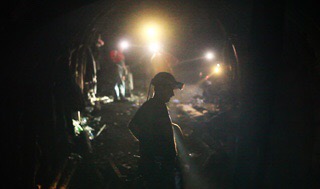
The movie starts overground with the camera gazing at some busy workers preparing and checking the machines before going deep down into the mine, the camera then ride on a cart and with a very long tracking shot slowly starts its descent into the inner part of earth. Once inside, we’re introduced and enveloped in  a world of darkness, a pitch black curtain broken only by sudden and random flashes of lights revealing a segment of a machine here and a face smeared with coal there. There are really few spoken words, we hear some random sentences uttered every now and then by the workers, but that’s all, much more important is the wall of noise created by movie, the soundscape being a crucial element of it. In the 68 minutes of deep immersion into the chthonian and dissonant world of the mine, we are almost constantly submerged by the cacophonous noise of the machinery, although the movie is also punctuated by sparse but significant and sudden moments of deafening silence. At the end of the movie for instance, when we emerge from the bowels of the earth, the peace and the vivid colors of the changing rooms and the stillness of the hanging clothes have an almost soothing quality for our eyes and ears.
As stated by the director herself, Aragane is not a direct inquiry into the harsh conditions of the people working in the mine, although it’s something that eventually and necessarily emerges, but more an attempt to convey on screen the time and the space of the coal mine as experienced by the workers, or, I would add, as experience by the mine itself. It takes some time to get used to the alien space and almost abstract geographies of the mine, for most of the time we don’t really know what’s going on and who is doing what, it’s more like being thrown into a cubistic landscape in the middle of its making. Once we get accustomed to the time and the space presented on screen though, everything slowly begins to make sense, what starts to surface from the images and sounds, and through the tracking shots and the slow and hypnotic camera movements, is the time of the mine – time experienced as duration – and the materiality of the space depicted. On this point Aragane is a documentary very akin to the works of the the Harvard Sensory Ethnography Lab, Aragane reminded me – albeit with some distinctions of course- of Leviatahn, Single Stream and The Iron Ministry, just to name a few.             
Aragane is a compelling viewing experience, not a cinematic revolution or a masterpiece of course, but nonetheless a very significant work for Japanese documentary – it’s only partly Japanese to be honest, since it was produced and shot outside the archipelago.  What particularly interests me here is that finally Japanese cinema has an important work of non-fiction able to emancipate itself from the imprint of social and political documentary that usually dominates the contemporary non-fiction scene in Japan, and a work that in doing so liberate and explore the experimental qualities of documentary. I might exaggerate, but to find something similar in the history of Japanese cinema we have to go back to the great Matsumoto Toshio and his Ishi no uta (The Song of Stone, 1963).

img_1304

Interview with Oda Kaori


Directed, shot and edited by Oda Kaori, Aragane was one of my favorite documentaries of 2015, a work that came out from film.factory, a film school based in Sarajevo and founded by renown Hungarian director Bela Tarr.
Aragane it’s an experimental documentary shot in a Bosnian coal mine, an immersive and hypnotic sensorial experience that was presented last year at the Yamagata International Documentary Film Festival, where it got a special mention. 
I wrote a review of the movie in Italian for the blog Sonatine, but I’m planning to write one in English as well and post it here, time permitting. 

In October I had the pleasure of interviewing Oda for the Italian newspaper Il Manifesto, the following is the original and longer version of that interview.

Can you tell us how you got involved in cinema, that is, how you got interested in watching and making movies in the first place?

 I wanted to be a professional basketball player, I played for 8 years since I was 10 years old, but unfortunately my right knee got broken. I underwent two big operations but it was not possible to keep playing seriously. Doctors said NO to me. So I was lost completely because the only thing I knew in life was basketball. I decided to go to the US to study abroad then, you know the typical thought that if you move the place, something may change in your life. There I took a film course, that was the first encounter to filmmaking, I was not cinephile at all and I am still not. (but I like some films, of course)

I made the very first film with my family in 2010 (ノイズが言うには Thus a Noise Speaks). It is a self-documentary made by my real family and myself about the coming-out as gay. The idea was to use filmmaking to communicate with my family and face the fact that they could not accept that I was gay. It was a tough experience but I learned a lot from that and started to see and use camera as a tool for communication. Communication between myself and the subject (the people/ the space).

 
(A still from Thus a Noise Speaks 「ノイズが言うには」)

How about film.factory? how did you happen to move to Sarajevo and be part of the group?  

 I got a chance to screen my first film in the student section of Nara International Film Festival in 2011, and there I met Kitagawa Shinji, the person who more than anybody else understands my filmmaking. He was the programmer/organizer of the section. The film got an audience award and we kept in touch since then. In 2012, he wrote me an email that there would be a new program in Sarajevo to support young filmmakers from all over the world. I was very much lost at that time, because it was very difficult to make my next film after a self-documentary by which I confronted the biggest conflict I had.

So I decided to apply to the program, moving to a new place and meeting new people.

Luckily, my application got accepted.   


Can you tell us more about Aragane, where did the idea come from? I heard that originally it was supposed to be a fiction inspired by a Kafka story (A Visit to a Mine), is that true?

Bela (Tarr) gave us an assignment to do an adaptation work. He wanted me to do ‘Bucket Rider’ a short story from Kafka that revolves around man looking for coal. So I went to a coal mine company to do research for the project. The space and the workers were incredibly attractive, immediately I knew I wanted to shoot them as I felt and not through an adaptation work.

What was the involvement of Bela Tarr in the making of Aragane? Did he give you any suggestions, ideas or was he just supervising the project?

I brought some shots I made there and told him that I wanted to make a film. He watched them and said ‘Go and shoot’. We had one meeting when I was still shooting and I had doubts about which direction I should go with the project, should I go more for the people and their story or more with the space itself?

He told me ‘Listen to yourself, what do you want to do?’

I said ‘I am attracted to the space and the physical work of miners’

After shooting, I edited the film and showed the first rough cut to him and he gave me some comments such as ‘maybe you should eliminate this shot’ or ‘keep this one’.

More than once you’ve mentioned space and your relationship with space when making a film, I think is a very fascinating subject. When I watched Aragane I felt very strongly that it’s a work about landscapes (a dark one, the mine), the materiality of it and the machinery in it. An “alien” landscape and the beauty of it. What brought you to focus more on the space/landscape and the machinery, and is there a reason behind the use of long takes?

 I think I was fascinated by the space because it was something totally new, complete darkness, magnificent volume of noises, but also sudden silence where there were no machines around.

The space drugged me into the film, my camera (gaze) was a communicator/mediator between what was there in front of camera and myself. I tried to understand and feel what was going on by shooting the space and its own time. Also, I didn’t approach the subject from the angle of the hard conditions of miners, unfairness and danger of their works (even though it is there in the film because it was just there). I hope people would not get me wrong by saying this. I/my camera shared some moments with them, I tried to be with them moment by moment. Focusing on social issue can be something good for miners, to say what is the problem and how ignorant we are about the issue, but I think the best I can do with my filmmaking is to try to be with the subject (space/people/time) and make them seen by being with them.

About the machinery, I think I shot them because their existence is big in that space and also because miners were proud of the machines, especially the huge ones digging into the side walls.

It may be a bit difficult to explain why the shots needed to be so long, but I tried to be honest toward the moments I captured with my camera.


I think the sound in Aragane is as important as the images, can you tell us more on how you were able to capture and magnify the sounds of the machines and, if you can, tell us about your relationship (as a filmmaker) to sounds/noise and soundscapes?

 It is very interesting to me that lots of people mention about sounds and soundscapes. The sound was recorded with the internal microphone of a Canon 5D, because I didn’t have something like Zoom, also I was most of the time alone, so my hands and focus was with the Camera/Image. My light was on the helmet to make the curtain space visible, so it would have been impossible for me to take care of the sound recording. What was recorded was done “without care” and automatically.

I did the sound mix myself, changing the volume here and there, cleaning a bit of noises, and making rhymes/music by adding some noise on top of another noise. That was fun and I think made the film to gain a sensorial feeling.

I was just playing with sound in Aragane , but I want to learn more about sound. The film made me realize and feel that Film is an audiovisual art.

It’s interesting that you’ve used the words “sensorial feeling”, the first time I saw Aragane I thought straight away of the works of the Harvard Sensory Ethnography Lab (Leviathan, Manakamana, Iron Ministry, etc.), you told me already you haven’t watched their movies and that you’re not really a cinephile, but I was wondering if you got ispired for your approach by any movies or more in general by any other work of art.

 After your email, Matteo, I watched ‘Manakamana’ ‘Iron MInistry’, and ‘People’s park’,

and I see what you see as similar.

It is very interesting because, before you mention about the Lab, I’ve thought that if I stop making films, I want to be an anthropologist. And I feel I am learning about human beings by making movies.

I might not be so good yet and I have not a clear idea about what I am doing with my camera, but it has been very clear for me that my theme is ‘where we come from, what we are, and where are we going?’ .

I know it sounds abstract and even pretentious, but I’m serious. I may not get the answers before I die, but I have at least the right to explore and challenge these themes with my life, I guess.

 I am inspired by: Wang Bing, Pedro Costa, Raymond Depardon, Wiseman, Cezanne. My bible: Letters To A Young Poet by Rilke.


One last question: what are your future plans, are you working on something at film.factory and how about after film.factory?

I have a few projects now.

One is my essay film, to conclude the experience in Bosnia and filmmaking here. This is my priority right now. It’s in the production stage.

And then I plan to do a workshop of filmmaking/photography/camera in a discipline center in Sarajevo. (It is a institution for the underage kids who commit crimes, not strict as much as a prison). I want to share the possibility of using the camera as a tool of communication and expression with these kids. This kind of workshop is what I want to do as my life time project, I don’t know if I can finance such a project, but I want to try my best to make it a constant practice in my life.

Or I might move to Mexico to do a project after film.factory, one of my colleagues is from Mexico and I want to shoot something there related to sea/water/cave. It’s still in the research/developing stage. Or maybe I’ll go back to Japan, it all depends on if I can support myself and how these projects can be produced!

 Feel free to add something you want to say or share.

 So many people have been supporting my filmmaking. My family, Kitagawa Shinji, Bela Tarr, and my dear colleagues. Most of the time, I shoot and edit alone and this sometimes make me misunderstand that I am making films alone, but in fact, there is always someone who introduces the subject to me, tries to support me mentally, gives me some thoughts on the film, shares the film, writes about the film, and watches the film. All these people make films. All these spaces and times make films. I’m just one of the gears/energies that make films happen.

Ogawa Production’s documentaries finally on DVD

 
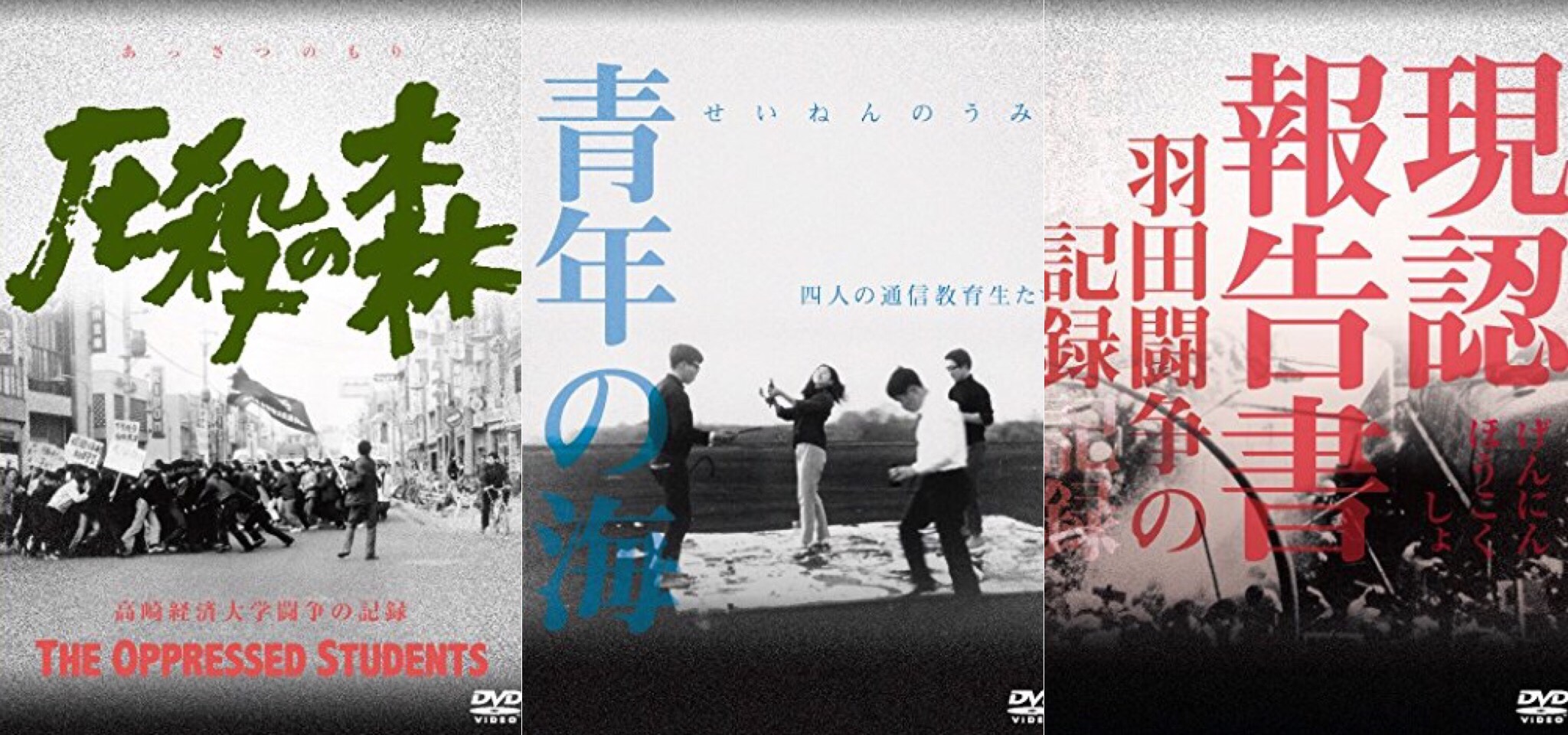
I’ve often written, here and elsewhere, about Ogawa Pro and the documentaries made by the collective, first in Sanrizuka – documenting the resistance of the peasants against the construction of Narita airport – and later in Yamagata. A couple of days ago through social networs I found out that finally all the works produced by the collective will see the light on DVD, a project by the Japanese label DIG. First, on June 2nd, we will get 3 of the early documentaries: A Sea of Youth (青年の海, 1966), The Oppressed Students (圧殺の森 高崎経済大学闘争の記録, 1967) and  A Report From Haneda 現認報告書 羽田闘争の記録, 1967) and later, presumably in one or two years, all the 20 documentaries made between 1966 and 1986 by the group. The news is big, at least for me, and although I have sample DVDs of many of the movies shot in Sanrizuka and Yamagata, copies kindly given to me by the festival people in Yamagata, it will be nice to have the films  “neatly transferred” on DVDs, the samples I have being a copy of a copy of a copy of a VHS. But here comes my biggest concern about this otherwise great news, will the transfer be really a proper one? Almost all the documentaries are shot in 16mm and I’m not really sure about the condition of the originals, in an ideal world we should see them first lovingly restored and then made them available for the home-video release. But the huge debt left by Ogawa complicates everything, what we’re likely to get is something close to the DVD of Kamei Fumio‘s Fighting Soldiers, a bare bones release, watchable of course but with a poor transfer, in the particular case probably due to the condition of the source material. The docs will not have English subtitles, adding them would have helped to “spread the word” of Ogawa Production to a wider international audience, but again, we don’t live in an ideal world and we should be happy and content with what we will get. Be that as it may, I’m pretty excited about this and I’ll write again about the project, the image quality, etc. when I get more information or in June, the time of the first releases. 

You can preorder the DVDs here

Interview with Toshi Fujiwara about No Man’s Zone (無人地帯, 2011)

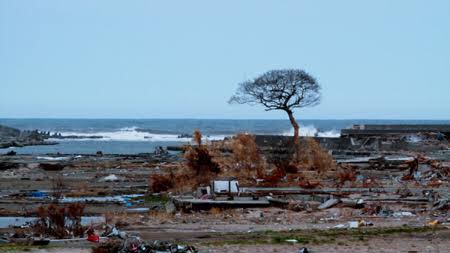
I’m reposting here and Interview I did in 2011 with Fujiwara Toshi, author of No Man’s Zone (無人地帯, 2011), to this day and in my opinion the best documentary about the March 11th’s triple disaster.
The interview was originally posted on the Italian blog Sonatine. You can purchase the DVD of the movie here (with English subtitles). 


Matteo Boscarol I’ve watched a couple of documentaries dealing with the disaster that hit Japan on March 11th, but in my opinion, your work stands apart from them. I think you adopted a broader perspective. Among other things, I felt No Man’s Zone was a visual essay on the impact that images of destruction have on our society.
Toshi Fujiwara Yes, you’re right but obviously it was something that was inside me from before the disaster and grew up over the years.
M.B. It was also like watching two documentaries, one with the row images and interviews from the area hit by the tragedy, the other one more reflective, with the narration and the editing giving a philosophical frame.
T.F. We’ve tried to create two separate layers very deliberately. One of the reasons is that it is a French-Japanese co-production. The cameraman and director are Japanese, and the editor is French…so why not have two layers to incorporate a certain distance within the contest. Originally, we thought of a French voice and the narration was different from the final one. It was more like a fictional story. The idea was that of a French woman and a Japanese director corresponding through the Internet. We collaborated with some French writers, but they didn’t get the right ideas because it was also supposed to be quite critical of the French culture itself. It turned into something rather awfully colonialist. So it didn’t work and I rewrote the whole narration.
M.B. In this way, it should be able to reach a foreign audience. The Japanese media didn’t do a good job, but at the same time, the international media excelled in misinformation, especially the Italian media.
T.F. Even here in Japan, it’s turning this way. Now the Japanese anti-nuclear movements are paradoxically against the people of Fukushima.
M.B. There’s a scene that particularly impressed me and even reminded me of some parts of Ogawa Shinsuke’s Heta Buraku. It’s the one when the camera is following an old lady wandering and speaking in her garden.
T.F Thank you for the compliment. It is probably because my cameraman, Takanobu Kato, was working with Ogawa. He was one of the last people to leave the production. It was important that he was with me because, being trained under Ogawa when his production was in Yamagata, he literally lived there raising rice and so on. As such, he knew how to shoot rice fields, and other details of life in the countryside.
M.B. In the same scene through the memory of the old lady, there are also references to a wider sense of time, historical and natural cycles, reaching as far as the period after the Second World War.
T.F. I would say that it goes even farther back in time; in fact, she recalls her father having been a silk worms teacher. It was before the war when Japan biggest export was silk itself.The images of movies of this kind focus usually on destruction, but we tried to suggest what was there before the destruction. What was destroyed and also what the people of these areas have lost is much more important.


M.B. What triggered you to go to Fukushima a month after the Earthquake to start to shoot?
T.F. I was disgusted by the way the images were shown on TV. The live footage didn’t show us how the people used to live, and didn’t give people a chance to communicate. Their lives up there were so different from the lives of journalists in Tokyo; moreover, the images are just raw material without any good editing. My intention was to make a film that would look distinctly different from what we watched on television, which was usually shot very hastily with a hand-held camera. One of my first commitments was to shoot as beautifully as we could. That’s why, when possible, we used a tripod. Already, I’d hated lots of contemporary documentaries because their shots aren’t beautiful. They shoot them too easily. Even though we did it in 10 days, we tried to do it as well as we could. Beautiful editing also was important.
M.B. And the voice of Khanjian Arsinée for the narration is very beautiful indeed.
T.F. Her voice is incredible. She’ s Armenian, but she grew up in Lebanon so her native tongues are Arabic and French. She moved to Canada when she was 17, in French-speaking Quebec. I liked her voice because she is not totally native in English [the narration is in English] and so we cannot clearly identify the nationality of her voice.


M.B. You went to Fukushima with your cameraman and one assistant—is that right?
T.F. Yes, it’s better to have a small crew also knowing that the TV people often annoy them…
M.B. How did the people there react to you and your crew?
T.F. Again, we were only three and we were not wearing any protective gear or masks, so they were extremely polite to us as they usually are to everybody else. You know, the people of Tohoku have a tradition for hospitality. Also, we were not asking abrupt and stupid questions like “what do you think of that and that…?”.
M.B. The problem of how to approach and relate to the people affected by disasters is a crucial one for the art of documentary. At the last Yamagata Documentary International Film Festival, there was a debate on this topic.
T.F. I was there myself, and I think the largest problem of these documentaries is that they’re more about the filmmakers going there and not necessarily about the places and the people living there. The general problem is that many filmmakers went to Tohoku, but they made films about their own confusion and panicked state of minds, while they forgot to make documentaries about the damages of the quake and the people who were directly touched by the tragedies. They are too self-centered and unconsciously self-obsessed. An even larger problem that I observe is that the audience in Tokyo takes comfort in seeing these movies, being reassured that the filmmakers are also confused. I find this tendency very problematic for being too masturbatory. They are forgetting the original function of cinema, which must be something open to create links and communications; under such circumstances, we should be mediums to make a bridge between those who experienced the tragedies and us who didn’t. That is one of the reasons why we tried to make “No Man’s Zone” an open film text, instead of sharing the personal experiences (if not self-excuses) of filmmakers. We wanted it to ask direct questions to the audience. Of course, my cameraman worked with Ogawa and I made a film about Tsuchimoto. Thus, I was influenced by others and different generations of documentary’s filmmakers, I’ve kind of skipped the generation of the so-called private documentaries.
M.B. Like Kawase Naomi?
I like Kawase and what she does; she is of my generation, but we do different things and that’s ok with me. I could say that I do documentaries like in the 60s, except that there is no more politics involved. Japanese leftist politics disintegrated in a very rapid way after the 70s.
M.B. Do you think March 11th will change something in filmmaking?
T.F. In my opinion, it should. But I haven’t seen the change yet. After all, only 9 months have passed. One thing for sure is that we have to try to do something different, different from what we were doing before. Actually, before the quake, I was working on a movie but now I’m not sure if it’s worthwhile to complete it. It’s about Japan before March 11th.
It’s a different period, it’s like being after a war in a way.
M.B. We should consider March 11th almost as important as August 15th, 1945.
A few months ago, I talked to Sono Sion, and he said that the tragedy was paradoxically “good” because it suddenly uncovered many problems affecting the Japanese society. For instance the relationship between urban centers and countryside, that is Tokyo-Tohoku…
T.F. I totally agree with him. We (in Tokyo) are just parasites, which is repeatedly stated in No Man’s Zone. The nuclear plants have been there for almost 40 years, and what is awful is that even now after 9 months in Tokyo, people don’t want to admit that we’re responsible.
And even now [this interview was conducted during the Christmas period], it’s like nothing has happened at all.At the Tokyo FilmEx this year, a lady in the audience from Fukushima was quite surprised after watching the movie. She walked outside and found the streets in full illumination for Christmas.
M.B. Can you tell us something about the music used in the film?
T.F. It was composed and performed by a free jazz American musician who’s been living in France for many years. His name is Barre Phillips and we’ve worked together before [Independence, 2002]. Again, we decided on a non-Japanese composer, one of the best that you can get, and also one that was not so expensive and not too commercial. The funny thing is that he recorded the music in a chapel of an ancient monastery in the south of France. In No Man’s Zone, there are a lot of Japanese traditional views with images of Buddhas and small gods, so I thought it would be interesting to have the music recorded in a Catholic chapel. In this way, the music and the narration can maybe suggest something universal. That’s why I wanted someone else and not myself to do the narration in English. It would otherwise have become just a documentary about my experience. This nuclear accident is asking tremendous and huge questions to all of us, to our civilization and how we have related ourselves to nature and to the universe, how we perceive our lives. We actually have to think about the philosophical and even the religious aspects of it all, I would say, and it’s stated at the end of the film, that Japan, embracing western civilization, has accepted its idea of a nature existing for us, to serve humans. It’s actually a very Christian concept. It is not even Jewish or Islamic; it’s a particular belief of Christianity to say that God created everything for us.

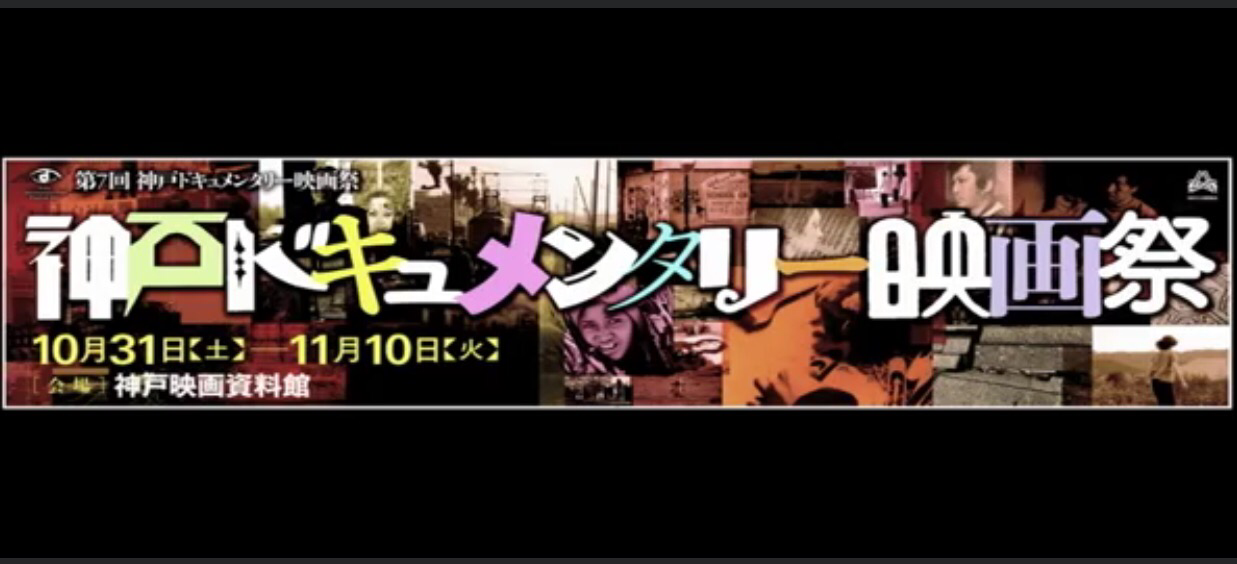
Kobe Documentary Film Festival 2015 第7回神戸ドキュメンタリー映画祭 (Oct 31st – Nov 10th)

In the autumn film festival madness, there are more film fests between October and November than stars in the sky, a very tiny but special place is occupied by the Kobe Documentary Film Festival,  an event established in 2009 at the Kobe Planet Film Archive. An important place for cinephiles and cinema lovers, the archive is a small structure, the theatre has only 38 seats, set up in 2007 and currently managed by Yasui Yoshio, one of the most renowed film historians and archivists of Japan. Incidentally Kobe has a special relationship to the seventh art, Edison’s Kinetoscope was imported to Kobe in 1896 and one year after the city was also the first place in Japan where the Lumiere brothers brought their Cinematographe

In these 7 years the mini festival, it’s more like a retrospective than a “real” fest, has presented works of Yanagisawa Hisao and Tsuchimoto Noriaki – in its 2 first editions, a special devoted to the great Tōhōku Earthquake and documentary in 2011, and the following year a retrospective on NDU and Nunokawa Tetsurō, a showcase that I was able to attend, a real discovery that allowed me to deepen my knowledge of one of the most important Japanese film collective of the 60s and 70s, a real treat. 

Kobe Documentary Film Festival kicks off tomorrow, October 31st,  and will last until November 10th. This year the main focus won’t be on one filmmaker or a movement in particular, but the screenings will be more varied. Discovering Images—The Age of Matsumoto Toshio, a documentary on Matsumoto Toshio by Takefumi Tsutsui, almost 12 hours (the work is divided in 5 parts) to retrace the career of one of the most important Japanese filmmakers and theorists of the post-bellic period, is maybe the most important to me. London (1994), Robinson in Space (1997) and Robinson in Ruins (2001) by Patrick Keiller, under the wave, on the ground (波のした、土のうえ) by Komori Haruka and Seo Natsumi will also be screened, and last but not least a special selection from the Yamagata International Documentary Film Festival, 5 films screened in the last 25 years at the prestigious event. 

Unfortunately I won’t be able to attend the festival this year, what I really wanted to see was the massive documentary on Matsumoto – I missed it at Yamagata as well, and under the wave, on the ground, but I’m sure there will be more chances to catch up with them. 

You can find the program here (only Japanese)

Yamagata Doc Film Fest, report – day 3 and awards

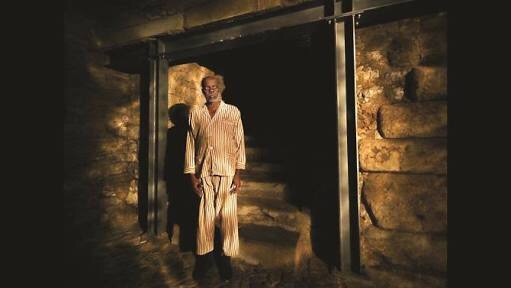
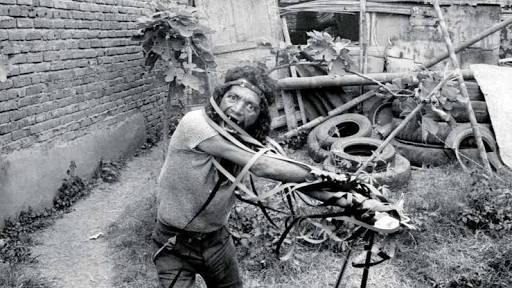
My final day in Yamagata (October 12th) was a bit more relaxed than the previous two, the festival fatigue started to kick in and the nights spent talking & drinking at Komian did the rest. There were many movies I really wanted to see, Pedro Costa’s Horse Money, Homeland (Iraq Year Zero) by Abbas Fahdel, Ospina’s It all Started at the End and others. Unfortunatly all of them were screened around the same time in the afternoon, and I had to choose one, so finally I opted for Ospina’s, my personal way of completing the discovery of the Cali Group and the independent cinema of Colombia between the 70s and 80s. It All Started at the End is a long and absorbing work that goes back to the beginning of the movement, and using a mix of styles and images (footage, digital, mobile phone’s camera) tells the story of a group of friends and artists who revolutionised cinema in Colombia.

In the morning I attended the screening of a TV documentary (actually a mokumentary) made in 2006 by Mori Tatsuya and Murakami Kenji (edited by Matsue Tetsuaki) Documentary:  Truth or Lies「ドキュメンタリーは嘘をつく」A work that plays with and criticises the way non-fiction is usually planned and made on TV, funny at times but not always entertaining and cutting, this short film has nonetheless the quality of making the audience think and let them see what’s happening behind the camera. 


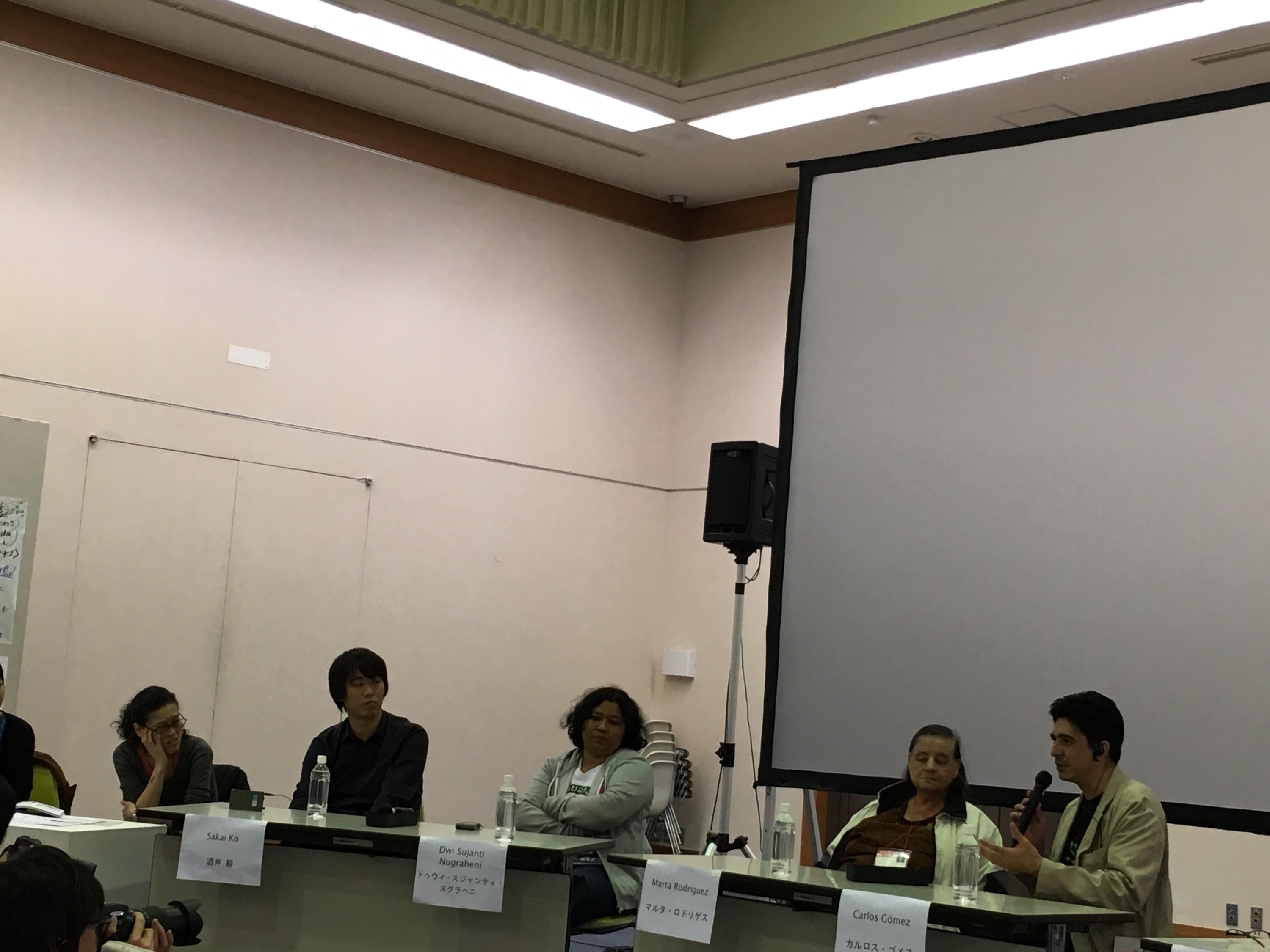
In the evening and as my final event for this edition of the festival, I decided to attend a symposium titled Creating a Space for Film, a discussion among six participants from different countries, Dwi Sujanti Nugraheni, Marta Rodríguez, Teng Mangansakan, Sakai Ko, Oki Hiroyuki, Carlos Gómez. Everyone of them brought and talk about his/her experience in creating a space for documentary, with indigenous people in Colombia for Marta Rodrigez and Carlos Gomez, in Indonesian schools with basically no budget for Nugraheni, in Sendai working with old people to find the still existing minwa (folklore in the oral tradition) for Sakai Ko, and in the Philippines in markets and basketball courts for Mangansakan. Very different stories and backgrounds, some governments opposing documentary like Indonesia, other supporting cinema like the Philippines, but everybody seemed to agree that what is fundamental and crucial is to build cinema and documentary literacy, through schools, workshops, festival and other activities. Without visual /media literacy there are no chances to have future generations of filmmakers and and audience capable of understanding and appreciating non-fiction cinema.

  
In conclusion, this year as two years ago, attending YIDFF was for me a really reinvigorating and fascinating experience, I didn’t see as many movies as I wanted to, but I as I wrote in the previous posts, there were some nice discoveries and above all I had the chance to meet, talk and exchange opinions with many filmmakers and film-festival people. The only downside to it is that I’ll have to wait two years until the next edition. See you soon Yamagata!

Today, October 14th the awards for this year festival were announced: 
The Robert and Frances Flaherty Prize (The Grand Prize):

Horse Money Dir: Pedro Costa

The Mayor’s Prize:
The Pearl Button Dir: Patricio Guzmán

Awards of Excellence:
Homeland (Iraq Year Zero) Dir: Abbas Fahdel

Silvered Water, Syria Self-portrait Dir: Ossama Mohammed, Wiam Simav Bedirxan

Special Prize: 
Us women . Them women Dir: Julia Pesce

New Asian Currents Awards

Ogawa Shinsuke Prize:
Standing Men Dir: Maya Abdul-Malak

Awards of Excellence:
Snakeskin Dir: Daniel Hui

Each Story Dir: Okuma Katsuya

Special Mention:
Glittering Hands Dir: Lee-Kil Bora

A Report about Mina Dir: Kaveh Mazaheri

ARAGANE Dir: Oda Kaori

I Am Yet to See Delhi Dir: Humaira Bilkis

Citizens’ Prizes
Homeland (Iraq Year Zero) Dir: Abbas Fahdel

Directors Guild of Japan Award

My No-Mercy Home Dir: Aori


Yamagata Doc Film Fest, report – day 2

  
Here I am after my second day in Yamagata, a less intense one compared to yesterday, but nonetheless an eventful day (Oct 11th). 

My day kicked off in the motning with 2 shorts by Luis Ospina, shot in collaboration with Carlos Mayolo, Listen, Look (1972) his debut and The Vampires of Poverty (1978), it is the last  one that impressed me more. Partly parody, party documentary and partly mockumentary, the movie satirises a certain way of making cinema and TV that exploits the poor, a tendency to use the less fortunate to prove a pre-established political or social theory. Very creative in the way it’s constructed, Ospina mixes color and B&W photography, funny, improvised, but also scripted in some of its parts, overall it was a refreshing experience for me. The discovery continued with the afterscreening talk, when Ospina elaborated and explained a bit more about the movie, the so-called Cali group in Colombia and the concept of poverty porn, he also talked about how he was ostracised in Latin America by the Marxists and the left after the mivie was released.You can watch many of his movies (legally and for free) on his homepage, here

The afternoon started with a short (30′) from Myanmar, When the Boat Comes In by Khin Maung Kyaw, a depiction of a small fishermen village and its difficulties to survive, a situation that worsened when the government  decided to issue a one-month fishing ban. An interesting exploration of the daily life of the villagers and their unhappiness, had the documentary been longer, it would have probably beneficiated in term of quality and depth, hopefully the director will expand it into a longer version one day.
The third movie of the day was Trip Along Exodus by Hind Shoufani, the daughter of a famous politician and revolutionary Palestinian who after fighting for many years for the liberation of his land , decided toabandoned the scenes and live in Syria, far from his family and relatives.
The work is made as a diary-movie, the director talks with his father, asking him questions, in person or by phone, and trying to bridge the gab between the two, the man has been always more interesting in the revolutionary cause than in his family. It’s a “pretty” movie, in the sense that it uses some cute animation here and there to cheer up the somber tone of the film, and also the sense that is more a personal movie than a political one. 
The day ended with the weakest work of all, PYRAMID: Kaleidoscope Memories of Destruction by Sasakubo Shin, a wanna-be experimental documentary shot in 8mm, to which I couldn’t connect at all. The music was good but it seems to me more a sort of long music video than an attempt to create something more concrete. 

Like every day, from 10 o’clock at night, almost everybody went to Komian, a sort of nomiya where directors, film-lovers, journalists and whoever else meet, talk and drink until 2 or 3 in the morning, a very special place that makes Yamagata even more unique.