2017: Kinema Junpo Best 10 – documentary

Awaited every year with trepidation by cinephiles and the community of Japanese film-lovers, and a perfect occasion for discussing the state of the art in the archipelago and agree or disagree with it, last month the prestigious film magazine Kinema Junpo announced its 2017 Best Ten Lists . Launched in 1924 with only non-Japanese films, and from 1926 including Japanese movies as well, the poll includes, in its present form, four categories: Japanese movies, non-Japanese movies, bunka eiga and a section awarding individual prizes such as best director, best actor, best actress, best screenplay, etc.
You can check the results for all the categories here. Given the nature of this space, I want to focus my attention (with the slowness that characterizes this blog, apologies) on the bunka eiga list, that is to say, the best 10 Japanese documentaries released in 2017 according to Kinema Junpo (as far as I know only three have been released outside of Japan and thus have international titles):

1 人生フルーツ Life is Fruity

2 標的の島 風(かじ)かたか The Targeted Island: A Shield Against Storms

3 やさしくなあに 奈緒ちゃんと家族の35年

4 ウォーナーの謎のリスト

5 谺雄二 ハンセン病とともに生きる

6 沈黙 立ち上がる慰安婦 The Silence

7 米軍が最も恐れた男 その名は、カメジロー

8 笑う101歳×2 笹本恒子 むのたけじ

9 まなぶ 通信制中学 60年の空白を越えて

10 廻り神楽

With the term bunka eiga (cultural film), for a comprehensive analysis of the word and its usage in relation with other definitions, read here, the magazine awards non-fiction movies that explore social, cultural and political themes, often focusing more on the subjects tackled than on the formal aspects of the films themselves.
It is almost a fact that we’re living in a new golden age for documentaries, an era when every year, in theaters or on streaming platforms alike, there’s at least one film that push the boundaries of non-fiction cinema towards new territories. Unfortunately Japan, with all the exceptions of the case, seems to have stayed or have left behind. This is not the right place to discuss and deep dive into the reasons for this impasse, suffice to say that it is a problem affecting Japanese cinema in general and not only nonfiction movies.

That being said, it is nice to see at the top of the list Life is Fruity, a movie directed by Fushihara Kenshi and produced by Tokai TV, a production company based in Nagoya that in the last twenty years or so has been releasing a bunch of interesting and insightful documentaries. Again, all of them have quasi-TV aesthetics, nonetheless the topics explored and, in the best cases, the touch used, make them worth watching. Of the 21 documentaries produced by Tokai TV I’ve had the chance to watch five, among these my favorite is 青空どろぼう (Sky’s Thieves, 2010), a movie on the Yokkaichi Asthma, one of Japan’s four major diseases caused by pollution.
Life is Fruity tells the story of 90-years-old architect Shuichi Tsubata and his wife Hideko living in Aichi prefecture in a house surrounded by vegetables and fruits. Almost half a century ago Tsubata was asked to plan a new town in the area, but his idea of building houses that could coexist with woods and blend with the natural environment was rejected, and a project more in tune with the fast growing Japanese economy of the time was chosen. Tsubata left his job, purchased a piece of land and built his dream-house in a manner of his master,  Czech-American architect Antonin Raymond.

You can see an English subtitled trailer by clicking on the Vimeo button:

Number two in the list is A targeted Village, the second documentary directed by Mikami Chie about the ongoing protests and resistance of Okinawa people against the American military presence and expansion in the island.
In 1983 director Ise Shinichi started to record the daily life of his 8-year-old niece Nao, a girl with intellectual disability who also suffers epilepsy, and her interaction with her family and society. After 12 years of shooting he edited the material into Nao-chan, a movie released in theaters in 1995, followed by 「ぴぐれっと」in 2002 and ありがとう 『奈緒ちゃん』自立への25 in 2006. やさしくなあに 奈緒ちゃんと家族の35年, number 3 in the Kinema Junpo list, is the fourth installment in this ongoing series and documents the ups and downs in the daily life of Nao and his family. I haven’t seen the movie yet, but it seems to perfectly continue the tradition of Japanese documentaries dealing with disability, from Tsuchimoto Noriaki to Yanagisawa Hisao (a retrospective of his works is happening now in Tokyo) and, in more recent years, Soda Kazuhiro with Mental.

Nao_chan.jpg

ウォーナーの謎のリスト is a documentary about American archeologist Langdon Warner and his list of culturally valuable Japanese sites that, allegedly, saved the most important temples and monuments from destruction during the American bombing of Japan in World War II. 谺雄二 ハンセン病とともに生きる tells the story of poet, activist and writer Kodama Yōji, who suffered from leprosy and fought against isolation and discrimination during his entire life, while with The Silence, second generation Japanese-Korean Park Soonam, records the struggle carried on by the victims of sexual slavery during the invasion of Korea by imperial Japan. In 米軍が最も恐れた男 その名は、カメジロー, his debut behind the camera, newscaster Sako Tadahiko explores the life of Senaga Kamejirō, an outspoken politician and communist who fought the American occupation of Okinawa until his death in 2001.
The list does not represent Japanese documentary landscape in its variety and complexity of course, by design the more experimental works are ruled out, nonetheless besides few titles, the films here selected don’t seem to hold any particular appeal to an international audience, again at the risk of becoming trite, it’s not because of the themes explored, but more because of what to me appears to be the lack of a distinctive style and vision.

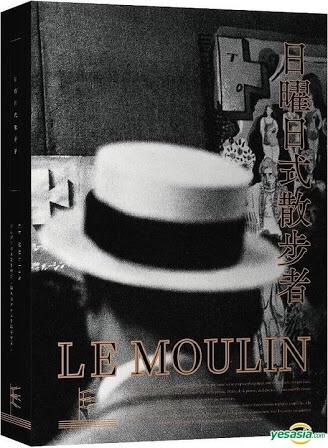
Le Moulin (Huang Ya-Li, 2016) out on Blu-ray and DVD

Just a quick post to share my excitement for a new home video release. I found out only a few days ago that from last June Le Moulin, one of the best documentaries I’ve seen in recent years, is available for on DVD and Blu-ray. The movie, directed by Huang Ya-Li, is a complex and fascinating exploration of the first Taiwan’s modern poetry group, Le Moulin Poetry Society, active in the island during the 1930s, when Taiwan was under Japanese colonial rule. You can read my piece on the movie here.

Le Moulin was made available in Taiwan by Fisfisa Media, but it comes with English, Traditional Chinese and Japanese subtitles, for more details on the technical aspects of the DVD and Blu-ray, please check the YesAsia page, where you can also order the movie.

I haven’t had the chance to check the DVD/Blu-ray yet, but it is nice to see that it also comes with a booklet of essays written by relatives of the Le Moulin poets and literary figures.

I will update this post once I get the release.

Best documentaries of 2017

Although I saw fewer documentaries released in 2017 than I wanted, this was for me the year of the box-set (Wiseman, Rouch, etc.), there were a couple that really impacted and resonated with me for long time, and others that, for various reasons, I’ve thoroughly enjoyed discovering.
It might sound tautological, but it is always better to clarify: this is the list of my favourite non-fiction movies, thus it reflects my taste in documentary and it’s very partial.

Outstanding works:

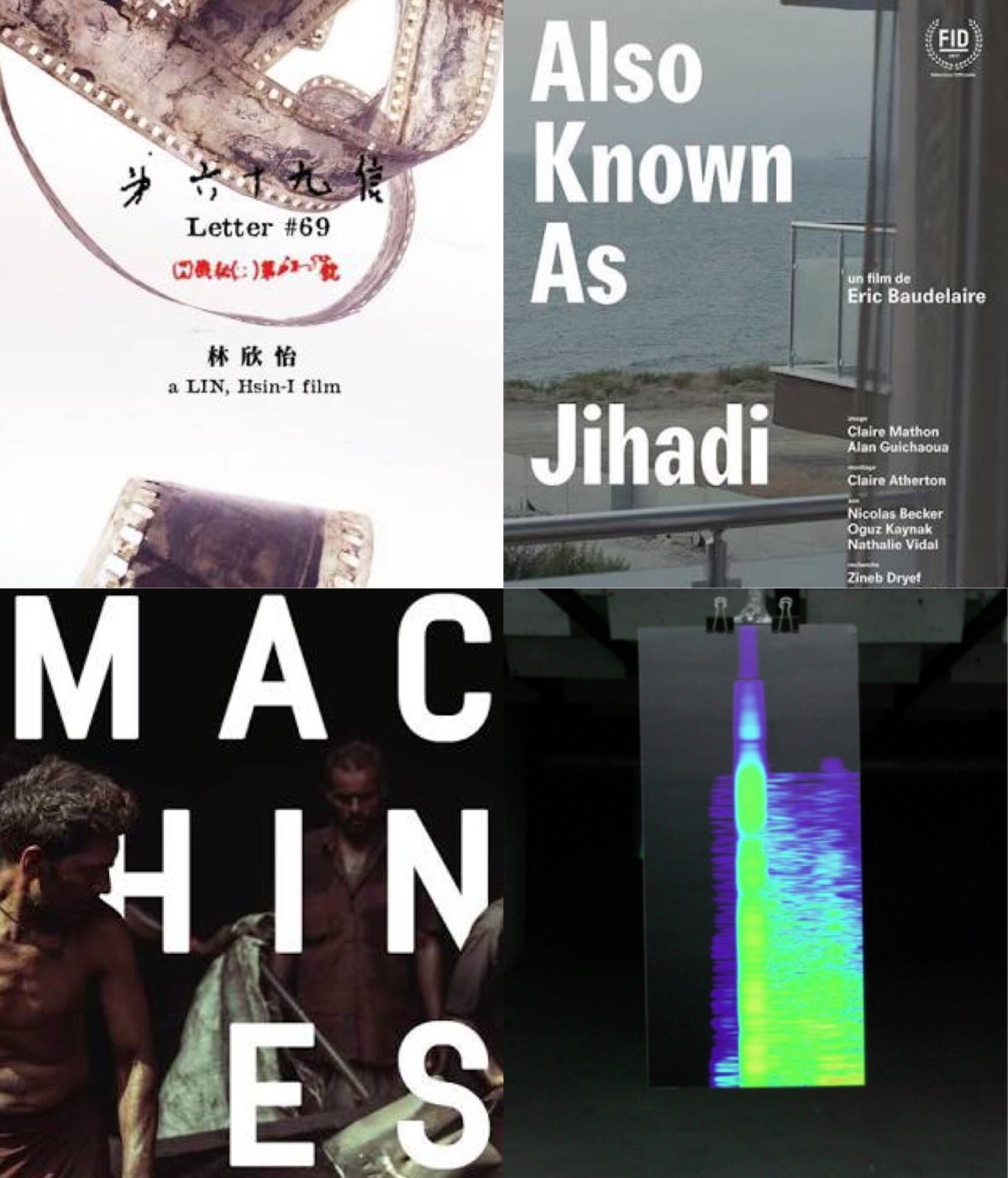
Also Know as Jihadi (Eric Baudelaire)
An homage to and partially a remake of Adachi Masao’s A.K.A. Serial Killer. Baudelaire’s finest work to date.

Letter #69 (Lin Hsin-i)
My fascination with the works of this young Taiwanese artist continues. read more

Machines (Rahul Jain)
You can read my review here

Rubber Costed Steel (Lawrence Abu Hamdan)
Short but powerful, thematically and aesthetically.

Honorable mentions:

Sennan Asbestos Disaster (Hara Kazuo)
Hara is back after more than 10 years with a work about the legal battle between the Citizen Group for Sennan Asbestos Damage and the Japanese government.

Ex-Libris: New York Public Library (Frederick Wiseman)
Not my favourite by the American legendary director, but Wiseman is Wiseman.

Donkeyote (Chico Pereira)

A Yangtze Landscape (Xu Xin)

Dislocation Blues (Sky Hopinka)

Turtle Rock (Xiao Xiao)
A soothing and beautifully shot documentary set in a remote village in China, the black and white photography reminded me of Lav Diaz.

Special (re)discoveries:

The Mad Masters (Jean Rouch, 1955)
Whatever it is, docufiction, ethnofiction, problematic documentary or theatrical exploitation, it’s a powerful and raw punch. Masterpiece.

Homeland: Iraq Year Zero (Abbas Fahdel, 2015)
Probably the best documentary I’ve seen in 2017.

A House in Ninh Hoa (Nguyễn Phương-Đan &. Philip Widmann, 2016)
You can read my review and interview with the director here.

Beirut Never More (Jocelyne Saab, 1976)
Jocelyne Saab was one of my cinematic discoveries of the year.

Remembering Matsumoto Toshio

…good starting point for this (re)discovery could be the recent release (by Cinelicious Pics) of Funeral Parade of Roses on Blu-ray and DVD, Matsumoto Toshio’s masterpiece newly restored in 4K, released in Japan in 1969 and recently screened in selected theaters around the U.S.A. The release is significant not only for the film itself, a unique movie experience indeed, but also because included in the package are eight extra works that Matsumoto made between 1961 and 1975: Nishijin, The Song of Stones, Ecstasis, Metastasis, Expansion, Mona Lisa, Siki Soku Ze Ku and Atman.
More than ten months have passed since the death of Matsumoto, and this release is a good and timely opportunity for me to collect my thoughts, trying to position his oeuvre in the context of post-war Japanese cinema, and to draw connections between Matsumoto and others filmmakers and the cultural milieu he grew up in as a filmmaker and artist.
In a career spanning more than fifty years Matsumoto made short and feature movies and moved freely from documentary to art-house films, and from pure experimental cinema to expanded cinema and video installations, in a very unique process of hybridization and genre overlapping that has few parallels in the world of cinema and image making.
In the seven months since his passing, prompted by the tragic event, I decided to

Continue reading “Remembering Matsumoto Toshio”

Yamagata City designated UNESCO Creative City of Film

The city of Yamagata has just been designated as member of the UNESCO Creative Cities Network for the field of Film, the first in Japan, joining other 116 existing member cities around the world.

As the readers of this blog have heard and read ad nauseam, the city is the place of the oldest, and arguably the most important, documentary film festival in the Asian continent, a place I had the pleasure of visiting several times in the last decade.

It goes without saying that this is great news for the festival and the city itself, and, as many commentators have pointed out, the congratulations should go first and foremost to the people of Yamagata, the volunteers and all the people involved, to one degree or another, in the organization of the festival.

Knowing how much Japanese people
Continue reading “Yamagata City designated UNESCO Creative City of Film”

Documentaries at the London Korean Film Festival 2017

The London Korean Film Festival has opened its 12th edition last Thursday and will run in the capital for two weeks, from November 10th through the 19th the festival will then go on tour around the UK, touching Sheffield, Manchester, Nottingham, Glasgow and Belfast.
In addition to showcasing a wide-range of titles produced in the Asian country, there will also be masterclasses, talks and collateral events, a special occasion for the British audience to get a glimpse of South Korean cinema and film culture in general. This year line-up includes not only UK and European premieres, animations, classics, shorts and indies, but also a fascinating focus on Korean Noir, “Illuminating the Dark Side of Society”, and, of particular interest for this blog, a program dedicated to documentary.

The first movie presented will be Two Doors (2012) directed by Kim Il-rhan and Hong Ji-you, a documentary investigating the the Yongsan Disaster, when in January of 2009 a sit-in rally in central Seoul resulted in the deaths of five protesters and one police officer. While Two Doors focuses more on the legal aspects of the tragedy, amassing documents against the violence used to prohibit the demonstration and the sit-in, The Remnants  (2017) is about the personal tribulations and the legal problems that some the people who took part in the demonstration had to go through in the seven years after the tragedy. The movie was directed by Lee Hyuk-sang, who was also creative director behind Two Doors, and the festival has organised a special conversation with the director on November 2.
Goodbye my Hero (2017) by Han Younghee, a movie addressing labour relations and workers’ rights in contemporary South Korea, and Park Kyung-hyun’s Dream of Iron (2017), a film essay about the development of the steel industry in the country during the 1960s, will complete the section.
The ‘Women’s Voices’ s section includes also a documentary, Candle Wave Feminists (2017) by Kangyu Garam, a movie that delves into the revolution that led to former prime minister Park’s impeachment and her spiritual mentor Choi Soon-Sil’s arrest.

All the documentaries will be screened this week starting from tomorrow, October 31st.

LKFF17-Screening-Schedule-1.jpg

Retrospective of Taiwanese documentary cinema at the Jihlava International Doc Film Fest

Since the discovery of Le Moulin two or so years ago, non-fiction cinema in contemporary Taiwan has been one of my main cinematic obsessions and a research interest that drove me to explore the flourishing documentary scene of the island. This year edition of the  Ji.hlava International Documentary Film Festival (October 24-29) is currently holding a retrospective on Taiwanese documentary from 1937 to 2014 titled Transparent Landscape: Taiwan, a program that presents 25 Taiwanese documentaries from the period, according to the festival “the historically most comprehensive showcase of Taiwanese documentary cinema ever”.  I won’t be able to attend it, but, it goes without saying, it’s an event I’m highly interested in and I hope a catalogue will be published, here the press release:

The section will include some of the most important works of Taiwanese independent filmmakers. Allowing a glimpse into Taiwan’s complicated historical-political development, these films offer significant insights into different periods of recent Taiwanese history.
The earliest Taiwanese documentaries are the 8mm ”home videos“, shot by photographer DENG Nan-guang in the 1930s. They realistically portray scenes of daily life under Japanese occupation, such as life and work along the Tamsui river and family outings. The recently restored short The Mountain by Richard Yao-chi CHEN (1967) will be presented outside of Taiwan for the first time. Other representative works from the1960s, are the films by renowned director BAI Jing-rui and photographer ZHUANG Ling. In this decade, only government-commissioned propaganda films could be produced, but with their creative ingenuity, those filmmakers still managed to convey the lives and thoughts of ordinary people.
The Green Team, the most important non-mainstream media in the period prior to and after the lifting of martial law in Taiwan (1987), will also be represented by two important productions. The Green Team documented many social movements and protests that took place on Taiwan’s road to democracy in the 80s, and their images eventually became weapons against the authoritarian state. There are obvious connections with the situation in Czech society in the late 80s before the collapse of the Soviet regime.
Apart from its focus on history, Transparent Landscape: Taiwan also pays tribute to the experimental spirit of Ji.hlava IDFF. By showcasing aesthetically experimental, creative films, traditional expectations on documentaries are challenged. The selection includes several masterpieces, such as works by internationally renowned artist CHEN Chieh-jen, photographer CHANG Chien-chi, the first Taiwanese to become a member of Magnum Photos, and YUAN Goang-ming, the pioneer of video art in Taiwan.
This comprehensive retrospective also includes early documentaries by the leading figures of Taiwanese cinema, such as CHUNG Mong-hong, WU Mi-sen, HUANG Ting-fu and others. Beginning from the 90s, they used experimental vocabulary to explore the boundaries of documentary filmmaking. Even today, their films are regarded as avant-garde filmmaking, no matter if they deal with aesthetic conceptions or with human problems.

You can find the complete program here, and more information about documentary in Taiwan on the TaiwanDoc page.

This slideshow requires JavaScript.

Kobe Discovery Film Festival 神戸発掘映画祭 2017

A new beginning for the Kobe Documentary Film Festival. From this year the annual event held at the Kobe Planet Film Archive since 2009 will change its name and concept into Kobe Discovery Film Festival (神戸発掘映画祭). The renaming reflects a shift of the festival’s focus from documentary to film and moving image preservation and restoration, and the (re)discovery of less known movies from the past, something on the lines of what, with great success, Il Cinema Ritrovato in Bologna has been able to become in recent years. I really like the idea, because I think that in an era like the one we live in, when digital images are produced, consumed and binged frenetically every day, going back to the dawn of cinema and exploring the fringes of film culture is a refreshing and re-balancing practice, especially in Japan.

The festival, although it is more a cinematic event organized in four days than an actual film festival, is also an opportunity to reflect on the importance of cinema archives in the contemporary mediascape, it may sounds tautological, but Kobe Planet Film Archive before being a theater is first of all, well, an important film archive.

The first edition of the Discovery Film Festival will take place from November 23 to 26 and is divided in six sections.
Amateur cinema discovered: home movie day, with screening of 13 Japanese short movies made in prewar Japan during the 1930s (there’s even a colour film, 兵隊と花), is an interesting occasion to get a glimpse of the everyday life in Japan in a period when the country was rapidly changing (mainly for the worst).
100 years of animation in Japan is dedicated to celebrate the early animations made in the country, divided in three sub-sections the program will present early examples of amateur experimental animation and silhouette animation, and some early works from the 1920s, including  An Old Fool (のろまな爺, 1924) by Ōfuji Noburō, rediscovered by the Planet Film Archive itself few years back. In the program also a couple of works recently discovered (sorry I don’t have the English titles): HOT CHINA 聖林(ハリウッド)見物, マンガ 空中凸凹拳闘 (1941),  カテイ石鹸 (an advertisement made in 1921) and 小人の電話 (1953).
The latest digitized films is a program that will showcase an interesting selection of movies recently digitized from 35mm prints, otherwise impossible to screen, by the Kobe Design University, while Selected by Planet will present a bunch of movies from its archives, including The Peerless Patriot (国士無双, 1932) directed by Itami Mansaku (father of Itami Jūzō), and the 1950’s 海魔陸をいく (no English title) by Igayama Masamitsu, a film between documentary and narrative cinema similar, as far as I know, to the works of Jean Painlevé.
A special screening of the color (Konikolor) version of A Jazz Girl is Born (ジャズ娘誕生, 1957) by Sunohara Masahisa, shown last year at Il Cinema Ritrovato, and a series of 8mm experiments by musician and filmmaker Mori Ari will conclude the festival. You can find the entire program (in Japanese) here.

The idea and the concept behind the Kobe Discovery Film Festival are really promising, also considering the important position of Planet Archive in preservation and restoration in Japan, and I whish the organizers the best of luck.

A House in Ninh Hoa

Recently I’ve been trying to catch up with some of the movies I missed at the Yamagata International Documentary Film Festival, it’s basically impossible to see all the works screened, and so two weeks ago or so I had the chance to watch A House in Ninh Hoa by Philip Widmann and Nguyễn Phương-Đan, a documentary shot in Vietnam and described as follows on the movie’s official page:

The old paternal house of the Le family, set in a rural scenery at the fringes of the small town of Ninh Hoa, close to the southern coast of Vietnam: A household dominated by women, neither rich nor poor, with chicken behind the kitchen and ‘rice paddies bordering the plot.
Through the everyday life of the inhabitants of the house, the constellation of the extended family becomes visible. A constellation that is fundamentally marked by the course that history took in the second half of the 20th century, and that has made Germany a substantial reference point in the life of the Le family.
One part of the family has been living close to the former West German capital of Bonn for more than 40 years while the other part still resides in Ninh Hoa. The community of the Les includes both relatives that are present and absent, and extends into the realm of the spirit world.
Three brothers embody the trajectories that history has taken: One brother was assigned as a diplomat to the embassy of the Republic of Vietnam in Bonn in the early 1970s. He took his wife and children with him. At the end of the war in 1975, the nation that had employed him ceased to exist, and they stayed in West Germany. Another brother who was a soldier disappeared in the last days of the war. His remains have never been found. The third one was sent into a re-education camp after the end of the war. Today, he is the only male family member left in the house in Ninh Hoa.

A House in Ninh Hoa is the kind of documentary I can easily connect with and relate to, challenging in its form, the movie questions the limits and the ontological foundation of the “genre”, even if it might look just as an “ordinary” documentary, at first glance.
Composed only by static shots, as far as I know there are no camera movements (no even one!), everything in the movie is told in tableaux, sort of Ozu-esque pillow shots, that reveal, fragment after fragment, the family story and the landscape where the movie takes place, and the movie is, to some extent, the very landscapes it depicts. The slow pace of the movie and its insistence on these spaces, domestic and external, build a very specific sense of duration, a cinematic tide that eventually envelopes the viewer in its own rhythm and its own time. This is achieved primarily through the editing, the shot compositions and the use of natural light, all stylistic elements that enhance the digital image, used here its full potential.
The title appears on screen only after 20 minutes or so and while the first fragments of the family stories are hinted here and there, it is only after an hour into the movie that everything becomes clearer, and the complete story of the family is explained in the last scene of the movie, when we see the only male family member left in the house reading from a piece of paper. Widmann and Phương-Đan thus construct the movie by removing information and data, and focusing instead on those elements usually considered secondary or peripheral such as anodyne landscapes and daily activities, presenting the family stories through an elliptical and fragmented narrative.
The afterlife, the connection with the departed and the spiritual world, in particular the brother never found at the end of the Vietnam war, is one of the central elements around which everything evolves for the family and consequently for the movie itself. Not only is the documentary imbued with an ethereal and contemplative aesthetic, but also everyone in the family speaks and moves around like they are themselves ghostly presences hovering around the house, thus evoking in the movie a sense of distance and absence, a metaphysical absence, and becoming in the end a reflection of the ephemerality of life.

Another point of interest of the movie, a major and more problematic one for me, is the position of the camera and the director/cameraman in relation to the people seen in the documentary. In the whole movie the camera is always an absent gaze, that is to say, there is never a look at the camera by the family members and never the person behind it is addressed directly by them. This raises a few questions, while there are no doubts that the story told in the documentary is true (Nguyễn Phương-Đan is a member of the family), A House in Ninh Hoa gives the idea of being composed also of reenacted and staged scenes. Exploring what the documentary form is and how much truth is conveyable through a certain cinematic style and approach, A House in Ninh Hoa is not only an eye pleasing piece of work — the stillness and beauty of the locations, and the shot compositions are outstanding — but also a fascinating dive into the limits of representation and the meaning of “truth” in relation to moving images. A beautiful and thought-provoking film that goes hand in hand with some of my favourite non-fiction works and that reminded me of a line spoken in Jocelyn Saab’s Beirut, My City (1982), a movie and a filmmaker I’ve also discovered in Yamagata. Reacting to a bombed landscape after buildings have been erased and reduced to ruins, the narrator/voice says that, I’m paraphrasing, a filmmaker/artist should try to capture reality, paradoxically, before it crystallizes into an image. A House in Ninh Hoa inhabits this paradox.

Director Philip Widmann was kind enough to reply to some of my questions and observations about the movie, and allowed me to use some of his words in the article.

P.S. The review of the movie was written before we exchanged our opinions and I decided not to modify it.

What is happening on the screen is maybe not entirely true but it is truthful, and personally I consider this more important. Truthfulness unites non-fiction and fiction as both need their inner logic, and unless you deal with public (historical) knowledge, it doesn’t matter if what you speak about is true as long as it is truthful. For the family members of course their truth is more important. But for the viewers of the film it isn’t.

The film is a staging of elements of the family’s everyday life that are punctuated by several discourses (biographical, historical, relating to identity, community, partnership etc.). In the eyes of the writers of the film these discourses are virulent but are rarely played out in the family life. Through the script we tried to infuse traces of these discourses into the scenes of the film. In order to work together, we explained the scenes and their supposed meaning to the family and discussed them. This exchange created a transparency that together with the static camera work relatively clearly delineated what would be part of the film and what wouldn’t, both in terms of framing and in terms of dialogue. Compared to forms that give preference to a mobile camera that follows people around and a way of speaking through interviews, this gave both the people in front and behind the camera a stronger sense of understanding and control.


Yamagata 2017 – day 5 (finale)

October 10th

My last day in Yamagata. The festival will officially wrap up in a couple of days, but there are only a few screenings left and the main part of the festival ended de facto today. It would be a good idea if the organizers could spread the movies a bit more, as the festival is designed now, everything tends to be concentrated during the long week end (Friday to Monday) when film buffs from other part of Japan visit Yamagata.

In the morning I saw Genet in Shatila (1976) by Richard Dindo, long time ago I read the book the movie is based on (Four hours in Chatila) and it was a pleasure to rediscover its poetry and Jean Genet’s attachment to the Palestine cause. The second movie of the day was Here and Elsewhere by J.L. Godard and J.P. Gorin, a turning point in Godard’s career because it trailblazed and anticipated an approach towards the image and the use of it and many stylistic elements that would fully thrive and bloom in his next movies, culminating with Histoire(s) du Cinéma.

The last movie I saw at the festival was The Targeted Island: A Shield Against Storms by Mikami Chie. Although the movie is shot like a TV documentary and I have some other issues with it, it ends with the most powerful final scene I’ve seen in Yamagata this year, a very young female protester and a very young policeman facing each other in silence under the rain. Breathtaking.

I guess that’s all for this year in Yamagata, the festival is always a special experience, even though keeping the quality of the movies selected high is becoming every time more and more difficult.
I’d like to give special thanks to all the people (directors, critics, scholars, film lovers and volunteers) I met and I discussed with during these five days, it has been an enriching experience.