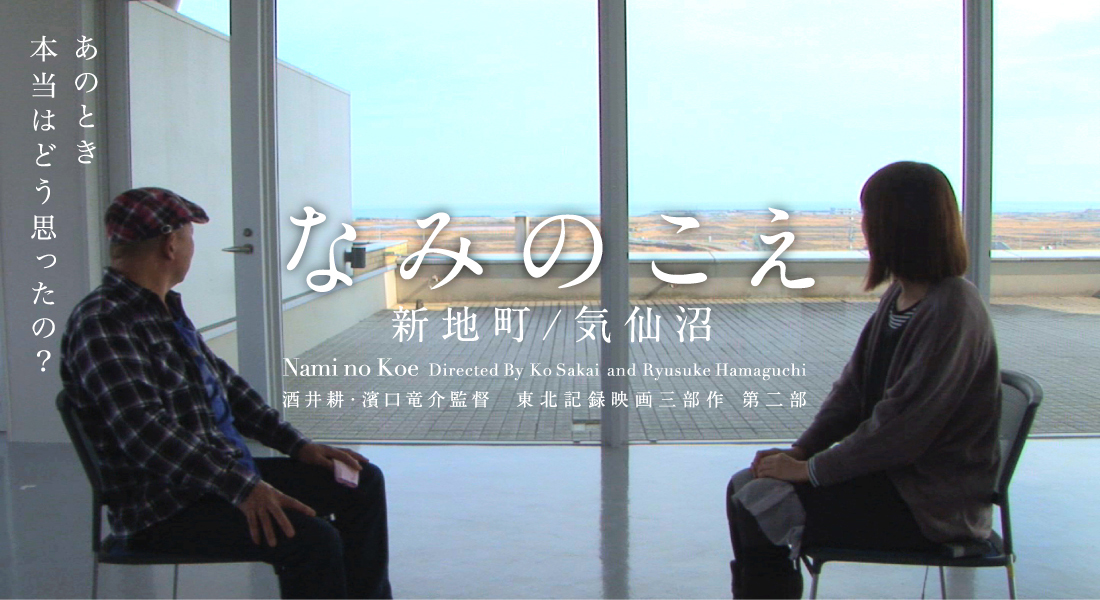
なみのこえ 気仙沼/新地町 Voices From the Waves: Shinchi-machi and Kesennuma (Sakai Kō and Hamaguchi Ryūsuke, 2013)

This is the translation of an article I originally wrote in Italian about two years ago for Sonatine.it, a contemporary Japanese cinema portal I often collaborate with.

Voices from the Waves is the second part of a trilogy of documentaries directed by Sakai Kō and Hamaguchi Ryūsuke about the disaster that struck northeastern Japan in March 2011. This second part consists of two documentaries, Voices of the Waves Kesennuma and Voices of the Waves Shinchi-machi. The only difference between the two works is that they were filmed in two different locations and are about the people who lived and experienced the disaster in two different but geographically very close areas. Both documentaries consist mainly of conversations between two people, often family members or colleagues, who survived the earthquake and tsunami.

Both films begin with images of the silent landscape of the areas, the sea and the waves, houses under construction and the remains of buildings that no longer exist. The idea around which the conversations take place is very simple: each person begins by telling where they were and what they were doing on the day of the earthquake and subsequent tsunami, and from there memories and reflections unfold.

In the first conversation of the Shinchi-machi film, a father and his grown-up daughter sit across from each other. As they recall the arrival of the tsunami and the size of the waves, their conversation is briefly interrupted by the father’s tears as he remembers friends and acquaintances who have disappeared, swept away by the tsunami. From the very first scenes, one of the trilogy’s strengths becomes clear: the moving stories of people who remember become something much more empathetic for the viewer than the flood of images of the disaster. In today’s mediascape, and the Japanese triple disaster of 2011 has become a striking case in point, spectacular images often fade from view in the few moments they are seen, leaving no trace. It is then that words, tone and intonation – in this case the man’s pronounced northeastern accent – manage to convey something much deeper and more affecting than the visual element alone.

Among the various couples we hear and see, whether friends, spouses or colleagues, some recall the difficulty of communicating with their loved ones in the moments immediately after the earthquake and the fact that they turned to images broadcast on television or circulated on the Internet. One of the most interesting parts of the first documentary is when we listen to two fishermen, both of whom were no longer fishermen at the time of the interview, but were doing other things to survive. This conversation, which is more edgy and direct and touches on the issue of radiation in the sea, reflects the character and occupation of the two and provides an interesting but painful variation on the people and personalities affected by the tragedy. The same problems that gripped the area in the aftermath of the disaster are perceived differently depending on people’s social class and economic background. It should be noted that some of these conversations are between a resident of the area and one of the two filmmakers, who then stands in for the second interviewee, but we will return to this important point later.
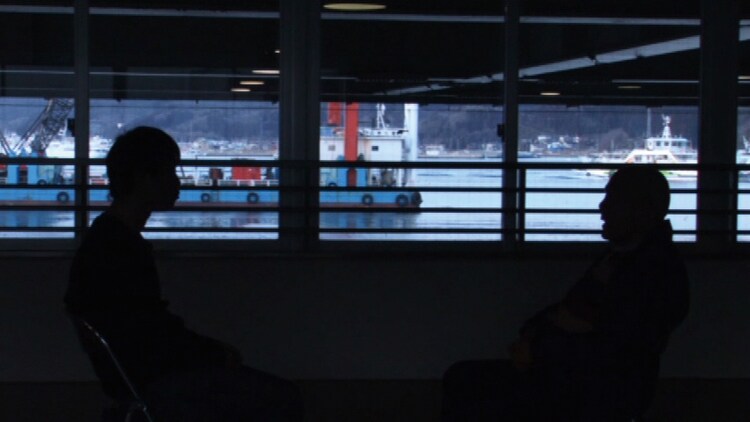
The second documentary, as the title suggests, was shot in Kesennuma, one of the towns hardest hit by the tsunami. It begins with a night-time view of the town’s harbour and then moves to the first conversation, probably recorded in the evening, between two colleagues working in a bar-restaurant. They share the memory and the feeling of despair and fear when they heard the sound of cars and houses colliding and destroying each other on that tragic day. A middle-aged couple does not want to remember the day of the tsunami because it is still so fresh, even though a year has passed since the tragedy. What emerges here is the willingness of the local people to forget, not to not remember, but to move on and not to base their future lives on the disaster. This is a sentiment that has emerged more and more in recent years, especially in Fukushima, and is often found in many communities affected by natural or man-made disasters, such as mercury poisoning and the resulting Minamata Syndrome, which Tsuchimoto Noriaki has explored in his documentaries.
Tsuchimoto, one of Japan’s greatest documentary filmmakers, who has devoted much of his career to following the lives of the victims of Minamata Syndrome, has often commented on how, after decades of documentaries on the subject, many of the victims’ relatives began to treat him coldly. It is therefore important to emphasise one more time that the conversations in Hamaguchi e Ko’s documentaries were filmed just over a year after the triple disaster, when the pain and memories were still fresh, but also when the perspective of those affected by the earthquake and tsunami was slowly but surely changing.

The talking pairs are often in an airy space, especially in the first documentary, where the conversations take place inside buildings, but with large windows looking out. The chosen setting therefore gives a sense of spaciousness and grandeur that an enclosed space would not allow. Between one conversation and the next, there are short ‘pillow shots’, scenes showing the area being rebuilt, the sea, the waves, the excavators and cranes that are still constantly at work. Although these images often capture the landscape filmed by a horizontally moving camera, the entire trilogy differs from most documentaries made about the earthquake and tsunami in that it is composed of mostly static shots. Many of the works that have attempted to document the plight of the local population and the triple disaster over the years have in fact done so through shots taken from a moving vehicle, partly because the vastness of the area affected by the tsunami requires it, but this choice of filming also ended up becoming almost a documentary style in itself and a cliché of how to film the disaster.

It is also significant that the two documentaries are not constructed with interviews, a practice used and abused in the aftermath of the triple disaster, which establishes a relationship of power and impartiality between interviewee and interviewer. Conversations between two people, even though they take place in a staged and constructed space, with at least two cameras and two directors in the room, achieve something different. No one intervenes from outside, of course there is editing, but a kind of horizontal and equal dialogue is created, because these are people who have experienced the tragedy first hand. In this sense, the fact that the two directors intervene in some of the conversations is interesting, almost revealing the “artificiality” of the work, but in the long run it reduces the impact of the two films. The same could be said of the different angles and techniques used to film the two interlocutors (this insightful essay by Markus Nornes is illuminating); while in some cases this works almost perfectly, in others it exacerbates a sense of artificiality that detracts from what is being said.
There is, however, one part where all these techniques are used to the full, and that is the final conversation of Voices From the Waves Kesennuma, when a young couple, a man and a woman aged 26 and 23, amid silences, awkwardness, nervous smiles, ringing mobile phones and yawns, bring out the cinematic power of the unspoken, of gestures and pauses, making this scene perhaps the most touching and at the same time amusing of all those seen in both works.

Anthropology and cinema: The Song of Akamata (Kitamura Minao, 1973)

I’m reposting something I wrote almost 4 years ago about Kitamura Minao and visual anthropology in Japan

Visual anthropology, ethnographic cinema, visual folklore and ethnographic film are all definitions floating around the same concept, a point of intersection between cinema, film or the visual arts on the one side and ethnology, anthropology or ethnographic field work on the other. Although all these definitions don’t exactly signify the same thing, I personally like the term “visual anthropology” the best, for no special reason.

I came to be interested in visual anthropology through the works of Jean Rouch, author and co-author of some of the most outstanding works in the history of documentary (Chronicle of a Summer, Moi, un noir, etc.) who was also a very well respected anthropologist who spend most of his life working in the African continent. Driven by this interest a couple of years ago I started to look for something or someone similar in Japan, and by pure chance one morning at Nagoya Cinemaskhole, I came across and discovered the works of Kitamura Minao.
Kitamura is one of the most respected visual anthropologist (I don’t know if he’d agree to be called so) working today in Japan, the founder of Visual Folkrore Inc. and, besides his works for TV (mainly for NHK), he’s also the author of some very compelling and inspiring theatrical documentaries. For instance, Kitamura is the director of one of my favourite films of 2012,

ほかいびと 伊那の井月 Hokaibito: Ina no Seigetsu (2012) about the life of Inoue Seigetsu, a poet and wanderer who lived the last part of his life (he died in 1887) shifting through the land of Ina, now located in Nagano prefecture, between the Edo and Meiji period, a time of dramatic changes that transformed and shaped Japan as a modern nation.

seigetsu_no_ina

Hokaibito: Ina no Seigetsu is a very unique documentary constructed by merging poems, written by Seigetsu himself and visualized on screen by nice handwritten strokes, with reconstructions of the life of the poet, played here by the legendary dancer Tanaka Min.
I haven’t seen so many of Kitamura’s works, especially those commissioned by museums or NHK, but a couple of years ago at the Kobe Planet Film Archive I had the chance to see two of his works made around 30 years ago: The Horse of Kaberu (1969) and The Song Of Akamata:
Life Histories of the Islanders of Iriomote Okinawa (1971).
The former in particular impressed me for its compelling topic: the failed attempt to film a sacred festival in Komi (filming the rituals in the remote island remains a taboo) that nonetheless turned out into a meaningful portrait of the people living or returning to the small land, and a revealing study of their deep relationship with traditions and religion practices of the island.
What follows is an introduction to the movie by Kitamura himself, given on the occasion of a symposium, “Expanding the horizon of Area Studies through film presentation The New Generation of Anthropological Cinema” held in Kyoto in 2006:

akamata

THE SONG OF AKAMATA:
LIFE HISTORIES OF THE ISLANDERS, IRIOMOTE, OKINAWA

KITAMURA Minao

There are two sacred festivals in the Okinawan Islands that, although they continue today, have not yet been filmed or documented: Uyagan-Sai of Ogami Island, Miyako; and Akamata of the Yaeyama Islands, which I attempted, on one notable occasion, to film with an Arriflex camera. The result is this rather peculiar work that did not actually achieve its main objective.
Once a year, during June of the lunar calendar, wearing a wild red wooden mask and covered in leaves and vines, Akamata appears from the sacred cave known as Nabindo. He visits the village founder’s house in Komi to bless the villagers and promise a good harvest for the coming season.
In July of 1972, I arrived at Komi with my filming crew, having traveled by Sabani, a kind of small fishing boat. Although 73 families had occupied the village in 1960, only 17 families remained. Most of the young people had left for Tokyo or Kawasaki, and each year an additional few families had also emigrated to Ishigaki Island or Naha. With such a small village population, I was doubtful that Akamata would be held.
At midnight of the first day of the festival, I was called outside, where I was surrounded by several young men with sickles. They returned to me a bottle of sake I had presented them with in honor of the festival, and then threatened me, shouting, “We never gonna let you shoot Akamata. Never! If you do, you’ll be found murdered.” Their parting shot, “If we ever allow your filming, it’s the end of the village,” made me even more curious about why Akamata made them so excited and energetic. What magnetic force made people come back to the island to join Akamata?
Due to these developments, instead of filming Akamata, I decided to document the life histories of the villagers and the ways of life of the people who had emigrated from Komi. I rallied my frightened crew and began a daytime visit to a family by asking them to let us take a souvenir photo. They liked our request, even though the camera was my 16mm Arriflex. We also voluntarily joined in the work of the village community, drank together, and sang together, with the camera and recorder turned on.
Before completing souvenir photos of all 17 families, I began to understand the fairly complicated relationships among the villagers. For instance, there were conflicts between native and newly introduced religions. After the photos had all been taken, we visited ex-islanders live in Ishigaki and Naha in order to ask why they had left their native island. I found that these ex-islanders living in the cities maintained the same values they had cherished in their native village. It seems that Akamata still lives in their minds.
The sacred masked Akamata, covered by leaves and vines, does not appear at all in “The Song of Akamata.” Nonetheless, this film succeeded in documenting and unmasking the real lives of the islanders.
Duration: 82 mins, Medium: DV, Year: 1973, 2006 (revised), Production: Yugyoki Location: Komi, Iriomote, Okinawa, Japan

Here the original

Asia is One アジアはひとつ (NDU, 1973) edited

I’m reposting an edited version of my piece on NDU’s Asia is One, an article I wrote two years ago.

NDU (Nihon Documentary Union) was a Japanese collective founded in 1968 by a group of Waseda University students who would eventually drop out to dedicate their lives to filmmaking and political struggle. From 1968 to 1973, when the group disbanded, this group of activists, who saw themselves first and foremost as a collective of activists, made four documentaries, moving from the streets of Tokyo – the first work was Onikko – A Record of the Struggle of Youth Labourers – to the distant islands of Micronesia, passing through Okinawa, the archipelago where they made two of their most important documentaries.

Motoshinkakarannu (1971) was made in and about Okinawa, before the archipelago was ‘returned’ to Japan. The group went to the island in 1971 and captured on film a society in transition. The film shows and focuses on the fringes of society, with illegal prostitution and life in the red districts, while also highlighting the historical and social fractures that have run through the area: anti-establishment and anti-American riots, the Black Panthers’ visit to Okinawa, water pollution and much more. I voted Motoshinkakarannu one of my favourite Japanese documentaries in a poll I organised a year ago, but today I’d like to turn my attention to the second film made by the collective in Okinawa (and beyond): Asia is One アジアはひとつ (1973, 16mm, 96′), a work that I hadn’t seen at the time of the poll and that would have certainly made my list along with Motoshinkakarannu.

Asia is One was screened on June 26th at Kyoto Kambaikan, as part of the AAS in Asia, and it was screen with English subtitles for the first time, the movie was shelved for many many years, forgotten, and was (re)discovered only in 2005 when was screened at the Yamagata International Documentary Film Festival. The screening in Kyoto was followed by a fascinating Q&A with the only surviving member of NDU, Inoue Osamu. Nunokawa Tetsurō, who after the dismantling of the collective made other interesting solo documentaries in Palestine and US, passed away in 2012. As described by Roland Domenig (1), with Asia is One

NDU further explored the margins of Okinawan society and continued to break through borders by focusing on the Taiwanese minority. The film portrays Taiwanese migrant workers on the main island of Okinawa who substitute the Okinawa laborers who in turn are employed as migrant workers on Japan’s main islands. It traces the history of Taiwanese coal miners on Iriomote Island, follows legal and illegal workers to the westernmost island of Yonaguni and finally lands in Taiwan in a village of he Atayal tribe of Taiwanese aborigines, where still the Japanese naval anthem is played every noon.

Formally the documentary is composed of landscapes and interviews, all of them out of sync, possibly due to the equipment used or maybe the lack of it. The uncanny space created by this displacement, but also by the use of music from radio broadcasts and kids voices, thrown here and there during the movie, gives the work a peculiar aesthetic tone, a type of non-fiction cinema that I like to call “chaos cinema”. (2)
To explain and understand the “chaotic” trait of Asia is One, and Motoshinkakarannu as well, we have to delve deeper in the philosophy that laid at the core of NDU’s approach. What the collective has tried to convey through their cinema is extremely fascinating, in their writings (3), mainly published in the magazine Eiga Hihyo, the group was explicitly pushing towards a cinema/activism of anonymity, trying to reach an “impersonal space” and rejecting even the term “work” (sakuhin) because it was seen as the product of a single person in command and as a result of a dominating power structure. In this regard famous was their criticism of Ogawa Production, a collective that bore the name of a single person and that was basically structured hierarchically (4). To this kind of collectivism NDU tried to oppose a more fluid idea of group activism, where the structure was a flat and horizontal one, and in doing so, promoting a cinema made by amateurs (5) and not by professionals. “Everybody can push the button and shoot with a 16mm camera” said Inoue, and this is even more true today since the advent of the digital revolution. Whether this approach was successful or not, and more importantly, whether this horizontal structure and “amateur cinema” is possible at all, are questions without answers that are haunting scholars to this day.
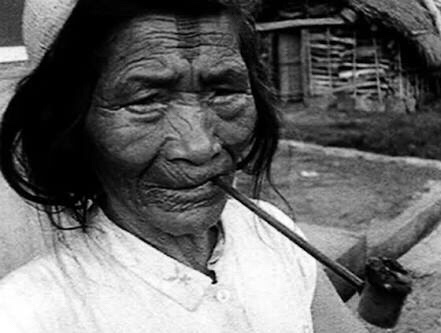
Going back to Asia is One, the part of the movie the resonated more with me was the last one, when the film moves to the Atayal village in Taiwan. There’s a quality in the close-ups of the tribe people, beautiful and ancient faces, that is extremely fascinating, also because it is in these scenes that the political discourse on identity, or the negation of it, reach its peak. From the 17th Century onward The Atayal people, like the rest of the tribes inhabiting the island, were forced to face the colonization of the Dutch first, the Spanish and the Chinese later, and eventually that of the Japanese Empire (1895 – 1945), which called them “barbarians” and tried to assimilate and annihilate their culture (6). That being said, the words spoken by the member of the tribe provide more context and add layers of complexity to the situation. “Japan conquered us and abolished many of our ancient traditions and customs”, but at the same time “we were drafted and went to war with pride and ready to die” and also “luckily the Japanese abolished some of our ancestral traditions like beheading”. Asia is One ends with the militaristic song If I Go to Sea against an everyday scene with the aboriginal Taiwanese people isolated in the mountains singing “We want to go to war again.”

Of course there is oppression and violence, physical and cultural, in every colonization, but things here are deeper than what they seem. In the process of cultural and historical coring that the movie conveys with its images and words, from Okinawa to Taiwan, I believe that two significant elements emerge. The first is the crisis of the identity concept, often a forced cultural and national superstructure imposed by the stronger and more powerful part on a “highly fluid space of human life” (6), as Inoue explained “identity was one of the most hated words inside the NDU, identity is a choking concept”. The second point that struck me is the recurrence of a power and social structure that exploits the margins, the outsiders and the weakest people. In mainland Okinawa the illegal prostitutes and worst jobs are done by people from Miyako island, and in Miyako and other small islands the lower part of society is occupied by Koreans, Taiwanese and aboriginal people. This perpetuating exploitation is possible only as long as a certain part of society is described as different and inferior, and only when and where the concept of border is a monolitic divide used to create the “other”, the “foreigner” and the “stranger”. NDU’s documentaries are an antidote against all this poisonous discourse, and an invitation to break through the borders, those in the world outside us, but also those inside ourselves.
A final note on the title, the movie as a product of a collective that was thriving towards anonymity, has not film credits, nor it had originally a title, Asia is One was attached to it only later, and it’s a kind of a joke because as Inoue himself said “we all know that Asia is not one!”

notes:

1 Faraway, yet so close by Roland Domenig, in The Legendary Filmmaking Collective NDU and Nunokawa Tetsurō ed. Yasui Yoshio, Tanaka Noriko, Kobe Documentary Film Festival Committee, 2012.

2 This might not be the best way to describe the movie, but aesthetically it reminded me, maybe because of the out of sync, of Imamura Shōhei’s documentaries shot in South East Asia during the 70s.

3 Some of the writings are translated in The Legendary Filmmaking Collective NDU and Nunokawa Tetsurō, op. cit.

4 You can find more in Forest of Pressure: Ogawa Shinsuke and Postwar Japanese Documentary, Abé Markus Nornes, Visible Evidence 2007.

5 Some interesting insights on amateurism in cinema can be found in The Flash of Capital: Film and Geopolitics in Japan, Eric Cazdyn, Duke University Press 2002.

6 In 1930 the village was the site of an anti-Japanese uprising, the so called Musha Incident, an event portrayed in Warriors of the Rainbow: Seediq Bale (Wei Te-Sheng, 2011)

7 Nunokawa Tetsurō in YIDFF 2005 Special Program, Borders Within – What it means to live in Japan.

Record of a Marathon Runner あるマラソンランナーの記録 (Kuroki Kazuo, 1964)

The Winter Olympics in Pyeongchang, the next edition of the Summer Olympics in Tokyo on the horizon, and the massive 100 Years of Olympic Films box set released last year by the Criterion Collection, revived and rekindled my interest in sport documentaries. I decided to revisit one of my favourite non-fiction films dedicated to sport, Record of a Marathon Runner, a movie made by Kuroki Kazuo between 1963 and 1964 about Kimihara Kenji, a Japanese marathon runner active during the 1960s and 1970s. Kuroki was a director who, long before establishing himself as an author somehow associated with the Japanese New Wave (Silence Has No Wing and Ryōma Assassination are two of his best work of the period), was a respected and innovative documentary filmmaker at the Iwanami Production, where he and other friends, Tsuchimoto Noriaki and Ogaka Shinsuke among others, formed the Ao no Kai (Blue Society), a group that tried to experiment and find new ways of expression through non-fiction cinema.

Record of a Marathon Runner is a PR movie (a sponsored movie) founded by Fuji Film, but paradoxically shot almost entirely on a Eastman Kodak film. If you want to know more about the movie’s troubled production and have more insights on Kuroki career, this interview is a must read.

It is possible to watch the relatively short documentary (only 62 minutes) on The Science Film Museum’s Yutube official page, unfortunately it’s without English subtitles.

For some scholars, and I couldn’t agree more, Record of a Marathon Runner represents the other side of the official discourse about the Olympics, the one exemplified, with great artistic results I have to admit, by Ichikawa Kon’s Tokyo Olympiad (1965). In Record of a Marathon Runner the connections with the big event are very thin if not completely absent, in fact someone could argue that the movie is not even about the Olympics at all, we don’t see the marathon or the games themselves, the camera “just” follows Kimihara Kenji, who would eventually finish in eighth place at the competition in Tokyo, throughout his training and running in the winter and spring of 1963-64, as he prepares for the big event.

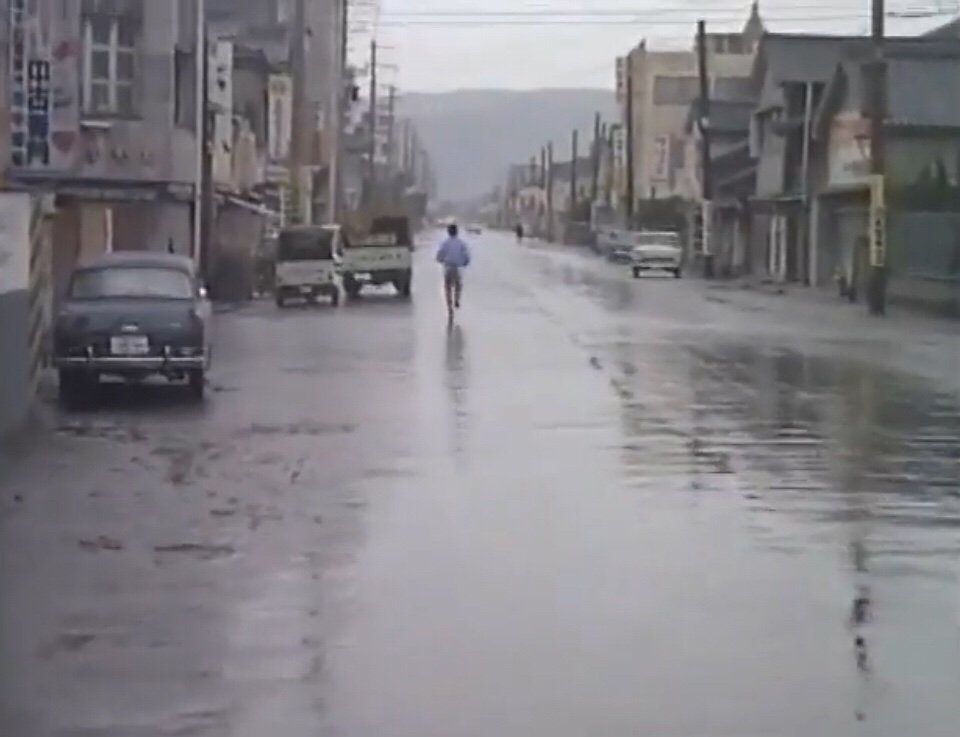
Although originally the documentary was conceived by Kuroki without narration, the movie uses a traditional narration alternating with the words spoken by the marathon runner himself and his coach. However, the tone of the words is so flat and has an almost matter-of-fact quality in it, that there’s no glamour nor pathos, on the contrary, everything, from the endless and solitary training, to the foot injury and the recovery, is displayed like some sort of natural phenomenon. Drained of any passion, the style of the movie reflects the act of running as felt by Kimihara himself, or at least as it is presented in the film, mechanical and without a real purpose, but it is also a way of transferring on screen the gray skies and the dull landscapes depicted, Kitakyūshū city with its industrial suburbs often drenched in rain, or the very ordinary countryside roads in Kagoshima prefecture.

This sense of necessity and that of the loneliness of the runner is amplified by the use of an eerie, dissonant and minimalist music, and by a cinematography that often uses long shots when depicting the athlete while training on the track, on the beach or on the streets. Even in the only scene when Kimihara is shot on a close-up while running, the monotonous sound design and the circularity of his movements form a hypnotic run that seem to lead nowhere. Another scene towards the end is also exemplary about this aesthetic approach: Kimihara after recovering from his injury participate in a competition- the Asahi road relay as the last runner – the only proper race we see on screen. After he wins and crosses the finish line though, he goes on running for a couple of minutes among people and trees like in a state of trance and without goal.

Focusing on the experience of running in preparation for a competition, highlighting its harshness and solitude, Kuroki also depicts indirectly the social background which Kimihara belongs to, the working class of a highly industrialized Kita Kyushu, and the life of an athlete before the brief and ephemeral light cast by the Olympic event.

Le Moulin (Huang Ya-Li, 2016) out on Blu-ray and DVD

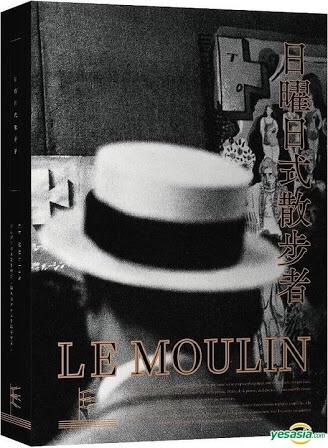
Just a quick post to share my excitement for a new home video release. I found out only a few days ago that from last June Le Moulin, one of the best documentaries I’ve seen in recent years, is available for on DVD and Blu-ray. The movie, directed by Huang Ya-Li, is a complex and fascinating exploration of the first Taiwan’s modern poetry group, Le Moulin Poetry Society, active in the island during the 1930s, when Taiwan was under Japanese colonial rule. You can read my piece on the movie here.

Le Moulin was made available in Taiwan by Fisfisa Media, but it comes with English, Traditional Chinese and Japanese subtitles, for more details on the technical aspects of the DVD and Blu-ray, please check the YesAsia page, where you can also order the movie.

I haven’t had the chance to check the DVD/Blu-ray yet, but it is nice to see that it also comes with a booklet of essays written by relatives of the Le Moulin poets and literary figures.

I will update this post once I get the release.

Documentaries at the London Korean Film Festival 2017

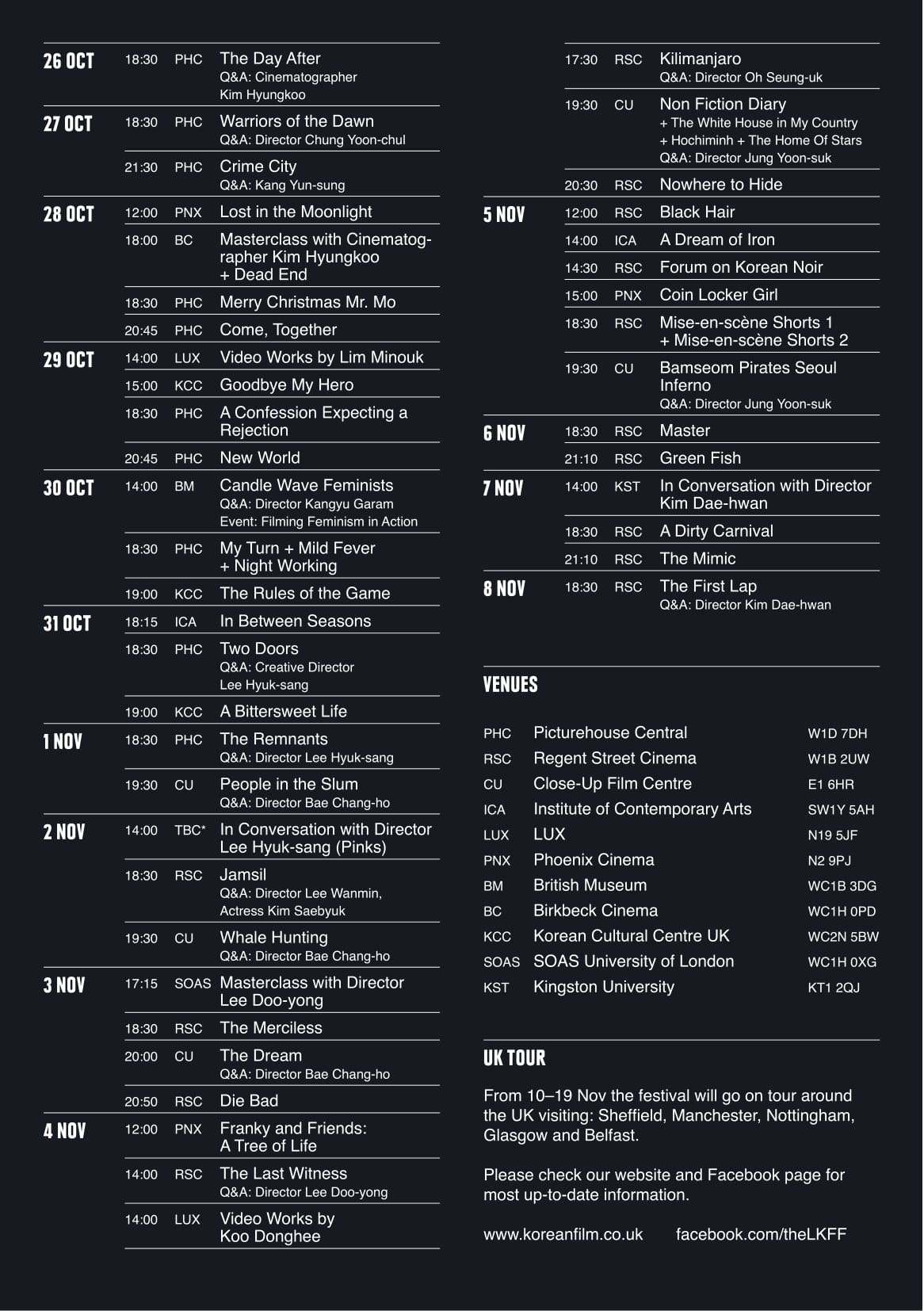
The London Korean Film Festival has opened its 12th edition last Thursday and will run in the capital for two weeks, from November 10th through the 19th the festival will then go on tour around the UK, touching Sheffield, Manchester, Nottingham, Glasgow and Belfast.
In addition to showcasing a wide-range of titles produced in the Asian country, there will also be masterclasses, talks and collateral events, a special occasion for the British audience to get a glimpse of South Korean cinema and film culture in general. This year line-up includes not only UK and European premieres, animations, classics, shorts and indies, but also a fascinating focus on Korean Noir, “Illuminating the Dark Side of Society”, and, of particular interest for this blog, a program dedicated to documentary.

The first movie presented will be Two Doors (2012) directed by Kim Il-rhan and Hong Ji-you, a documentary investigating the the Yongsan Disaster, when in January of 2009 a sit-in rally in central Seoul resulted in the deaths of five protesters and one police officer. While Two Doors focuses more on the legal aspects of the tragedy, amassing documents against the violence used to prohibit the demonstration and the sit-in, The Remnants  (2017) is about the personal tribulations and the legal problems that some the people who took part in the demonstration had to go through in the seven years after the tragedy. The movie was directed by Lee Hyuk-sang, who was also creative director behind Two Doors, and the festival has organised a special conversation with the director on November 2.
Goodbye my Hero (2017) by Han Younghee, a movie addressing labour relations and workers’ rights in contemporary South Korea, and Park Kyung-hyun’s Dream of Iron (2017), a film essay about the development of the steel industry in the country during the 1960s, will complete the section.
The ‘Women’s Voices’ s section includes also a documentary, Candle Wave Feminists (2017) by Kangyu Garam, a movie that delves into the revolution that led to former prime minister Park’s impeachment and her spiritual mentor Choi Soon-Sil’s arrest.

All the documentaries will be screened this week starting from tomorrow, October 31st.

LKFF17-Screening-Schedule-1.jpg

Retrospective of Taiwanese documentary cinema at the Jihlava International Doc Film Fest

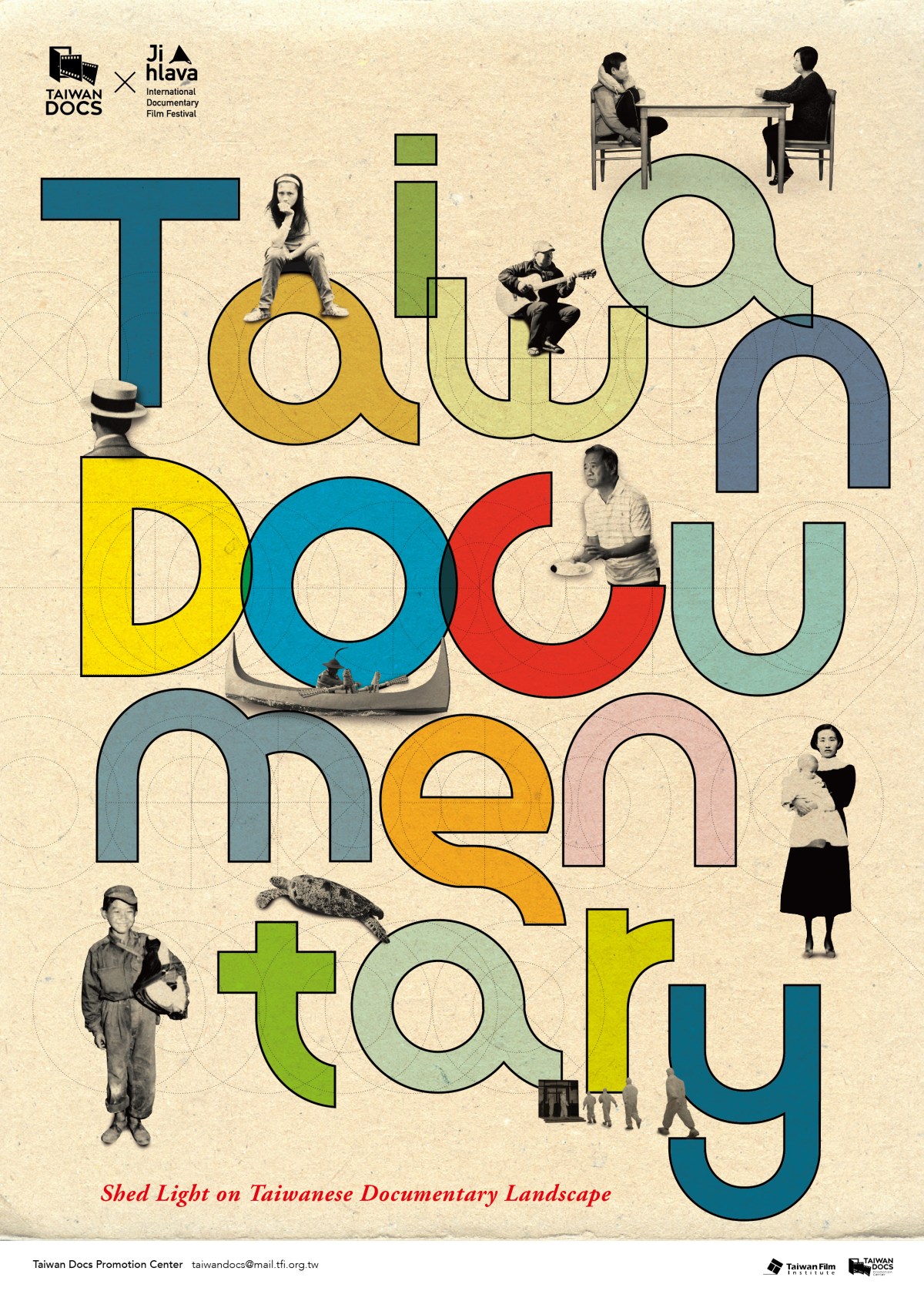
Since the discovery of Le Moulin two or so years ago, non-fiction cinema in contemporary Taiwan has been one of my main cinematic obsessions and a research interest that drove me to explore the flourishing documentary scene of the island. This year edition of the  Ji.hlava International Documentary Film Festival (October 24-29) is currently holding a retrospective on Taiwanese documentary from 1937 to 2014 titled Transparent Landscape: Taiwan, a program that presents 25 Taiwanese documentaries from the period, according to the festival “the historically most comprehensive showcase of Taiwanese documentary cinema ever”.  I won’t be able to attend it, but, it goes without saying, it’s an event I’m highly interested in and I hope a catalogue will be published, here the press release:

The section will include some of the most important works of Taiwanese independent filmmakers. Allowing a glimpse into Taiwan’s complicated historical-political development, these films offer significant insights into different periods of recent Taiwanese history.
The earliest Taiwanese documentaries are the 8mm ”home videos“, shot by photographer DENG Nan-guang in the 1930s. They realistically portray scenes of daily life under Japanese occupation, such as life and work along the Tamsui river and family outings. The recently restored short The Mountain by Richard Yao-chi CHEN (1967) will be presented outside of Taiwan for the first time. Other representative works from the1960s, are the films by renowned director BAI Jing-rui and photographer ZHUANG Ling. In this decade, only government-commissioned propaganda films could be produced, but with their creative ingenuity, those filmmakers still managed to convey the lives and thoughts of ordinary people.
The Green Team, the most important non-mainstream media in the period prior to and after the lifting of martial law in Taiwan (1987), will also be represented by two important productions. The Green Team documented many social movements and protests that took place on Taiwan’s road to democracy in the 80s, and their images eventually became weapons against the authoritarian state. There are obvious connections with the situation in Czech society in the late 80s before the collapse of the Soviet regime.
Apart from its focus on history, Transparent Landscape: Taiwan also pays tribute to the experimental spirit of Ji.hlava IDFF. By showcasing aesthetically experimental, creative films, traditional expectations on documentaries are challenged. The selection includes several masterpieces, such as works by internationally renowned artist CHEN Chieh-jen, photographer CHANG Chien-chi, the first Taiwanese to become a member of Magnum Photos, and YUAN Goang-ming, the pioneer of video art in Taiwan.
This comprehensive retrospective also includes early documentaries by the leading figures of Taiwanese cinema, such as CHUNG Mong-hong, WU Mi-sen, HUANG Ting-fu and others. Beginning from the 90s, they used experimental vocabulary to explore the boundaries of documentary filmmaking. Even today, their films are regarded as avant-garde filmmaking, no matter if they deal with aesthetic conceptions or with human problems.

You can find the complete program here, and more information about documentary in Taiwan on the TaiwanDoc page.

This slideshow requires JavaScript.

A House in Ninh Hoa

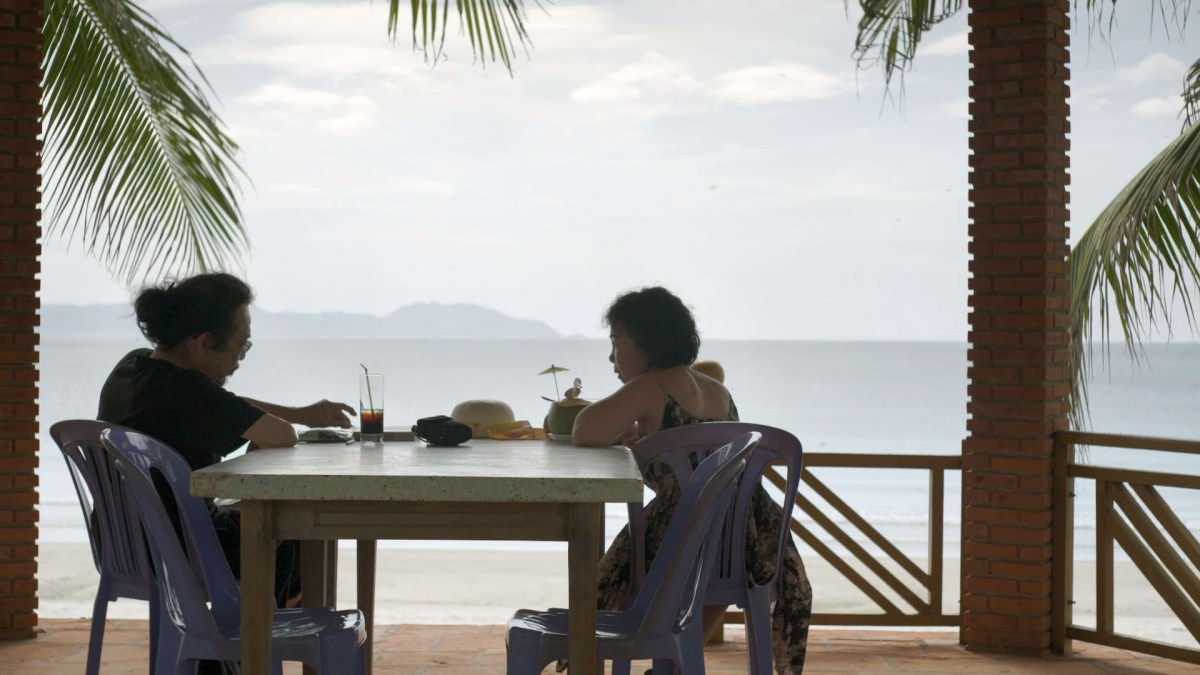
Recently I’ve been trying to catch up with some of the movies I missed at the Yamagata International Documentary Film Festival, it’s basically impossible to see all the works screened, and so two weeks ago or so I had the chance to watch A House in Ninh Hoa by Philip Widmann and Nguyễn Phương-Đan, a documentary shot in Vietnam and described as follows on the movie’s official page:

The old paternal house of the Le family, set in a rural scenery at the fringes of the small town of Ninh Hoa, close to the southern coast of Vietnam: A household dominated by women, neither rich nor poor, with chicken behind the kitchen and ‘rice paddies bordering the plot.
Through the everyday life of the inhabitants of the house, the constellation of the extended family becomes visible. A constellation that is fundamentally marked by the course that history took in the second half of the 20th century, and that has made Germany a substantial reference point in the life of the Le family.
One part of the family has been living close to the former West German capital of Bonn for more than 40 years while the other part still resides in Ninh Hoa. The community of the Les includes both relatives that are present and absent, and extends into the realm of the spirit world.
Three brothers embody the trajectories that history has taken: One brother was assigned as a diplomat to the embassy of the Republic of Vietnam in Bonn in the early 1970s. He took his wife and children with him. At the end of the war in 1975, the nation that had employed him ceased to exist, and they stayed in West Germany. Another brother who was a soldier disappeared in the last days of the war. His remains have never been found. The third one was sent into a re-education camp after the end of the war. Today, he is the only male family member left in the house in Ninh Hoa.

A House in Ninh Hoa is the kind of documentary I can easily connect with and relate to, challenging in its form, the movie questions the limits and the ontological foundation of the “genre”, even if it might look just as an “ordinary” documentary, at first glance.
Composed only by static shots, as far as I know there are no camera movements (no even one!), everything in the movie is told in tableaux, sort of Ozu-esque pillow shots, that reveal, fragment after fragment, the family story and the landscape where the movie takes place, and the movie is, to some extent, the very landscapes it depicts. The slow pace of the movie and its insistence on these spaces, domestic and external, build a very specific sense of duration, a cinematic tide that eventually envelopes the viewer in its own rhythm and its own time. This is achieved primarily through the editing, the shot compositions and the use of natural light, all stylistic elements that enhance the digital image, used here its full potential.
The title appears on screen only after 20 minutes or so and while the first fragments of the family stories are hinted here and there, it is only after an hour into the movie that everything becomes clearer, and the complete story of the family is explained in the last scene of the movie, when we see the only male family member left in the house reading from a piece of paper. Widmann and Phương-Đan thus construct the movie by removing information and data, and focusing instead on those elements usually considered secondary or peripheral such as anodyne landscapes and daily activities, presenting the family stories through an elliptical and fragmented narrative.
The afterlife, the connection with the departed and the spiritual world, in particular the brother never found at the end of the Vietnam war, is one of the central elements around which everything evolves for the family and consequently for the movie itself. Not only is the documentary imbued with an ethereal and contemplative aesthetic, but also everyone in the family speaks and moves around like they are themselves ghostly presences hovering around the house, thus evoking in the movie a sense of distance and absence, a metaphysical absence, and becoming in the end a reflection of the ephemerality of life.

Another point of interest of the movie, a major and more problematic one for me, is the position of the camera and the director/cameraman in relation to the people seen in the documentary. In the whole movie the camera is always an absent gaze, that is to say, there is never a look at the camera by the family members and never the person behind it is addressed directly by them. This raises a few questions, while there are no doubts that the story told in the documentary is true (Nguyễn Phương-Đan is a member of the family), A House in Ninh Hoa gives the idea of being composed also of reenacted and staged scenes. Exploring what the documentary form is and how much truth is conveyable through a certain cinematic style and approach, A House in Ninh Hoa is not only an eye pleasing piece of work — the stillness and beauty of the locations, and the shot compositions are outstanding — but also a fascinating dive into the limits of representation and the meaning of “truth” in relation to moving images. A beautiful and thought-provoking film that goes hand in hand with some of my favourite non-fiction works and that reminded me of a line spoken in Jocelyn Saab’s Beirut, My City (1982), a movie and a filmmaker I’ve also discovered in Yamagata. Reacting to a bombed landscape after buildings have been erased and reduced to ruins, the narrator/voice says that, I’m paraphrasing, a filmmaker/artist should try to capture reality, paradoxically, before it crystallizes into an image. A House in Ninh Hoa inhabits this paradox.

Director Philip Widmann was kind enough to reply to some of my questions and observations about the movie, and allowed me to use some of his words in the article.

P.S. The review of the movie was written before we exchanged our opinions and I decided not to modify it.

What is happening on the screen is maybe not entirely true but it is truthful, and personally I consider this more important. Truthfulness unites non-fiction and fiction as both need their inner logic, and unless you deal with public (historical) knowledge, it doesn’t matter if what you speak about is true as long as it is truthful. For the family members of course their truth is more important. But for the viewers of the film it isn’t.

The film is a staging of elements of the family’s everyday life that are punctuated by several discourses (biographical, historical, relating to identity, community, partnership etc.). In the eyes of the writers of the film these discourses are virulent but are rarely played out in the family life. Through the script we tried to infuse traces of these discourses into the scenes of the film. In order to work together, we explained the scenes and their supposed meaning to the family and discussed them. This exchange created a transparency that together with the static camera work relatively clearly delineated what would be part of the film and what wouldn’t, both in terms of framing and in terms of dialogue. Compared to forms that give preference to a mobile camera that follows people around and a way of speaking through interviews, this gave both the people in front and behind the camera a stronger sense of understanding and control.


Yamagata 2017 – day 5 (finale)

October 10th

My last day in Yamagata. The festival will officially wrap up in a couple of days, but there are only a few screenings left and the main part of the festival ended de facto today. It would be a good idea if the organizers could spread the movies a bit more, as the festival is designed now, everything tends to be concentrated during the long week end (Friday to Monday) when film buffs from other part of Japan visit Yamagata.

In the morning I saw Genet in Shatila (1976) by Richard Dindo, long time ago I read the book the movie is based on (Four hours in Chatila) and it was a pleasure to rediscover its poetry and Jean Genet’s attachment to the Palestine cause. The second movie of the day was Here and Elsewhere by J.L. Godard and J.P. Gorin, a turning point in Godard’s career because it trailblazed and anticipated an approach towards the image and the use of it and many stylistic elements that would fully thrive and bloom in his next movies, culminating with Histoire(s) du Cinéma.

The last movie I saw at the festival was The Targeted Island: A Shield Against Storms by Mikami Chie. Although the movie is shot like a TV documentary and I have some other issues with it, it ends with the most powerful final scene I’ve seen in Yamagata this year, a very young female protester and a very young policeman facing each other in silence under the rain. Breathtaking.

I guess that’s all for this year in Yamagata, the festival is always a special experience, even though keeping the quality of the movies selected high is becoming every time more and more difficult.
I’d like to give special thanks to all the people (directors, critics, scholars, film lovers and volunteers) I met and I discussed with during these five days, it has been an enriching experience.

Yamagata 2017 – day 4

October 9th

Today I had to write an article for Il Manifesto about the Politics and Film: Palestine and Lebanon 70s–80, so I could not see as many movies as I’d have liked to. Anyway, the first work of the day was Tremorings of Hope by Agatsuma Kazuki, a movie depicting the struggles of the people of Hadenya, one small community in Miyagi prefecture, to rebuild their lives after the tsunami completely erased their town. It was as I expected, not a bad movie but nothing exceptional or new, definitely too long though.

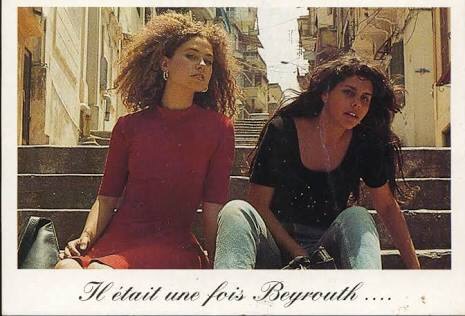
The only other movie I had the time to see was Once Upon a Time in Beirut: The Story of a Star by Jocelyne Saab, a complex interweaving of history and history of Lebanese cinema through the personal and fictional gaze of the director. A mesmerizing, tragic and fun film composed by images taken from Lebanese and not Lebanese movies of the first half of the 20th century. The icing on the cake was a Q & A with Saab herself via Skype.