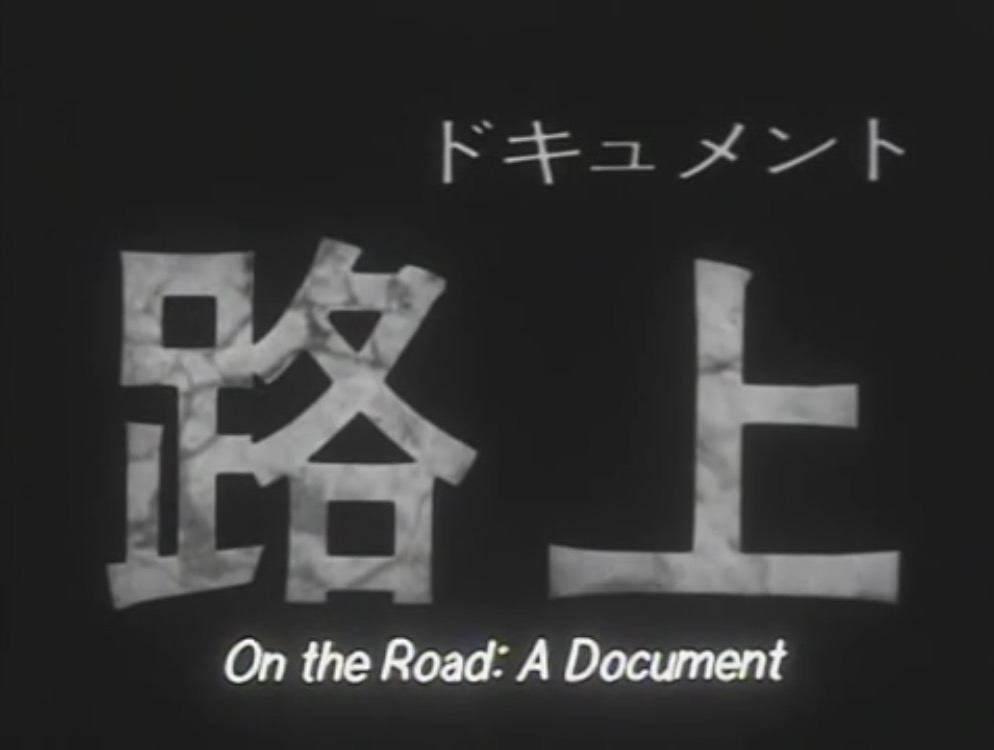
On the Road: A Document ドキュメント 路上(Tsuchimoto Noriaki, 1964)

One of the towering figures in Japanese documentary, Tsuchimoto Noriaki began his career as a documentarist, like many of his generation, at Iwanami Production in 1956. Tsuchimoto was since his university years a very active student, involved in the establishment of Zengakuren, member of the Japanese Communist Party and eventually expelled from Waseda University in 1953 for political activities. Mostly known in Japan and in the rest of the world, and rightly so, for his life-long series on Minamata and the mercury poisoning caused by Chisso Corporation, a total of 15 films in more than 40 years, Tsuchimoto in his long career tackled with his movies many different issues. Another Afghanistan: Kabul Diary 1985 and Traces: the Kabul Museum 1988, two movies set and about Afghanistan in a crucial time for the country, Nuclear Scrapbook (1982) on the danger of Japan’s nuclear policies, and On the Road: A Document, are some of his best non-Minamata works. It’s on this last one that I’d like to focus my attention today.
At the Beginning of the 60s Tokyo, and Japan in general, was in turmoil and experiencing huge changes, on the one hand the country was trying to leave behind and “forget” the tragedies of war, the consequent American occupation and more than 20 years of militarization and nationalism, on the other hand Japan was projecting itself and its people at maximum speed towards the future and a new phase. This “double” movement implied, among other things, starting a series of infrastructure projects that would completely alter the landscape of urban and suburban areas of the country, especially in preparation for the big international showcase of 1964, the Tokyo Olympics: streets, highways, the launch of the Shinkansen (the famous bullet train), and the devil’s pact with atomic energy. All changes that would shape, for better or for worse, the country’s future and made it what it is today.
On the Road was made in this whirl of structural, social and political changes, let’s not forget the huge demonstrations against the ANPO treaty in 1960 and those that would shake the country in the following years, a period of turmoil that is reflected in the film’s production history, as Zakka Films site puts it:

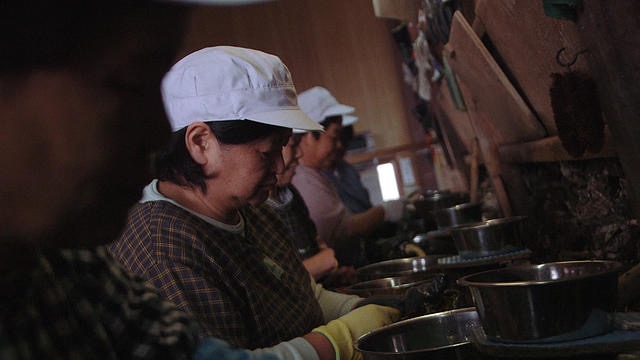
On the Road was originally commissioned as a traffic safety film with the Metropolitan Police as one of the sponsors. But it actually had a double existence: in reality Tsuchimoto was also working with the drivers’ union. When a police official finally saw the film, he dismissed it as “useless—the plaything of a cinephile,” and so it was never used for its original purpose. While winning numerous awards abroad, including at Venice, it was shelved in Japan for nearly 40 years.

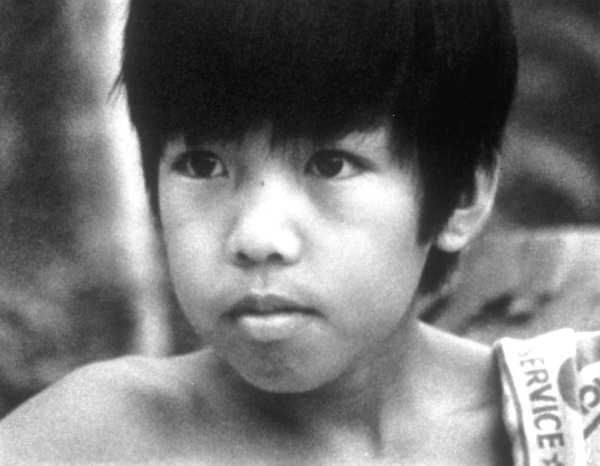
The production is also a strong statement of Tsuchimoto’s artistic independence and creativity as a filmmaker, “The film was conceived as an experimental dramatized documentary” and “Tsuchimoto had amateur actors play the principal roles and, because the sound and image were recorder separately, asked drivers to reenact their duties, meeting and conversations”*. For all these reasons On the Road turned into a formally and highly creative documentary and a very different one, in style and concept, from those of the Minamata series that would follow in five years. Alienating music, fast editing and a cacophonic cityscape rendered through a jazz-like rhythm bring to mind the city symphony movies of the beginning of the 20th century, reimagined for and in the 60s. A snap-shot of an era of change for Japanese society framing a mutating urbanscape with a free-style touch that makes it highly watchable and fresh even for today’s viewers.

While it’s important to praise and introduce all the movies of the Minamata series to the broadest audience possible, it’s also vital not to overlook some of Tsuchimoto’s works made outside of his life-long series and by doing so affirming his importance and role in the history of Japanese documentary.

On the Road: A Document is available on DVD (with English subtitles) at Zakka Films, of course!

* from the DVD booklet

Documentary in East and Southeast Asia, a list/database

Few months have passed since I’ve launched here on the blog, a project to create a list of the most significant East and Southeast documentaries, and, as I expected, the submissions did not come in big numbers — after all “documentary” and “East and Southeast Asia” are terms still part of a niche in the discourse about cinema around the world — but the quality of their content was very high. I think it’s about the right time to publish the list and have it circulated around the web.

The idea was to compile a list of the most significant and important works of non-fiction made in East and Southeast Asia, a database that could function as a guide for cinephiles and anybody else interested in documentary, but also as a sort of cartography to discover and explore non-fiction cinema, and its history and development in the region.
Cinema arrived at varying times in different areas of the continent, thus evolving in completely diverse ways, and this is even more true when considering documentary, a minority mode of cinema whose limits and definitions have been hazy and shifting since the dawn of the seventh art. Moreover, because many countries in the region have experienced, and tragically are still experiencing, colonization and dictatorship, in most of the area documentary was for a long period associated to propaganda, and it’s only in the last decades, with the impact of political change and the liberating advent of new and affordable technologies, that non-fiction cinema was able to free itself, rise and gain its status as a mode of free-expression and art, although unfortunately not yet in every country. For these reasons some national cinematographies (namely Japan) are more represented than others on the list, while others are sadly absent. Lack of access is also another problem that affected the making of the list, even today in the internet age and in a time where the net has become, or at least is trying to be, a different mode of distribution, access is a big and unresolved issue.
I’m sure there are many knowledgeable scholars out there in the world, who could give us more titles and insights to enrich the project. The list does not pretend to be all-inclusive, it’s not a dictionary or a documentary encyclopedia — although at certain stage in the future it might turn into one — but the aim is nonetheless to offer a database, a list and a sort of expanding work in progress. If you think there are works worth to be included, do please leave a comment or even better, reach me by email here, we can discuss about it.

Last but not least a big and special thank you to the bunch of scholars and film experts who submitted their titles, the project wouldn’t have seen the light without their vital contributions. Special credits go to Rowena Santos Aquino, film scholar and critic who specialises in documentary film history/theory and Asian cinemas/histories, Nadin Mai, independent researcher specialized in Slow Cinema and Trauma Cinema, and curator of Tao films, and Frank Witkam were essential in broadening and deepening the scope of the list.

Works are listed in chronological order:
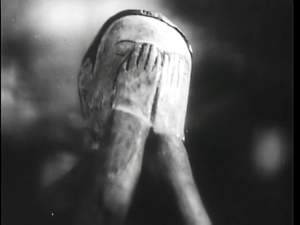
vlcsnap-2013-10-27-18h56m10s89

Fighting Soldiers (Kamei Fumio, Japan 1939)
Although in the 20s and 30s Japan had Prokino, it can be said that Fighting Soldiers was the first true example of Japanese (Asian?) non-fiction cinema made with an authorial touch. You can read more here.

Children in the Classroom (Hani Susumu, Japan 1954), Children Who Draw (Hani Susumu, Japan 1955)
Capturing the daily routine of an elementary school class in the manner of  direct cinema and cinema vérité, but way before the terms were coined, these two films brought radical changes and opened up new possibilities in the world of Japanese non-fiction cinema.

The Weavers of Nishijin (Matsumoto Toshio, Japan 1961)
The process of manufacturing textile in a famous Kyoto’s district rendered through rhythm, montage and music in a beautiful and grainy B&W.

Record of a Marathon Runner (Kazuo Kuroki, Japan 1964)
Focusing on the young runner Kimihara Kenji and his preparation for Tokyo Olympics, Kuroki turns a PR sport movie into a fine piece of authorial expression.

Summer in Narita (Ogawa Pro, Japan 1968), Narita: Heta Village (Ogawa Pro, Japan 1973)
The two films here stand for the whole Sanrizuka/Narita series, but especially Heta Village deserves to be in this list, a milestone in world documentary and an extraordinary documentary about time and place“.

Okinawa Islands (Higashi Yoichi, Japan 1969)
From August to October 1968, a film crew from the Japanese mainland ventured into U.S.-controlled Okinawa. Student struggles entered a new phase from 1968, rejecting “values” in the broad sense of the word. Higashi strongly felt the need to be free from previously established values, choosing in this work to grapple with the theme of Okinawa. The Okinawan problems analyzed in this film remain unresolved today. (from YIDFF)

A.K.A. Serial Killer (Adachi Masao, Japan 1969)
The avant-garde Japanese documentary film par excellence, and the first embodiment of Landscape Theory, A.K.A. Serial Killer is a film solely composed of a series of locations where young Norio Nagayama lived and passed by before committing the crimes for which he was later arrested.

Motoshinkakarannu (NDU, Japan 1971), Asia is One (NDU, Japan 1973)
Promoting an anonymus cinema made by amateurs and not by professionals, the Nihon Documentary Union delves here into the margins of Okinawan and Taiwanese society, focusing their gaze on the minorities and on the historical fractures in the areas. More here.

Minamata: The Victims and Their World (Tsuchimoto Noriaki, Japan 1971), The Shiranui Sea (Tsuchimoto Noriaki, Japan 1975)
Another monument in the history of world documentary, the Minamata series is an incredible and touching exploration of one of the biggest poisoning incident ever happened in Japan, and how it tragically affected people and their lives. You can read more here.

Extreme Private Eros 1974 Love Song (Hara Kazuo, Japan 1974)
A defining work for Japanese non-fiction cinema, exploring the personal sphere (the famous scene showing the birth of Hara’s child remains shocking even by today’s standards) in a period when it was “cool” to make politically engaged films, Hara was nonetheless able to avoid sealing himself and the movie off from the rest of the world in a sort of closed and solipsistic universe, more than ever the private is here the public and vice-versa.

God Speed You! Black Emperor (Yanagimachi Mitsuo, Japan 1976)
The camera follow a group of Japanese bikers, “The Black Emperors”, part of the so-called bōsōzoku movement, the motorcycling subculture that arose during the 70s in Japan.

The Cherry Tree with Grey Blossoms (Haneda Sumiko, Japan 1976)
Shot in a small valley in Gifu prefecture, the movie is a reflection on the mortality and ephemerality of all things disguised as a documentary about a 1300-year-old cherry tree. More here.
turumba

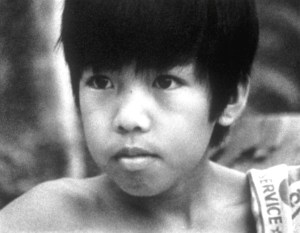
Turumba (Kidlat Tahimik, the Philippines 1981)
Turumba is a commissioned piece, which shows the work of a family making paper mâché figurines in preparation for the major “Turumba” festival in the area.

Oliver (Nick Deocampo, the Philippines 1983), Children of the Regime (Nick Deocampo, the Philippines 1985), Revolutions happen like refrains in a song (Nick Deocampo, the Philipines 1987)
These three films are all part of a trilogy of life under Marcos and Martial Law. Children is a documentary on child prostitution while Revolutions is a personal essay film in which Deocampo traces his own personal development and history against the backdrop of the People Power Revolution, which started in 1983 and later led to the ousting of president Marcos. Just like Oliver, a work that follows the life and work of a transvestite in the Philippines in the 1980s, it is shot on Super-8.

Magino Village: a Tale (Ogawa Production, Japan 1986)
Another masterpiece from Ogawa Pro, a stunning and epic movie that follows and tracks down the various histories traversing a village in Northern Japan, and at the same time a record of 15 years lived together by the collective.
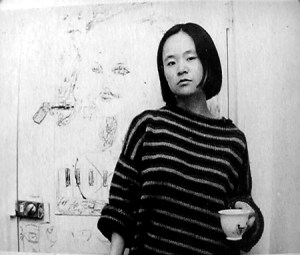
bumming_in_beijing

Bumming in Beijing – The Last Dreamers (Wu Wenguang, China 1990)
Generally considered one of the films that heralded the advent of what Lu Xinyu terms the ‘New Chinese Documentary Film Movement,’ its subject is fittingly a group of Wu’s artist friends and their (marginal) lives in Beijing.

I Have Graduated (Wang Guangli, China 1992)
Series of interviews with university students graduating in 1992 in the post-Tiananmen Square protests/massacre, interspersed with performances of songs.

The Murmuring (Byun Young-joo, South Korea 1995), Habitual Sadness (Byun Young-joo, South Korea 1997), My Own Breathing (Byun Young-joo, South Korea 1999)
Byun’s ‘comfort women’/‘low voice’ trilogy is a monumental project that gives space for Korean survivors to give their testimony, protest for redress, and fight against the social stigma of their traumatic past, staunchly filmed in the observational, present tense of the everyday and with the women’s direct collaboration.

Quitting (Zhang Yang, China 2001)
Centered on the late actor Jia Hongsheng’s real battle with drug addiction, the film is a docudrama in which Jia, his actual parents and sister, and his doctors play themselves as they reenact events that occurred during his addiction in the 1990s.

DV China (Zheng Dasheng, China 2002)
With its subject of a state employee making amateur films in collaboration with the villagers of Jindezheng, with limited state funds and equipment, the film gives the lie that ‘independent,’ ‘amateur,’ and the state media are mutually exclusive terms.

The Big Durian  (Amir Muhammad, Malaysia 2003)
A soldier who in 1987 began to randomly fire his rifle in the streets of Kuala Lumpur is an entry point to exploring racism and racial politics that the incident triggered among the city’s diverse population.

tie-xi-qu-west-of-the-tracks

Tie Xi Qu: West of the Tracks (Wang Bing, China 2003)
Quite possibly one of the most startling documentary debuts in recent decades, one that painstakingly observes the gradual decline of state-run factories as well as livelihoods and community bonds in the Tiexi district.

S-21: The Khmer Rouge Killing Machine (Rithy Panh, Cambodia-France 2003)
Arguably Panh’s most striking documentary on the Cambodian genocide, as it brings together survivors and torturers/executioners to the site of Tuol Sleng, now a museum but formerly a prison during the Khmer Rouge regime where tens of thousands were killed.

Memories of Agano (Satō Makoto, Japan 2004)
Ten years after the acclaimed film Living on the River Agano, the film crew returns to Niigata. Personal memories reflect upon remnants of those who passed away as the camera observes abandoned rice fields and hearths that have lost their masters.
More here

Singapore Rebel (Martyn See, Singapore 2004), Zahari’s 17 Years (Martyn See, Singapore 2006), Dr. Lim Hock Siew (Martyn See, Singapore 2010)
These three works represent oppositional voices/perspectives – opposition party leader Chee Soon Juan, ex-political detainee Said Zahari, and the second-longest held political prisoner the late Dr. Lim – which betray See’s commitment to political filmmaking and suppressed Singaporean histories.

Dear Pyongyang (2005,Yang Yong-hi Japan)
A second generation zainichi Korean director makes inquiries about the history of her activist father and mother. Over the years she records on video visits to her three brothers and their families, who migrated from Ikuno, Osaka to Pyongyang over thirty years ago, while reflecting on how she had been running away from the values her father forced upon her. (from YIDFF)

Oxhide I (Liu Jiayin, China 2005), Oxhide II (Liu Jiayin, China 2009)
Novelistic in detail and scope and in pushing the notion of filming in real time and filming real life perhaps to an extreme, with a shot count of twenty-three and nine, respectively, Liu and her family reenact real-life events and pierce the multilayeredness of lived experience.

The Heavenly Kings (Daniel Wu, Hong Kong 2006)
Following the formation of the boy band Alive, of which Wu is a member, the film follows the band’s attempts to crack the music market and, in the process, delivers satirical jabs at the Cantopop industry and Hong Kong popular culture in general and reveals itself as a hoax.

24 City  (Jia Zhangke, China 2007)
One of Jia’s documentary contributions, with a bit of fictional play with the interview, which nevertheless does not take away from its sober examination of the demolition of a factory town and its transformation as ‘24 City’.

Investigation on the night that won’t forget (Lav Diaz, the Philippines 2009)
Perhaps Diaz most invisible and least accessible film. The films is a two-shot recording of Erwin Romulo speaking about the circumstances of the death of popular film critic Alexis Tioseco and the subsequent investigation.

Disorder (Huang Weikai, China 2009)
A black-and-white found-footage film assembled from 1,000+ hours of footage shot by amateur filmmakers of everyday scenes in the Guangzhou region, whose effect is assaulting and absorbing.

Last Train Home (Lixin Fan, Canada 2009)
Canada-based Chinese filmmaker’s debut follows a couple who work in the city and annually make the long trek to their home village for Chinese New Year and becomes, in the long run, a frank portrait of one family’s diverging values/priorities.

The Actresses (E J-yong, South Korea 2009) Behind the Camera (E J-yong, South Korea 2012)
This mockumentary diptych takes the premise of a photo shoot and remote directing, starring top Korean stars, to address celebrity culture, the (absurd) nature of filmmaking, and the public/private divide.

Live Tape (Matsue Tetsuaki, Japan 2010)
On New Year’s Day in 2009, Musician Kenta Maeno strums his guitar and sings in a pilgrimage from Kichijoji Hachiman Shrine, packed with people paying respects, to Inokashira Park, where he joins his band on the outdoor stage. Live Tape is a miraculous live documentary capturing Maeno’s New Year’s Day nomadic guerrilla show in a single 74-minute take.

Arirang (Kim Ki-duk, South Korea 2011)
Kim’s sole documentary effort thus far followed a three-year hiatus from directing and is aptly a self-portrait of himself as a suffering (and at times, insufferable) artist – and perhaps even a parody of artistic self-portraits.

Golden Slumbers (Davy Chou, France-Cambodia 2011)
With his lineage of being the grandson of famed (and disappeared) Cambodian producer of the 1960s/1970s Van Chann, Cambodian-French filmmaker searches for the oral history of pre-Khmer Rouge Cambodian cinema and cinephilia.

ex_press

Ex Press (Jet Leyco, the Philippines 2011)
A passenger train travels across the landscape of the Philippines, while a monologue description of the journey presents fragments of memory and fantasy that look back at the country’s past.

Theatre 1 and 2 (Soda Kazuhiro, Japan, USA, France 2012)
The most complex and broadest in scope of Soda’works. Following Oriza Hirata and the Seinendan Theatre Company, Theatre 1 and 2 form a deep analysis of the creative process, but at the same time touching topics such as politics, performance, economy, art, engagement.

No Man’s Zone (Fujiwara Toshi, Japan 2012)
One of the best works about the triple disaster that hit Japan in March 2011, No Man’s Zone reflects on the meaning of natural and man-made disasters for our age, but has also been defined Tarkovskian in its aesthetics.

The Act of Killing (Joshua Oppenheimer, Christine Cynn, Anonymus, Norway-Denmark-UK, 2012), The Look of Silence (Joshua Oppenheimer, 2014)
Two successive works on the 1965-66 massacres of civilians in the name of Communist purges and the suppression of this past are set stubbornly in the present and made in collaboration with both perpetrators and survivors.

War is a tender thing (Adjani Arumpac, the Philippines 2013)
Arumpac is the child of a Christian mother and a Muslim father. She explores the second-longest running conflict in the world, the Mindanao War, through the lens of her parents’ divorce.

Storm Children, Book I (Lav Diaz, the Philippines 2014)
The film is supposed to be the first part of a two-part film, albeit Diaz never said when he would finish the second part of it. Storm Children follows the lives of children in the parts of the country hit hardest by typhoon Yolanda in 2013. Months later, the documentary shows that nothing has been done to alleviate the people’s struggle.

IMG_0170Aragane (Oda Kaori, Bosnia and Herzegovina, Japan 2015)
A breath of fresh air in the Japanese documentary world, Aragane, made by Oda at Bela Tarr’s school in Sarajevo, explores in the manner of structural cinema the time and dark spaces of a Bosnian coal mine. You can read more here.

Jade Miners (Midi Z, 2015), City of Jade (Midi Z, 2016)
This duology by the Taiwan-trained Burmese filmmaker was clandestinely shot in northern Myanmar to capture hundreds of labourers (one of which has been his brother, City of Jade’s focus) toiling the earth in jade mines, which are also part of a site of a civil war.
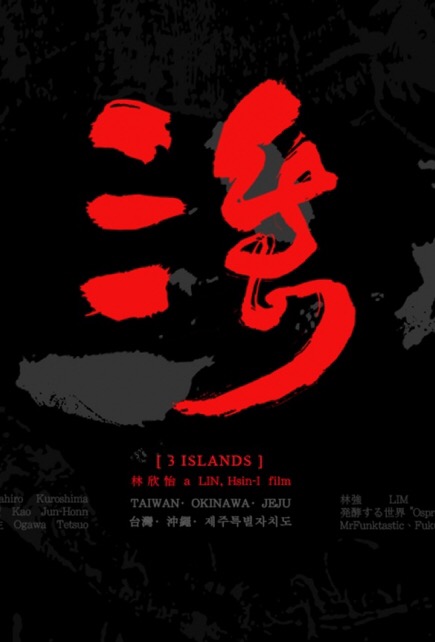
Some thoughts on 3 Islands (Lin Hsin-I, 2015)


I finally had the time to rewatch 3 Islands, an experimental documentary directed in 2015 by Lin Hsin-I, a work I enjoyed on my first viewing a month or so ago, but one that, because of its complexity and all the historical references, I really wanted to watch it again before trying to write down a “proper” review.
The movie is a blending of experimental cinema and non-fiction, a “genre” that has recently become more and more the main field of my interest*, but at the same time an exploration of the historical resonances that tragically bind together three different territories, Okinawa, Taiwan, and the Jeju island in South Korea.
3 Islands is a complex and multilayered work punctuated by literary quotes (Marguerite Duras, Kenzaburō Ōe and T.S. Eliot among others**), archival footage, contemporary art, beautiful digital shots of jungle and ruins, fictional memories and a minimalist and eerie music to wrap up everything.

img_2371

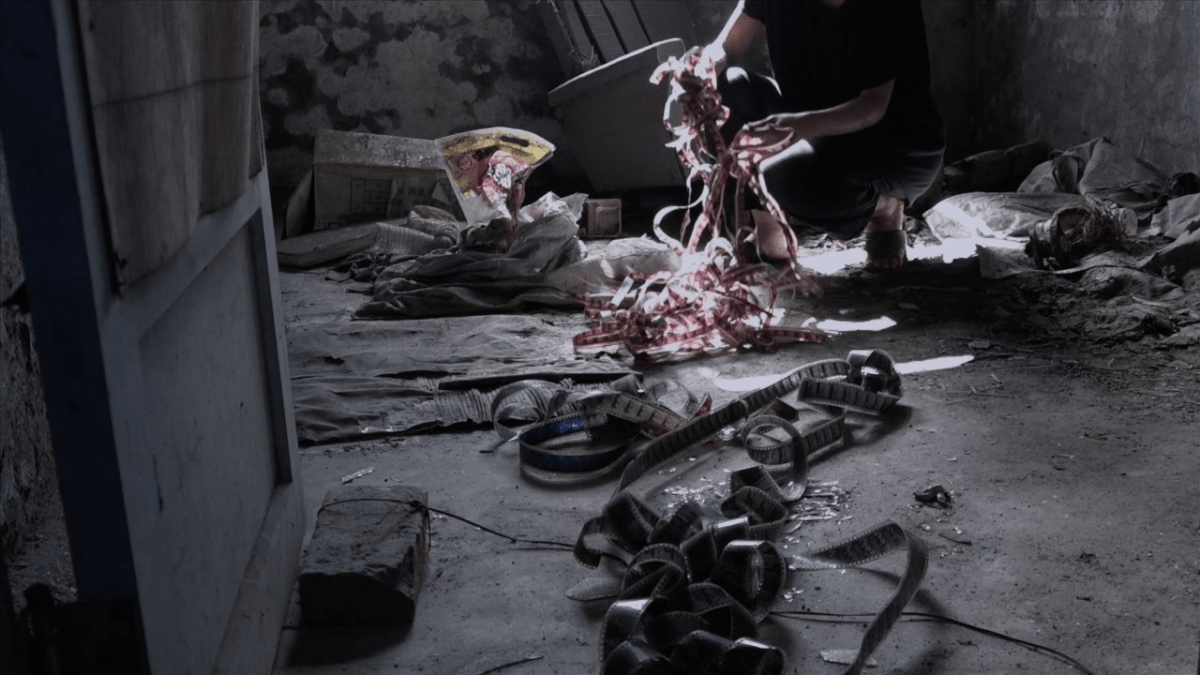
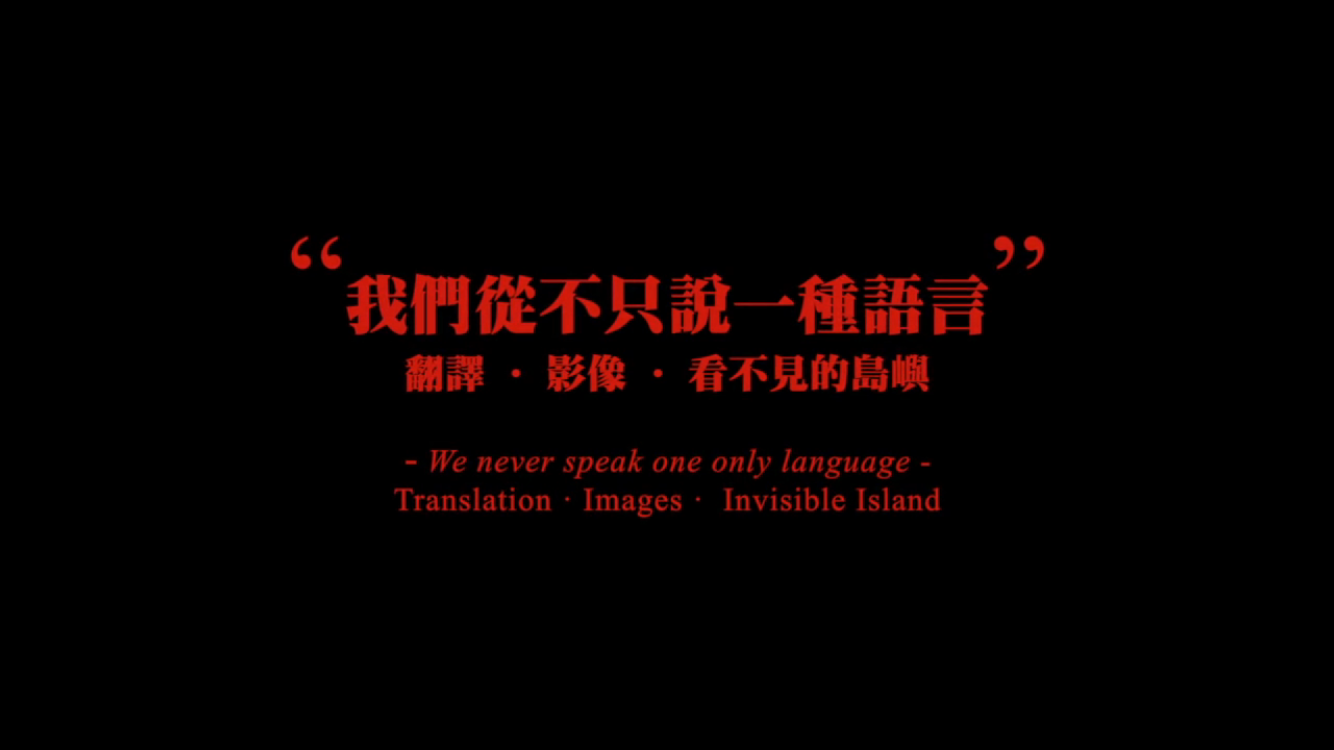
The movie’s very first image is a close up of an old strip of celluloid in what appears to be a destroyed building, later on we’ll discover is probably an abandoned theater in Tainan, Taiwan. The shots of the strip and those of the hands that pull it, are superimposed with quotes from Marguerite Duras and those from a Taiwanese artist, dealing with personal and historical memory, the differences in language(s) and the impossibility to convey a truth of any sort through them. It is thus clear from the very beginning that what interests the director is also, if not mainly, an exploration of the aesthetic limits of non-fiction and those of representation more in general.
In the following scenes, written messages of a young kamikaze who died in the battle of Okinawa are intertwined with images of mural art in Taiwan and connected with footage of kamikaze attacks on American ships. Moments of battles as experienced during II World War by Zhang Zheng Guan, presumably a Taiwanese pilot who fought the Pacific War with the Japanese Imperial Army, are narrated (in Japanese) over a split screen, one side showing the places where the carnage and horrors of war took place as they are today, the other showing the act of filming and photographing the very same spots. The gimmick of the split screen has here its raison d’être because, as written above, the film gives equal importance to the facts, stories and histories narrated in it, but also to the problem of representation itself, without, and this is one of Lin Hsin-I big achievements, becoming just an empty and self-absorbing aesthetic show-off. Archival war images and scenes from the Taiwanese jungle are then linked to those of the protests in Okinawa against the American base in Futenma, and everything is connected by the memories narrated, one of the more dense and horrifying passages of this account is when it describes scenes of mutilated and headless body still moving, and other where men are walking and singing with their hands on the belly holding their own intestines and livers.

img_2355

In the central part of the movie Lin Hsin-I  moves her focus on the island of Jeiju, a very small territory located between Japan and South Korea, also a place of geopolitical importance due to its proximity to Chinese waters. Again we are presented with images from today and photos and archival footage from the colonial past of the area, and more importantly from the Jeju uprising in 1948, a revolt where people were raped, tortured and brutally murdered by the Korean government’s militia. Talking or writing about the massacre was taboo for more than 50 years and was only in 2005 that an official apology from the South Korean president was issued.
As often happen to me when I watch works that are also about Japan, the least interesting parts are those that take place, or are about, the archipelago, not because they’re less compelling or thought-provoking, but more because they usually look like a déjà-vu to me. The same happened with 3 Islands and its final part about Ichimura Misako, a woman who decided to live like a homeless at Yoyoji Park in Tokyo, to whom the director felt deeply connected.
That being said, 3 Islands remains nonetheless one of the best work of non-fiction cinema I’ve had the chance to see this year, a multitude of images and words colliding and clashing together to create a polyphonic narrative.
From the aesthetic point of view, the work feels perhaps more akin to installation art than a movie, but because of this quality it works as a unique intellectual and visual experience: fragmentation, peripherality and the centrifugal complexity of its images, give 3 Islands a very peculiar rhythm and style, allowing the film to be challenging and compelling in every single minute of its duration.

https://youtu.be/iQ6yan9YKOI

3 Islands’ documentary images try to shift from literary writings to the actual fixing of body-scene. Adopting literatures as well as the personal research and practices of artists as scripts, parallel with reversible movements of the flesh, the work recounts the unknown history and the symptomatic interpretations of the 3 islands of East Asia—Taiwan, Okinawa, and Jeju Island.

Notes

* And apparently in Taiwanese documentary as well “The 15 nominees for the Taiwanese Competition at this year’s Taiwan International Documentary Festival (TIDF) signal a reversal from the previous social issue-driven, journalistic documentaries, with many entries crossing over into the domain of contemporary art. More here)

** Not really a quote, but there’s a very brief moment towards the end of the film when the director herself pronounces the words “Ogawa Shinsuke”. An homage to one of her inspirations?

Memories of Agano (阿賀の記憶 Satō Makoto, 2004)

This is an unfinished draft for an essay on Satō Makoto’s Memories of Agano 「阿賀の記憶」, a work in progress, at this stage no more than a series of random thoughts about one of my favorite movies.


last update: 26 September 2017


“…the habit of imposing a meaning to every single sign”

Trinh Minh-Ha


Satō Makoto’s documentaries seem to be (again) part of the filmic discourse in Japan, or at least on the rise in some cinematic circles, and deservedly so. Nine years have passed since his death, this year (2016) a book titled「日常と不在を見つめて ドキュメンタリー映画作家 佐藤真の哲学」(roughly rendered “Gazing at everyday and absence, the philosophy of documentarist Satō Makoto”) was published and a screening of all his documentaries, followed by discussions and talks, was held in Tokyo in March and later at the Kobe Planet Film Archive. I haven’t read the book yet, but the title summarizes and conveys perfectly the themes embodied in Satō’s last works: the dicothomy absence/presence and the presence of absence, that is to say the phantasmatic presence of cinema.

Sato’s final works, Self And Others, Memories of Agano and Out of Place: Memories of Edward Said witness and embody a shift in Satō’s approach, movies through which he was attacking and partly deconstructing the documentary form, to be fair with his works though, it’s a touch that was partly present in his films since the beginning, but in these three documentaries it becomes a very prominent characteristic. This publication seems to be timely and enlightening because is tackling Sato’s oeuvre not necessarily from a purely cinematic point of view, the book’s curator is by her own admission not a cinema expert, but it’s expanding the connections of Satō’s movies and writings towards the philosophical.

I hope the book will kindle and revive a new interest on his works, Satō is in my opinion one of the most important Japanese directors of the last 30 years, and sadly one of the most unknown in the West, I don’t really think there’s much out there in the internet or on paper about Satō, nor in English nor in other non-Japanese languages, and it’s a pity and a missed occasion because his movies, again, are more than “just” documentaries, or even better, are documentaries that have the power to question their own form and stretch in many differents areas. If you’re not familiar with his works, you can get a glimpse of Satō and his touch reading this beautiful and long interview, or you can buy them on DVD thanks to Siglo, it’s a rarity in Japan, but they come with English subtitles.

This year (2017) Yamagata International Documentary Film Festival will also hold a retrospective for the 10th anniversary of Satō’s death, commemorating and celebrating his works, his influence and his reception abroad.

One of Satō’s documentaries that resonates with me more than others, even after many viewings, is Memories of Agano (阿賀の記憶, 2004). As the YIDFF describes it:

Ten years after the acclaimed film Living on the River Agano, the film crew returns to Niigata. Personal memories reflect upon remnants of those who passed away as the camera observes abandoned rice fields and hearths that have lost their masters.

It is a relatively short but complex movie running only 55 minutes, an experiment in the form of a non-fiction film, splendidly shot on 16mm by cameraman Kobayashi Shigeru, the same cameraman who worked and lived together with Satō in Niigata for more than three years during the shooting of Living on the River Agano. The film is a poem on the passing of time and consequently on the objects that will outlive us, the persistence of things in time, including cinema itself. The original idea was in fact to make a film about the remnants of Meiji, that is “the glass photographic plates of the Niigata landscape from the late Meiji to early Taisho era (1910s) left behind by photographer Ishizuka Saburo. Using those old black and white photographs as a motif, we started out making the film with the same concept as Gocho Shigeo in Self and Others”. This quasi-obsession with objects is the thread that waves through the film’s fabric: boiling tea pots, old wooden houses, tools…

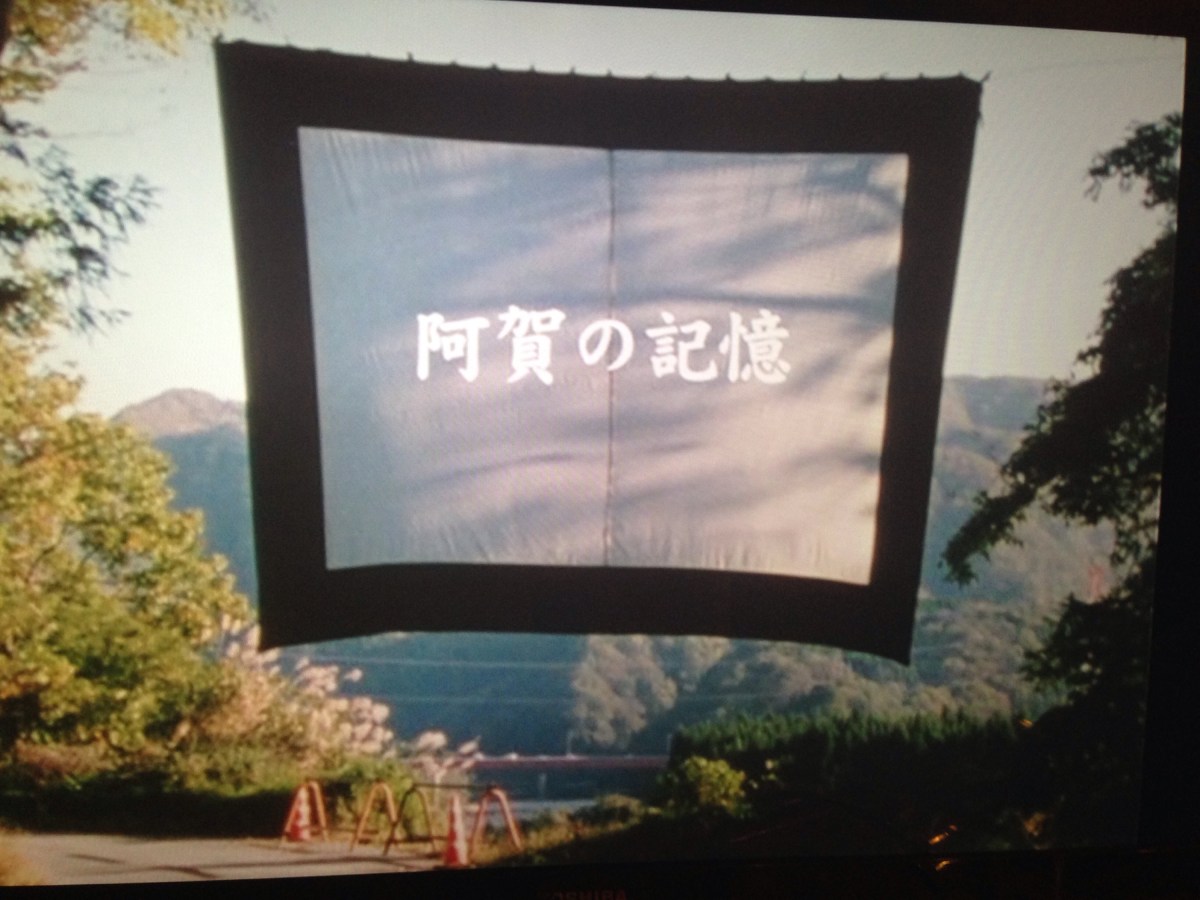
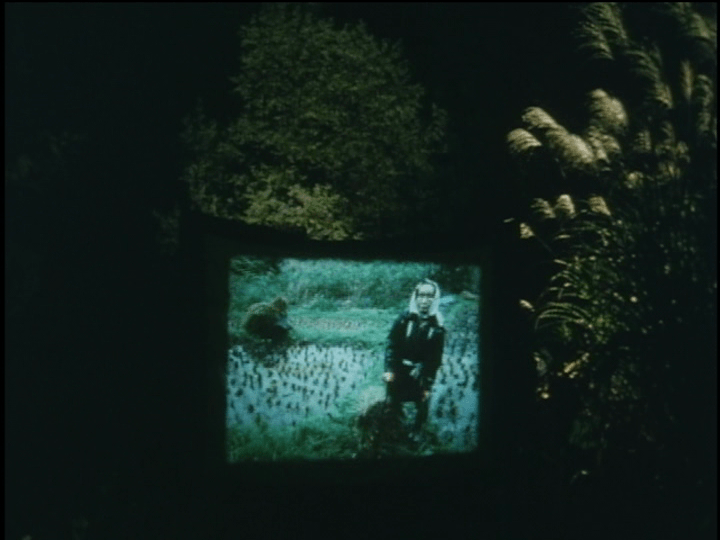
One of the most stunning scene of the movie and one that defines Memories of Agano is placed at the very beginning, when Satō and Kobayashi after returning to the area where the first movie was shot hang a big canvas tarp in the middle of a wood projecting on it the documentary they made 10 years before. The effect is profoundly disturbing and touching at the same time, images and thus memories are suddenly like tangible spectres.

On another level, Memories of Agano with its intertwining of past, present and landscapes ー the external ones with mountains, fields, rivers, and the interior landscapes of old and almost empty houses ー could also be read as an attempt to approach and partly re-elaborate the fūkeiron-cinema, the theory-of-landscape-oriented-cinema, 「footnote: “launched” almost five decades ago with A.K.A. Serial Killer (1969),  The Man Who Left His Will on Film (1970), Red Army/PLFP: Declaration of World War (1971) and The First Emperor (1973)」

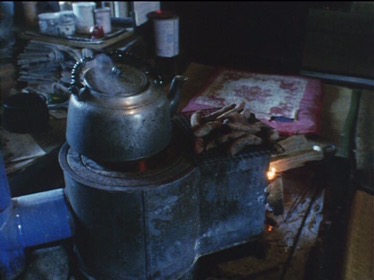
As for its aesthetics, one of the quality that strikes me every time I rewatch it, is the slow pace and the use of long takes that give the movie a dreamlike quality of lethargic torpor. The scene that embodies at most this aesthetic idea is an almost static shot of a teapot boiling on an old stove lasting about 10 minutes, on the background, sort of white noise, the words of an old lady spoken with a thick Niigata accent. She talks sparsly with Satō himself also about the fact she doesn’t wanna be filmed, half jokingly half seriously, a breaking of the fourth wall so to speak, a dialogue between camera and object filmed that was prominently present in Living on River Agano as well (“Are you filming me?” “Don’t shoot me!” are sentences that punctuate the course of this movie and the one made in 1992).

Memories of Agano also present itself as a documentary of opacity rather than one of transparency, the choice of not using the subtitles when people speak with their thick Niigata accent, a Japanese citizen from another area of the archipelago would probably understand 50% or 60% of what is said, a technical option that was used in Living on the River Agano – signals a major change in Satō’s approach to documentary and cinema in general. Feeding the viewer with limpid and clear messages and making a “comprehensible” movie is not what interests Satō here, but rather placing obstacles, visual riddles so to speak – the aforementioned tarp for instance, but also visually striking moments of pure experimentation – and thus presenting the opacity of the cinematic language seems to be the goals he had in mind when he conceived Memories of Agano. The images are thus escaping the organizing discourse tipical of so many Japanese documentaries, in contrast they open to new (cinematic) discoveries and keep resonating with the viewers and engage us on many different levels.

NDU and Asia is One (アジアはひとつ)

NDU (Nihon Documentary Union) was a Japanese collective established in 1968 by a group of Waseda University students, who would eventually drop out, one of the most prestigious universities in Japan. From 1968 to 1973, the year the group dismantled, this group of activists, they considered themselves first of all as a collective of activists,  made four documentaries, moving from the street of Tokyo – the first work was Onikko – A Record of the Struggle of Youth Laborers – to the far away islands in Micronesia passing through Okinawa, the archipelago where they shot two of the their most significant documentaries. Motoshinkakarannu (1971) was made and is about Okinawa before the reversion to Japan, the group went to the island in 1971 and captured on film a society in flux and in the middle of a shifting passage. The film show and focuses on the margins of society with illegal prostitution and life in the red districts, at the same time highlighting the historical and social fractures that were traversing the area: anti-establishment and anti-American riots, the Black Panthers visiting Okinawa, pollution of water and much more. I listed Motoshinkakarannu as one of my favorite Japanese documentaries in the poll I’ve organised a year ago, but today I want to shift my attention on the second movie made by the collective in Okinawa (and beyond): Asia is One (アジアはひとつ),  a work that I hadn’t seen at the time of the poll, and that would have certainly figured in my list paired with Motoshinkakarannu.

Asia is One was screened on June 26th at Kyoto Kambaikan, as part of the AAS in Asia, and it was screen with English subtitles for the first time, the movie was shelved for many many years, forgotten, and was (re)discovered only in 2005 when was screened at the Yamagata International Documentary Film Festival. The screening in Kyoto was followed by a fascinating Q&A with the only surviving member of NDU, Inoue Osamu, Nunokawa Tetsurō, who after the dismantling of the collective made other interesting solo documentaries in Palestine and US, passed away in 2012. As described by Roland Domenig (1), with Asia is One

NDU further explored the margins of Okinawan society and continued to break through borders by focusing on the Taiwanese minority. The film portrays Taiwanese migrant workers on the main island of Okinawa who substitute the Okinawa laborers who in turn are employed as migrant workers on Japan’s main islands. It traces the history of Taiwanese coal miners on Iriomote Island, follows legal and illegal workers to the westernmost island of Yonaguni and finally lands in Taiwan in a village of he Atayal tribe of Taiwanese aborigines, where still the Japanese naval anthem is played every noon.

Formally the documentary is composed of  landscapes and interviews, all of them out of sync, possibly due to the equipment used or maybe the lack of it. The uncanny space created by this displacement, but also by the use of music from radio broadcasts and kids voices, thrown here and there during the movie, gives the work  a peculiar aesthetic tone, a type of non-fiction cinema that I like to call “chaos cinema”. (2)
To explain and understand the “chaotic” trait of Asia is One, and Motoshinkakarannu, we have to delve deeper in the philosophy that laid behind NDU. What the collective has tried to convey through their cinema is extremely fascinating, in their writings (3), mainly published in the magazine Eiga Hihyo, the group was explicitly pushing towards a cinema/activism of anonymity, trying to reach an “impersonal space” and rejecting even the term “work” (sakuhin) because it was seen as the product of a single person in command and as a result of a dominating power structure. In this regard famous was their criticism of Ogawa Production, a collective that bore the name of a single person and that was basically structured hierarchically (4). To this kind of collectivism NDU tried to oppose a more fluid idea of group activism, where the structure was a flat and horizontal one,  and in doing so promoting a cinema made by amateurs (5) and not by professionals. “Everybody can push the button and shoot with a 16mm camera” said Inoue, and this is even more true today since the advent of the digital revolution. Whether this approach was successful or not, and more importantly, whether this horizontal structure and “amateur cinema” is possible at all, are questions without answers that are haunting scholars to this day.
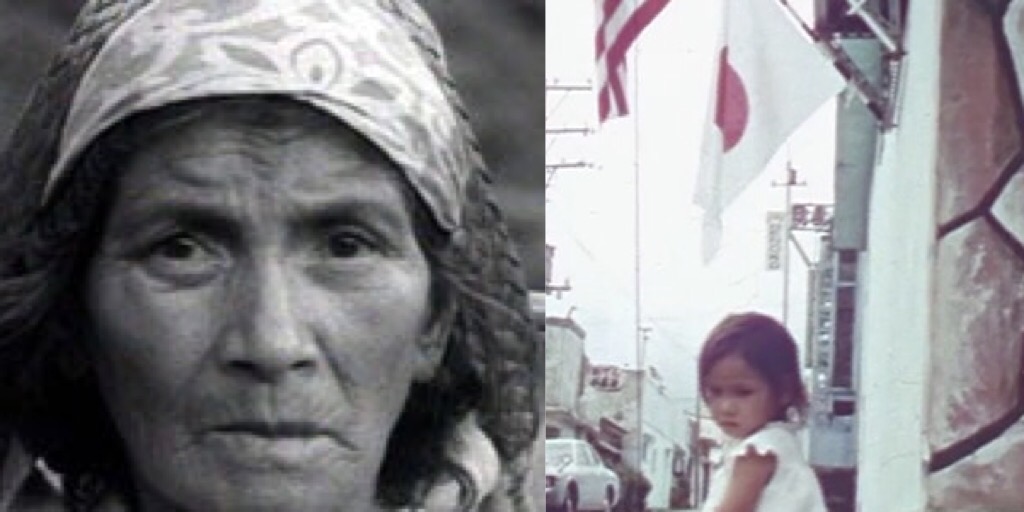
Going back to Asia is One, the part of the movie the resonates more with me is the last one, when the film moves to the Atayal village in Taiwan. There’s a quality in the close-ups of the tribe people, beautiful and ancient faces, that is very fascinating, also because it is in these scenes that the political discourse on identity, or the negation of it, reach its peak. From the 17th Century onward The Atayal people, like the rest of the tribes inhabiting the island,  had to face the colonization of the Dutch, the Spanish, the Chinese and later of the Japanese (1895 – 1945). Calling them “barbarians” the Japanese Empire tried to assimilate and annihilate their culture (6), the words from the tribe people in the movie add layers of complexity to the situation  : “Japan conquered us and abolished many of our ancient traditions and customs”, but at the same time “we were drafted and went to war with pride and ready to die” and “luckily the Japanese abolished some of our ancestral traditions like beheading”.
Asia is One ends with the militaristic song If I Go to Sea against an everyday scene with the aboriginal Taiwanese people isolated in the mountains singing “We want to go to war again.” Of course there is oppression and violence, physical and cultural, in every colonization, but things here are very layered. It seems to me that in this process of cultural and historical coring that the movie conveys, from Okinawa to Taiwan, two very significant points emerge. The first is the crisis of the identity concept, often a forced cultural and national superstructure imposed by the stronger part on a “highly fluid space of human life” (6), as Inoue explained “identity was one of the most hated words inside the NDU, identity is a choking concept”. The second point that struck me is the recurrence of a power and social structure that exploits the margins and the outsiders, in mainland Okinawa the illegal prostitutes and worst jobs are done from people from Miyako island, and in Miyako and other small islands the lower part of society is occupied by Koreans, Taiwanese and aboriginal people.
A final note on the title, the movie as a product of a collective that was thriving towards anonymity, has not film credits, nor it had originally a title, Asia is One was attached to it only later, and it’s a kind of a joke because as Inoue himself said “we all know that Asia is not one!”

notes:

1 Faraway, yet so close by Roland Domenig, in The Legendary Filmmaking Collective NDU and Nunokawa Tetsurō ed. Yasui Yoshio, Tanaka Noriko, Kobe Documentary Film Festival Committee, 2012.

2 This might not be the best way to describe the movie, but aesthetically it reminded me, maybe because of the out of sync, of Imamura Shōhei’s documentaries shot in South East Asia during the 70s.

3 Some of the writings are translated in The Legendary Filmmaking Collective NDU and Nunokawa Tetsurō, op. cit.

4 You can find more in  Forest of Pressure: Ogawa Shinsuke and Postwar Japanese Documentary, Abé Markus Nornes, Visible Evidence 2007.

5 Some interesting insights on amateurism in cinema can be found in The Flash of Capital: Film and Geopolitics in Japan, Eric Cazdyn, Duke University Press 2002.

6 In 1930 the village was the site of an anti-Japanese uprising, the so called Musha Incident, an event portrayed in Warriors of the Rainbow: Seediq Bale (Wei Te-Sheng, 2011)

7 Nunokawa Tetsurō in YIDFF 2005 Special Program, Borders Within – What it means to live in Japan.

Aragane 「鉱」by Oda Kaori

Aragane is the first full-length movie by Oda Kaori, a talented Japanese director who had her debut in 2012 at the Nara International Film Festival with the short Thus A Noise Speaks, a meta self-documentary that unflinchingly explored her coming out as a female gay and the subsequent reactions from her family. Aragane is a completely different work though, an experimental documentary that Oda directed, photographed and edited herself, but also a “product” of Bela Tarr‘s film.factory, the film school based in Sarajevo and established by the Hungarian director few years ago, a place where the Japanese director studied for three years. Aragane, the Japanese title means “ore” or small pieces of stone, was shot in a Bosnian coal mine and it’s an immersive and hypnotic sensorial experience, a very special and rewarding one that was presented last year at the Yamagata International Documentary Film Festival and later at the DocLisboa in Portugal.

I had the pleasure of meeting Oda in Yamagata and later on she was kind enough to answer my questions by email, you can read the interview here.

Aragane

Bosnia and Herzegovina, Japan              2015, 68’                                                Director: Kaori Oda, Cinematographer: Kaori Oda, Editor: Kaori Oda, Producers: Shinji Kitagawa – FieldRain, Emina Ganic – film.factory.

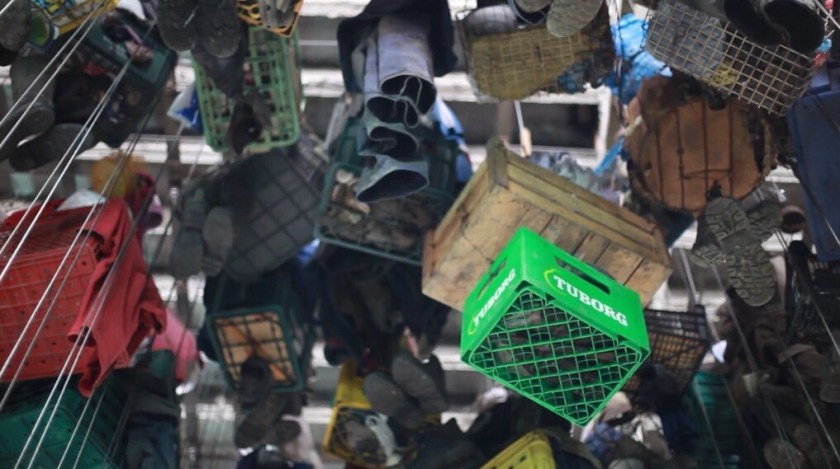
The movie starts overground with the camera gazing at some busy workers preparing and checking the machines before going deep down into the mine, the camera then ride on a cart and with a very long tracking shot slowly starts its descent into the inner part of earth. Once inside, we’re introduced and enveloped in  a world of darkness, a pitch black curtain broken only by sudden and random flashes of lights revealing a segment of a machine here and a face smeared with coal there. There are really few spoken words, we hear some random sentences uttered every now and then by the workers, but that’s all, much more important is the wall of noise created by movie, the soundscape being a crucial element of it. In the 68 minutes of deep immersion into the chthonian and dissonant world of the mine, we are almost constantly submerged by the cacophonous noise of the machinery, although the movie is also punctuated by sparse but significant and sudden moments of deafening silence. At the end of the movie for instance, when we emerge from the bowels of the earth, the peace and the vivid colors of the changing rooms and the stillness of the hanging clothes have an almost soothing quality for our eyes and ears.
As stated by the director herself, Aragane is not a direct inquiry into the harsh conditions of the people working in the mine, although it’s something that eventually and necessarily emerges, but more an attempt to convey on screen the time and the space of the coal mine as experienced by the workers, or, I would add, as experience by the mine itself. It takes some time to get used to the alien space and almost abstract geographies of the mine, for most of the time we don’t really know what’s going on and who is doing what, it’s more like being thrown into a cubistic landscape in the middle of its making. Once we get accustomed to the time and the space presented on screen though, everything slowly begins to make sense, what starts to surface from the images and sounds, and through the tracking shots and the slow and hypnotic camera movements, is the time of the mine – time experienced as duration – and the materiality of the space depicted. On this point Aragane is a documentary very akin to the works of the the Harvard Sensory Ethnography Lab, Aragane reminded me – albeit with some distinctions of course- of Leviatahn, Single Stream and The Iron Ministry, just to name a few.             
Aragane is a compelling viewing experience, not a cinematic revolution or a masterpiece of course, but nonetheless a very significant work for Japanese documentary – it’s only partly Japanese to be honest, since it was produced and shot outside the archipelago.  What particularly interests me here is that finally Japanese cinema has an important work of non-fiction able to emancipate itself from the imprint of social and political documentary that usually dominates the contemporary non-fiction scene in Japan, and a work that in doing so liberate and explore the experimental qualities of documentary. I might exaggerate, but to find something similar in the history of Japanese cinema we have to go back to the great Matsumoto Toshio and his Ishi no uta (The Song of Stone, 1963).

img_1304

ALONE (Gudu/孤独), Wang Bing and immanent cinema 


Alone
is the shorter version (89′) of Three Sister, a documentary about three little girls living alone in the mountains of the Yunnan province in China, a movie that was entered at the Venice Film Festival in 2013. Both of them are directed by Wang Bing, one of the most prominent filmmakers working today in non-fiction. Here’s the synopsis, taken from the International Documentary Film Festival Amsterdam where the movie premiered in 2013:

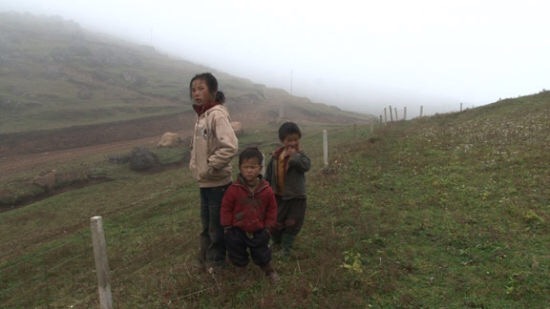
Ten years after Tie Xi Qu: West of the Tracks, which documented China’s transition to a modern industrial society and the growing pains this involves, filmmaker Wang Bing finds three sisters aged four, six and ten living with no parents 10,000 feet above sea level, in a small village in Yunnan province. Their mother has disappeared, while their father works in a nearby city and comes home every now and again to bring them new clothes. Family members and other villagers help keep the three children alive – efforts which, along with the communal vegetable garden, evoke the old days of socialism. This oscillation between modernization on the one hand and older values on the other is reflected by switching from long, patient observation by the camera to sudden accelerations and questions from the filmmaker, who operates the camera himself while recording the silent desperation and deprivations of this fragmented family. The mist that surrounds the village almost daily gives the impression that it has withdrawn from the rest of the world – although this proves an illusion. The surrounding areas are modernizing, the mayor explains, so the cost of living will have to increase here, too. All this escapes the children completely. They are too busy collecting food and delousing one another to notice.

More than a review of the movie, I’m sure you can find them out there in the vastness of the internet, what I’d like to do today is to throw some thoughts on the technical and aesthetic aspects of Wang Bing’s filmmaking, elements that make his movies – specifically Alone and by extension Three Sisters – a cinema of immanence (the definition is of course taken from Deleuze, you can read something about Wang Bing and the French philosopher here, while this review in Italian gave me the idea for this post). 

I think it’s not far fetched to say that it is because we, as viewers, are compelled and fascinated by the visual quality of Wang Bing’s works, that we also feel so engaged and moved by the stories he depicts in his documentaries. Remarkable is for instance the use he does of light, natural when shooting in the big expanses of rural China, and artificial -diegetic – when the filming takes place indoor; it’s something really impressive, but that often goes unnoticed because the subjects filmed and the stories told, socially and politically relevant, capture and consume the viewer attention. Every scene shot inside the shack where the three sisters live feels in fact like a painting, and this happens for a series of technical reasons: use of light, camera position, framing, duration and time of filming. 

IMG_0377
(a still from Night and Fog in Zona)

Something I’ve noticed when I was watching Night and Fog in Zona, the beautiful documentary on Wang Bing by Jung Sung-il, something very simple but at the same time a sort of revelation on his movie making style, is the way Wang Bing holds his camera (if I’m wrong I hope some readers will correct me). Rarely on his shoulder, and this is true especially when shooting indoor or outdoor while sitting, the camera often rests on his lap, or at least below his head, static and almost devoid of movements, it forges images that are less distant and thus more engaged with, and almost merged, with what he’s shooting. Wang Bing is crafting a cinema of immanence, an immanence made possible by the digital, and this is all the more true when he is filming people and their faces. It’s in these shots and scenes that the sound design gains its importance, the camera is gazing at the sisters from such an extreme proximity that we can literally hear their breathing, swallowing and sniffling, adding an element of almost tactile sonority to the movie. It is through this style and aesthetics that Wang Bing is able to convey the poverty and miserable destiny of the sisters, but at the same time their playfulness and innocence, everything here is depicted against the background of mountains, villages and shacks, deep inside the cold desolation of rural China, landscapes of absolute beauty and absolute indifference. 

Under the Cherry Tree (Tanaka Kei, 2015)

Under the Cherry Tree (桜の樹の下)  is the feature documentary debut of director Tanaka Kei, a work that follows the lives of the elderly residents of a public housing complex in Kawasaki. The movie had its premiere last October at the Yamagata International Documentary Film Festival (Perspective Japan) where I had the chance to see it.

Under_the_Cherry_Tree

From the opening scene the film reveals its touch, low-tech and anti-spectacular in style, with a pretty straightforward approach, even though there are some formal choices that tend to be elliptical, I’ll come back to it later. Through her camera Tanaka gives voice to the elderly living in the building, focusing especially on four of them whom, during the 92 minutes of the movie, we slowly get to know and attached to. They all tell stories of solitude, each of them of course has a diverse background and even comes from different areas of Japan. Recollecting their past and the reasons for their present condition, a life on the edge of poverty, is a sort of candid confession that each of them is not afraid to make in front of the camera.  In the chatting with the director what strongly emerges is a sense of impending death, a common horizon that feels very near, and yet seems to be accepted and sometimes even anticipate as a sort of deliverance particularly from one elderly lady. Enveloped in their loneliness, the only sparse moments of comfort for these people are represented by the weekly meetings with the care staff or other various recreational activities organised in the neighborhood.
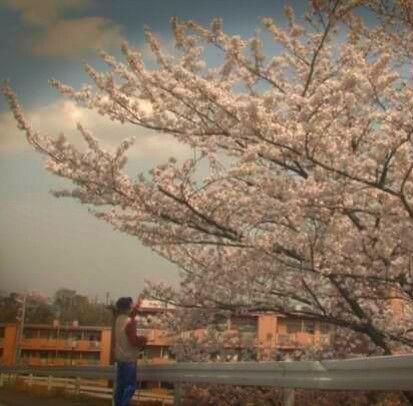
There’s a big cherry tree near the housing complex, often we see these old people taking a stroll, passing under it and stopping to contemplate its flowers, one of the few bursts of beauty coloring their lives and the visual element that gives the movie its title.
As gray as it might seem, the documentary is not only and always a bleak depiction of lives without hope, on the contrary and on a deeper level, is more an act of understanding and acceptance of what it means to become old in a society that doesn’t really know what to do with its old population. To lighten up the mood there are here and there some comic moments, especially when the two old ladies, one of them has also mental problems and lives in a flat piled with garbage, visit each other, chat and quarrel. Renouncing the classical narration in favor of intertitles and written texts to introduce the four protagonists is a perfect choice by the director, as a result the movie is smooth in its flow and doesn’t feel redundant or pathetic, gaining instead a matter-of-fact quality that is one of the best traits of the movie.

Under the Cherry Tree perfectly situates itself in a recent trend of Japanese documentary, a trend that has become almost a sub-genre, exploring and depicting the population ageing in Japan by focusing on personal lives of few individuals. A demographic trend that will dictate the political and economic decisions for years to come, Under the Cherry Tree goes together with Walking With my Mother,  Everyday Alzheimer 1 and 2 as one of the best examples of this unavoidable turn that Japanese non-fiction and Japanese society in general is undertaking.


The best documentaries of 2015 – my list

As 2015 comes to an end, it’s that time of the year again, the period when every cinephile is compelled to make his/her best movies list. I couldn’t not post my own one. I’ve mostly watched documentaries from East Asia, my list is then more like a “Best documentary of 2015 from East Asia” type of list, but at the end I’ve added a couple of movies from other part of the world and some (re)discoveries I’ve done during this 2015. Just a disclaimer, it’s a favorite list more than a best list, here we go (listed in the order I’ve seen them):

Walking with my Mother (Sakaguchi Katsumi, 2014)

An exploration of loss, sickness and memory in a society (the Japanese one) that is getting older and older, told in the shape of a private documentary, here some thoughts on the movie.

walking_with_mother

Aragane (Oda Kaori, 2015)

The camera follows patiently and almost hypnotically the workers of an old coal mine in Bosnia down into the darkness of their daily routine. The movie is visually stunning, partly documentary and partly experimental cinema, director Oda Kaori knows how to use the digital medium for her cinematic purposes in a work that revolves around the concept of duration and its materiality, and that is almost structural cinema in its construction. I had the pleasure of meeting and interviewing the director, the conversation was published on the Italian newspaper Il Manifesto, I’m currently working on an English translation and on a review/piece for this blog (maybe next year).

Oyster Factory (Sōda Kazuhiro, 2015)

The latest work from Japanese director Sōda Kazuhiro, together with Theatre 1 and 2, my favourite among his documentaries. I’ve written more about the film here.

IMG_5344

France Is Our Mother Country (Rithy Panh, 2015)

Rithy Panh (2-21: The Khmer Rouge Killing Machine, The Missing Picture) constructs a critical and satirical work about the colonial rule of Cambodia by France, using only footage, archival images and propaganda films shot by the rulers themselves. The power of re-editing and collage documentary.

france-is-our-mother-country

Night and Fog in Zona (Jung Sung-il, 2015)

A documentary about the great Wang Bing by movie critic-turned-director Jung Sung-ilhere you can read my review.

IMG_0379-0

The Moulin (Huang Ya-li, 2015)

Formally engaging and elliptical, I don’t really know how much of my fascination for this movie comes from its themes, a group of Taiwanese avant-garde artists active in the 30′ during the Japanese colonial period, and how much from the documentary itself.

TheMoulin_Taiwan4

Documentaries from other parts of the world:

The Iron Ministry ( J.P. Sniadecki, 2014) and in general all the movies by Sniadecki: Demolition, People’s Park, Yumen….

Jujun (Paul Thomas Anderson, 2015)


(re)discoveries of 2015:

The Vampires of Poverty (Carlos Mayolo, Luis Ospina, 1977)

All the documentaries/works of the great Agnès Varda (it was a pleasure watching 14 of her films this year)


Interview with Toshi Fujiwara about No Man’s Zone (無人地帯, 2011)

I’m reposting here and Interview I did in 2011 with Fujiwara Toshi, author of No Man’s Zone (無人地帯, 2011), to this day and in my opinion the best documentary about the March 11th’s triple disaster.
The interview was originally posted on the Italian blog Sonatine. You can purchase the DVD of the movie here (with English subtitles). 


Matteo Boscarol I’ve watched a couple of documentaries dealing with the disaster that hit Japan on March 11th, but in my opinion, your work stands apart from them. I think you adopted a broader perspective. Among other things, I felt No Man’s Zone was a visual essay on the impact that images of destruction have on our society.
Toshi Fujiwara Yes, you’re right but obviously it was something that was inside me from before the disaster and grew up over the years.
M.B. It was also like watching two documentaries, one with the row images and interviews from the area hit by the tragedy, the other one more reflective, with the narration and the editing giving a philosophical frame.
T.F. We’ve tried to create two separate layers very deliberately. One of the reasons is that it is a French-Japanese co-production. The cameraman and director are Japanese, and the editor is French…so why not have two layers to incorporate a certain distance within the contest. Originally, we thought of a French voice and the narration was different from the final one. It was more like a fictional story. The idea was that of a French woman and a Japanese director corresponding through the Internet. We collaborated with some French writers, but they didn’t get the right ideas because it was also supposed to be quite critical of the French culture itself. It turned into something rather awfully colonialist. So it didn’t work and I rewrote the whole narration.
M.B. In this way, it should be able to reach a foreign audience. The Japanese media didn’t do a good job, but at the same time, the international media excelled in misinformation, especially the Italian media.
T.F. Even here in Japan, it’s turning this way. Now the Japanese anti-nuclear movements are paradoxically against the people of Fukushima.
M.B. There’s a scene that particularly impressed me and even reminded me of some parts of Ogawa Shinsuke’s Heta Buraku. It’s the one when the camera is following an old lady wandering and speaking in her garden.
T.F Thank you for the compliment. It is probably because my cameraman, Takanobu Kato, was working with Ogawa. He was one of the last people to leave the production. It was important that he was with me because, being trained under Ogawa when his production was in Yamagata, he literally lived there raising rice and so on. As such, he knew how to shoot rice fields, and other details of life in the countryside.
M.B. In the same scene through the memory of the old lady, there are also references to a wider sense of time, historical and natural cycles, reaching as far as the period after the Second World War.
T.F. I would say that it goes even farther back in time; in fact, she recalls her father having been a silk worms teacher. It was before the war when Japan biggest export was silk itself.The images of movies of this kind focus usually on destruction, but we tried to suggest what was there before the destruction. What was destroyed and also what the people of these areas have lost is much more important.


M.B. What triggered you to go to Fukushima a month after the Earthquake to start to shoot?
T.F. I was disgusted by the way the images were shown on TV. The live footage didn’t show us how the people used to live, and didn’t give people a chance to communicate. Their lives up there were so different from the lives of journalists in Tokyo; moreover, the images are just raw material without any good editing. My intention was to make a film that would look distinctly different from what we watched on television, which was usually shot very hastily with a hand-held camera. One of my first commitments was to shoot as beautifully as we could. That’s why, when possible, we used a tripod. Already, I’d hated lots of contemporary documentaries because their shots aren’t beautiful. They shoot them too easily. Even though we did it in 10 days, we tried to do it as well as we could. Beautiful editing also was important.
M.B. And the voice of Khanjian Arsinée for the narration is very beautiful indeed.
T.F. Her voice is incredible. She’ s Armenian, but she grew up in Lebanon so her native tongues are Arabic and French. She moved to Canada when she was 17, in French-speaking Quebec. I liked her voice because she is not totally native in English [the narration is in English] and so we cannot clearly identify the nationality of her voice.


M.B. You went to Fukushima with your cameraman and one assistant—is that right?
T.F. Yes, it’s better to have a small crew also knowing that the TV people often annoy them…
M.B. How did the people there react to you and your crew?
T.F. Again, we were only three and we were not wearing any protective gear or masks, so they were extremely polite to us as they usually are to everybody else. You know, the people of Tohoku have a tradition for hospitality. Also, we were not asking abrupt and stupid questions like “what do you think of that and that…?”.
M.B. The problem of how to approach and relate to the people affected by disasters is a crucial one for the art of documentary. At the last Yamagata Documentary International Film Festival, there was a debate on this topic.
T.F. I was there myself, and I think the largest problem of these documentaries is that they’re more about the filmmakers going there and not necessarily about the places and the people living there. The general problem is that many filmmakers went to Tohoku, but they made films about their own confusion and panicked state of minds, while they forgot to make documentaries about the damages of the quake and the people who were directly touched by the tragedies. They are too self-centered and unconsciously self-obsessed. An even larger problem that I observe is that the audience in Tokyo takes comfort in seeing these movies, being reassured that the filmmakers are also confused. I find this tendency very problematic for being too masturbatory. They are forgetting the original function of cinema, which must be something open to create links and communications; under such circumstances, we should be mediums to make a bridge between those who experienced the tragedies and us who didn’t. That is one of the reasons why we tried to make “No Man’s Zone” an open film text, instead of sharing the personal experiences (if not self-excuses) of filmmakers. We wanted it to ask direct questions to the audience. Of course, my cameraman worked with Ogawa and I made a film about Tsuchimoto. Thus, I was influenced by others and different generations of documentary’s filmmakers, I’ve kind of skipped the generation of the so-called private documentaries.
M.B. Like Kawase Naomi?
I like Kawase and what she does; she is of my generation, but we do different things and that’s ok with me. I could say that I do documentaries like in the 60s, except that there is no more politics involved. Japanese leftist politics disintegrated in a very rapid way after the 70s.
M.B. Do you think March 11th will change something in filmmaking?
T.F. In my opinion, it should. But I haven’t seen the change yet. After all, only 9 months have passed. One thing for sure is that we have to try to do something different, different from what we were doing before. Actually, before the quake, I was working on a movie but now I’m not sure if it’s worthwhile to complete it. It’s about Japan before March 11th.
It’s a different period, it’s like being after a war in a way.
M.B. We should consider March 11th almost as important as August 15th, 1945.
A few months ago, I talked to Sono Sion, and he said that the tragedy was paradoxically “good” because it suddenly uncovered many problems affecting the Japanese society. For instance the relationship between urban centers and countryside, that is Tokyo-Tohoku…
T.F. I totally agree with him. We (in Tokyo) are just parasites, which is repeatedly stated in No Man’s Zone. The nuclear plants have been there for almost 40 years, and what is awful is that even now after 9 months in Tokyo, people don’t want to admit that we’re responsible.
And even now [this interview was conducted during the Christmas period], it’s like nothing has happened at all.At the Tokyo FilmEx this year, a lady in the audience from Fukushima was quite surprised after watching the movie. She walked outside and found the streets in full illumination for Christmas.
M.B. Can you tell us something about the music used in the film?
T.F. It was composed and performed by a free jazz American musician who’s been living in France for many years. His name is Barre Phillips and we’ve worked together before [Independence, 2002]. Again, we decided on a non-Japanese composer, one of the best that you can get, and also one that was not so expensive and not too commercial. The funny thing is that he recorded the music in a chapel of an ancient monastery in the south of France. In No Man’s Zone, there are a lot of Japanese traditional views with images of Buddhas and small gods, so I thought it would be interesting to have the music recorded in a Catholic chapel. In this way, the music and the narration can maybe suggest something universal. That’s why I wanted someone else and not myself to do the narration in English. It would otherwise have become just a documentary about my experience. This nuclear accident is asking tremendous and huge questions to all of us, to our civilization and how we have related ourselves to nature and to the universe, how we perceive our lives. We actually have to think about the philosophical and even the religious aspects of it all, I would say, and it’s stated at the end of the film, that Japan, embracing western civilization, has accepted its idea of a nature existing for us, to serve humans. It’s actually a very Christian concept. It is not even Jewish or Islamic; it’s a particular belief of Christianity to say that God created everything for us.