Taiwan 1986-1990, between militant documentary and alternative media practices: Green Team

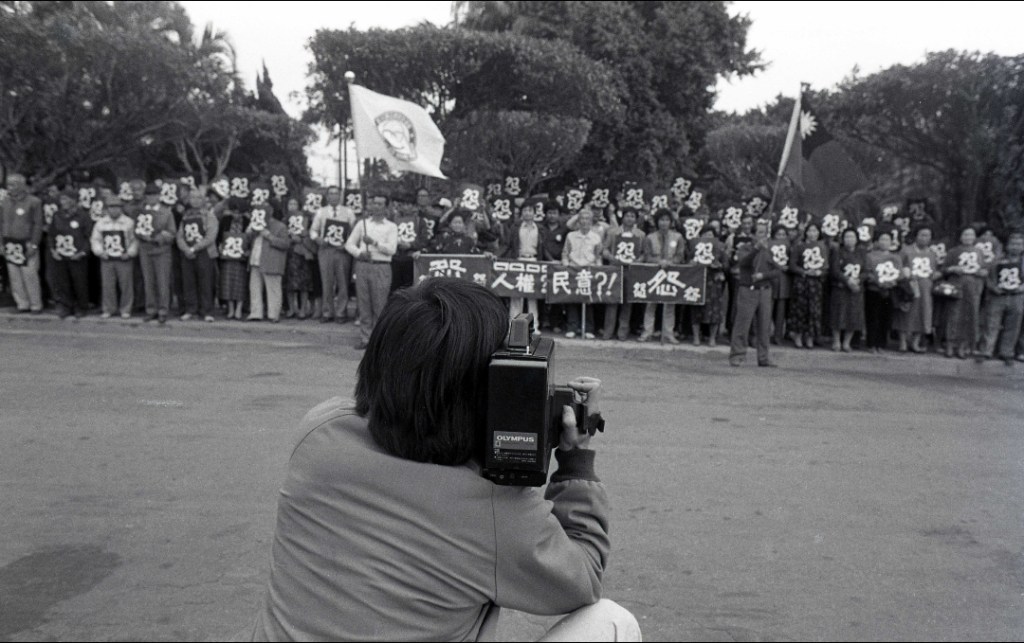
In 1979, after the Formosa Incident, Taiwanese politician Hsu Hsin-liang was forced to leave the country for his opposition to the ruling party, the Kuomintang (KMT), he would spend the following ten years in exile in the US. In 1986, after the first opposition party in Taiwan, the Democratic Progressive Party (DPP), was created, and while the campaign for the upcoming election was getting to the heart, Hsu tried to return to Taiwan, flying back to his country via Japan. On November 30th 1986, thousands of supporters gathered at Taoyuan Airport to welcome back the politician. Not only was Hsu not allowed to repatriate, but the central government sent a large number of police and military personnel to the airport, attacking his supporters with water cannons and tear gas. The three national and pro-government television stations used the images of the clashes to craft a narrative in which the supporters were depicted as a violent mob attacking the police. A completely different narrative emerged from a series of videos that were shot on the ground, in the midst of the clashes, by a group of DPP supporters and activists. Images that clearly showed how it was the police that provoked and attacked the people, and not vice versa. These videos were edited together to create The Taoyuan Airport Incident (1986), the first documentary made by the Green Team, a group active between 1986 and 1990 in Taiwan. The collective was originally formed by “Mazi” Wang Zhizhang, Li Sanchong and Fu Dao, and later added members such as Lin Xinyi, Zheng Wentang, and Lin Hongjun. In these four years, the collective made more than 300 works, all of them shot using video camcorders. In their works the group documented the various movements and protests that swept and destabilized the social and political fabric of the Island, in the years soon before and after the lifting of the Martial Law (July 15th 1987). 

In 1998, the Green Team handed over their videos to the National Tainan University of the Arts, and 2006 saw the creation of the Taiwan Green Group Image Record Sustainability Association (literal translation). This was done in order to digitize and preserve the original video tapes (more than 3000 hours), and to set up an archive and a searchable website. Moreover, in more recent years, the works of the Green Team have been presented internationally, circulating at different film festivals around the globe. The starting point could be considered the retrospective organized at the Taiwan International Documentary Festival in 2016, where 21 works of the collective were screened on the occasion of the 30th anniversary of The Taoyuan Airport Incident. Screenings at festivals around the world soon followed, in 2017 at the Ji.hlava International Documentary Film Festival, in the Czech Republic, and two years ago in Rome during Flowers of Taiwan, an event organized to promote the cinema of the island. Furthermore, in the past years, the online platform DaFilms has made them available on streaming a couple of times in collaboration with Taiwan Docs.
Green Team’s videos mark a pivotal moment in the history of documentary and in the evolution of alternative media in Taiwan. During the forty years of Martial Law, documentaries were still produced in the country and enjoyed some success—the Fragrant Formosa TV series, for instance—however, practically none of them, even those produced independently, depicted and commented overtly on the social, let alone the political, situation in the country.

By documenting protests and fights related to environmental issues, indigenous self determination, and women rights, Green Team’s output opened a path that many Taiwanese documentaries would follow in the next decades. Another important novelty brought in the field by the group was the use of portable and low-cost video cameras, a technology that had become affordable and mass-produced in the mid 1980s.

The intersection of this technological shift and a mutated socio-political situation, made possible a novel documentary practice and an alternative media approach that was unthinkable only a few years before. At the same time, Green Team’s activity represented also an evolution of what had been happening since the beginning of the decade, when the media control exerted by the state started to show its cracks as a consequence of the Formosa Incident in 1979. In the aftermath of the event, political magazines critical of the government began to flourish, and in the second half of the 1980s, thanks to the aforementioned technological shift, this radical dissent took the shape of independent videos. To be in the trenches criticizing the government you needed now to bring your videocamera.

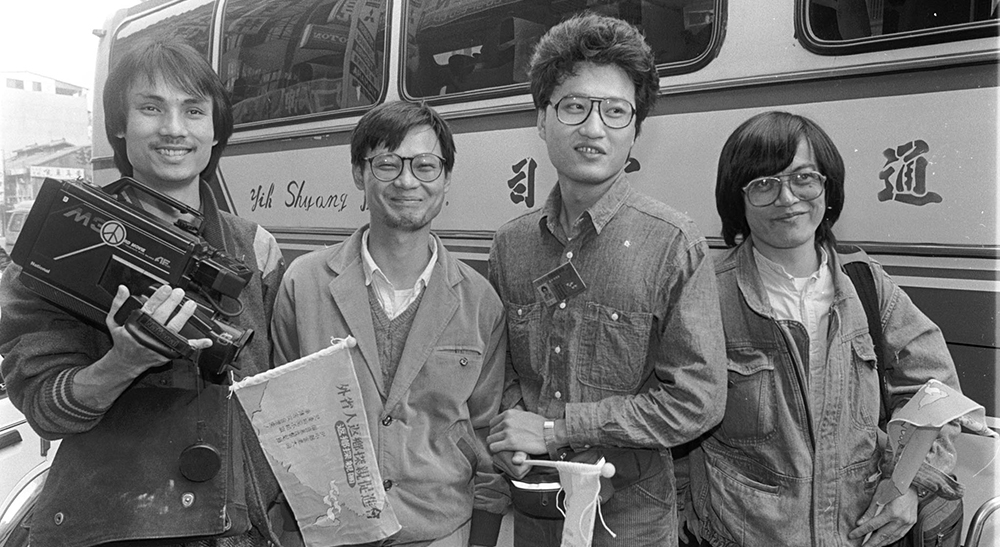
One of the VHS camcorders used by the Green Team (source)

On a purely aesthetic level, this approach resulted in works of low image quality and an almost amateurish look. After all, Green Team’s videos were never meant to be shown on huge screens and in cinemas, and by the members own admission, they never tried to make cinematic works in the first place. The group was more interested in using their videos ‘to break the barrier of media control and fulfil the concept of social practice” (Chuan 2014). This “video revolution” was made possible and successful also because of the adoption of underground distribution and exhibition practices, a clear break with what was done in the past and what was going on, at the time, in the mainstream media. I will return to this point at the end of this piece.

Labor battles and environmental protests

I have watched only a small fraction of the videos made by the collective, but two of them stood out for me, both for the topics covered, labor disputes and environmental issues, and for their construction as visual expressions. While I have touched on other videos as well, I have spent more ink, so to speak, on those two.

In 1987 alone, Taiwan saw as many as 1835 protests erupting in different parts of the island. Demonstrations and acts of civil resistance sprung up in all areas of social life: from environmental to labor issues, from student movements to indigenous rights, and from feminist fights to peasants protests. Farmers resistance is at the core of The 20th May Incident (1988), a work that documents the demonstrations of thousands of peasants in the city of Taipei, protesting against the government’s indifference to their rights and requests. It was the first farmers’ demonstration after the abolition of the Martial Law.  The protest turned into an urban battle when the police stopped some farmers from using the bathrooms. Led by the Yunlin Farmers’ Rights Association and supported by a group of university students, the protesters fought back and some of them were arrested. At night, peasants and students marched to the police station, demanding the release of the people imprisoned. The police instead reacted by attacking them and arresting in total more than a hundred people.

Similar to the strategy employed during the events at The Taoyuan Airport two years prior, the national TV stations kept spreading lies through their channels, labelling the protesters as members of a conspiracy group. When the Green Team released the documentary with the images of what really happened, the government, fearing to be exposed, tried to seize the VHS cassettes of the video circulating around the country.

In 1985, the KMT government greenlighted the construction of a titanium dioxide plant, by American company DuPont, near Lukang, Changhua County. In the following months, the local residents organized a series of demonstrations that eventually caused the project to be cancelled. Lukang Residents’ Anti-DuPont Movement (1987) documents this historical victory through images of street protests, peaceful (and less peaceful) demonstrations, and discussions about broader environmental and civic issues.  The work opens with a brief explanation of the situation, and interviews with the opinions of the people of Lukang. The work then moves on to show the march of the citizens in front of the presidential office to give the authorities a petition to stop the construction of the plant. Next, we see professors, poets and experts speaking at a special seminar organized in the city. This is the most insightful part of the video in my opinion, the points touched are very nuanced, complex, and more relevant than ever, even today more than 35 years later. Environment should be considered as a public asset and a collective right, says one of the speakers, and if the government is not able to protect it, it should be prosecuted. Environmental rights do not just belong to the people who are now alive, the current generation, the speaker continues, but to the citizens of the future as well. A professor of law adds that environmental rights are part of the right to life, basic human rights, and constitutional rights. In the same seminar another speaker touches on the division of labor on the global scale, that is, the exploitative nature of multinationals, in this case DuPont coming to Taiwan to use the resources of the land, without giving back anything but pollution and empty promises of “progress”.

These words provide a perfect philosophical background and set the table for what is coming on screen in the second part of the video, when we see the protests and clashes between the police and the citizens, as the distrust of the people towards the institutions has increased. It is particularly impactful to see how these demonstrations are somehow reminiscent of local folklore festivals (plus the rage). A big drum is rhythmically struck and accompanies the protest on the streets, it is often heard and seen at the center of the action, and even used as a battering ram, as it were, to break the security cordon made by riot police. Ending the video with images of a religious festival, held  to express the gratitude for the success of the protests to the goddess Mazu, is thus a natural continuation of what we saw before, and a conclusion that emphasizes a reinforced sense of identity and belonging for the people of the area. 

In the work, we see an organization of university students being involved in supporting the protests and in helping to do environmental research in the area. One of the major traits emerging from the works made by the Green Team, at least the ones I was able to watch, is the almost constant presence and involvement of students from various universities, but especially from the capital, in most of the demonstrations and acts of resistance that shook Taiwan at the time. This is the case with Labour’s Battle Song (Laid-off Shinkong Textile Workers’ Protest) as well, a work shot by the collective in 1988. 
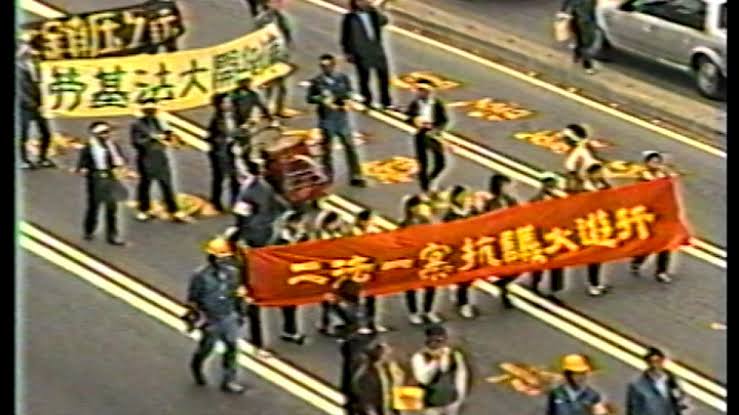
The film opens with a brief overview of the events that happened in Shilin district, Taipei, in 1988, when the closure of the Shinkong Textile factory left hundreds of workers unemployed and without a place to live. Some workers decided to self-organize in groups and to occupy factory spaces to express their anger towards both the company and the government.  From the very first sequence it is clear how this protest is not only aimed against the closure of the plant, but also against the exploitative nature of the job. Women seem to be the ones who were more affected by the demanding labor conditions in the factory: they had to work for long hours to provide an income for their families, but at the cost of neglecting their personal lives. The documentary also sheds light on the inherent dangers of the job done in the plant and on the conditions inside the factory. This is exemplified by a very young lady without a hand, shown and interviewed during a demonstration, and who painfully recalls the incident that left her disabled.

One of the major driving forces behind the movement is a group of aboriginal students from Taitung and Hualien. As the female narrator beautifully put it, their traditional war dances and songs—performed joyfully on the street, together with factory workers and as a form of protest—bring not only a sense of needed solidarity to the workers, but have the power to “challenge the discreteness of the middle class”. Singing and dancing become fundamental elements of the workers’ identity, class identity, both during the demonstrations and in their recreational time in the occupied spaces. A particularly creative move involves turning the repetitive movements of the assembly line in the factory into a choreographed dance to perform on the streets. 

On November 12, 1988, the plant workers took part in a historical event, a demonstration joined by others labor groups from across Taiwan to protest the government’s proposed amendments to the Labor Standards Act and Labor Union Act. This event marked a pivotal moment in Taiwan’s independent labor movement, with Shinkong’s workers playing a crucial role in the fight.  The class divide is a common thread permeating the whole work and that powerfully emerges when we see the workers camping on the cold streets in front of the company’s head office. It is winter and they are preparing food to share with their comrades, while life in the rest of the city goes on as usual, indifferent to their struggle.

As time passed, challenges started to surface. The company cut off water and electricity in the plant and dormitory, leading workers to question their strategy and methods of dissent. By December 23, after more than two months, many workers reluctantly started to give up the struggle as SWAT teams were deployed at the protest site. The video cut to scenes of empty factories and rooms where workers used to live, the sense of defeat brings with it also a feeling of personal loss, a period of 75 days of resistance and labor fights is ending, but with it are also fading the memories of lives lived together for years. As a counterpoint to this mood, the film concludes on a positive note, with a montage of black-and-white photos, primarily featuring female workers, set to a labor song. While this specific fight has ended, the broader message remains clear: “Oppose exploitation. Fight for equality. Keep Fighting. Tomorrow will be better!”
Underground distribution and exhibition practices

The Green Team was not the only group of video-activists operating in Taiwan at the end of the 1980s and at the beginning of the 1990s, but was the one that lasted longer, and whose works had a lasting impact on future generations of Taiwanese documentarians. The importance of the group and its activities is deeply intertwined with the manner their works were produced and distributed. The group released their works through video dealers—more than sixty at the height of their activities—selling their VHS cassettes at video rental shops and at night markets, but also through branches of the DPP, and by organizing screening tours in the countryside. Free copies were also made and dispatched for political movement purposes, for The Taoyuan Airport Incident, for instance, about 2000 cassettes were produced and distributed around the country. When the videos were about the peasants’ protests, such as The 20th May Incident, the collective formed a group in charge of screening them in rural villages to spread the knowledge, spark discussions, and as a vehicle for social and political participation. The production method behind these works is also very important, at first the funding came from donations (but not from political parties), and later mainly from the sales of their videocassettes. After shooting the footage, the members of the group edited all the material and made the cassettes, when possible on the same day, and on the following day the videos were already dispatched, by car, to the selling points. This was the case for the first years of their activities at least, and since they could not stay up to speed with the official media, later on, the collective tried to set its own underground TV station, an event documented in Green TV’s Inaugural Film (1989). 

The reasons for the end of Green Team’s activities are multiple. On the one hand, the technological advance that made their success possible in the first place, brought about also a cheaper reproducibility. Piracy, that is to say, copying video cassettes illegally, became a problem, and selling videos through the channels described above became, thus, unsustainable. This happened also because other groups of video activists operating at the time in Taiwan were selling their videos at a cheaper price. On the other hand, the end of the Martial Law contributed to creating a freedom of speech that allowed the traditional media, TV and newspapers, to cover social and political issues considered taboo before, making the Green Team’s videos less exceptional. In truth, the issues affecting people living at the margins of society remained still very much ignored by mainstream media, and became a topic to explore for filmmakers and groups in the next two decades. 

In this new cultural landscape and mediascape, the Green Team, their videos, and their distribution and exhibition practices partly lost their raison d’être. In the second half of the 1990s, cinemas and TV became the main release platforms for documentaries, and while maintaining their independence, documentaries started to be financed by the “system”, television channels or public institutions. The average documentary filmmaker changed as well, more directors came now from film studies and were naturally more interested in making documentaries as cinematic art—the 1980s saw also the ascent of the so-called Taiwan New Wave, capped by Hou Hsiao-Hsien winning the Golden Lion for City of Sadness at the Venice Film Festival in September 1989. Not to mention the advent of the digital revolution—smaller, cheaper and more portable cameras—an event that would radically change, in the following decades, the field of documentary, allowing filmmakers to shift their focus towards more personal and individual themes. 

References and further readings:

Chen Pin-Chuan “A Critical History of Taiwanese Independent Documentary” 2014.

https://greenteam.tnnua.edu.tw/index.php

Lee Daw-Ming “A Brief History of Documentary Film in Taiwan” 2013.

Lin, Sylvi Li-chun and Sang Tze-Lan Deborah, edit. “Documenting Taiwan on Film Issues and Methods in New Documentaries” Routledge 2012.

Wang Mo-lin ““Identity in Taiwanese Documentary Film” 1995.

30年前的新媒體 ! 綠色小組賣錄影帶對抗國民黨「老三台」

Kobe Discovery Film Festival 2022 – dispatch 2: home movies and Where But Into The Sea

Second report from the Kobe Discovery Film Festival 2022 (you can read this first one here).

On October 15th, the festival held a couple of screenings of home movies from the Kobe area, on the occasion of Home Movie day 2022. It was a very pleasant and eye-opening experience for me, the audience had the chance to see a couple of short films (from the 1960s, 1970s and 1980s, if I’m not wrong), projected on screen with the person who filmed it, or a family member, in attendance. It was like opening a treasure chest, a personal one, in front of a bunch of strangers, a way to share personal memories, often forgotten, with other people. The home movie day, held since 2002 all over the world, it’s a fascinating event situated at the intersection between personal history, History with a capital “H”, and film studies. It is an exploration of the possibility of building an alternative video history from the bottom up, almost a micro history as it were, excavating personal memories to document social changes, and also an occasion to celebrate a dying format (8mm, super 8, etc.). Besides the specific places and experiences captured on the films projected—a trip to the zoo, scenes of a countryside house, a family vacation, a day at the Osaka Expo 1970—it was interesting to learn how home movies from the 60s generally retain even today a better visual quality and colours (especially the reds), compared to those shot in the following decades. As the film and film equipment got more affordable, the quality of the celluloid also dropped, causing the films to deteriorate easily with the passing of time. Insightful was also to learn, from a live commentary done by a scholar of the subject, that, because of the cost of the film, home movies made in the 50s or 60s were usually edited faster, with shorter cuts that is, while later on the cuts tended to be longer.

In September 1939, after the Nazi invasion of Poland, Maria Kamm and her brother Marcel Weyland were forced to leave their hometown and to start an endless journey around the globe to survive. After fifteen months in a refugee camp in Lithuania, they arrived in Tsuruga, a port city in Fukui prefecture, and from there they moved to Kobe, later to Shanghai, where the family was separated, and finally they reached, at different times, their final destination, Melbourne in Australia.

海でなくてどこに Where But Into The Sea (2021) is a film documenting their odyssey around the world, constructed by interweaving interviews, poetry, letters, and a historical investigation by scholar Kanno Kenji. The film is directed by Ōsawa Mirai, but the idea of the project came about when Kanno met Maria in Melbourne in 2016, and later decided to shape his research also into a visual work.
The documentary is a delicate portrait of two people, their family, their past, and how their personal experiences intersected the large historical events of the last century. It is also about a less known and studied fact, how the asylum process for Jewish people worked in wartime Japan and in the Japanese occupied territories.

The movie has a beautiful and poetic ending, made in collaboration with artist Miyamoto Keiko, it was a discovery for me to learn that this scene was inspired, as the director himself confirmed in the talk after the screening, by the films of Satō Makoto—specifically Memories of Agano (2005) and the movie in the movie screened on a tarp, but also Out of Place: Memories of Edward Said (2006). Ōsawa was Satō’s student when he was teaching at The Film School of Tokyo (Eiga bigakko), and he is also the director of 廻り神楽 Mawari Kagura (2018), a documentary that has been on my radar for some time.

You can read more on the official page of the project.

Kobe Discovery Film Festival 2022 – dispatch 1: two newly discovered films by NDU

A week ago, I had the pleasure of attending the opening weekend of this year’s Kobe Discovery Film Festival (October 15-16, 21-23), as always held at and organized by the Kobe Planet Film Archive. Now in its sixth edition, the event started in 2009 as Kobe Documentary Film Festival, and later changed its name and guiding philosophy (2017), when it broadened its scope to include programs about home movies, film preservation, film restoration, and the (re)discovery of less known movies from the past. I will write, time permitting, about some of the other films I saw at a different time (second dispatch is here), but today I’d like to focus on what, for me, was the highlight of the festival, a short program dedicated to two documentaries made by NDU (Nihon Documentary Union).              

2022 has been a sad year for NDU’s former members, but a fruitful one in establishing its legacy in the history of Japanese cinema and beyond. Inoue Osamu, one of the key members of the group, passed away last June, and this year marks also the tenth anniversary of the passing of Nunokawa Tetsurō, one of the main figures of the collective. On the positive side of things, 2022 was the year NDU received its first official international exposure, when last spring the Japan Society in New York organized a special (online) screening of two of their best works, 沖縄エロス外伝 モトシンカカランヌー Motoshinkakarannu (1971) and アジアはひとつ Asia is One (1973). I’ve written about NDU and Nunokawa in more than one occasion (check the links below), and for a more in-depth and better written piece, check Alexander Zahlten’s  The archipelagic thought of Asia is One (1973).

The two films shown in Kobe, Tokyo ’69 – One Day Blue Crayons… (1969) and Public Order Project: Martial Law at Noon (1981) – have only recently been (re)discovered or identified as works by the collective and have rarely been screened before (the latter has actually never been shown publicly). Neither is more than half an hour long, but I believe they represent two essential pieces of the fascinating mosaic that was NDU, not least because they encapsulate a certain era of social dissent, and consequently documentary making, in Japan between the late 1960s and early 1980s. After the screenings, Nakamura Yoko, a film scholar specialising in NDU, spoke briefly about the films in the context of NDU and Nunokawa’s career, which was very helpful in understanding the two films, especially Public Order Project: Martial Law at Noon.

東京’69 – 青いクレヨンのいつかは . . . Tokyo ’69 – One Day Blue Crayons . . . (1969) Shot on 16mm between 1967-68, this documentary is a propaganda film funded by the Tokyo headquarters of the Japanese Socialist Party to support Governor Minobe Ryōkichi, who was elected in 1967. While on the surface a piece of political advertising, Tokyo ’69 – one day blue crayons . . . reflects on and depicts various problems facing the capital and its citizens in the late 1960s, a time when urban sprawl was increasingly and dramatically changing. Expropriation and exploitation seem to be two of the main threads running through the film: we learn that 95% of Tokyo’s land was in the hands of 5% of the population, as redistributed after the war. The film also shows how truck drivers carry and deliver goods they don’t use or own, or how workers who come to the city from other areas live in precarious conditions. For example, we see a man from Hokkaido working almost 14 hours a day while living and sleeping in an extremely small rented room.

It is also interesting to note the focus on the lack of crèches for working women to leave their children in, a problem that still seems to be unresolved, and the criticism of the new stadium built for the 1964 Olympics, a structure that, as NDU points out, was of no use to the people of Tokyo after the games. An uncanny resemblance to what is happening now after the 2021 Games. The title of the documentary seems to refer to the final scene, in which we see a young boy drawing pictures with crayons in a sketchbook. At one point he is asked a series of questions, including “What colour is the sky?”, and his annoyed answer is always “shiran” (I don’t know). The hope is that one day the sky will be blue.

According to the festival leaflet, this film has never appeared in Nunokawa’s statements, but it is credited as an NDU production at the very end, in the bottom right-hand corner of the screen, a fact confirmed by Inoue before his death. The film was made at the same time as 鬼ッ子 闘う青年労働者の記録 Onikko-A Record of the Struggle of Youth Labourers (1969), also funded by the Socialist Party, a work that shares not only the general tone but also some famous shots. The freight train carrying petrol for American planes to Vietnam passing through Shinjuku station, and a tank parade in the middle of the city.

In its critique of Tokyo and its exploration of the dark side of the 1960s economic miracle, the documentary reminded me very much of Tsuchimoto Noriaki’s 東京部 Tokyo Metropolis (1962), a short documentary made for television that was never broadcast because it was considered too dark and pessimistic (you can watch it, in Japanese and legally, here, here

治安出動草稿 お昼の戒厳令 Public Order Project: Martial Law at Noon (source)

治安出動草稿 お昼の戒厳令 Public Order Project: Martial Law at Noon (1981). Shot in Super 8 by a group of NDU members in one day – though credited at the end as a Nunokawa production – the film documents the second Six Cities Joint Disaster Prevention Drill, organised in Shinjuku on 1 September 1981. When it was announced that some twelve million people were expected to take part, an astonishing and frightening number, Date Masayasu, a former Shinjuku city official turned cultural critic and writer, declared alarmingly:  “We will be moved under the command of the Self-Defence Forces! “. Inspired by this comment, Nunokawa and seven other members of the collective began filming people marching and gathering in Shinjuku, protests in the streets, and military manoeuvres in Tokyo and the surrounding area on 1 September.

As is often the case with NDU’s films, especially the later ones, there is no great explanation of what is happening on screen, or the reasons for what we are seeing. As the film progresses, however, a sense, if not a meaning, slowly begins to emerge. In a country regularly hit by natural disasters such as earthquakes, typhoons and floods, emergency drills are a normal part of life, but this one felt and was very different. The connection made by Date and Nunokawa and NDU with the documentary is a subtle but deep and powerful one, at least for me. Disaster drills of this scale are deeply connected to public order and the idea of a strong and unified nation/state imposing its will from above. Self-Defence Forces landing in Shizuoka from the sea, helicopters flying constantly over the city, the sheer mass of people moving in the streets – it is worth repeating, almost 12 million people! – and the effort to coordinate six cities within the megalopolis, all this is seen and understood in the film as something dangerously close to an act of military mobilisation. The documentary is very effective in capturing and expressing this massive sense of potential fear. A past – the narration mentions, for example, the lynchings of Koreans and other minorities that continued after the great Kantō earthquake in 1923 – that could resurface at any time in the future.

Formally, the film alternates between scenes of helicopters flying over the city – the sound here is distorted and becomes almost hypnotic – and scenes of the Self-Defence Forces, sometimes in slow motion, with scenes of clashes between demonstrators and the police. It is worth noting how different the scale of the protests were from those of a decade earlier. Japanese people continued to protest and demonstrate even after the end of the so-called political season, Narita docet, but the number of people involved and the motivations changed dramatically, for reasons that cannot be explored in this piece. What stood out for me aesthetically, compared to other NDU works, was the extensive use of electronic music throughout the documentary, especially in the final part, when activists and police clash and march to the sound of electronic drums. As a mere curiosity and possible coincidence, it is interesting to note that on the same day, 1 September 1981, Kraftwerk, the German group that more than anyone else pioneered electronic music in popular culture, were also in Tokyo, ready to embark on their first Japanese tour.

The film has not been included in any of NDU’s special features to date and, as the flyer suggests, this special screening in Kobe was made possible thanks to the efforts of Mitsui Mineo, a former collaborator of Nunokawa’s and probably a former member of NDU, who worked with him on his documentaries in Palestine.

Explore more about NDU:

Alexander Zahlten:  The archipelagic thought of Asia is One (1973).

To The Japs: South Korean A-Bomb Survivors Speak out (1971)

Asia is One (1973)

special (online) screening of Motoshinkakarannu (1971) and Asia is One (1973) at Japan Society New York

MADE IN JAPAN, YAMAGATA 1989 -2021 10 documentaries streaming on DAfilms

A mini retrospective on the streaming platform DAfilms.com, from 17 January to 6 February (free of charge until 24 January) introduces 10 Japanese documentaries presented at the Yamagata International Film Festival from 1989 to 2021. A fascinating path through the cinema of the real produced in Japan in the last three decades.

In 1973 when the Ogawa Production collective made Narita: Heta Village, the sixth documentary on the struggle and resistance of the peasants in Sanrizuka against the construction of the new Narita airport, they not only created one of the most important documentaries in the history of Japanese cinema, but also captured and foreshadowed a series of shifts that would take place in the archipelago in the following years. By moving the attention and the camera from the clashes, a “civil war” as it has been described by many, to focus more on the life of the peasants, their customs and their sense of time, the collective anticipated the interest that cinema and literature would later show towards rural and provincial areas. From a cinema more linked to contingent events taking place in the political and social sphere, towards one more interested in macrohistory and its large movements and cycles. This interest of the group, led by Ogawa Shinsuke, is reflected in their decision to move to the north of Japan, to the Yamagata prefecture, where the collective lived for 14 years, from the second half of the 1970s until the end of the following decade. As it was revealed later, after Ogawa’s death, this period was not without internal conflicts, and within itself it had many of the problems that had already poisoned many of the New Left groups during the 1970s, such as a marked authoritarianism, and an absolute lack of female presence in crucial positions. If the cinematic peak of this long period spent in Yamagata is Magino Village – A Tale / The Sundial Carved with a Thousand Years of Notches (1986), an unidentified filmic object that constructs a mythological and epic mapping of the area and its inhabitants, perhaps it can be said that the most important legacy of the collective and of Ogawa himself is the creation, in 1989, of the Yamagata International Documentary Film Festival (YIDFF).

Held once every two years in the Japanese city, the festival has become, in its three decades of existence, an important event for those who love the cinema of real and its infinite expressive possibilities. The festival has always stood out to me for the way it is experienced, horizontally so to speak, after the screenings: professionals and filmmakers mingle and interact with enthusiasts, cinema lovers or even just the curious, who come to enjoy the almost party and rock concert-like atmosphere of the event. At the same time, however, Yamagata has also been, since its very beginning, an important launching pad for many Asian authors and for the creation, especially in the 1990s, of a transnational documentary film culture. The first of its kind in Asia, the event contributed to the birth of other festivals, the Taiwan International Documentary Festival for instance, and it also functioned as a pole of attraction for the new wave of Asian filmmakers who came to the fore during a crucial period for the area, the period of democratisation of art with the advent of digital, in China but also in Hong Kong and other parts of South East Asia more generally.

The online retrospective organised by the YIDFF in cooperation with DAfilms is an excellent opportunity to discover some of the most important Japanese films presented at the festival since its foundation. Two works ideally open and close the retrospective, A Movie Capital, a documentary on the first edition of the festival made in 1991 by Iizuka Toshio, one of the members of Ogawa Production, beautifully captures that sense of collaboration and artistic brotherhood between Asian directors mentioned above. While Komian and Pickles by Satō Koichi— presented during the 2021 edition, moved online due to the pandemic— gives an idea of the sense of commonality in Yamagata during the event. The closure of Komian, a popular venue for post-screening discussions and meetings, follows to the closure of a local tsukemono (pickled food) business, Maruhachi Yatarazuke pickling company, the owner of Komian. The film is an occasion to remember and treasure the experiences offered at the venue, but also an example of how the gentrification process, magnified by the economic damage caused by COVID-19, is active and reshaping the urban texture even in small Japanese cities.

The most artistically accomplished works presented in the retrospective are, however, others. All of them are worth watching of course, but I would personally recommend Living on the River Agano by Satō Makoto (I wrote about three of his movies here), Yang Yonghee’s 2005 film Dear Pyongyang, Storytellers by Hamaguchi Ryūsuke and Sakai Kō, and Cenote (2019) by Oda Kaori (here an interview with the artist and a piece on the movie). Here the complete line-up:

A Movie Capital // Toshio IIZUKA // 1991

Living on the River Agano // Makoto SATO // 1992

The Weald // Naomi KAWASE // 1997

The New God // Yutaka TSUCHIYA // 1999

A2 // Tatsuya MORI // 2001

The Cheese and the Worms // Haruyo KATO // 2005

Dear Pyongyang // Yong-hi YANG // 2005

Storytellers // Ko SAKAI, Ryusuke HAMAGUCHI // 2013

Cenote // Kaori ODA // 2019

Pickles and Komian Club // Koichi SATO // 2021

The complete selection will be available entirely for free on DAFilms.com from January 17 – 23 at this link: https://dafilms.com/program/1126-made-in-japan-yamagata-1989-2021

Image Forum Festival 2018 イメージフォーラムフェスティバル 2018

The 32nd Image Forum Festival ended last Sunday in Tokyo. The nine-day-long event, hosted at two different locations in the Japanese capital, the Theatre Image Forum and the Spiral Hall, screened in total more than 80 films, including 23 in the East Asian Experimental Film Competition, the main section. Established in its present form in 1987, the festival succeeded and replaced an experimental film festival that was held, in various phases and different shapes, in the capital from 1973 to 1986.

To this day the festival continue to embody the mission and the legacy of its predecessors. Primarily dedicated to experimental cinema and video, the event provides a special opportunity for the viewers to experience on a big screen a mix of feature films, home cinema, documentary and experimental animation.
After Tokyo, the festival will move to Kyoto, Yokohama and Nagoya, with slightly different contents, there will be special sections dedicated to artists of each city. This is a right and welcomed decision, since too often Tokyo ends up cannibalizing the cultural and artistic events taking place in the archipelago.

This slideshow requires JavaScript.

This year’s special retrospectives were dedicated to the provocative films of Christoph Schlingensief, German director who expanded his works beyond cinema to touch theater, television and public happenings, Kurt Kren, Austrian artist associated with Viennese Actionism, but also author of structural films, and the experiments on celluloid by Japanese photographer Yamazaki Hiroshi. I wasn’t aware of the films of Schlingensief, and I have to say that it was at the same time a discovery and a delusion. While I really liked 100 Years of Adolf Hitler (1989), claustrophobic and parodic reconstruction of the last hours of the dictator and comrades in his bunker, I couldn’t digest the other two movies of the so called German Trilogy. German Chainsaw Massacre (1990) and especially Terror 2000 (1992) are too much of a mess and stylistically all over the place , and probably too bound to the events of the time, the Fall of the Berlin Wall and the consequent unification of the two Germanies, for me to decipher them.

Unfortunately I wasn’t able to check the works of Yamazaki, but I’m planning to see them at the end of September, when the festival will come to Nagoya. As with his conceptual photos, the shorts made during his entire life explore the relationship between time and light, a topic I’m very attracted to.
I also missed the screening of Caniba (2017) by Lucien Castaing-Taylor and Véréna Paravel, about the “cannibal” Sagawa Issei, if I’m not wrong, this was the Japanese premiere of the film, and the special focus Experimenta India, a collection of visual art from the Asian country.
Interesting was to catch Matangi/Maya/M.I.A. (Steve Loveridge, 2018), about the famous ex-refugee of Tamil origin, now a pop icon and singer, an artist I was completely unaware of. The documentary is based on more than 20 years of footage filmed by herself and her friends in Sr Lanka and London. While I didn’t connect with the first part of the movie, too self-indulgent for my taste, the film gets much better in the last 30-40 minutes when, albeit briefly, touches on complex and fascinating topics such as immigration and art, fame, and social awareness in the show business.

The East Asia Experimental competition was pretty solid, besides several short films coming from a variety of areas like South Korea, China, Hong Kong, Taiwan and naturally Japan, two were the long documentaries screened. A Yangtze Landscape (Xu Xin, 2017), a visual exploration of the social and geographical landscape along the longest river in Asia (you can read my review here), and Slow Motion, Stop Motion (Kurihara Mie, 2018) a movie that positively surprised me and won both the Grand Prize and the Audience Award. A review is coming soon, stay tuned.

Documentaries at the London Korean Film Festival 2017

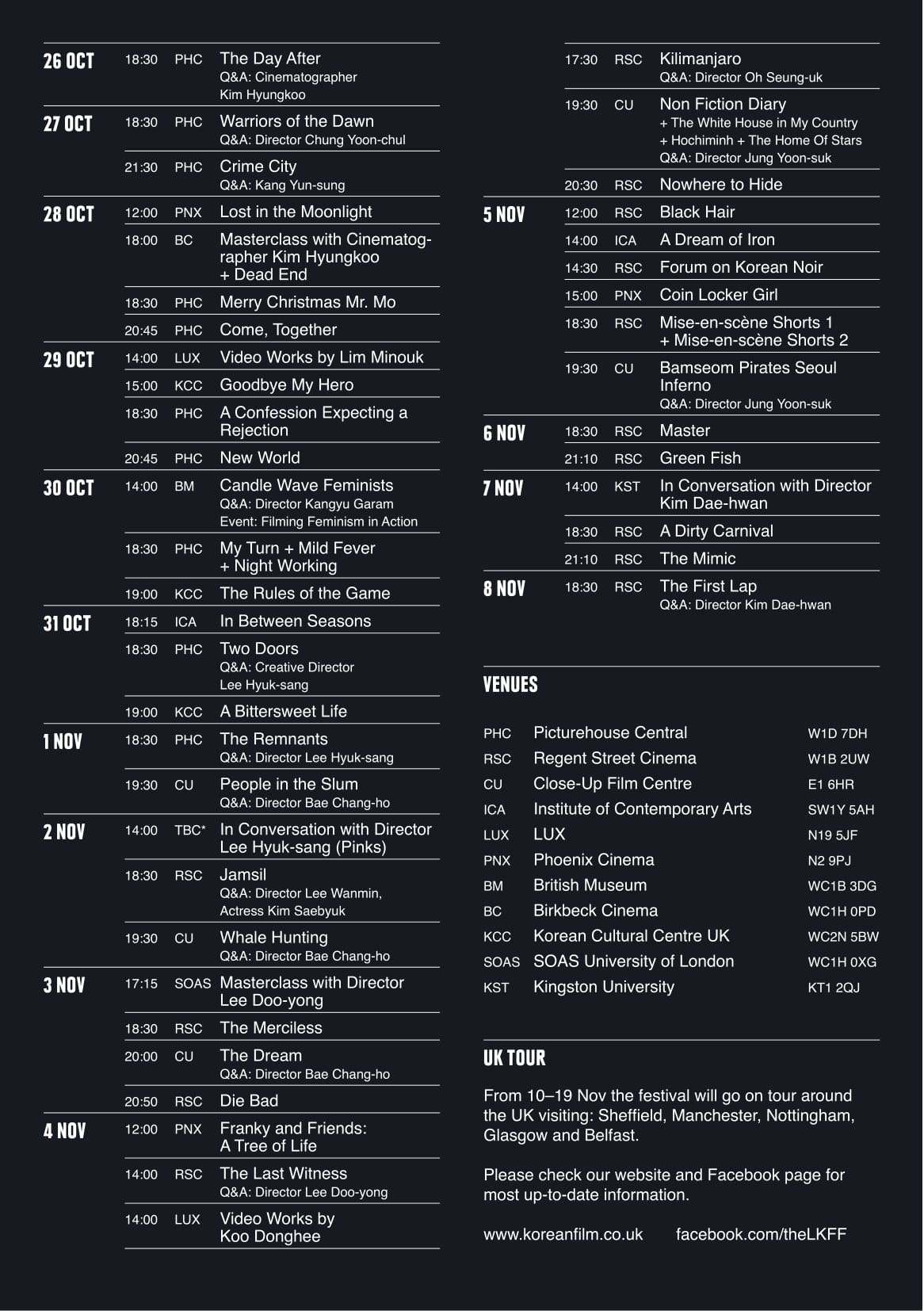
The London Korean Film Festival has opened its 12th edition last Thursday and will run in the capital for two weeks, from November 10th through the 19th the festival will then go on tour around the UK, touching Sheffield, Manchester, Nottingham, Glasgow and Belfast.
In addition to showcasing a wide-range of titles produced in the Asian country, there will also be masterclasses, talks and collateral events, a special occasion for the British audience to get a glimpse of South Korean cinema and film culture in general. This year line-up includes not only UK and European premieres, animations, classics, shorts and indies, but also a fascinating focus on Korean Noir, “Illuminating the Dark Side of Society”, and, of particular interest for this blog, a program dedicated to documentary.

The first movie presented will be Two Doors (2012) directed by Kim Il-rhan and Hong Ji-you, a documentary investigating the the Yongsan Disaster, when in January of 2009 a sit-in rally in central Seoul resulted in the deaths of five protesters and one police officer. While Two Doors focuses more on the legal aspects of the tragedy, amassing documents against the violence used to prohibit the demonstration and the sit-in, The Remnants  (2017) is about the personal tribulations and the legal problems that some the people who took part in the demonstration had to go through in the seven years after the tragedy. The movie was directed by Lee Hyuk-sang, who was also creative director behind Two Doors, and the festival has organised a special conversation with the director on November 2.
Goodbye my Hero (2017) by Han Younghee, a movie addressing labour relations and workers’ rights in contemporary South Korea, and Park Kyung-hyun’s Dream of Iron (2017), a film essay about the development of the steel industry in the country during the 1960s, will complete the section.
The ‘Women’s Voices’ s section includes also a documentary, Candle Wave Feminists (2017) by Kangyu Garam, a movie that delves into the revolution that led to former prime minister Park’s impeachment and her spiritual mentor Choi Soon-Sil’s arrest.

All the documentaries will be screened this week starting from tomorrow, October 31st.

LKFF17-Screening-Schedule-1.jpg

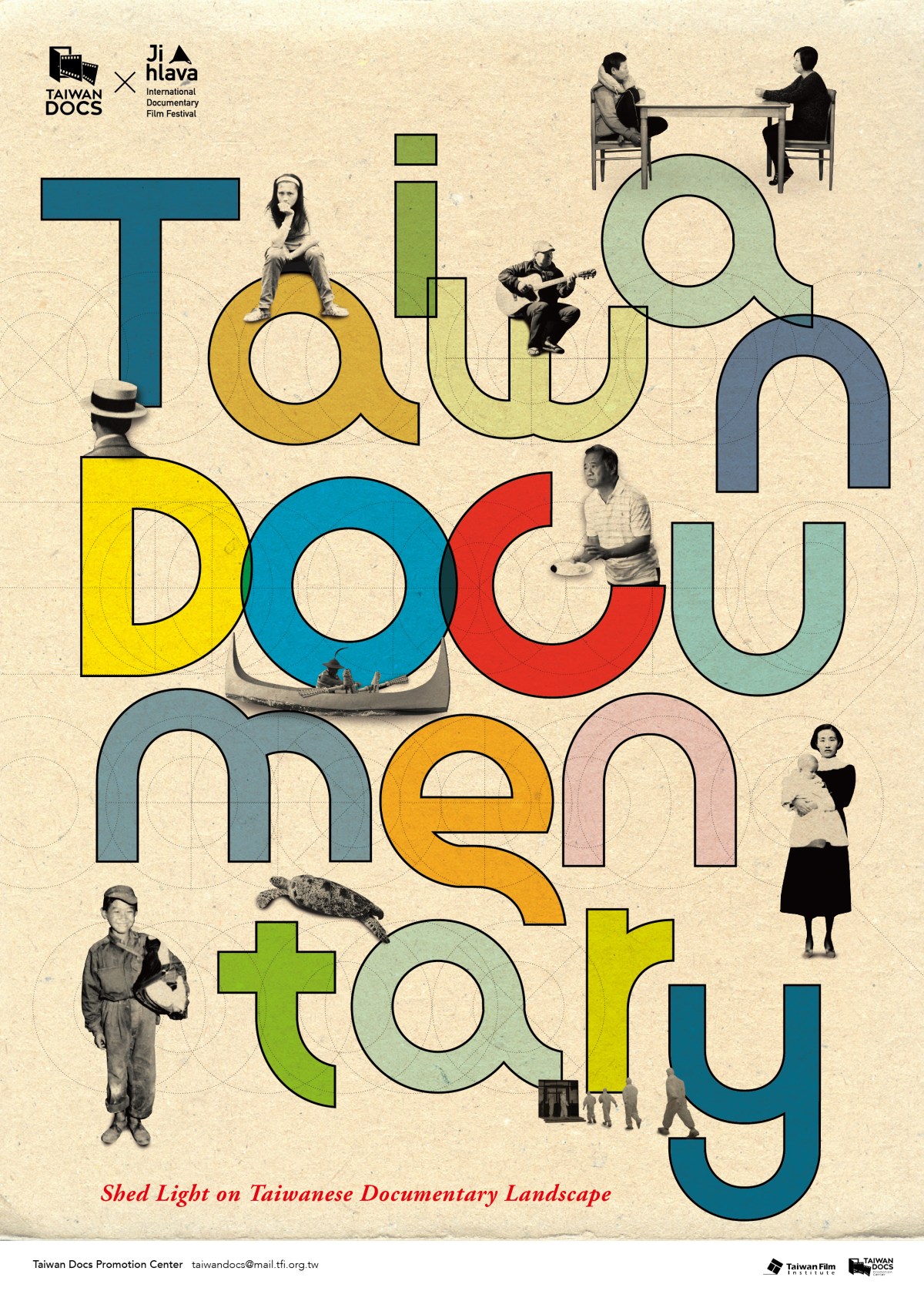
Retrospective of Taiwanese documentary cinema at the Jihlava International Doc Film Fest

Since the discovery of Le Moulin two or so years ago, non-fiction cinema in contemporary Taiwan has been one of my main cinematic obsessions and a research interest that drove me to explore the flourishing documentary scene of the island. This year edition of the  Ji.hlava International Documentary Film Festival (October 24-29) is currently holding a retrospective on Taiwanese documentary from 1937 to 2014 titled Transparent Landscape: Taiwan, a program that presents 25 Taiwanese documentaries from the period, according to the festival “the historically most comprehensive showcase of Taiwanese documentary cinema ever”.  I won’t be able to attend it, but, it goes without saying, it’s an event I’m highly interested in and I hope a catalogue will be published, here the press release:

The section will include some of the most important works of Taiwanese independent filmmakers. Allowing a glimpse into Taiwan’s complicated historical-political development, these films offer significant insights into different periods of recent Taiwanese history.
The earliest Taiwanese documentaries are the 8mm ”home videos“, shot by photographer DENG Nan-guang in the 1930s. They realistically portray scenes of daily life under Japanese occupation, such as life and work along the Tamsui river and family outings. The recently restored short The Mountain by Richard Yao-chi CHEN (1967) will be presented outside of Taiwan for the first time. Other representative works from the1960s, are the films by renowned director BAI Jing-rui and photographer ZHUANG Ling. In this decade, only government-commissioned propaganda films could be produced, but with their creative ingenuity, those filmmakers still managed to convey the lives and thoughts of ordinary people.
The Green Team, the most important non-mainstream media in the period prior to and after the lifting of martial law in Taiwan (1987), will also be represented by two important productions. The Green Team documented many social movements and protests that took place on Taiwan’s road to democracy in the 80s, and their images eventually became weapons against the authoritarian state. There are obvious connections with the situation in Czech society in the late 80s before the collapse of the Soviet regime.
Apart from its focus on history, Transparent Landscape: Taiwan also pays tribute to the experimental spirit of Ji.hlava IDFF. By showcasing aesthetically experimental, creative films, traditional expectations on documentaries are challenged. The selection includes several masterpieces, such as works by internationally renowned artist CHEN Chieh-jen, photographer CHANG Chien-chi, the first Taiwanese to become a member of Magnum Photos, and YUAN Goang-ming, the pioneer of video art in Taiwan.
This comprehensive retrospective also includes early documentaries by the leading figures of Taiwanese cinema, such as CHUNG Mong-hong, WU Mi-sen, HUANG Ting-fu and others. Beginning from the 90s, they used experimental vocabulary to explore the boundaries of documentary filmmaking. Even today, their films are regarded as avant-garde filmmaking, no matter if they deal with aesthetic conceptions or with human problems.

You can find the complete program here, and more information about documentary in Taiwan on the TaiwanDoc page.

This slideshow requires JavaScript.

Kobe Discovery Film Festival 神戸発掘映画祭 2017

A new beginning for the Kobe Documentary Film Festival. From this year the annual event held at the Kobe Planet Film Archive since 2009 will change its name and concept into Kobe Discovery Film Festival (神戸発掘映画祭). The renaming reflects a shift of the festival’s focus from documentary to film and moving image preservation and restoration, and the (re)discovery of less known movies from the past, something on the lines of what, with great success, Il Cinema Ritrovato in Bologna has been able to become in recent years. I really like the idea, because I think that in an era like the one we live in, when digital images are produced, consumed and binged frenetically every day, going back to the dawn of cinema and exploring the fringes of film culture is a refreshing and re-balancing practice, especially in Japan.

The festival, although it is more a cinematic event organized in four days than an actual film festival, is also an opportunity to reflect on the importance of cinema archives in the contemporary mediascape, it may sounds tautological, but Kobe Planet Film Archive before being a theater is first of all, well, an important film archive.

The first edition of the Discovery Film Festival will take place from November 23 to 26 and is divided in six sections.
Amateur cinema discovered: home movie day, with screening of 13 Japanese short movies made in prewar Japan during the 1930s (there’s even a colour film, 兵隊と花), is an interesting occasion to get a glimpse of the everyday life in Japan in a period when the country was rapidly changing (mainly for the worst).
100 years of animation in Japan is dedicated to celebrate the early animations made in the country, divided in three sub-sections the program will present early examples of amateur experimental animation and silhouette animation, and some early works from the 1920s, including  An Old Fool (のろまな爺, 1924) by Ōfuji Noburō, rediscovered by the Planet Film Archive itself few years back. In the program also a couple of works recently discovered (sorry I don’t have the English titles): HOT CHINA 聖林(ハリウッド)見物, マンガ 空中凸凹拳闘 (1941),  カテイ石鹸 (an advertisement made in 1921) and 小人の電話 (1953).
The latest digitized films is a program that will showcase an interesting selection of movies recently digitized from 35mm prints, otherwise impossible to screen, by the Kobe Design University, while Selected by Planet will present a bunch of movies from its archives, including The Peerless Patriot (国士無双, 1932) directed by Itami Mansaku (father of Itami Jūzō), and the 1950’s 海魔陸をいく (no English title) by Igayama Masamitsu, a film between documentary and narrative cinema similar, as far as I know, to the works of Jean Painlevé.
A special screening of the color (Konikolor) version of A Jazz Girl is Born (ジャズ娘誕生, 1957) by Sunohara Masahisa, shown last year at Il Cinema Ritrovato, and a series of 8mm experiments by musician and filmmaker Mori Ari will conclude the festival. You can find the entire program (in Japanese) here.

The idea and the concept behind the Kobe Discovery Film Festival are really promising, also considering the important position of Planet Archive in preservation and restoration in Japan, and I whish the organizers the best of luck.

Autumn madness: Kobe Doc Fest, Ogawa Production in London and much more


It’s again Autumn madness, that time of the year when there are more cinema-related events around the world than stars in the sky: festivals, special screenings, symposia, festivals, home-movie days and again festivals, festivals and festivals. For cinephiles around the globe it is at the same time a period of blessing and curse, which festival to go to? which screenings to attend? and how not to spend all the money saved during the year…
Let’s take a look of what the Autumn madness has to offer this year in terms of Asian non-fiction cinema.

By far the biggest festival in the region, the Busan International Film Festival, kicks off on October 6th and this year is a special one for BIFF, following the problems the event has been facing in the recent 12 months (you can read more here and here).
The line-up is as always huge and varied, and if we include the market, trying to follow even only a small portion of the screenings offered is an almost impossible task. Anyway, as South and Southeast Asian documentary is concern, these are some movies that will be shown and worth seeing if you’re in Busan:

Documentary Competition

Diamond Island (Davy Chou, 2016) Cambodia/France/Germany/Thailand/Qatar

Sunday Beauty Queen (Baby Ruth Villarama, 2016) Philippines/Hong Kong, China/Japan/United Kingdon

Time to Read Poems (Lee Soojung, 2016) South Korea

A Whale of a Tale (Sasaki Megumi, 2016) Japan/United States

Absent Without Leave (Lau Kek-Huat Chen Jing-Lian, 2016) Taiwan/Malaysia

Burmese on the Roof (Oh Hyunjin, 2016) South Korea

Farming Boys (Jang Sejung Byun Siyeon, 2016) South Korea

Neighborhood (Sung Seungtaek, 2016) South Korea

Railways Sleepers (Sompot CHIDGASORNPONGSE, 2016) Thailand

SUN (Won Hoyeon, 2016) South Korea

The Crescent Rising (Sheron Dayoc, 2016) Philippines

Documentary Showcase

Becoming Who I Was (Moon Changyong Jeon Jin, 2016) South Korea

Fake (Mori Tatsuya, 2016) Japan

In Exile (Tin Win Naing, 2016) Germany/Myanmar

Ta’ang (Wang Bing, 2016) Hong Kong, China/France

The Remnants (Lee Hyuk-sang KIM Il-rhan, 2016) South Korea

WEEKENDS  (Lee Dongh, 2016) South Korea

If you want to know more and read each movie’s synopsys, do please visit BIFF’s homepage: Documentary Competition and Documentary Showcase.

One of the most interesting festivals of the season, at least for me, is the Kobe Documentary Film Festival, a small and minor event organized every year since 2009 at the Kobe Planet Film Archive. This year the main theme will be “The pleasure of children movies” and as usual a wide range of movies will be screened, a fascinating program goes under the title of CIE Films (CIE 映画) where CIE stands for “Civil Information and Education Section”. Established by the Allied Powers soon after the end of World War II as a special section of the General Headquarters (GHQ), its task was to advise the Supreme Commander for the Allied Powers (SCAP) on policies relating to “public information, education, religion, and other sociological and cultural problems of Japan.” CIE donated about 1300 Natco 16mm projectors to the Japanese Ministry of Education to be distributed around the country, and with them short educational movies from United States, Canada and other countries in hopes of implementing the process of democratization in the country through cinema. This part of history of Japanese cinema is an important one if we want to grasp and understand the subsequent development of educational film, and by extension documentary, in the archipelago. A first part of the program is thus dedicated to foreign movies introduced in Japan by CIE, Everyone’s School (1948), Near Home (1948), Beautiful Dreamer (1949), Freedom of the Press (1951), Experimental Elementary School (1949) and Nanook of the North (1922),  with other programs continuing on the same trail and presenting Japanese educational films produced from the late 50’s to the 70’s, science, art, environment and big events (like the Expo in Osaka in 1970) are some of the themes tackled in the short movies, including 5 works created in different style of animation (puppet and stop motion paper animation).
It is worth mentioning that a program is also dedicated to the less known works (about and with children) of Shimizu Hiroshi, on of the finest Japanese filmmakers of the last century, but one who definitely deserve more space and consideration in the world cinema community. A good starting point is this DVD box set put out by Criterion, and two sets from Shochiku (the first is the same as the Criterion one) and “amazingly” both come with English subtitles.
The Festival will take place from October 21st to the 25th and will be preceded by the Home-Movie Day on October 15th, if you read Japanese the festival home page has the complete line-up.

tiff2016-yoko

From Kobe to Tokyo, where the 29th Tokyo International Film Festival will open its gates on October 25th, South and Southeast Asian non-fiction cinema will be represented by a bunch of works, to keep on the radar the new endeavor by  Matsue Tetsuaki (Live Tape, Flash Back Memories), DDT: Dramatic Dream Team!! -We are Japanese Wrestlers!, a year in the life of a pro-wrestling group, Welcome to SATO, about a children’s center in the day laborers’ town of Kamagasaki, and Mamoru Hosoda’s Job: Animation Film Director“A Soulful Film Illuminating Hope”, a documentary made for TV (part of NHK’s The Professionals series) about director Mamoru Hosoda.

vlcsnap-2016-10-02-16h00m26s750
Let’s leave Asia and move to Europe, and more precisely to London, where from November 17th to Dec 11th the Institute of Contemporary Arts is organizing a retrospective on Ogawa Shinsuke‘s (or better Ogawa Production) works. I’ve written many times on this blog about Ogawa and the importance of his movies for the history and development of documentary in Asia (although not yet a long and more in-depth piece), and of course a must is Forest of Pressure written by Abe Markus Nornes. This is the schedule:

Thu 17 Nov: The Oppressed Students (1967)

Sat 19 Nov: The Battle Front for the Liberation of Japan – Summer in Narita (1968) +Sanrizuka – The Three Day War (1970)

Tue 22 Nov: Sanrizuka – Peasants of the Second Fortress (1971)

Thu 24 Nov: The Wages of Resistance: The Narita Stories (Otsu Koshiro and Daishima Haruhiko, 2015)

Sat 26 Nov: Heta Village: Rending Village Time | A lecture by Markus Nornes +Sanrizuka – Heta Village (1973)

Sun 27 Nov: Filmmaking and the Way to the Village (Fukuda Katsuhiko, 1973) +Devotion: A Film About the Ogawa Productions (Barbara Hammer, 2000)

Wed 30 Nov: Dokkoi! Songs from the Bottom (1975)

Sat 10 Dec: “Nippon”: Furuyashiki Village (1982)

Sun 11: The Sundial Carved with a Thousand Years of Notches – The Magino Village Story (1986)

If you’re in London, it’s really a chance not to be missed.