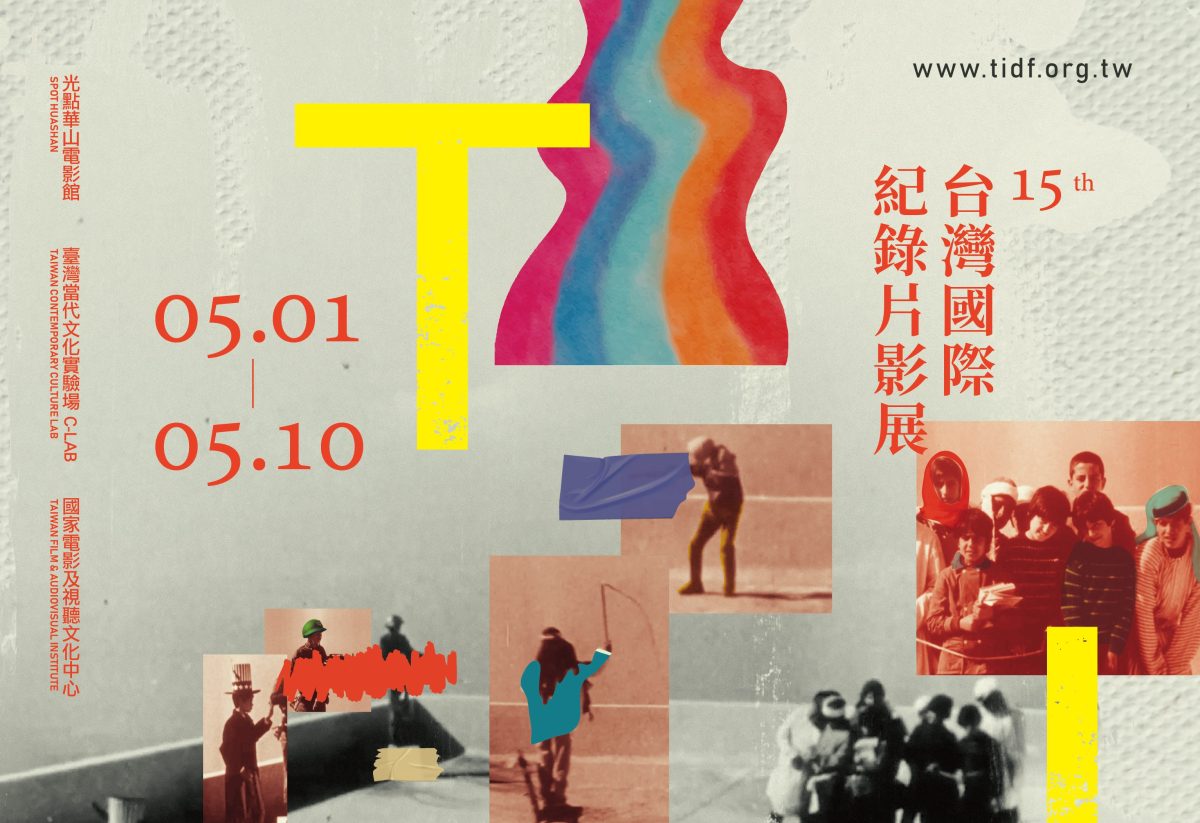
An embarrassment of riches awaits at this year’s Taiwan International Documentary Festival (May 1–10), now in its fifteenth edition. While the full programme, with its three major competitions—the Asian Vision Competition, International Competition, and Taiwan Competition—is well worth exploring in its entirety, I would like to highlight a few special sections that particularly caught my attention.
Palestine and Its Archiveless Archive examines how the scattered filmography of a people—subjected to decades of violence and now facing the threat of genocide—can itself become a form of resistance. This resistance unfolds not only through images, but also against them, as several experimental works here presented reflect on the entanglement between images and the construction of narratives of oppression. Notable examples include A Stone’s Throw (2024) by Razan Alsalah—one of my favorite documentaries of last year—The Diary of a Sky (2024) by the always engaging Lawrence Abu Hamdan, and A Fidai Film (2024) by Kamal Aljafari.
Another major highlight is Sensible but Unsayable — A Retrospective of the Sensory Ethnography Lab, a group whose distinctive aesthetic has profoundly shaped the trajectory of non-fiction cinema over the past fifteen years. The programme brings together twelve films, encompassing many of their key formal experiments, including the widely acclaimed Leviathan (2012) by Lucien Castaing-Taylor and Véréna Paravel. Among the selections, I would especially recommend De Humani Corporis Fabrica (2022), also by the duo, and especially Expedition Content by Ernst Karel and Veronika Kusumaryati, which stands, in my view, as a defining work in the recent history of audiovisual practices.
Among the programmes featuring films I have not yet seen—but am particularly eager to—Reel Taiwan: The Late 1980s on Film stands out. If the late 1980s marked a period of profound social transformation and upheaval—the lifting of Martial Law in 1987 being a decisive turning point—it was also a moment of technological transition, as film began to give way to videotape and, eventually, digital media.
Framed by this dual shift, the programme presents four works by Lee Daw-ming and Hu Tai-li—the latter author of Voices of Orchid Island—, two filmmakers whose practice developed alongside—but distinct from—the more action-oriented Green Team (on which I have written at length elsewhere). Rather than engaging directly with sites of confrontation and resistance, their films—while maintaining a clear political stance—approach these issues from broader historical perspectives or through attention to marginalized communities, all while continuing to work on film. The four works included in the programme are:
Beyond the Killing Fields: Refugees on the Thai-Cambodian Border (Lee Daw-ming, 1986)
Songs of Pasta’ay (Hu Tai-li & Lee Daw-ming, 1988)
Beyond the Anti-DuPont Movement: Portraits of Some Social Activists (Lee Daw-ming, 1990)
Voice of the People (Lee Daw-ming, 1991)
It is also nice to see an homage to the late Tomonari Nishikawa, an experimental filmmaker whose work is featured in Stranger Than Documentary, a program highlighting cross-disciplinary approaches to nonfiction cinema, alongside the world premiere of the Public Television Service (PTS) production Water in the Balance by Ke Chin-yuan, and a well-deserved tribute to filmmaker Peter Watkins with a screening of Punishment Park (1971).
 Asian Docs