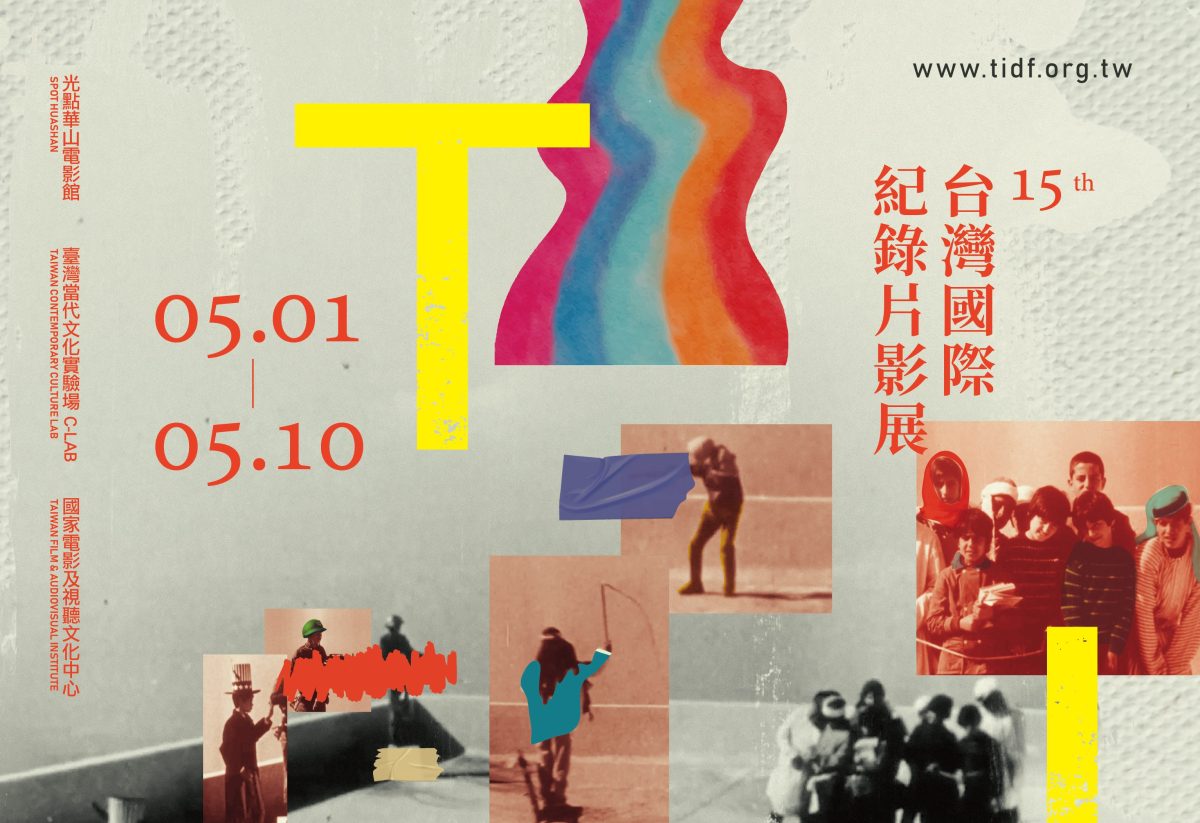
Taiwan International Documentary Festival 2026 (May 1-10) – preview

An embarrassment of riches awaits at this year’s Taiwan International Documentary Festival (May 1–10), now in its fifteenth edition. While the full programme, with its three major competitions—the Asian Vision Competition, International Competition, and Taiwan Competition—is well worth exploring in its entirety, I would like to highlight a few special sections that particularly caught my attention.

Palestine and Its Archiveless Archive examines how the scattered filmography of a people—subjected to decades of violence and now facing the threat of genocide—can itself become a form of resistance. This resistance unfolds not only through images, but also against them, as several experimental works here presented reflect on the entanglement between images and the construction of narratives of oppression. Notable examples include A Stone’s Throw (2024) by Razan Alsalah—one of my favorite documentaries of last yearThe Diary of a Sky (2024) by the always engaging Lawrence Abu Hamdan, and A Fidai Film (2024) by Kamal Aljafari.

Another major highlight is Sensible but Unsayable — A Retrospective of the Sensory Ethnography Lab, a group whose distinctive aesthetic has profoundly shaped the trajectory of non-fiction cinema over the past fifteen years. The programme brings together twelve films, encompassing many of their key formal experiments, including the widely acclaimed Leviathan (2012) by Lucien Castaing-Taylor and Véréna Paravel. Among the selections, I would especially recommend De Humani Corporis Fabrica (2022), also by the duo, and especially Expedition Content by Ernst Karel and Veronika Kusumaryati, which stands, in my view, as a defining work in the recent history of audiovisual practices.

Among the programmes featuring films I have not yet seen—but am particularly eager to—Reel Taiwan: The Late 1980s on Film stands out. If the late 1980s marked a period of profound social transformation and upheaval—the lifting of Martial Law in 1987 being a decisive turning point—it was also a moment of technological transition, as film began to give way to videotape and, eventually, digital media.
Framed by this dual shift, the programme presents four works by Lee Daw-ming and Hu Tai-li—the latter author of Voices of Orchid Island—, two filmmakers whose practice developed alongside—but distinct from—the more action-oriented Green Team (on which I have written at length elsewhere). Rather than engaging directly with sites of confrontation and resistance, their films—while maintaining a clear political stance—approach these issues from broader historical perspectives or through attention to marginalized communities, all while continuing to work on film. The four works included in the programme are:

Beyond the Killing Fields: Refugees on the Thai-Cambodian Border (Lee Daw-ming, 1986)
Songs of Pasta’ay (Hu Tai-li & Lee Daw-ming, 1988)
Beyond the Anti-DuPont Movement: Portraits of Some Social Activists (Lee Daw-ming, 1990)
Voice of the People (Lee Daw-ming, 1991)

It is also nice to see an homage to the late Tomonari Nishikawa, an experimental filmmaker whose work is featured in Stranger Than Documentary, a program highlighting cross-disciplinary approaches to nonfiction cinema, alongside the world premiere of the Public Television Service (PTS) production Water in the Balance by Ke Chin-yuan, and a well-deserved tribute to filmmaker Peter Watkins with a screening of Punishment Park (1971).

Yamagata International Documentary Film Festival 2025 – preview

It’s that time of year again: autumn arrives, bringing with it a cascade of film festivals around the globe. Just to name a few of the major ones in Asia, we have Busan and Tokyo, along with the Image Forum Festival, the biggest event dedicated to experimental cinema in Japan. December will also see the debut of the newly established Aichi Nagoya International Animation Film Festival in Nagoya. But I digress.

One of the oldest and most prestigious festivals in Japan is without doubt the Yamagata International Documentary Film Festival, an event I’ve been attending for more than a decade now (and about which I’ve written various reports and reflections on this very website).

I plan to attend this year’s edition (October 9–16) as well, though life is unpredictable and you never know what might happen in the “real” world. Below are some of the screenings and programs that have caught my eye and that I’m especially looking forward to.

Being a biennial festival, YIDFF is not the place to see world premieres, but rather a chance to catch up with significant films already screened elsewhere or to discover under-the-radar documentaries, often from the Asian continent. This year’s International Competition will showcase Park by So Yo-Hen, which won the Grand Prize at the Taiwan International Documentary Festival last year, and With Hasan in Gaza by Kamal Aljafari, presented at Locarno a couple of months ago. Aljafari will also present his more experimental A Fidai Film in the program Palestine – Memory of the Land, a work I am eager to revisit on the big screen, this time with more information and conext to help decipher it.

Returning to the competition lineup, Letters to My Dead Parents by Ignacio Agüero weaves together personal stories with the history of the labor movement in Chile, while I Was, I Am, and I Will Be! by Itakura Yoshiyuki promises an exploration of Kamagasaki, a town of day laborers, at a moment when the city was preparing for Expo 2025.

New Asian Currents has usually been the section where I’ve made the most discoveries over my years of attending Yamagata. While many of these came from last-minute decisions or suggestions by friends and fellow critics on site, this time there are a couple of titles I’m especially eager to check out. Collective Dreams Stitched into December by Bappadittya Sarkar—a patchwork of interconnected stories set in the Indian city of Jaipur—promises to satiate my appetite for more documentaries from this vast country. Meanwhile, The Tales of the Tale by Song Cheng-ying and Hu Chin-ya captures the stories and dreams of an old mining town of Houtong in Taiwan.

In Perspective Japan, The Yoshida-ryo Dormitory by Fujikawa Keizō documents the ongoing battle to keep the country’s oldest student dormitory open—a struggle deeply intertwined with the social fabric of the city and the political activism of Japan at large (you can read more here). In the same section, Spring, On the Shores of Aga by Komori Haruka carries a special resonance for me, as it is connected to Satō Makoto, his cinematic legacy and the Agano area.

Every edition of the festival offers audiences a major retrospective, and this year it is Unscripted: The Art of Direct Cinema—32 works spanning five decades of a documentary mode that revolutionized the way non-fiction films are conceived, produced, and filmed. Although I have already seen most of these documentaries – but not all!- this is a perfect opportunity to revisit some “classics” and to gain deeper insights through the accompanying discussions.

Among the peripheral screenings and events, one that stands out is Feb 11, 1990 Rough Cut Screening: The Other Version—four and a half hours of material documenting the very first YIDFF in 1989, footage not included in Iizuka Toshio’s A Movie Capital (1991).
For those, like me, fascinated by Sanrizuka, the resistance against the construction of Narita Airport, and the legacy of Ogawa Pro, the special presentation Sanrizuka: Disappearing Landscapes – The Heta Project Screening is not to be missed. Another highlight is the invitation of Voices of the Silenced, this year’s closing film—a reflection on counter-archives and the suppression of minorities in Japan (particularly the Korean minority) by Park Soo-nam and Park Maeui. The documentary screened in Berlin two years ago, but YIDFF lists it as 2025, so I wonder whether the film has been reworked.

All of these films, however, feel like just planets orbiting around the central sun: Palestinian cinema, and Palestine itself—the true core of this year’s festival, even if the number of works is not overwhelming. At least, that is how I perceive it. Palestine, its culture, and the struggle of its people have always held a special place at YIDFF. This year, while the dedicated program Palestine—Memory of the Land features only eight films, additional Palestinian works will appear across other sections, and I expect that conversations at nearly every venue will inevitably turn toward the ongoing genocide of the Palestinian people.

As it is the case for the Direct Cinema section, I’ve already seen most of the films in the Palestinian program, but here more than ever I’m eager for the post-screening discussions, and for the chance to share on the big screen—together with other viewers—some true masterpieces of political cinema.

The documentary I’d like to highlight in these closing lines is Fertile Memory (1980) by Michel Khleifi. When I first encountered it, the film was a revelation. It reflects a culture and a society oppressed and dispossessed by the Israeli state from the outside, while at the same time telling the story of two women struggling to navigate the shifts and tensions within Palestinian society itself.

What is equally striking is how the film unfolds as a meditation on landscapes: the geographical terrain, where human history and geological time are layered, and the human landscape of faces—faces that reveal emotions, hopes, regrets, and anger. In this sense, the breathtaking images of the Palestinian land, with its warm colors and sinuous contours, both contrast with and converse with the more intimate shots of the two women moving and working inside their homes. Particularly moving are the images of food and its preparation, as well as those moments when one of the protagonists is framed between a door left ajar and the jamb. We should keep the door open and continue to talk and discuss about Palestine, its people and memories.

See the full line-up here

See you in Yamagata!