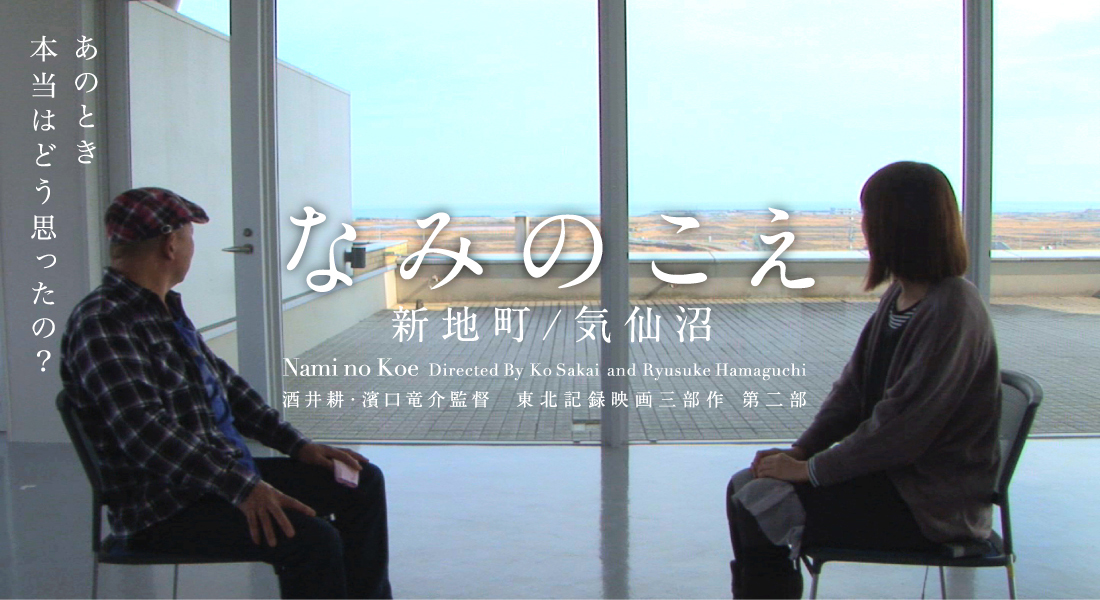
なみのこえ 気仙沼/新地町 Voices From the Waves: Shinchi-machi and Kesennuma (Sakai Kō and Hamaguchi Ryūsuke, 2013)

This is the translation of an article I originally wrote in Italian about two years ago for Sonatine.it, a contemporary Japanese cinema portal I often collaborate with.

Voices from the Waves is the second part of a trilogy of documentaries directed by Sakai Kō and Hamaguchi Ryūsuke about the disaster that struck northeastern Japan in March 2011. This second part consists of two documentaries, Voices of the Waves Kesennuma and Voices of the Waves Shinchi-machi. The only difference between the two works is that they were filmed in two different locations and are about the people who lived and experienced the disaster in two different but geographically very close areas. Both documentaries consist mainly of conversations between two people, often family members or colleagues, who survived the earthquake and tsunami.

Both films begin with images of the silent landscape of the areas, the sea and the waves, houses under construction and the remains of buildings that no longer exist. The idea around which the conversations take place is very simple: each person begins by telling where they were and what they were doing on the day of the earthquake and subsequent tsunami, and from there memories and reflections unfold.

In the first conversation of the Shinchi-machi film, a father and his grown-up daughter sit across from each other. As they recall the arrival of the tsunami and the size of the waves, their conversation is briefly interrupted by the father’s tears as he remembers friends and acquaintances who have disappeared, swept away by the tsunami. From the very first scenes, one of the trilogy’s strengths becomes clear: the moving stories of people who remember become something much more empathetic for the viewer than the flood of images of the disaster. In today’s mediascape, and the Japanese triple disaster of 2011 has become a striking case in point, spectacular images often fade from view in the few moments they are seen, leaving no trace. It is then that words, tone and intonation – in this case the man’s pronounced northeastern accent – manage to convey something much deeper and more affecting than the visual element alone.

Among the various couples we hear and see, whether friends, spouses or colleagues, some recall the difficulty of communicating with their loved ones in the moments immediately after the earthquake and the fact that they turned to images broadcast on television or circulated on the Internet. One of the most interesting parts of the first documentary is when we listen to two fishermen, both of whom were no longer fishermen at the time of the interview, but were doing other things to survive. This conversation, which is more edgy and direct and touches on the issue of radiation in the sea, reflects the character and occupation of the two and provides an interesting but painful variation on the people and personalities affected by the tragedy. The same problems that gripped the area in the aftermath of the disaster are perceived differently depending on people’s social class and economic background. It should be noted that some of these conversations are between a resident of the area and one of the two filmmakers, who then stands in for the second interviewee, but we will return to this important point later.
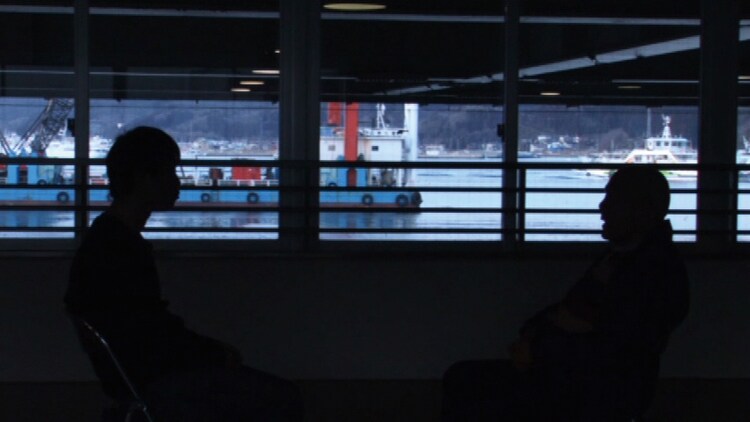
The second documentary, as the title suggests, was shot in Kesennuma, one of the towns hardest hit by the tsunami. It begins with a night-time view of the town’s harbour and then moves to the first conversation, probably recorded in the evening, between two colleagues working in a bar-restaurant. They share the memory and the feeling of despair and fear when they heard the sound of cars and houses colliding and destroying each other on that tragic day. A middle-aged couple does not want to remember the day of the tsunami because it is still so fresh, even though a year has passed since the tragedy. What emerges here is the willingness of the local people to forget, not to not remember, but to move on and not to base their future lives on the disaster. This is a sentiment that has emerged more and more in recent years, especially in Fukushima, and is often found in many communities affected by natural or man-made disasters, such as mercury poisoning and the resulting Minamata Syndrome, which Tsuchimoto Noriaki has explored in his documentaries.
Tsuchimoto, one of Japan’s greatest documentary filmmakers, who has devoted much of his career to following the lives of the victims of Minamata Syndrome, has often commented on how, after decades of documentaries on the subject, many of the victims’ relatives began to treat him coldly. It is therefore important to emphasise one more time that the conversations in Hamaguchi e Ko’s documentaries were filmed just over a year after the triple disaster, when the pain and memories were still fresh, but also when the perspective of those affected by the earthquake and tsunami was slowly but surely changing.

The talking pairs are often in an airy space, especially in the first documentary, where the conversations take place inside buildings, but with large windows looking out. The chosen setting therefore gives a sense of spaciousness and grandeur that an enclosed space would not allow. Between one conversation and the next, there are short ‘pillow shots’, scenes showing the area being rebuilt, the sea, the waves, the excavators and cranes that are still constantly at work. Although these images often capture the landscape filmed by a horizontally moving camera, the entire trilogy differs from most documentaries made about the earthquake and tsunami in that it is composed of mostly static shots. Many of the works that have attempted to document the plight of the local population and the triple disaster over the years have in fact done so through shots taken from a moving vehicle, partly because the vastness of the area affected by the tsunami requires it, but this choice of filming also ended up becoming almost a documentary style in itself and a cliché of how to film the disaster.

It is also significant that the two documentaries are not constructed with interviews, a practice used and abused in the aftermath of the triple disaster, which establishes a relationship of power and impartiality between interviewee and interviewer. Conversations between two people, even though they take place in a staged and constructed space, with at least two cameras and two directors in the room, achieve something different. No one intervenes from outside, of course there is editing, but a kind of horizontal and equal dialogue is created, because these are people who have experienced the tragedy first hand. In this sense, the fact that the two directors intervene in some of the conversations is interesting, almost revealing the “artificiality” of the work, but in the long run it reduces the impact of the two films. The same could be said of the different angles and techniques used to film the two interlocutors (this insightful essay by Markus Nornes is illuminating); while in some cases this works almost perfectly, in others it exacerbates a sense of artificiality that detracts from what is being said.
There is, however, one part where all these techniques are used to the full, and that is the final conversation of Voices From the Waves Kesennuma, when a young couple, a man and a woman aged 26 and 23, amid silences, awkwardness, nervous smiles, ringing mobile phones and yawns, bring out the cinematic power of the unspoken, of gestures and pauses, making this scene perhaps the most touching and at the same time amusing of all those seen in both works.

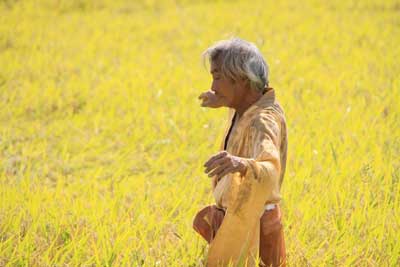
Anthropology and cinema: The Song of Akamata (Kitamura Minao, 1973)

I’m reposting something I wrote almost 4 years ago about Kitamura Minao and visual anthropology in Japan

Visual anthropology, ethnographic cinema, visual folklore and ethnographic film are all definitions floating around the same concept, a point of intersection between cinema, film or the visual arts on the one side and ethnology, anthropology or ethnographic field work on the other. Although all these definitions don’t exactly signify the same thing, I personally like the term “visual anthropology” the best, for no special reason.

I came to be interested in visual anthropology through the works of Jean Rouch, author and co-author of some of the most outstanding works in the history of documentary (Chronicle of a Summer, Moi, un noir, etc.) who was also a very well respected anthropologist who spend most of his life working in the African continent. Driven by this interest a couple of years ago I started to look for something or someone similar in Japan, and by pure chance one morning at Nagoya Cinemaskhole, I came across and discovered the works of Kitamura Minao.
Kitamura is one of the most respected visual anthropologist (I don’t know if he’d agree to be called so) working today in Japan, the founder of Visual Folkrore Inc. and, besides his works for TV (mainly for NHK), he’s also the author of some very compelling and inspiring theatrical documentaries. For instance, Kitamura is the director of one of my favourite films of 2012,

ほかいびと 伊那の井月 Hokaibito: Ina no Seigetsu (2012) about the life of Inoue Seigetsu, a poet and wanderer who lived the last part of his life (he died in 1887) shifting through the land of Ina, now located in Nagano prefecture, between the Edo and Meiji period, a time of dramatic changes that transformed and shaped Japan as a modern nation.

seigetsu_no_ina

Hokaibito: Ina no Seigetsu is a very unique documentary constructed by merging poems, written by Seigetsu himself and visualized on screen by nice handwritten strokes, with reconstructions of the life of the poet, played here by the legendary dancer Tanaka Min.
I haven’t seen so many of Kitamura’s works, especially those commissioned by museums or NHK, but a couple of years ago at the Kobe Planet Film Archive I had the chance to see two of his works made around 30 years ago: The Horse of Kaberu (1969) and The Song Of Akamata:
Life Histories of the Islanders of Iriomote Okinawa (1971).
The former in particular impressed me for its compelling topic: the failed attempt to film a sacred festival in Komi (filming the rituals in the remote island remains a taboo) that nonetheless turned out into a meaningful portrait of the people living or returning to the small land, and a revealing study of their deep relationship with traditions and religion practices of the island.
What follows is an introduction to the movie by Kitamura himself, given on the occasion of a symposium, “Expanding the horizon of Area Studies through film presentation The New Generation of Anthropological Cinema” held in Kyoto in 2006:

akamata

THE SONG OF AKAMATA:
LIFE HISTORIES OF THE ISLANDERS, IRIOMOTE, OKINAWA

KITAMURA Minao

There are two sacred festivals in the Okinawan Islands that, although they continue today, have not yet been filmed or documented: Uyagan-Sai of Ogami Island, Miyako; and Akamata of the Yaeyama Islands, which I attempted, on one notable occasion, to film with an Arriflex camera. The result is this rather peculiar work that did not actually achieve its main objective.
Once a year, during June of the lunar calendar, wearing a wild red wooden mask and covered in leaves and vines, Akamata appears from the sacred cave known as Nabindo. He visits the village founder’s house in Komi to bless the villagers and promise a good harvest for the coming season.
In July of 1972, I arrived at Komi with my filming crew, having traveled by Sabani, a kind of small fishing boat. Although 73 families had occupied the village in 1960, only 17 families remained. Most of the young people had left for Tokyo or Kawasaki, and each year an additional few families had also emigrated to Ishigaki Island or Naha. With such a small village population, I was doubtful that Akamata would be held.
At midnight of the first day of the festival, I was called outside, where I was surrounded by several young men with sickles. They returned to me a bottle of sake I had presented them with in honor of the festival, and then threatened me, shouting, “We never gonna let you shoot Akamata. Never! If you do, you’ll be found murdered.” Their parting shot, “If we ever allow your filming, it’s the end of the village,” made me even more curious about why Akamata made them so excited and energetic. What magnetic force made people come back to the island to join Akamata?
Due to these developments, instead of filming Akamata, I decided to document the life histories of the villagers and the ways of life of the people who had emigrated from Komi. I rallied my frightened crew and began a daytime visit to a family by asking them to let us take a souvenir photo. They liked our request, even though the camera was my 16mm Arriflex. We also voluntarily joined in the work of the village community, drank together, and sang together, with the camera and recorder turned on.
Before completing souvenir photos of all 17 families, I began to understand the fairly complicated relationships among the villagers. For instance, there were conflicts between native and newly introduced religions. After the photos had all been taken, we visited ex-islanders live in Ishigaki and Naha in order to ask why they had left their native island. I found that these ex-islanders living in the cities maintained the same values they had cherished in their native village. It seems that Akamata still lives in their minds.
The sacred masked Akamata, covered by leaves and vines, does not appear at all in “The Song of Akamata.” Nonetheless, this film succeeded in documenting and unmasking the real lives of the islanders.
Duration: 82 mins, Medium: DV, Year: 1973, 2006 (revised), Production: Yugyoki Location: Komi, Iriomote, Okinawa, Japan

Here the original

Record of a Marathon Runner あるマラソンランナーの記録 (Kuroki Kazuo, 1964)

The Winter Olympics in Pyeongchang, the next edition of the Summer Olympics in Tokyo on the horizon, and the massive 100 Years of Olympic Films box set released last year by the Criterion Collection, revived and rekindled my interest in sport documentaries. I decided to revisit one of my favourite non-fiction films dedicated to sport, Record of a Marathon Runner, a movie made by Kuroki Kazuo between 1963 and 1964 about Kimihara Kenji, a Japanese marathon runner active during the 1960s and 1970s. Kuroki was a director who, long before establishing himself as an author somehow associated with the Japanese New Wave (Silence Has No Wing and Ryōma Assassination are two of his best work of the period), was a respected and innovative documentary filmmaker at the Iwanami Production, where he and other friends, Tsuchimoto Noriaki and Ogaka Shinsuke among others, formed the Ao no Kai (Blue Society), a group that tried to experiment and find new ways of expression through non-fiction cinema.

Record of a Marathon Runner is a PR movie (a sponsored movie) founded by Fuji Film, but paradoxically shot almost entirely on a Eastman Kodak film. If you want to know more about the movie’s troubled production and have more insights on Kuroki career, this interview is a must read.

It is possible to watch the relatively short documentary (only 62 minutes) on The Science Film Museum’s Yutube official page, unfortunately it’s without English subtitles.

For some scholars, and I couldn’t agree more, Record of a Marathon Runner represents the other side of the official discourse about the Olympics, the one exemplified, with great artistic results I have to admit, by Ichikawa Kon’s Tokyo Olympiad (1965). In Record of a Marathon Runner the connections with the big event are very thin if not completely absent, in fact someone could argue that the movie is not even about the Olympics at all, we don’t see the marathon or the games themselves, the camera “just” follows Kimihara Kenji, who would eventually finish in eighth place at the competition in Tokyo, throughout his training and running in the winter and spring of 1963-64, as he prepares for the big event.

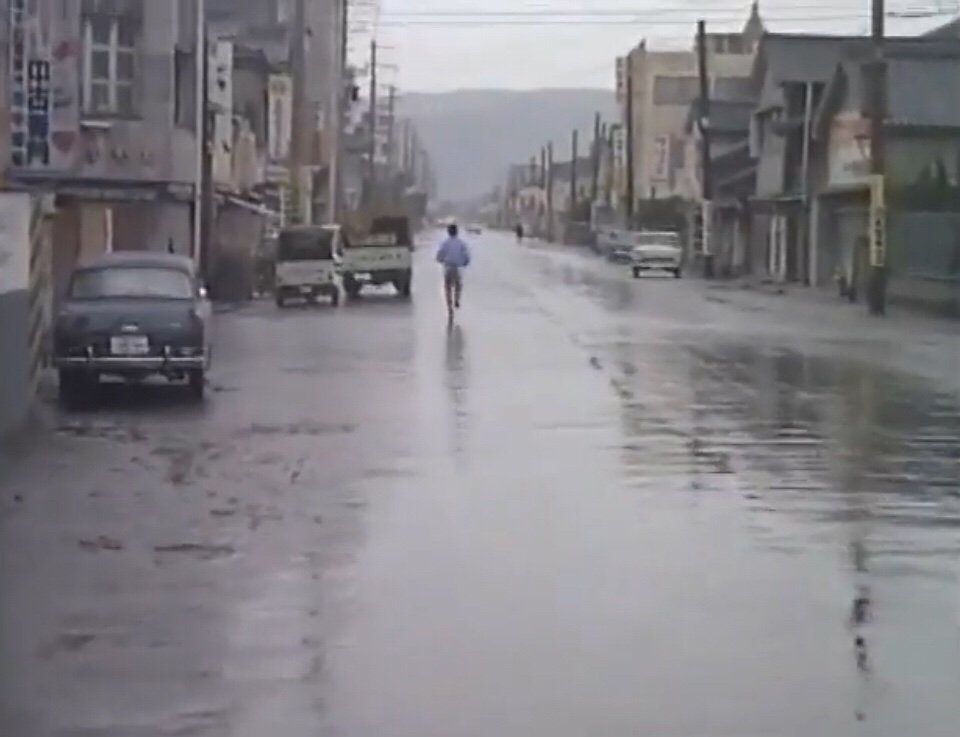
Although originally the documentary was conceived by Kuroki without narration, the movie uses a traditional narration alternating with the words spoken by the marathon runner himself and his coach. However, the tone of the words is so flat and has an almost matter-of-fact quality in it, that there’s no glamour nor pathos, on the contrary, everything, from the endless and solitary training, to the foot injury and the recovery, is displayed like some sort of natural phenomenon. Drained of any passion, the style of the movie reflects the act of running as felt by Kimihara himself, or at least as it is presented in the film, mechanical and without a real purpose, but it is also a way of transferring on screen the gray skies and the dull landscapes depicted, Kitakyūshū city with its industrial suburbs often drenched in rain, or the very ordinary countryside roads in Kagoshima prefecture.

This sense of necessity and that of the loneliness of the runner is amplified by the use of an eerie, dissonant and minimalist music, and by a cinematography that often uses long shots when depicting the athlete while training on the track, on the beach or on the streets. Even in the only scene when Kimihara is shot on a close-up while running, the monotonous sound design and the circularity of his movements form a hypnotic run that seem to lead nowhere. Another scene towards the end is also exemplary about this aesthetic approach: Kimihara after recovering from his injury participate in a competition- the Asahi road relay as the last runner – the only proper race we see on screen. After he wins and crosses the finish line though, he goes on running for a couple of minutes among people and trees like in a state of trance and without goal.

Focusing on the experience of running in preparation for a competition, highlighting its harshness and solitude, Kuroki also depicts indirectly the social background which Kimihara belongs to, the working class of a highly industrialized Kita Kyushu, and the life of an athlete before the brief and ephemeral light cast by the Olympic event.

Yamagata 2017 – day 2

October 7th

Yamagata is a special film event not only because is a filmfest devoted to documentary, but also because is a place where you can meet and talk with a variety of different people. One of the highlights of the first two days for me was the nice and eye-opening conversation I had with Matsumoto Masamichi, Athénée Français Cultural Center’s director, about Carmelo Bene, his cinema and his Terayama Shuji-like status in Italy and France.

For the morning screening of my second day at the festival, I chose In Memory of the Chinatown by Chen Chun-Tien, a movie that confirmed my idea that the Taiwanese documentary scene is at the moment one of the most intriguing and alive in Asia, particularly for its tendency to hybridizing genres and experimenting with form.

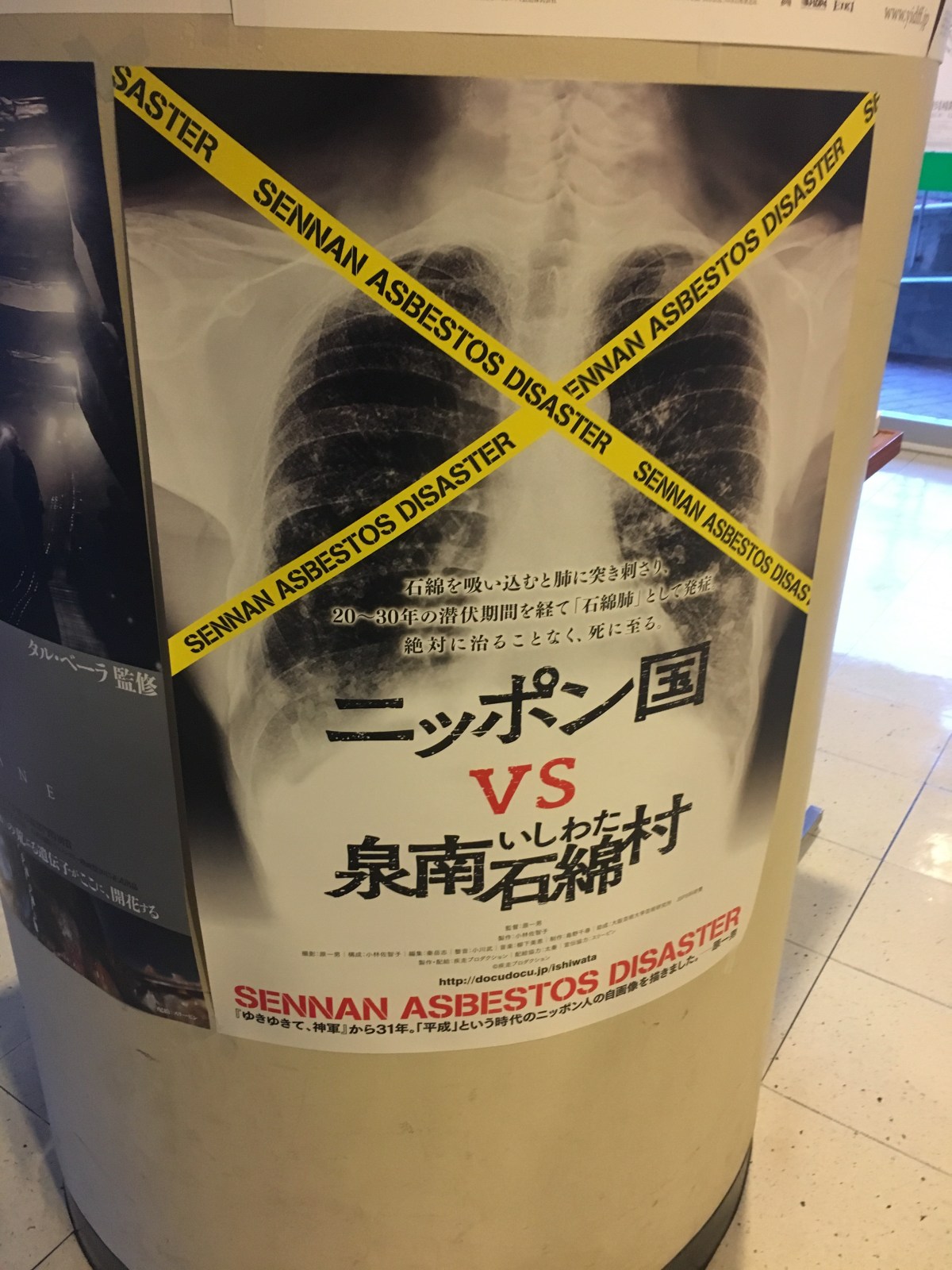
My afternoon screening was Sennan Asbestos Disaster, the latest movie by Hara Kazuo and the first one he shot, for a theatrical released at least, in a very long time. The viewing experience was one of the best I had so far in Yamagata, because I was sitting among the people appearing in the film, those affected by the asbestos pollution. Their comments and laughing aloud during the screening made it a really touching experience.

The last screening of the day I attended was dedicated to the short experimental films made by the late Matsumoto Toshio. The selection included

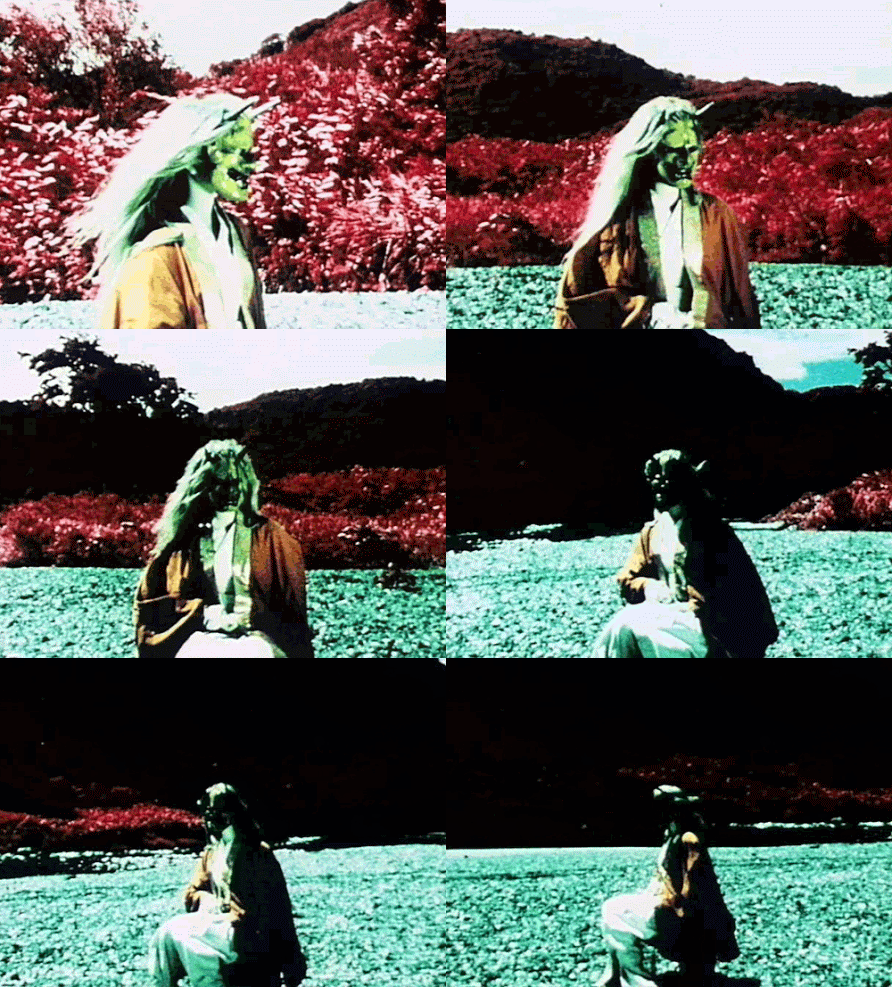
Mona Lisa, Atman, Everything Visible Is Empty, White Hole, Relation and Sway. Seeing them on the big screen and in 16mm was amazing, especially Atman was a hallucinatory trip. The screening was followed by a talk by Takashi Ito, who explain his relationship with Matsumoto and revealed some interesting and unknown fact about Atman (the diagram for shooting the movie designed by Matsumoto looked like a mandala, the person wearing the hannya mask was in fact a mannequin and the movie was shot using infrared film).

Yamagata International Documentary Film Festival 2017

The Yamagata International Documentary Film Festival, one of the most awaited film-related events of the Japanese archipelago, will kick off its fifteenth edition next week on October 5th. For eight days the city of Yamagata will be the capital of documentary cinema, hosting not only an international competition with movies from all over the globe, but also a plethora of  more or less known documentaries presented in other sections, special screenings and retrospectives. For the cinephiles and the film lovers visiting the northern Japanese city, the festival will be an occasion to discover hidden gems of historical importance and an unmissable chance to meet directors, scholars and documentary-obsessed people.
Festival opens on the 5th with a special screening commemorating the passing of Matsumoto Toshio, one of the true giants of Japanese cinema. Two of his best known documentaries, Nishijin (1961) and Ginrin / Bicycle in Dreams (1955) will be presented for the occasion in their original format (35mm), while For My Crushed Right Eye (1968) will be screened as it was originally conceived, that is in 16mm and with 3 projectors. Funeral Parade of Roses (1969) and other experimental works made by Matsumoto during the 1970s and 1980s will also be shown during the festival, including one of my favourite, Atman (1975), a kaleidoscopic trip to the philosophical source of movement and image.
Among the titles presented in the International Competition a must-see for me is Ex Libris—The New York Public Library, the latest work by Frederick Wiseman, but I’m also looking forward to I Am Not Your Negro by Raoul Peck and the long-awaited new work by Hara Kazuo, Sennan Asbestos Disaster, the first feature documentary the director of The Emperor’s Naked Army Marches On made in more than a decade. The movie follows the victims who suffered asbestos-related damages in the city of Sennan in Osaka, during their eight years fight for compensation.
Also in competition the beautiful Machines by Rahul Jain (I wrote about it here), Donkeyote, a subtle reflection on dreams and hopes through the eyes of a donkey and its ageing owner, directed by Chico Pereira, and Another Year by Zhu Shengze, a movie that has received much praise in the international festival circuit. Wake (Subic) by John Gianvito, about the pollution afflicting the residents of a former US naval base in Luzon Island, the Philippines, looks interesting and so does Tremoring of Hope, the difficult recovery of the people of Hadenya in Miyagi, six years after the Great East Japan Earthquake.
Here the complete line-up.
A promising section that will probably sparkle heated post-screening debates is Politics and Film: Palestine and Lebanon 70s–80s, a selection of films made in Palestine and Lebanon during the Lebanon civil war (1975-1990) and in recent years, movies that show and reflect on the struggles and politics of the area. Among them the (in)famous Red Army / PFLP: Declaration of World War, filmed by Wakamatsu Koji and Adachi Masao in 1971, and Genet in Shatila (1999), about the French writer and his relation with the Palestinian revolution as he witnessed the aftermath of the Shatila’s massacre in September of 1982.

Introducing Asian documentary filmmakers, New Asian Currents is usually one of my favorite section for its scope and the variety of films shown, this year 21 works from the continent will be presented, giving us a glimpse of the life, difficulties and struggles the people inhabiting the huge and diversified area have to cope with in their daily life. A Yangtze Landscape by Xu Xin is an interesting movie (more here) that deserves to be seen on the big screen, exploring the geographical and social landscape surrounding the Yangtze River in its long course of more than thousands kilometers. While the works of Yamashiro Chikako are a rare example, rare in Japan at least, of how to tackle a series of thorny historical issues, Okinawa and its relation with mainland Japan and with its past, merging documentary with the experimental.
Here the section’s complete line-up.
I’m ashamed to admit, but I know almost nothing of African documentary. Africa Views will thus be my entrance gate to it, “a program that introduces over 20 films created since the year 2000—with a particular focus on the Sub-Saharan region—depicting a contemporary Africa that lets off a considerable racket as it creaks toward progress, and introducing us to the people who live there.” What caught my attention in Perspective Japan are the new films by Murakami Kenji and Onishi Kenji, two short experiments in 8mm whose screening promises to be, like two years ago, a real cinema-event.
The Festival will also hold a retrospective on Fredi M. Murer, a Swiss director that the program describes as “a leader of the internationally-acclaimed Swiss Nouveau Cinema movement that was active from the late 1960s through the 1980s, together with Daniel Schmid and Alain Tanner. (…) Depending on the period in which they were made, Murer’s works may be classified variously as experimental film, documentary, or narrative film.” The retrospective that interest me the most though is Ten Trips Around the Sun: Sato Makoto’s Documentary Horizon Today, a tribute to Sato Makoto on the 10th anniversary of his death, that will include screenings of his major works accompanied by discussions and panels.

North Korean missiles permitting, I’ll be in Yamagata from October 6 to 11, and, as I did two years ago, I will try to keep a diary of my viewings experiences, here or more likely on my Twitter account.

P.S. I’ve also created a list on Letterboxd with most of the movies that will be in Yamagata.

This slideshow requires JavaScript.

From the archives: Kamei Fumio, Hani Susumu, and Ogawa Production in two Italian publications (1967, 1970)

The Centro sperimentale di cinematografia (Experimental film centre) in Rome is one of the oldest cinema schools in the world and the oldest in Europe. Founded in 1935, the centre nourished and helped establishing, in different degrees, the career of many important filmmakers, photographers and actors. Japanese director Masumura Yasuzō famously studied at the school for about two years at the beginning of the 1950s under luminaries such as Michelangelo Antonioni, Federico Fellini and Luchino Visconti, an experience that without doubt helped shaping his approach to cinema and his views as a filmmaker.
In 1937 the centre started to publish its own film journal, Bianco e Nero, a monthly magazine that is still been published to this day. A couple of years back I bought a copy from 1967 (February) that has an article, penned by film critic Claudio Bertieri, on the documentaries of Hani Susumu and Kamei Fumio. In November of the previous year the Festival dei Popoli in Florence, an event dedicated to non-fiction still running today, presented a mini-retrospective on Japanese documentary, and Bertieri discusses in the short article, titled Susumu Hani, Fumio Kamei ed il documentario giapponese (Susumu Hani, Fumio Kamei and Japanese documentary), the movies he was able to see at the festival. He devotes most of the article on Hani, Yuki Matsuri (1953), Children in the Classroom (1954), Children Who Draw (1955), Twins in the Class (1956) and Hōryū-ji (1958) are the documentaries here analysed, while the rest of the piece is spent examining Kamei’s It’s Good to Live (1956) and The World of Yukara (1964), a trilogy about Ainu’s traditions. Although written in 1967 — a period when Japanese documentaries certainly were not known or available to watch as they are today (well, they are not that discussed even today…)— and with few dated observations here and there, most of the analysis remain solid to this day. Documentary as opposed to mainstream cinema ‘the man in the street here [in Europe] has not seen Louisiana Story, in Japan he does not know Hani or Kamei’, Hani’s ability to capture moments of pure innocence in children, or Kamei sensibility when portraying human suffering are spot-on insights.

Even more interesting, but for different reasons, is Cinema: Giappone e Zengakuren (Cinema: Japan and Zengakuren) a short book published in 1970 by Samonà e Savelli, later Savelli – La Nuova Sinistra, a publisher established in 1963 and the first to directly represent the extra-parliamentary left-wing in the Italian publishing world. Over the next decade the books printed by Savelli – La Nuova Sinistra, also fueled by political and social unrest in the peninsula, would gain momentum and become a cultural reference point for left-wing groups such as Potere Operaio and Lotta Continua , and for the newspaper Il Manifesto.

The book is devoted to Ogawa Shinsuke’s The Battle Front for the Liberation of Japan – Summer in Narita (1968), the first movie in the Narita/Sanrizuka Series. A brief introduction that outlines the Japanese political situation and the fierce resistance by the peasants and the students, is followed by a translation of some writings by members of Ogawa Production, just a couple of paragraphs nothing more, while the main part of the volume is a transcription of the dialogues spoken in the film. It was a period where revolutionary cinema(s) of the globe were connecting to each other and were trying to build a common front against capitalism, the people in power and the establishment. The back cover is in this regard illuminating: Comitato di Cinema e Rivoluzione: Baldelli, Filippi, Ivens, Ogawa, Rocha, Solanas, Straub (Cinema and Revolution’s committee: Baldelli, Filippi, Ivens, Ogawa, Rocha, Solanas, Straub).

Reading these two publications after almost 50 years since they were originally printed was a very fascinating discovery, Ogawa and Kamei are two of the most important documentarists in the history of world cinema and essentially the reason this blog exists. Cinema: Japan and Zengakuren in particular is revelatory not as much for the information it contains, there are some mistakes of course—in the pre-internet age Japan was still a land far away and often misrepresented—but more as an artifact of an era long gone but still able to resonate with our present. An era when the arts were explicitly politicized, in a state of never-ending struggle and ready to change the world.

This slideshow requires JavaScript.

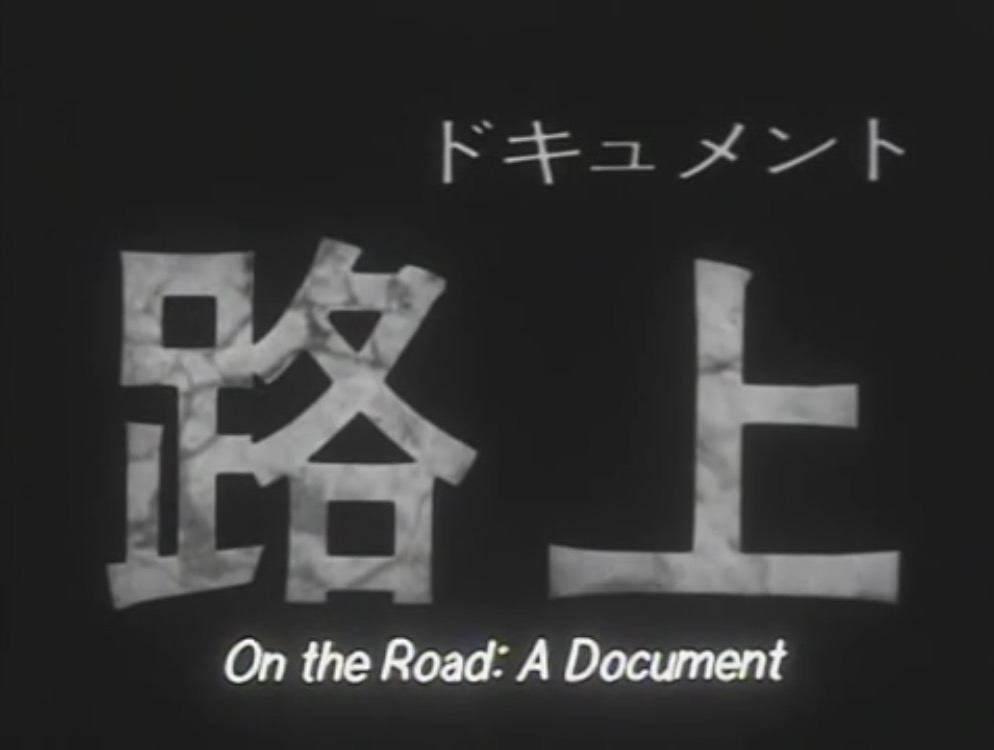
On the Road: A Document ドキュメント 路上(Tsuchimoto Noriaki, 1964)

One of the towering figures in Japanese documentary, Tsuchimoto Noriaki began his career as a documentarist, like many of his generation, at Iwanami Production in 1956. Tsuchimoto was since his university years a very active student, involved in the establishment of Zengakuren, member of the Japanese Communist Party and eventually expelled from Waseda University in 1953 for political activities. Mostly known in Japan and in the rest of the world, and rightly so, for his life-long series on Minamata and the mercury poisoning caused by Chisso Corporation, a total of 15 films in more than 40 years, Tsuchimoto in his long career tackled with his movies many different issues. Another Afghanistan: Kabul Diary 1985 and Traces: the Kabul Museum 1988, two movies set and about Afghanistan in a crucial time for the country, Nuclear Scrapbook (1982) on the danger of Japan’s nuclear policies, and On the Road: A Document, are some of his best non-Minamata works. It’s on this last one that I’d like to focus my attention today.
At the Beginning of the 60s Tokyo, and Japan in general, was in turmoil and experiencing huge changes, on the one hand the country was trying to leave behind and “forget” the tragedies of war, the consequent American occupation and more than 20 years of militarization and nationalism, on the other hand Japan was projecting itself and its people at maximum speed towards the future and a new phase. This “double” movement implied, among other things, starting a series of infrastructure projects that would completely alter the landscape of urban and suburban areas of the country, especially in preparation for the big international showcase of 1964, the Tokyo Olympics: streets, highways, the launch of the Shinkansen (the famous bullet train), and the devil’s pact with atomic energy. All changes that would shape, for better or for worse, the country’s future and made it what it is today.
On the Road was made in this whirl of structural, social and political changes, let’s not forget the huge demonstrations against the ANPO treaty in 1960 and those that would shake the country in the following years, a period of turmoil that is reflected in the film’s production history, as Zakka Films site puts it:

On the Road was originally commissioned as a traffic safety film with the Metropolitan Police as one of the sponsors. But it actually had a double existence: in reality Tsuchimoto was also working with the drivers’ union. When a police official finally saw the film, he dismissed it as “useless—the plaything of a cinephile,” and so it was never used for its original purpose. While winning numerous awards abroad, including at Venice, it was shelved in Japan for nearly 40 years.

The production is also a strong statement of Tsuchimoto’s artistic independence and creativity as a filmmaker, “The film was conceived as an experimental dramatized documentary” and “Tsuchimoto had amateur actors play the principal roles and, because the sound and image were recorder separately, asked drivers to reenact their duties, meeting and conversations”*. For all these reasons On the Road turned into a formally and highly creative documentary and a very different one, in style and concept, from those of the Minamata series that would follow in five years. Alienating music, fast editing and a cacophonic cityscape rendered through a jazz-like rhythm bring to mind the city symphony movies of the beginning of the 20th century, reimagined for and in the 60s. A snap-shot of an era of change for Japanese society framing a mutating urbanscape with a free-style touch that makes it highly watchable and fresh even for today’s viewers.

While it’s important to praise and introduce all the movies of the Minamata series to the broadest audience possible, it’s also vital not to overlook some of Tsuchimoto’s works made outside of his life-long series and by doing so affirming his importance and role in the history of Japanese documentary.

On the Road: A Document is available on DVD (with English subtitles) at Zakka Films, of course!

* from the DVD booklet

Memories of Agano (阿賀の記憶 Satō Makoto, 2004)

This is an unfinished draft for an essay on Satō Makoto’s Memories of Agano 「阿賀の記憶」, a work in progress, at this stage no more than a series of random thoughts about one of my favorite movies.


last update: 26 September 2017


“…the habit of imposing a meaning to every single sign”

Trinh Minh-Ha


Satō Makoto’s documentaries seem to be (again) part of the filmic discourse in Japan, or at least on the rise in some cinematic circles, and deservedly so. Nine years have passed since his death, this year (2016) a book titled「日常と不在を見つめて ドキュメンタリー映画作家 佐藤真の哲学」(roughly rendered “Gazing at everyday and absence, the philosophy of documentarist Satō Makoto”) was published and a screening of all his documentaries, followed by discussions and talks, was held in Tokyo in March and later at the Kobe Planet Film Archive. I haven’t read the book yet, but the title summarizes and conveys perfectly the themes embodied in Satō’s last works: the dicothomy absence/presence and the presence of absence, that is to say the phantasmatic presence of cinema.

Sato’s final works, Self And Others, Memories of Agano and Out of Place: Memories of Edward Said witness and embody a shift in Satō’s approach, movies through which he was attacking and partly deconstructing the documentary form, to be fair with his works though, it’s a touch that was partly present in his films since the beginning, but in these three documentaries it becomes a very prominent characteristic. This publication seems to be timely and enlightening because is tackling Sato’s oeuvre not necessarily from a purely cinematic point of view, the book’s curator is by her own admission not a cinema expert, but it’s expanding the connections of Satō’s movies and writings towards the philosophical.

I hope the book will kindle and revive a new interest on his works, Satō is in my opinion one of the most important Japanese directors of the last 30 years, and sadly one of the most unknown in the West, I don’t really think there’s much out there in the internet or on paper about Satō, nor in English nor in other non-Japanese languages, and it’s a pity and a missed occasion because his movies, again, are more than “just” documentaries, or even better, are documentaries that have the power to question their own form and stretch in many differents areas. If you’re not familiar with his works, you can get a glimpse of Satō and his touch reading this beautiful and long interview, or you can buy them on DVD thanks to Siglo, it’s a rarity in Japan, but they come with English subtitles.

This year (2017) Yamagata International Documentary Film Festival will also hold a retrospective for the 10th anniversary of Satō’s death, commemorating and celebrating his works, his influence and his reception abroad.

One of Satō’s documentaries that resonates with me more than others, even after many viewings, is Memories of Agano (阿賀の記憶, 2004). As the YIDFF describes it:

Ten years after the acclaimed film Living on the River Agano, the film crew returns to Niigata. Personal memories reflect upon remnants of those who passed away as the camera observes abandoned rice fields and hearths that have lost their masters.

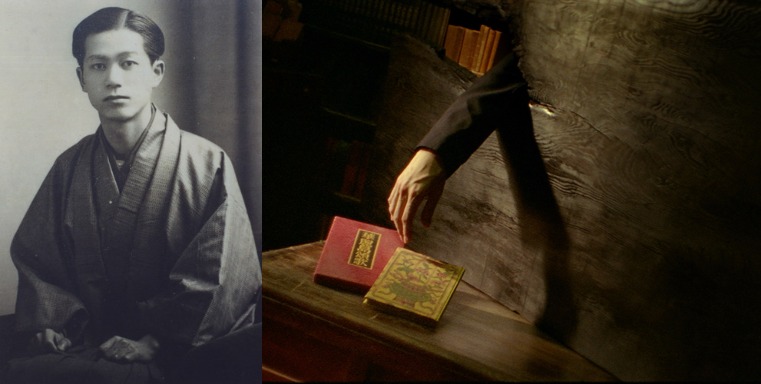
It is a relatively short but complex movie running only 55 minutes, an experiment in the form of a non-fiction film, splendidly shot on 16mm by cameraman Kobayashi Shigeru, the same cameraman who worked and lived together with Satō in Niigata for more than three years during the shooting of Living on the River Agano. The film is a poem on the passing of time and consequently on the objects that will outlive us, the persistence of things in time, including cinema itself. The original idea was in fact to make a film about the remnants of Meiji, that is “the glass photographic plates of the Niigata landscape from the late Meiji to early Taisho era (1910s) left behind by photographer Ishizuka Saburo. Using those old black and white photographs as a motif, we started out making the film with the same concept as Gocho Shigeo in Self and Others”. This quasi-obsession with objects is the thread that waves through the film’s fabric: boiling tea pots, old wooden houses, tools…

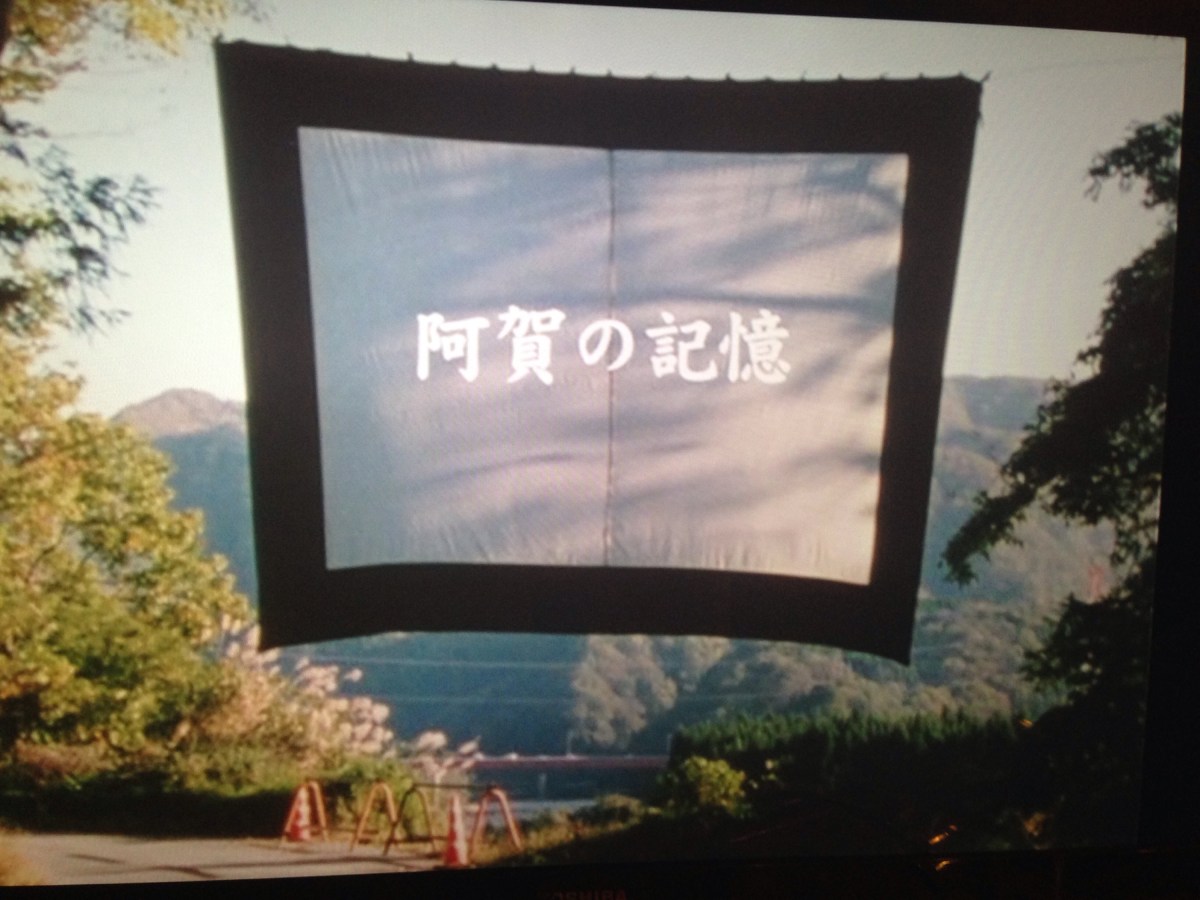
One of the most stunning scene of the movie and one that defines Memories of Agano is placed at the very beginning, when Satō and Kobayashi after returning to the area where the first movie was shot hang a big canvas tarp in the middle of a wood projecting on it the documentary they made 10 years before. The effect is profoundly disturbing and touching at the same time, images and thus memories are suddenly like tangible spectres.

On another level, Memories of Agano with its intertwining of past, present and landscapes ー the external ones with mountains, fields, rivers, and the interior landscapes of old and almost empty houses ー could also be read as an attempt to approach and partly re-elaborate the fūkeiron-cinema, the theory-of-landscape-oriented-cinema, 「footnote: “launched” almost five decades ago with A.K.A. Serial Killer (1969),  The Man Who Left His Will on Film (1970), Red Army/PLFP: Declaration of World War (1971) and The First Emperor (1973)」

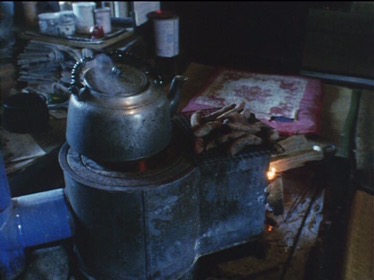
As for its aesthetics, one of the quality that strikes me every time I rewatch it, is the slow pace and the use of long takes that give the movie a dreamlike quality of lethargic torpor. The scene that embodies at most this aesthetic idea is an almost static shot of a teapot boiling on an old stove lasting about 10 minutes, on the background, sort of white noise, the words of an old lady spoken with a thick Niigata accent. She talks sparsly with Satō himself also about the fact she doesn’t wanna be filmed, half jokingly half seriously, a breaking of the fourth wall so to speak, a dialogue between camera and object filmed that was prominently present in Living on River Agano as well (“Are you filming me?” “Don’t shoot me!” are sentences that punctuate the course of this movie and the one made in 1992).

Memories of Agano also present itself as a documentary of opacity rather than one of transparency, the choice of not using the subtitles when people speak with their thick Niigata accent, a Japanese citizen from another area of the archipelago would probably understand 50% or 60% of what is said, a technical option that was used in Living on the River Agano – signals a major change in Satō’s approach to documentary and cinema in general. Feeding the viewer with limpid and clear messages and making a “comprehensible” movie is not what interests Satō here, but rather placing obstacles, visual riddles so to speak – the aforementioned tarp for instance, but also visually striking moments of pure experimentation – and thus presenting the opacity of the cinematic language seems to be the goals he had in mind when he conceived Memories of Agano. The images are thus escaping the organizing discourse tipical of so many Japanese documentaries, in contrast they open to new (cinematic) discoveries and keep resonating with the viewers and engage us on many different levels.

The best documentaries of 2015 – my list

As 2015 comes to an end, it’s that time of the year again, the period when every cinephile is compelled to make his/her best movies list. I couldn’t not post my own one. I’ve mostly watched documentaries from East Asia, my list is then more like a “Best documentary of 2015 from East Asia” type of list, but at the end I’ve added a couple of movies from other part of the world and some (re)discoveries I’ve done during this 2015. Just a disclaimer, it’s a favorite list more than a best list, here we go (listed in the order I’ve seen them):

Walking with my Mother (Sakaguchi Katsumi, 2014)

An exploration of loss, sickness and memory in a society (the Japanese one) that is getting older and older, told in the shape of a private documentary, here some thoughts on the movie.

walking_with_mother

Aragane (Oda Kaori, 2015)

The camera follows patiently and almost hypnotically the workers of an old coal mine in Bosnia down into the darkness of their daily routine. The movie is visually stunning, partly documentary and partly experimental cinema, director Oda Kaori knows how to use the digital medium for her cinematic purposes in a work that revolves around the concept of duration and its materiality, and that is almost structural cinema in its construction. I had the pleasure of meeting and interviewing the director, the conversation was published on the Italian newspaper Il Manifesto, I’m currently working on an English translation and on a review/piece for this blog (maybe next year).

Oyster Factory (Sōda Kazuhiro, 2015)

The latest work from Japanese director Sōda Kazuhiro, together with Theatre 1 and 2, my favourite among his documentaries. I’ve written more about the film here.

IMG_5344

France Is Our Mother Country (Rithy Panh, 2015)

Rithy Panh (2-21: The Khmer Rouge Killing Machine, The Missing Picture) constructs a critical and satirical work about the colonial rule of Cambodia by France, using only footage, archival images and propaganda films shot by the rulers themselves. The power of re-editing and collage documentary.

france-is-our-mother-country

Night and Fog in Zona (Jung Sung-il, 2015)

A documentary about the great Wang Bing by movie critic-turned-director Jung Sung-ilhere you can read my review.

IMG_0379-0

The Moulin (Huang Ya-li, 2015)

Formally engaging and elliptical, I don’t really know how much of my fascination for this movie comes from its themes, a group of Taiwanese avant-garde artists active in the 30′ during the Japanese colonial period, and how much from the documentary itself.

TheMoulin_Taiwan4

Documentaries from other parts of the world:

The Iron Ministry ( J.P. Sniadecki, 2014) and in general all the movies by Sniadecki: Demolition, People’s Park, Yumen….

Jujun (Paul Thomas Anderson, 2015)


(re)discoveries of 2015:

The Vampires of Poverty (Carlos Mayolo, Luis Ospina, 1977)

All the documentaries/works of the great Agnès Varda (it was a pleasure watching 14 of her films this year)


Some thoughts on 『抱擁』”Walking with My Mother” (2014, Sakaguchi Katsumi) 

 This is not a review, but I felt the need to drop a few and random lines about『抱擁』(Walking with My Mother) a documentary made by Sakaguchi Katsumi about his mother Sochie. The movie premiered last October at the Tokyo International Film Festival. Here the synopsis from the festival’s homepage:

How do you live after losing your loved ones? Suchie (78) is distraught after losing her daughter and then her husband. Countless tranquilizers were given to calm her. Her son, Director Katsumi Sakaguchi, turns to his camera to understand her more. When Mariko arrives for the funeral and sees her sister’s despair, she decides to take her back to their hometown for the first time in 38 years. Here, Mariko devotes her life to her sister. Her son reveals four painful years of her distress and conflict through the camera. Grief always comes after the sadness of losing those closest to us. What rescued her from it?

  
Besides its main themes – the exploration of loss, sickness and memory in an society, not only the Japanese one, that is getting older and older – the main aspect of the documentary that soon, from the very first scene, struck me is a technical  one: its editing. It might sound strange and far-fetched for a work of this kind –  after all it’s partly a self-documentary and partly a home-movie, not at all an art-house work –  but the film is really packed with “action”, in the sense that the 93 minutes are full of happenings.The sickness, the pain, the panic, the death of Sochie’s husband (and director’s father) and the funeral, the suicide talk and the memories of the hard-working days, the return to her hometown and the rural landscape of Tanegashima, the devoted sister and the relatives, the hospitals and the doctors. All this, a fine selection of 4 years of shooting, is held together by a masterfully done editing, fast and rythmic even when the subject is “just” an old women moving around the house complaining about her bad health. This is the real “secret” of Walking with My Mother. It would be nice if we could count the cuts, it’s like the Violence at Noon of documentary, I’m exaggerating of course, but I can garantee that there is not a single cut longer than a minute, and that the average are about 10 or 15 seconds long. An interesting choice indeed by Sakaguchi, who opens up new aesthetic possibilities for self-documentaries or, more in general, non-fictions works made on the edge of home-movies.