Memories of Agano (阿賀の記憶 Satō Makoto, 2004)

This is an unfinished draft for an essay on Satō Makoto’s Memories of Agano 「阿賀の記憶」, a work in progress, at this stage no more than a series of random thoughts about one of my favorite movies.


last update: 26 September 2017


“…the habit of imposing a meaning to every single sign”

Trinh Minh-Ha


Satō Makoto’s documentaries seem to be (again) part of the filmic discourse in Japan, or at least on the rise in some cinematic circles, and deservedly so. Nine years have passed since his death, this year (2016) a book titled「日常と不在を見つめて ドキュメンタリー映画作家 佐藤真の哲学」(roughly rendered “Gazing at everyday and absence, the philosophy of documentarist Satō Makoto”) was published and a screening of all his documentaries, followed by discussions and talks, was held in Tokyo in March and later at the Kobe Planet Film Archive. I haven’t read the book yet, but the title summarizes and conveys perfectly the themes embodied in Satō’s last works: the dicothomy absence/presence and the presence of absence, that is to say the phantasmatic presence of cinema.

Sato’s final works, Self And Others, Memories of Agano and Out of Place: Memories of Edward Said witness and embody a shift in Satō’s approach, movies through which he was attacking and partly deconstructing the documentary form, to be fair with his works though, it’s a touch that was partly present in his films since the beginning, but in these three documentaries it becomes a very prominent characteristic. This publication seems to be timely and enlightening because is tackling Sato’s oeuvre not necessarily from a purely cinematic point of view, the book’s curator is by her own admission not a cinema expert, but it’s expanding the connections of Satō’s movies and writings towards the philosophical.

I hope the book will kindle and revive a new interest on his works, Satō is in my opinion one of the most important Japanese directors of the last 30 years, and sadly one of the most unknown in the West, I don’t really think there’s much out there in the internet or on paper about Satō, nor in English nor in other non-Japanese languages, and it’s a pity and a missed occasion because his movies, again, are more than “just” documentaries, or even better, are documentaries that have the power to question their own form and stretch in many differents areas. If you’re not familiar with his works, you can get a glimpse of Satō and his touch reading this beautiful and long interview, or you can buy them on DVD thanks to Siglo, it’s a rarity in Japan, but they come with English subtitles.

This year (2017) Yamagata International Documentary Film Festival will also hold a retrospective for the 10th anniversary of Satō’s death, commemorating and celebrating his works, his influence and his reception abroad.

One of Satō’s documentaries that resonates with me more than others, even after many viewings, is Memories of Agano (阿賀の記憶, 2004). As the YIDFF describes it:

Ten years after the acclaimed film Living on the River Agano, the film crew returns to Niigata. Personal memories reflect upon remnants of those who passed away as the camera observes abandoned rice fields and hearths that have lost their masters.

It is a relatively short but complex movie running only 55 minutes, an experiment in the form of a non-fiction film, splendidly shot on 16mm by cameraman Kobayashi Shigeru, the same cameraman who worked and lived together with Satō in Niigata for more than three years during the shooting of Living on the River Agano. The film is a poem on the passing of time and consequently on the objects that will outlive us, the persistence of things in time, including cinema itself. The original idea was in fact to make a film about the remnants of Meiji, that is “the glass photographic plates of the Niigata landscape from the late Meiji to early Taisho era (1910s) left behind by photographer Ishizuka Saburo. Using those old black and white photographs as a motif, we started out making the film with the same concept as Gocho Shigeo in Self and Others”. This quasi-obsession with objects is the thread that waves through the film’s fabric: boiling tea pots, old wooden houses, tools…

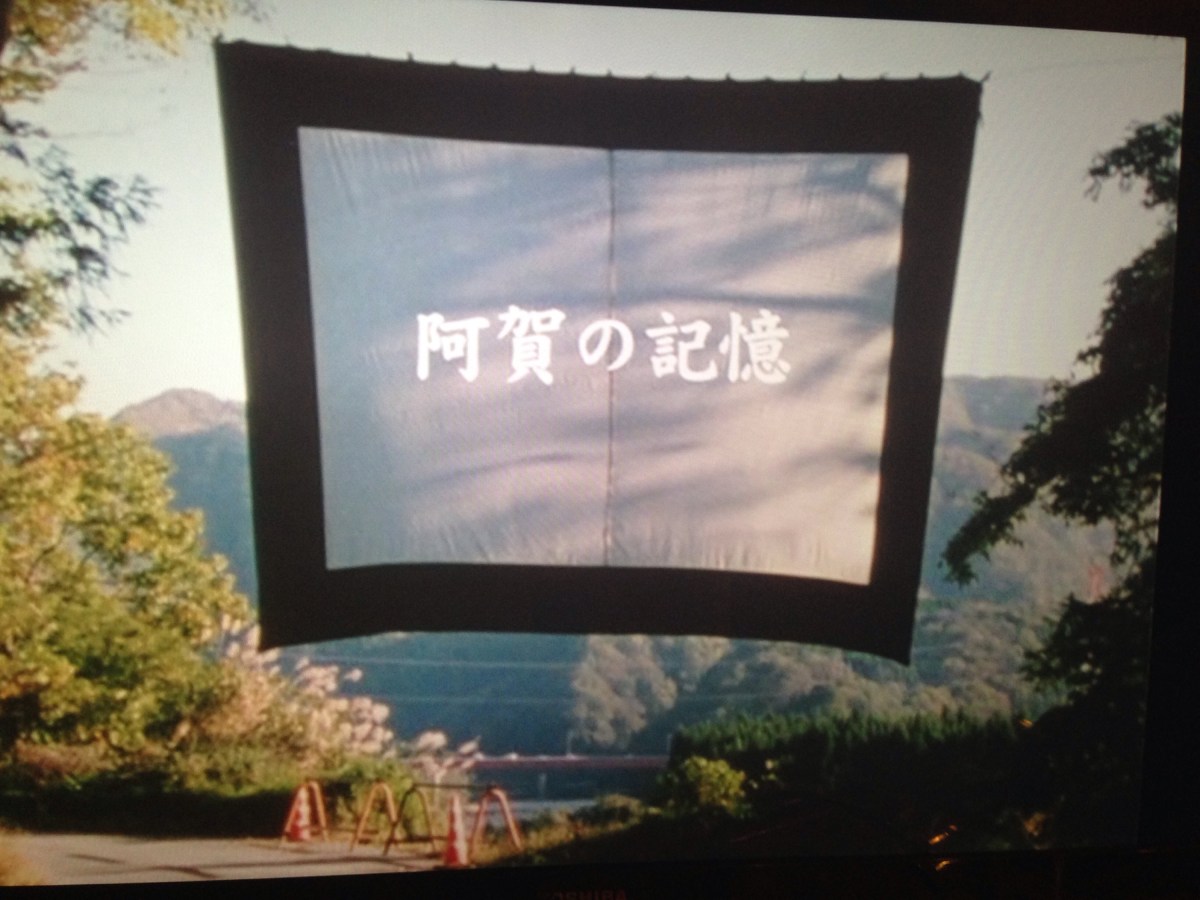
One of the most stunning scene of the movie and one that defines Memories of Agano is placed at the very beginning, when Satō and Kobayashi after returning to the area where the first movie was shot hang a big canvas tarp in the middle of a wood projecting on it the documentary they made 10 years before. The effect is profoundly disturbing and touching at the same time, images and thus memories are suddenly like tangible spectres.
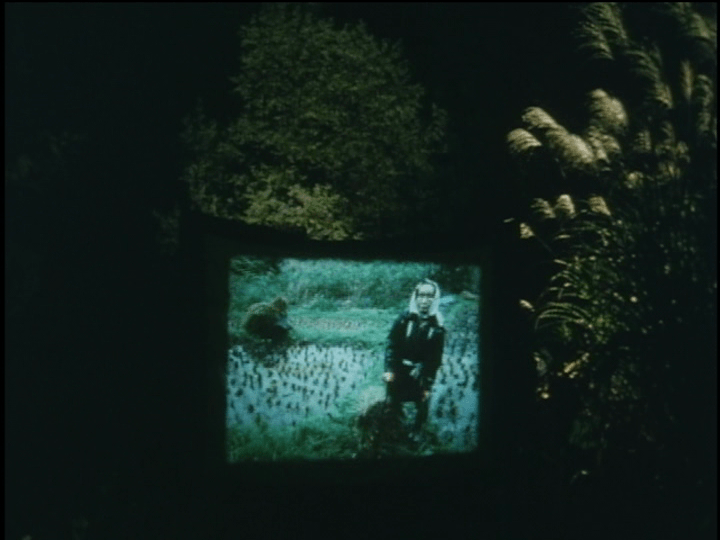
On another level, Memories of Agano with its intertwining of past, present and landscapes ー the external ones with mountains, fields, rivers, and the interior landscapes of old and almost empty houses ー could also be read as an attempt to approach and partly re-elaborate the fūkeiron-cinema, the theory-of-landscape-oriented-cinema, 「footnote: “launched” almost five decades ago with A.K.A. Serial Killer (1969),  The Man Who Left His Will on Film (1970), Red Army/PLFP: Declaration of World War (1971) and The First Emperor (1973)」
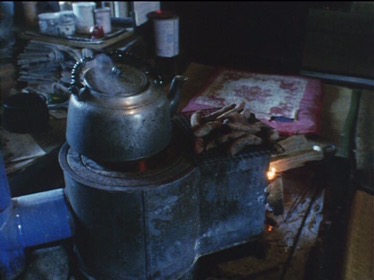
As for its aesthetics, one of the quality that strikes me every time I rewatch it, is the slow pace and the use of long takes that give the movie a dreamlike quality of lethargic torpor. The scene that embodies at most this aesthetic idea is an almost static shot of a teapot boiling on an old stove lasting about 10 minutes, on the background, sort of white noise, the words of an old lady spoken with a thick Niigata accent. She talks sparsly with Satō himself also about the fact she doesn’t wanna be filmed, half jokingly half seriously, a breaking of the fourth wall so to speak, a dialogue between camera and object filmed that was prominently present in Living on River Agano as well (“Are you filming me?” “Don’t shoot me!” are sentences that punctuate the course of this movie and the one made in 1992).

Memories of Agano also present itself as a documentary of opacity rather than one of transparency, the choice of not using the subtitles when people speak with their thick Niigata accent, a Japanese citizen from another area of the archipelago would probably understand 50% or 60% of what is said, a technical option that was used in Living on the River Agano – signals a major change in Satō’s approach to documentary and cinema in general. Feeding the viewer with limpid and clear messages and making a “comprehensible” movie is not what interests Satō here, but rather placing obstacles, visual riddles so to speak – the aforementioned tarp for instance, but also visually striking moments of pure experimentation – and thus presenting the opacity of the cinematic language seems to be the goals he had in mind when he conceived Memories of Agano. The images are thus escaping the organizing discourse tipical of so many Japanese documentaries, in contrast they open to new (cinematic) discoveries and keep resonating with the viewers and engage us on many different levels.
NDU and Asia is One (アジアはひとつ)

NDU (Nihon Documentary Union) was a Japanese collective established in 1968 by a group of Waseda University students, who would eventually drop out, one of the most prestigious universities in Japan. From 1968 to 1973, the year the group dismantled, this group of activists, they considered themselves first of all as a collective of activists,  made four documentaries, moving from the street of Tokyo – the first work was Onikko – A Record of the Struggle of Youth Laborers – to the far away islands in Micronesia passing through Okinawa, the archipelago where they shot two of the their most significant documentaries. Motoshinkakarannu (1971) was made and is about Okinawa before the reversion to Japan, the group went to the island in 1971 and captured on film a society in flux and in the middle of a shifting passage. The film show and focuses on the margins of society with illegal prostitution and life in the red districts, at the same time highlighting the historical and social fractures that were traversing the area: anti-establishment and anti-American riots, the Black Panthers visiting Okinawa, pollution of water and much more. I listed Motoshinkakarannu as one of my favorite Japanese documentaries in the poll I’ve organised a year ago, but today I want to shift my attention on the second movie made by the collective in Okinawa (and beyond): Asia is One (アジアはひとつ),  a work that I hadn’t seen at the time of the poll, and that would have certainly figured in my list paired with Motoshinkakarannu.

Asia is One was screened on June 26th at Kyoto Kambaikan, as part of the AAS in Asia, and it was screen with English subtitles for the first time, the movie was shelved for many many years, forgotten, and was (re)discovered only in 2005 when was screened at the Yamagata International Documentary Film Festival. The screening in Kyoto was followed by a fascinating Q&A with the only surviving member of NDU, Inoue Osamu, Nunokawa Tetsurō, who after the dismantling of the collective made other interesting solo documentaries in Palestine and US, passed away in 2012. As described by Roland Domenig (1), with Asia is One

NDU further explored the margins of Okinawan society and continued to break through borders by focusing on the Taiwanese minority. The film portrays Taiwanese migrant workers on the main island of Okinawa who substitute the Okinawa laborers who in turn are employed as migrant workers on Japan’s main islands. It traces the history of Taiwanese coal miners on Iriomote Island, follows legal and illegal workers to the westernmost island of Yonaguni and finally lands in Taiwan in a village of he Atayal tribe of Taiwanese aborigines, where still the Japanese naval anthem is played every noon.

Formally the documentary is composed of  landscapes and interviews, all of them out of sync, possibly due to the equipment used or maybe the lack of it. The uncanny space created by this displacement, but also by the use of music from radio broadcasts and kids voices, thrown here and there during the movie, gives the work  a peculiar aesthetic tone, a type of non-fiction cinema that I like to call “chaos cinema”. (2)
To explain and understand the “chaotic” trait of Asia is One, and Motoshinkakarannu, we have to delve deeper in the philosophy that laid behind NDU. What the collective has tried to convey through their cinema is extremely fascinating, in their writings (3), mainly published in the magazine Eiga Hihyo, the group was explicitly pushing towards a cinema/activism of anonymity, trying to reach an “impersonal space” and rejecting even the term “work” (sakuhin) because it was seen as the product of a single person in command and as a result of a dominating power structure. In this regard famous was their criticism of Ogawa Production, a collective that bore the name of a single person and that was basically structured hierarchically (4). To this kind of collectivism NDU tried to oppose a more fluid idea of group activism, where the structure was a flat and horizontal one,  and in doing so promoting a cinema made by amateurs (5) and not by professionals. “Everybody can push the button and shoot with a 16mm camera” said Inoue, and this is even more true today since the advent of the digital revolution. Whether this approach was successful or not, and more importantly, whether this horizontal structure and “amateur cinema” is possible at all, are questions without answers that are haunting scholars to this day.
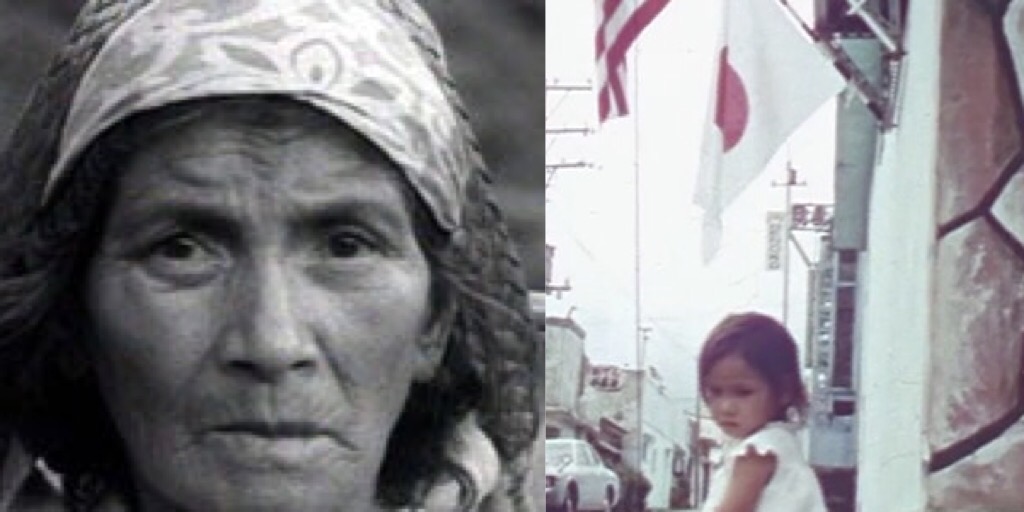
Going back to Asia is One, the part of the movie the resonates more with me is the last one, when the film moves to the Atayal village in Taiwan. There’s a quality in the close-ups of the tribe people, beautiful and ancient faces, that is very fascinating, also because it is in these scenes that the political discourse on identity, or the negation of it, reach its peak. From the 17th Century onward The Atayal people, like the rest of the tribes inhabiting the island,  had to face the colonization of the Dutch, the Spanish, the Chinese and later of the Japanese (1895 – 1945). Calling them “barbarians” the Japanese Empire tried to assimilate and annihilate their culture (6), the words from the tribe people in the movie add layers of complexity to the situation  : “Japan conquered us and abolished many of our ancient traditions and customs”, but at the same time “we were drafted and went to war with pride and ready to die” and “luckily the Japanese abolished some of our ancestral traditions like beheading”.
Asia is One ends with the militaristic song If I Go to Sea against an everyday scene with the aboriginal Taiwanese people isolated in the mountains singing “We want to go to war again.” Of course there is oppression and violence, physical and cultural, in every colonization, but things here are very layered. It seems to me that in this process of cultural and historical coring that the movie conveys, from Okinawa to Taiwan, two very significant points emerge. The first is the crisis of the identity concept, often a forced cultural and national superstructure imposed by the stronger part on a “highly fluid space of human life” (6), as Inoue explained “identity was one of the most hated words inside the NDU, identity is a choking concept”. The second point that struck me is the recurrence of a power and social structure that exploits the margins and the outsiders, in mainland Okinawa the illegal prostitutes and worst jobs are done from people from Miyako island, and in Miyako and other small islands the lower part of society is occupied by Koreans, Taiwanese and aboriginal people.
A final note on the title, the movie as a product of a collective that was thriving towards anonymity, has not film credits, nor it had originally a title, Asia is One was attached to it only later, and it’s a kind of a joke because as Inoue himself said “we all know that Asia is not one!”

notes:

1 Faraway, yet so close by Roland Domenig, in The Legendary Filmmaking Collective NDU and Nunokawa Tetsurō ed. Yasui Yoshio, Tanaka Noriko, Kobe Documentary Film Festival Committee, 2012.

2 This might not be the best way to describe the movie, but aesthetically it reminded me, maybe because of the out of sync, of Imamura Shōhei’s documentaries shot in South East Asia during the 70s.

3 Some of the writings are translated in The Legendary Filmmaking Collective NDU and Nunokawa Tetsurō, op. cit.

4 You can find more in  Forest of Pressure: Ogawa Shinsuke and Postwar Japanese Documentary, Abé Markus Nornes, Visible Evidence 2007.

5 Some interesting insights on amateurism in cinema can be found in The Flash of Capital: Film and Geopolitics in Japan, Eric Cazdyn, Duke University Press 2002.

6 In 1930 the village was the site of an anti-Japanese uprising, the so called Musha Incident, an event portrayed in Warriors of the Rainbow: Seediq Bale (Wei Te-Sheng, 2011)

7 Nunokawa Tetsurō in YIDFF 2005 Special Program, Borders Within – What it means to live in Japan.

Interview with Oda Kaori


Directed, shot and edited by Oda Kaori, Aragane was one of my favorite documentaries of 2015, a work that came out from film.factory, a film school based in Sarajevo and founded by renown Hungarian director Bela Tarr.
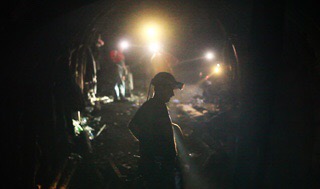
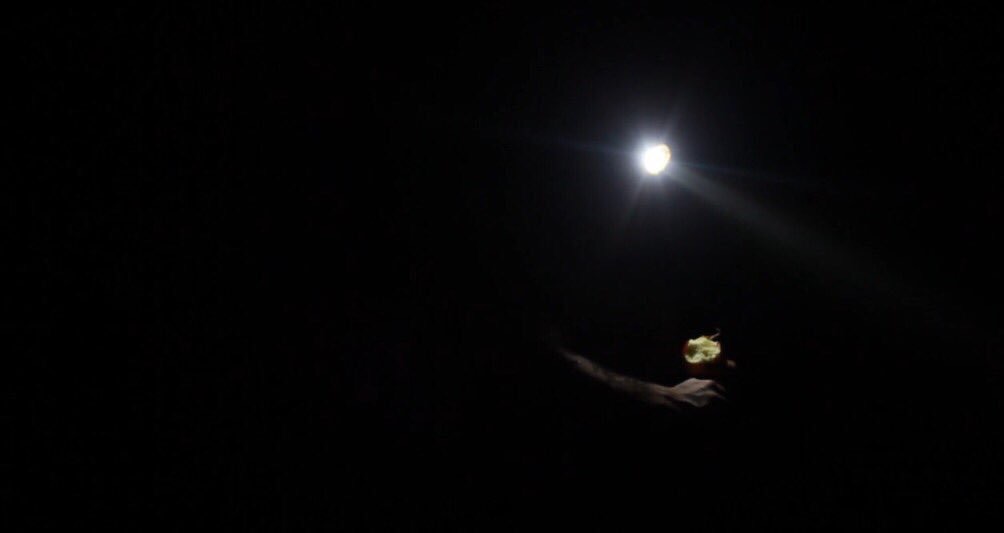
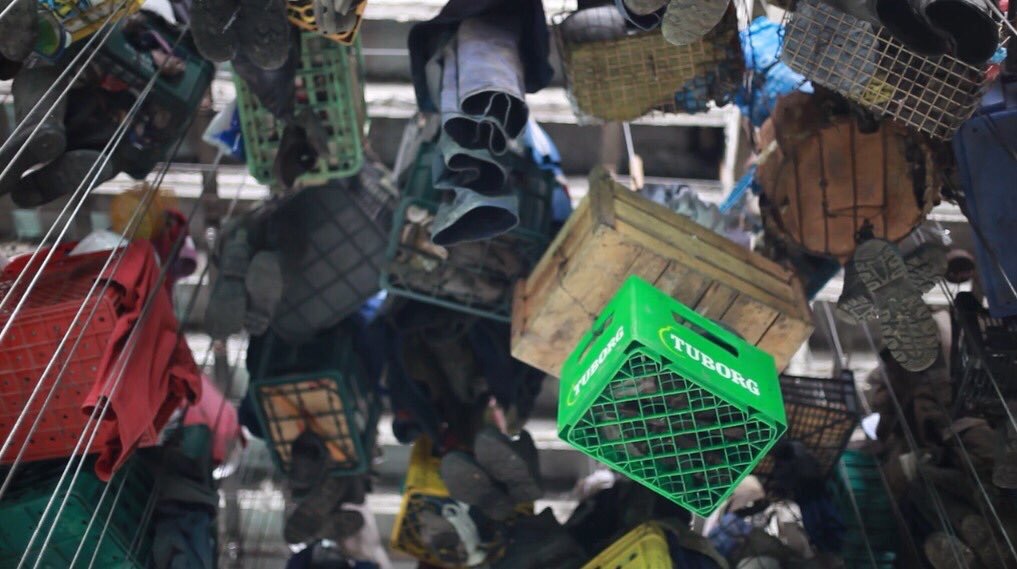
Aragane it’s an experimental documentary shot in a Bosnian coal mine, an immersive and hypnotic sensorial experience that was presented last year at the Yamagata International Documentary Film Festival, where it got a special mention. 
I wrote a review of the movie in Italian for the blog Sonatine, but I’m planning to write one in English as well and post it here, time permitting. 

In October I had the pleasure of interviewing Oda for the Italian newspaper Il Manifesto, the following is the original and longer version of that interview.

Can you tell us how you got involved in cinema, that is, how you got interested in watching and making movies in the first place?

 I wanted to be a professional basketball player, I played for 8 years since I was 10 years old, but unfortunately my right knee got broken. I underwent two big operations but it was not possible to keep playing seriously. Doctors said NO to me. So I was lost completely because the only thing I knew in life was basketball. I decided to go to the US to study abroad then, you know the typical thought that if you move the place, something may change in your life. There I took a film course, that was the first encounter to filmmaking, I was not cinephile at all and I am still not. (but I like some films, of course)

I made the very first film with my family in 2010 (ノイズが言うには Thus a Noise Speaks). It is a self-documentary made by my real family and myself about the coming-out as gay. The idea was to use filmmaking to communicate with my family and face the fact that they could not accept that I was gay. It was a tough experience but I learned a lot from that and started to see and use camera as a tool for communication. Communication between myself and the subject (the people/ the space).

 
(A still from Thus a Noise Speaks 「ノイズが言うには」)

How about film.factory? how did you happen to move to Sarajevo and be part of the group?  

 I got a chance to screen my first film in the student section of Nara International Film Festival in 2011, and there I met Kitagawa Shinji, the person who more than anybody else understands my filmmaking. He was the programmer/organizer of the section. The film got an audience award and we kept in touch since then. In 2012, he wrote me an email that there would be a new program in Sarajevo to support young filmmakers from all over the world. I was very much lost at that time, because it was very difficult to make my next film after a self-documentary by which I confronted the biggest conflict I had.

So I decided to apply to the program, moving to a new place and meeting new people.

Luckily, my application got accepted.   


Can you tell us more about Aragane, where did the idea come from? I heard that originally it was supposed to be a fiction inspired by a Kafka story (A Visit to a Mine), is that true?

Bela (Tarr) gave us an assignment to do an adaptation work. He wanted me to do ‘Bucket Rider’ a short story from Kafka that revolves around man looking for coal. So I went to a coal mine company to do research for the project. The space and the workers were incredibly attractive, immediately I knew I wanted to shoot them as I felt and not through an adaptation work.

What was the involvement of Bela Tarr in the making of Aragane? Did he give you any suggestions, ideas or was he just supervising the project?

I brought some shots I made there and told him that I wanted to make a film. He watched them and said ‘Go and shoot’. We had one meeting when I was still shooting and I had doubts about which direction I should go with the project, should I go more for the people and their story or more with the space itself?

He told me ‘Listen to yourself, what do you want to do?’

I said ‘I am attracted to the space and the physical work of miners’

After shooting, I edited the film and showed the first rough cut to him and he gave me some comments such as ‘maybe you should eliminate this shot’ or ‘keep this one’.

More than once you’ve mentioned space and your relationship with space when making a film, I think is a very fascinating subject. When I watched Aragane I felt very strongly that it’s a work about landscapes (a dark one, the mine), the materiality of it and the machinery in it. An “alien” landscape and the beauty of it. What brought you to focus more on the space/landscape and the machinery, and is there a reason behind the use of long takes?

 I think I was fascinated by the space because it was something totally new, complete darkness, magnificent volume of noises, but also sudden silence where there were no machines around.

The space drugged me into the film, my camera (gaze) was a communicator/mediator between what was there in front of camera and myself. I tried to understand and feel what was going on by shooting the space and its own time. Also, I didn’t approach the subject from the angle of the hard conditions of miners, unfairness and danger of their works (even though it is there in the film because it was just there). I hope people would not get me wrong by saying this. I/my camera shared some moments with them, I tried to be with them moment by moment. Focusing on social issue can be something good for miners, to say what is the problem and how ignorant we are about the issue, but I think the best I can do with my filmmaking is to try to be with the subject (space/people/time) and make them seen by being with them.

About the machinery, I think I shot them because their existence is big in that space and also because miners were proud of the machines, especially the huge ones digging into the side walls.

It may be a bit difficult to explain why the shots needed to be so long, but I tried to be honest toward the moments I captured with my camera.


I think the sound in Aragane is as important as the images, can you tell us more on how you were able to capture and magnify the sounds of the machines and, if you can, tell us about your relationship (as a filmmaker) to sounds/noise and soundscapes?

 It is very interesting to me that lots of people mention about sounds and soundscapes. The sound was recorded with the internal microphone of a Canon 5D, because I didn’t have something like Zoom, also I was most of the time alone, so my hands and focus was with the Camera/Image. My light was on the helmet to make the curtain space visible, so it would have been impossible for me to take care of the sound recording. What was recorded was done “without care” and automatically.

I did the sound mix myself, changing the volume here and there, cleaning a bit of noises, and making rhymes/music by adding some noise on top of another noise. That was fun and I think made the film to gain a sensorial feeling.

I was just playing with sound in Aragane , but I want to learn more about sound. The film made me realize and feel that Film is an audiovisual art.

It’s interesting that you’ve used the words “sensorial feeling”, the first time I saw Aragane I thought straight away of the works of the Harvard Sensory Ethnography Lab (Leviathan, Manakamana, Iron Ministry, etc.), you told me already you haven’t watched their movies and that you’re not really a cinephile, but I was wondering if you got ispired for your approach by any movies or more in general by any other work of art.

 After your email, Matteo, I watched ‘Manakamana’ ‘Iron MInistry’, and ‘People’s park’,

and I see what you see as similar.

It is very interesting because, before you mention about the Lab, I’ve thought that if I stop making films, I want to be an anthropologist. And I feel I am learning about human beings by making movies.

I might not be so good yet and I have not a clear idea about what I am doing with my camera, but it has been very clear for me that my theme is ‘where we come from, what we are, and where are we going?’ .

I know it sounds abstract and even pretentious, but I’m serious. I may not get the answers before I die, but I have at least the right to explore and challenge these themes with my life, I guess.

 I am inspired by: Wang Bing, Pedro Costa, Raymond Depardon, Wiseman, Cezanne. My bible: Letters To A Young Poet by Rilke.


One last question: what are your future plans, are you working on something at film.factory and how about after film.factory?

I have a few projects now.

One is my essay film, to conclude the experience in Bosnia and filmmaking here. This is my priority right now. It’s in the production stage.

And then I plan to do a workshop of filmmaking/photography/camera in a discipline center in Sarajevo. (It is a institution for the underage kids who commit crimes, not strict as much as a prison). I want to share the possibility of using the camera as a tool of communication and expression with these kids. This kind of workshop is what I want to do as my life time project, I don’t know if I can finance such a project, but I want to try my best to make it a constant practice in my life.

Or I might move to Mexico to do a project after film.factory, one of my colleagues is from Mexico and I want to shoot something there related to sea/water/cave. It’s still in the research/developing stage. Or maybe I’ll go back to Japan, it all depends on if I can support myself and how these projects can be produced!

 Feel free to add something you want to say or share.

 So many people have been supporting my filmmaking. My family, Kitagawa Shinji, Bela Tarr, and my dear colleagues. Most of the time, I shoot and edit alone and this sometimes make me misunderstand that I am making films alone, but in fact, there is always someone who introduces the subject to me, tries to support me mentally, gives me some thoughts on the film, shares the film, writes about the film, and watches the film. All these people make films. All these spaces and times make films. I’m just one of the gears/energies that make films happen.

New documentary for Hara Kazuo


Hara Kazuo is one of the most internationally well known Japanese documentarists, his The Emperor Naked Army Marches On (1987) is the first Japanese entry in the Sight & Sound’s poll The Best Documentaries of All Time and a movie that is often screened, talked about and studied in Japan as well as abroad. Now, personally The Emperor is not my favourite work from Hara, Sayonara CP (his debut from 1972) and especially Extreme Private Eros (1974) are better docs for reasons I’m not going to explore here today, and to be honest he’s not even among my favorite directors of non-fiction, but nonetheless I can’t deny he’s a very important and pivotal figure in Japanese cinema. Hara is also the only Japanese documentarist whose writings have been translated in English and collected in a volume, a very good one indeed, that everyone interested in non-fiction cinema should read. The title is Camera Obtrusa: The Action Documentaries of Hara Kazuo: By Hara Kazuo and was published in 2009 by Kaya Press.

All that was to introduce him and to give an idea of his status as a respected director in the international documentary world. The good news is that Hara has a new work out, the first documentary for the big screen after 22 years of absence, he’s been active with feature films, on TV, writing books and with other projects, but 「ニッポン国泉南石綿村 劇場版 命て なんぼなん?」, this the title of the movie, breaks a silence of more than two decades. The film had its premiere at a small event in Tokyo, フィクションとドキュメンタリーのボーダーを超えて, and is about the victims of asbestos exposure in Sennan city (Osaka), where Hara has been intermittently filming for more than a decade, while at the same time working on a project about Minamata’s victims. 
I haven’t seen the movie yet, but I hope to catch up with it as soon as possible, although, for some reason, I have very low expectations, but I’m ready and willing to be surprised. 

Addendum: Hara won’t be screening it again until summer at the earliest, and most likely the fall (again somewhere in Tokyo), as he’s planning on reworking/editing it after these screenings in Shibuya. 

Many thanks to Jordan A. Yamaji Smith for the update

Motohachi Seiichi’s new documentary『アラヤシキの住人たち』


Motohachi Seiichi is a photographer and documentary filmmaker whose works and activity and I’m referring here especially to his achievements in non-fiction, although presented at international film festivals, have not yet reached the audience and the recognition they deserved, in my opinion of course. 


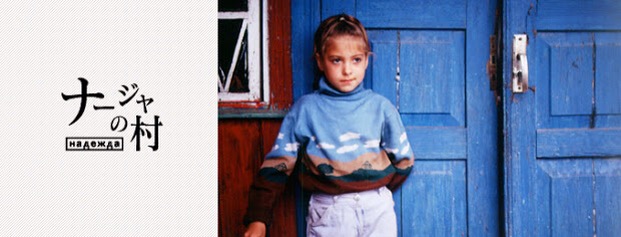
He’s the author of, among others,  Nadja’s Village and Alexei and the Spring, works screened at the Berlin International Film Festival, but also the producer of other interesting documentaries such as A Village That Changed Into Water (Onishi Nobuo, 2007) or Tale of a Butcher Shop (2013), the latter listed last year by Kinema Junpo in its annual best bunka eiga section. 


His new documentary, 『アラヤシキの住人たち』(Arayashiki no jūnintachi)  will open in some selected cinemas in Japan on May 1st and was shot during a year at the Kyodo Gakusha farm, a cooperative community which hosts people from a variety of backgrounds such as mentally disadvantaged persons or who are tired of the city life. Raising animals, growing vegetables and making cheese with ecological and organic methods, staying in this community means for its people also exploring a different style of living. It seems a documentary worth mentioning and following for a series of reasons, the topic of course but also the style adopted, at least from what we can glimpse from the trailer, is a move “back” when documentary in Japan meant to be first of all a visual work and the filmmaker cared about framing, light, editing etc. and wasn’t just a branch or a development of video journalism…..

Fighting Soldiers 「戦ふ兵隊」(Kamei Fumio, 1939) 

Kamei Fumio’s Fighting Soldiers is a defining work in the history of Japanese documentary, possibly one of the first non-fiction works made in the archipelago to have a very distinctive authorial touch, to the extent that it is often referred to as the “first Japanese documentary”.

In 1939, on behalf of Toho (PCL had changed its name to Toho just three years earlier), Kamei and cameraman Miki Shigeru went to China to make a propaganda documentary, or rather a war record, about the Japanese Imperial troops involved in the ongoing invasion of Manchuria. However, Kamei made something very different from what the government and the army expected, and the film was immediately banned from release. What the authorities particularly disliked was the portrayal of the soldiers, and also the depiction of Chinese casualties. As the head of the Japanese Metropolitan Police Board famously remarked at an advance screening: “These aren’t fighting soldiers, they’re tired soldiers!” .

I’m going to focus on the first 5 minutes of the film, one of my favourite openings in Japanese cinema and a powerful example of Kamei’s use of montage, a “method of philosophical expression” that the Japanese director so beautifully explained in his book Takakau eiga:

I think documentary film must be like haiku. If the viewer observes something with shot A, then shot B must produce the space for the viewers to freely develop their own creative possibilities. Shot B, therefore, demands a new observation by the viewer. Shot B is what i call the MA of documentary film.
(quote from “The Flash of Capital” Eric Cazdyn, pag. 64)

Kamei was obviously and directly influenced by Soviet cinema and, in particular, Soviet montage theory, a technique he mastered while studying film in Leningrad (now St Petersburg) in the early 1930s.

You can watch the opening here:

All the following stills are taken from the first five minutes of Fighting Soldiers and are here displayed in chronological order:

(1)

vlcsnap-2015-01-23-09h07m34s210

(2)

vlcsnap-2015-01-23-09h13m01s252

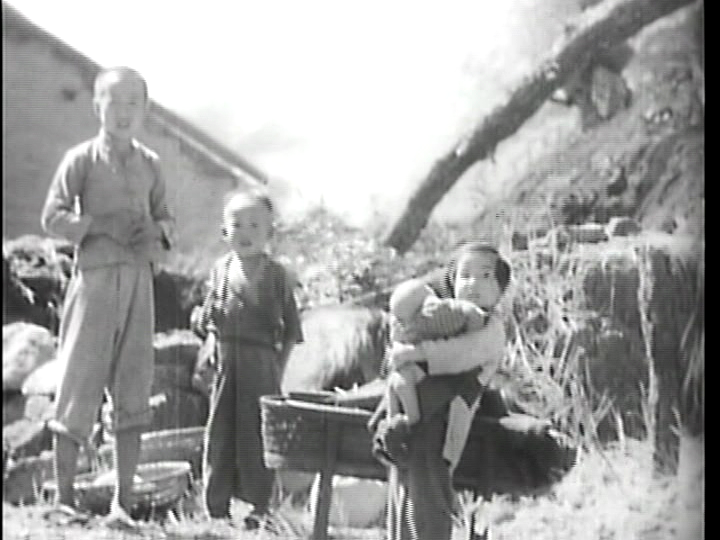
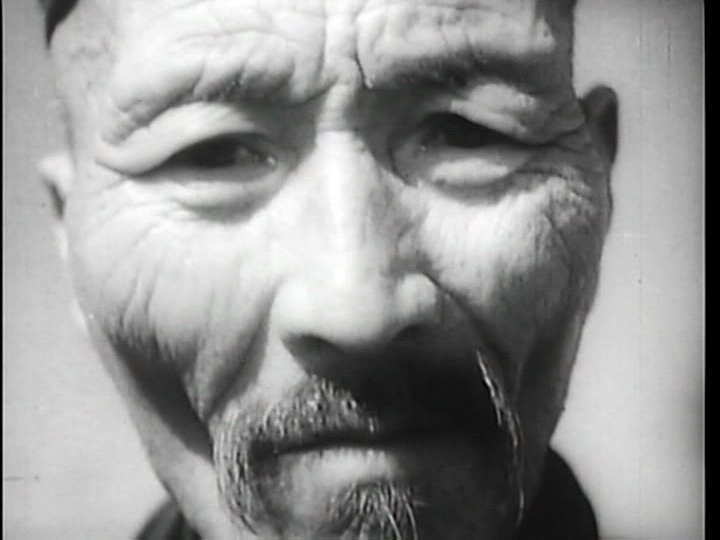
After the opening credits, the film begins with an old man praying in front of a shrine, images of destroyed houses, shots of children staring at the camera (1) and a powerful close-up of the same old man (2).

(3)

vlcsnap-2015-01-23-09h08m29s106

(4)

vlcsnap-2015-01-23-09h08m46s24

(5)

vlcsnap-2015-01-23-09h09m42s79

(6)

vlcsnap-2015-01-23-09h09m53s194

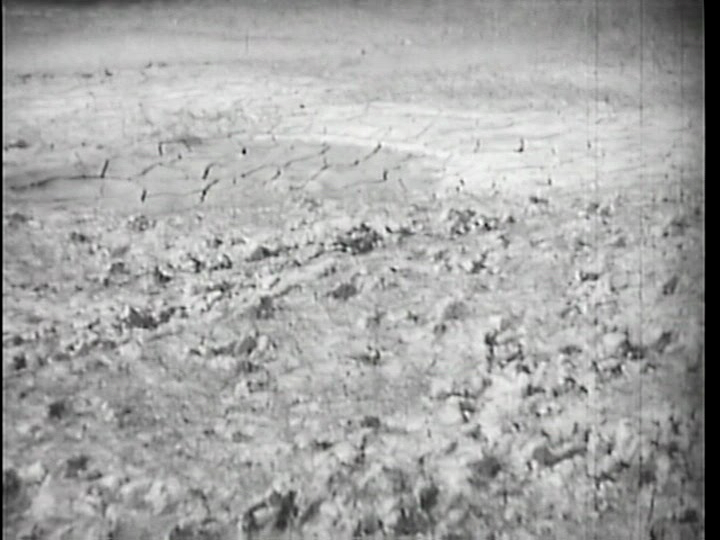
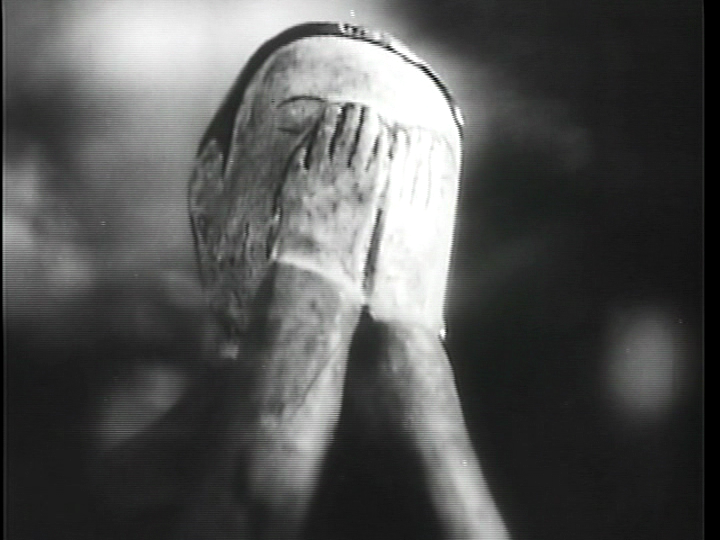
In the next scene, a group of people carrying all their belongings, walk away from the destroyed town (3) through a barren land (4), soon after, the movie cuts to a close-up of a small statue hands on its face, almost frozen in a scream of despair (5). Next we see the same statue from a different perspective with the expanse of dry land on its background (6).

(7)

vlcsnap-2015-01-23-09h10m52s1

(8)

vlcsnap-2015-01-23-09h11m10s188

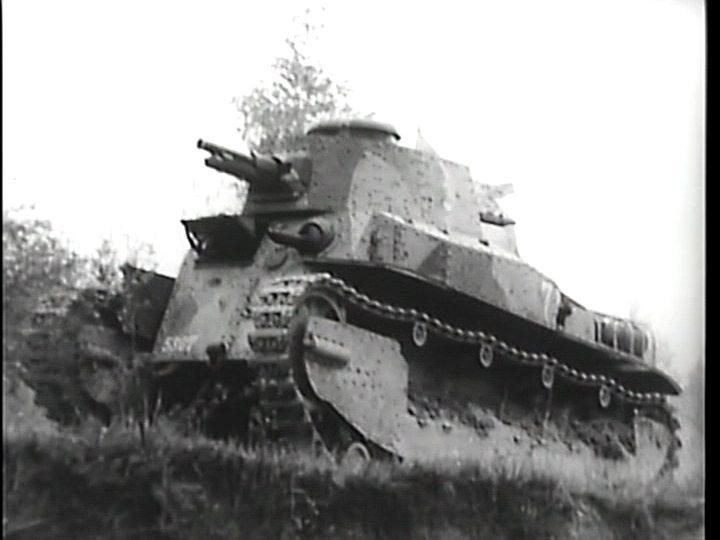
In the next shot we see the departure (or arrival) of Japanese tanks (7) from the land they conquered and destroyed, these war vehicles are seen from a medium distance. Next, in one of the most stunning shots and cuts in the history of Japanese documentary, the point of view shifts and we are now on a tank moving through the ruins of the bombed city. It’s a short tracking shot, and there’s also an amazing close-up of a Japanese flag flapping from the tank, but what we see in the background of the flag is the village reduced to rubble (8).

As a filmmaker, Kamei had the philosophical necessity, paradoxically even though he was making what is still considered a propaganda documentary, to bring to the fore what is usually relegated to the background: the suffering, the grief, the destruction and the loss that every military conflict brings. Because of this inner conflict/dichotomy, Fighting Soldiers is still hated or loved by many viewers and critics, and the film is considered by many critics and scholars to be both a cinematic miracle and an enigma. To make matters worse, in the years that followed, Kamei himself would often repeat and write that what he had made was in no way an anti-war film.
Problematic films, more than perfect ones, encourage us to think about and engage with their themes, they do not offer easy and ready-made points of view or solutions, they keep coming back to us, view after view, challenging our vision. Fighting Soldiers is one of these films, and one of the best to come out of the world of Japanese non-fiction cinema.

It’s a real shame that the film isn’t as well known in the West and that, apart from a cheap Japanese DVD, we don’t have a proper DVD or BD release.

Further readings:

Japanese Documentary Film – The Meiji Era Through Hiroshima, Abe Mark Nornes, University of Minnesota Press, 2003.

The Flash of Capital, Eric Cazdyn, Duke University Press, 2002.
Net

A Talk by Kamei Fumio
The typical genius of Kamei Fumio