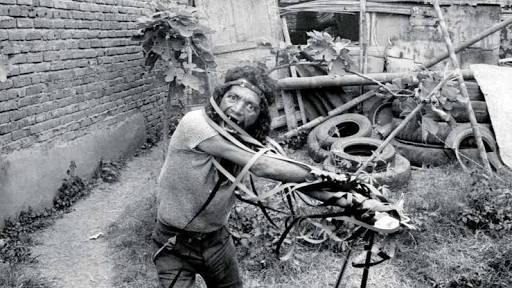
Here I am after my second day in Yamagata, a less intense one compared to yesterday, but nonetheless an eventful day (Oct 11th).
My day kicked off in the motning with 2 shorts by Luis Ospina, shot in collaboration with Carlos Mayolo, Listen, Look (1972) his debut and The Vampires of Poverty (1978), it is the last one that impressed me more. Partly parody, party documentary and partly mockumentary, the movie satirises a certain way of making cinema and TV that exploits the poor, a tendency to use the less fortunate to prove a pre-established political or social theory. Very creative in the way it’s constructed, Ospina mixes color and B&W photography, funny, improvised, but also scripted in some of its parts, overall it was a refreshing experience for me. The discovery continued with the afterscreening talk, when Ospina elaborated and explained a bit more about the movie, the so-called Cali group in Colombia and the concept of poverty porn, he also talked about how he was ostracised in Latin America by the Marxists and the left after the mivie was released.You can watch many of his movies (legally and for free) on his homepage, here.
The afternoon started with a short (30′) from Myanmar, When the Boat Comes In by Khin Maung Kyaw, a depiction of a small fishermen village and its difficulties to survive, a situation that worsened when the government decided to issue a one-month fishing ban. An interesting exploration of the daily life of the villagers and their unhappiness, had the documentary been longer, it would have probably beneficiated in term of quality and depth, hopefully the director will expand it into a longer version one day.
The third movie of the day was Trip Along Exodus by Hind Shoufani, the daughter of a famous politician and revolutionary Palestinian who after fighting for many years for the liberation of his land , decided toabandoned the scenes and live in Syria, far from his family and relatives.
The work is made as a diary-movie, the director talks with his father, asking him questions, in person or by phone, and trying to bridge the gab between the two, the man has been always more interesting in the revolutionary cause than in his family. It’s a “pretty” movie, in the sense that it uses some cute animation here and there to cheer up the somber tone of the film, and also the sense that is more a personal movie than a political one.
The day ended with the weakest work of all, PYRAMID: Kaleidoscope Memories of Destruction by Sasakubo Shin, a wanna-be experimental documentary shot in 8mm, to which I couldn’t connect at all. The music was good but it seems to me more a sort of long music video than an attempt to create something more concrete.
Like every day, from 10 o’clock at night, almost everybody went to Komian, a sort of nomiya where directors, film-lovers, journalists and whoever else meet, talk and drink until 2 or 3 in the morning, a very special place that makes Yamagata even more unique.



 Asian Docs