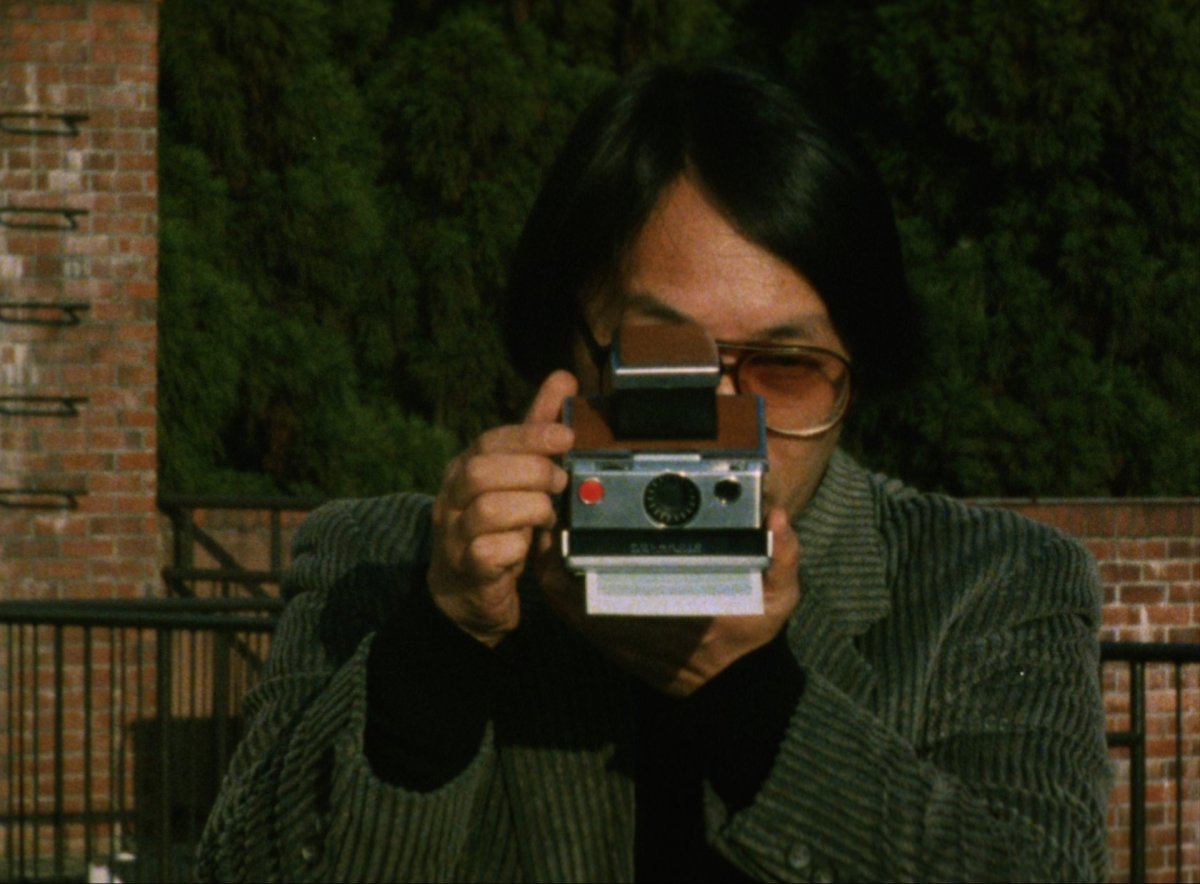
Remembering Matsumoto Toshio

…good starting point for this (re)discovery could be the recent release (by Cinelicious Pics) of Funeral Parade of Roses on Blu-ray and DVD, Matsumoto Toshio’s masterpiece newly restored in 4K, released in Japan in 1969 and recently screened in selected theaters around the U.S.A. The release is significant not only for the film itself, a unique movie experience indeed, but also because included in the package are eight extra works that Matsumoto made between 1961 and 1975: Nishijin, The Song of Stones, Ecstasis, Metastasis, Expansion, Mona Lisa, Siki Soku Ze Ku and Atman.
More than ten months have passed since the death of Matsumoto, and this release is a good and timely opportunity for me to collect my thoughts, trying to position his oeuvre in the context of post-war Japanese cinema, and to draw connections between Matsumoto and others filmmakers and the cultural milieu he grew up in as a filmmaker and artist.
In a career spanning more than fifty years Matsumoto made short and feature movies and moved freely from documentary to art-house films, and from pure experimental cinema to expanded cinema and video installations, in a very unique process of hybridization and genre overlapping that has few parallels in the world of cinema and image making.
In the seven months since his passing, prompted by the tragic event, I decided to

Continue reading “Remembering Matsumoto Toshio”

Kobe Documentary Film Festival 2015 第7回神戸ドキュメンタリー映画祭 (Oct 31st – Nov 10th)

In the autumn film festival madness, there are more film fests between October and November than stars in the sky, a very tiny but special place is occupied by the Kobe Documentary Film Festival,  an event established in 2009 at the Kobe Planet Film Archive. An important place for cinephiles and cinema lovers, the archive is a small structure, the theatre has only 38 seats, set up in 2007 and currently managed by Yasui Yoshio, one of the most renowed film historians and archivists of Japan. Incidentally Kobe has a special relationship to the seventh art, Edison’s Kinetoscope was imported to Kobe in 1896 and one year after the city was also the first place in Japan where the Lumiere brothers brought their Cinematographe

In these 7 years the mini festival, it’s more like a retrospective than a “real” fest, has presented works of Yanagisawa Hisao and Tsuchimoto Noriaki – in its 2 first editions, a special devoted to the great Tōhōku Earthquake and documentary in 2011, and the following year a retrospective on NDU and Nunokawa Tetsurō, a showcase that I was able to attend, a real discovery that allowed me to deepen my knowledge of one of the most important Japanese film collective of the 60s and 70s, a real treat. 

Kobe Documentary Film Festival kicks off tomorrow, October 31st,  and will last until November 10th. This year the main focus won’t be on one filmmaker or a movement in particular, but the screenings will be more varied. Discovering Images—The Age of Matsumoto Toshio, a documentary on Matsumoto Toshio by Takefumi Tsutsui, almost 12 hours (the work is divided in 5 parts) to retrace the career of one of the most important Japanese filmmakers and theorists of the post-bellic period, is maybe the most important to me. London (1994), Robinson in Space (1997) and Robinson in Ruins (2001) by Patrick Keiller, under the wave, on the ground (波のした、土のうえ) by Komori Haruka and Seo Natsumi will also be screened, and last but not least a special selection from the Yamagata International Documentary Film Festival, 5 films screened in the last 25 years at the prestigious event. 

Unfortunately I won’t be able to attend the festival this year, what I really wanted to see was the massive documentary on Matsumoto – I missed it at Yamagata as well, and under the wave, on the ground, but I’m sure there will be more chances to catch up with them. 

You can find the program here (only Japanese)