Yamagata 2017 – day 1

October 6th

Arrived this morning in a gray, cloudy and a bit chilly, but not too much, Yamagata. My first day at the festival was welcomed by the screening of Funeral Parade of Roses, and it could not have been otherwise, this is the first edition of the festival without Toshio Matsumoto and attending the screening of a movie I’ve seen so many times, but never on the big screen, was almost a duty and my way of paying respect to the great director.

Funeral Parade of Roses was followed by Cats, Dogs, Farm Animals and Sashimi, the story of Dondon, a boy “trapped” in a rural area of the Philippines from one dead-end job to another. The movie is directed by Perry Dizon a member of Lav Diaz group, for which he often works as an actor.

For the afternoon/evening slot I’ve opted for the documentaries made by Jocelyne Saab during the 1970s about Lebanon and Beiruit instead of Ex Libris, the latest from Wiseman that I’ll catch the day after tomorrow, and the decision turned out to be a bliss. The early works by the Lebanese director and former journalist are a rarity, unfortunately Saab wasn’t able to attend the festival, some health issues kept her in Paris, but the movies were an absolute revelation. Part essay-films and part a personal view of the horrors perpetrated to Beirut and Lebanon between from the breaking of the civil war in 1975, the three movies, Beirut Never More (’76), Letter from Beirut (’78) and Beirut My City (’82) are also a deep reflection on identity, memory, and the meaning(less) of images in war. Saab, especially in the first and third documentaries, tries, I am here paraphrasing the words spoken in the last film, to capture the reality of war, its horror and tragedy, paradoxally before it could cristyllize in images, consequently becoming something different and detached. I’m still elaborating the impact that these works had, and are still having, on me; once the festival is finished, I’ll try to write something.

Yamagata International Documentary Film Festival 2017

The Yamagata International Documentary Film Festival, one of the most awaited film-related events of the Japanese archipelago, will kick off its fifteenth edition next week on October 5th. For eight days the city of Yamagata will be the capital of documentary cinema, hosting not only an international competition with movies from all over the globe, but also a plethora of  more or less known documentaries presented in other sections, special screenings and retrospectives. For the cinephiles and the film lovers visiting the northern Japanese city, the festival will be an occasion to discover hidden gems of historical importance and an unmissable chance to meet directors, scholars and documentary-obsessed people.
Festival opens on the 5th with a special screening commemorating the passing of Matsumoto Toshio, one of the true giants of Japanese cinema. Two of his best known documentaries, Nishijin (1961) and Ginrin / Bicycle in Dreams (1955) will be presented for the occasion in their original format (35mm), while For My Crushed Right Eye (1968) will be screened as it was originally conceived, that is in 16mm and with 3 projectors. Funeral Parade of Roses (1969) and other experimental works made by Matsumoto during the 1970s and 1980s will also be shown during the festival, including one of my favourite, Atman (1975), a kaleidoscopic trip to the philosophical source of movement and image.
Among the titles presented in the International Competition a must-see for me is Ex Libris—The New York Public Library, the latest work by Frederick Wiseman, but I’m also looking forward to I Am Not Your Negro by Raoul Peck and the long-awaited new work by Hara Kazuo, Sennan Asbestos Disaster, the first feature documentary the director of The Emperor’s Naked Army Marches On made in more than a decade. The movie follows the victims who suffered asbestos-related damages in the city of Sennan in Osaka, during their eight years fight for compensation.
Also in competition the beautiful Machines by Rahul Jain (I wrote about it here), Donkeyote, a subtle reflection on dreams and hopes through the eyes of a donkey and its ageing owner, directed by Chico Pereira, and Another Year by Zhu Shengze, a movie that has received much praise in the international festival circuit. Wake (Subic) by John Gianvito, about the pollution afflicting the residents of a former US naval base in Luzon Island, the Philippines, looks interesting and so does Tremoring of Hope, the difficult recovery of the people of Hadenya in Miyagi, six years after the Great East Japan Earthquake.
Here the complete line-up.
A promising section that will probably sparkle heated post-screening debates is Politics and Film: Palestine and Lebanon 70s–80s, a selection of films made in Palestine and Lebanon during the Lebanon civil war (1975-1990) and in recent years, movies that show and reflect on the struggles and politics of the area. Among them the (in)famous Red Army / PFLP: Declaration of World War, filmed by Wakamatsu Koji and Adachi Masao in 1971, and Genet in Shatila (1999), about the French writer and his relation with the Palestinian revolution as he witnessed the aftermath of the Shatila’s massacre in September of 1982.

Introducing Asian documentary filmmakers, New Asian Currents is usually one of my favorite section for its scope and the variety of films shown, this year 21 works from the continent will be presented, giving us a glimpse of the life, difficulties and struggles the people inhabiting the huge and diversified area have to cope with in their daily life. A Yangtze Landscape by Xu Xin is an interesting movie (more here) that deserves to be seen on the big screen, exploring the geographical and social landscape surrounding the Yangtze River in its long course of more than thousands kilometers. While the works of Yamashiro Chikako are a rare example, rare in Japan at least, of how to tackle a series of thorny historical issues, Okinawa and its relation with mainland Japan and with its past, merging documentary with the experimental.
Here the section’s complete line-up.
I’m ashamed to admit, but I know almost nothing of African documentary. Africa Views will thus be my entrance gate to it, “a program that introduces over 20 films created since the year 2000—with a particular focus on the Sub-Saharan region—depicting a contemporary Africa that lets off a considerable racket as it creaks toward progress, and introducing us to the people who live there.” What caught my attention in Perspective Japan are the new films by Murakami Kenji and Onishi Kenji, two short experiments in 8mm whose screening promises to be, like two years ago, a real cinema-event.
The Festival will also hold a retrospective on Fredi M. Murer, a Swiss director that the program describes as “a leader of the internationally-acclaimed Swiss Nouveau Cinema movement that was active from the late 1960s through the 1980s, together with Daniel Schmid and Alain Tanner. (…) Depending on the period in which they were made, Murer’s works may be classified variously as experimental film, documentary, or narrative film.” The retrospective that interest me the most though is Ten Trips Around the Sun: Sato Makoto’s Documentary Horizon Today, a tribute to Sato Makoto on the 10th anniversary of his death, that will include screenings of his major works accompanied by discussions and panels.

North Korean missiles permitting, I’ll be in Yamagata from October 6 to 11, and, as I did two years ago, I will try to keep a diary of my viewings experiences, here or more likely on my Twitter account.

P.S. I’ve also created a list on Letterboxd with most of the movies that will be in Yamagata.

This slideshow requires JavaScript.

From the archives: Kamei Fumio, Hani Susumu, and Ogawa Production in two Italian publications (1967, 1970)

The Centro sperimentale di cinematografia (Experimental film centre) in Rome is one of the oldest cinema schools in the world and the oldest in Europe. Founded in 1935, the centre nourished and helped establishing, in different degrees, the career of many important filmmakers, photographers and actors. Japanese director Masumura Yasuzō famously studied at the school for about two years at the beginning of the 1950s under luminaries such as Michelangelo Antonioni, Federico Fellini and Luchino Visconti, an experience that without doubt helped shaping his approach to cinema and his views as a filmmaker.
In 1937 the centre started to publish its own film journal, Bianco e Nero, a monthly magazine that is still been published to this day. A couple of years back I bought a copy from 1967 (February) that has an article, penned by film critic Claudio Bertieri, on the documentaries of Hani Susumu and Kamei Fumio. In November of the previous year the Festival dei Popoli in Florence, an event dedicated to non-fiction still running today, presented a mini-retrospective on Japanese documentary, and Bertieri discusses in the short article, titled Susumu Hani, Fumio Kamei ed il documentario giapponese (Susumu Hani, Fumio Kamei and Japanese documentary), the movies he was able to see at the festival. He devotes most of the article on Hani, Yuki Matsuri (1953), Children in the Classroom (1954), Children Who Draw (1955), Twins in the Class (1956) and Hōryū-ji (1958) are the documentaries here analysed, while the rest of the piece is spent examining Kamei’s It’s Good to Live (1956) and The World of Yukara (1964), a trilogy about Ainu’s traditions. Although written in 1967 — a period when Japanese documentaries certainly were not known or available to watch as they are today (well, they are not that discussed even today…)— and with few dated observations here and there, most of the analysis remain solid to this day. Documentary as opposed to mainstream cinema ‘the man in the street here [in Europe] has not seen Louisiana Story, in Japan he does not know Hani or Kamei’, Hani’s ability to capture moments of pure innocence in children, or Kamei sensibility when portraying human suffering are spot-on insights.

Even more interesting, but for different reasons, is Cinema: Giappone e Zengakuren (Cinema: Japan and Zengakuren) a short book published in 1970 by Samonà e Savelli, later Savelli – La Nuova Sinistra, a publisher established in 1963 and the first to directly represent the extra-parliamentary left-wing in the Italian publishing world. Over the next decade the books printed by Savelli – La Nuova Sinistra, also fueled by political and social unrest in the peninsula, would gain momentum and become a cultural reference point for left-wing groups such as Potere Operaio and Lotta Continua , and for the newspaper Il Manifesto.

The book is devoted to Ogawa Shinsuke’s The Battle Front for the Liberation of Japan – Summer in Narita (1968), the first movie in the Narita/Sanrizuka Series. A brief introduction that outlines the Japanese political situation and the fierce resistance by the peasants and the students, is followed by a translation of some writings by members of Ogawa Production, just a couple of paragraphs nothing more, while the main part of the volume is a transcription of the dialogues spoken in the film. It was a period where revolutionary cinema(s) of the globe were connecting to each other and were trying to build a common front against capitalism, the people in power and the establishment. The back cover is in this regard illuminating: Comitato di Cinema e Rivoluzione: Baldelli, Filippi, Ivens, Ogawa, Rocha, Solanas, Straub (Cinema and Revolution’s committee: Baldelli, Filippi, Ivens, Ogawa, Rocha, Solanas, Straub).

Reading these two publications after almost 50 years since they were originally printed was a very fascinating discovery, Ogawa and Kamei are two of the most important documentarists in the history of world cinema and essentially the reason this blog exists. Cinema: Japan and Zengakuren in particular is revelatory not as much for the information it contains, there are some mistakes of course—in the pre-internet age Japan was still a land far away and often misrepresented—but more as an artifact of an era long gone but still able to resonate with our present. An era when the arts were explicitly politicized, in a state of never-ending struggle and ready to change the world.

This slideshow requires JavaScript.

100 best Japanese labor films

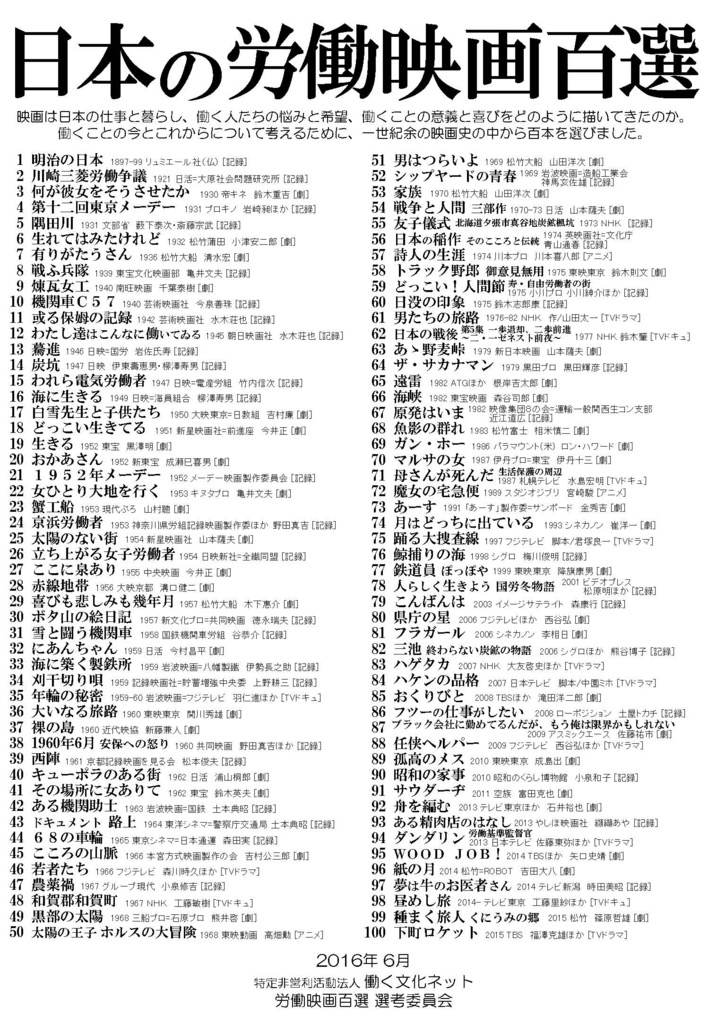
Last June the NPO organization “Hataraku Bunka Net” made and released a list of the 100 best Japanese labor films, a vast and varied list that besides documentaries includes also many classic movies and big names, TV series, indies and so on, from the beginning of cinema, with the actualities filmed by the Lumière company at the end of 19th century, to the present day. Below you can find the list in Japanese followed by my translation (feel free to correct me if you find any mistakes):

  1. 『明治の日本』(1897~1899, Lumière company )
  2. Kawasaki Mitsubishi Strike 「川崎・三菱造船所労働争議」(1921)
  3. What Made Her Do It? 「何が彼女をそうさせたか」(Suzuki Shigeyoshi, 1930)
  4.  Twelfth Annual Tokyo May Day 「第 12 回東京メーデー」(Prokino, 1931)
  5. Sumida River 「隅田川」(Yabushita Taiji, 1931)
  6. I Was Born, But… 「生れてはみたけれど」(Ozu Yasujirō, 1932)
  7. Mr. Thank You 「有りがたうさん」(Shimizu Hiroshi, 1936)
  8. Fighting Soldiers 「戦ふ兵隊」(Kamei Fumio, 1939)
  9.  Renga jokō 「煉瓦女工」(Chiba Yasuki, 1940)
  10. Kikansha C57 「機関車C57」 (Imaizumi Zenju, 1940)
  11. Record of a Kindergarten Teacher 「或る保姆の記録」(Mizuki Soya, 1942)
  12. We’re Working So So Hard 「私たちはこんなに働いている」(Mizuki Soya, 1945)
  13. Rushing Forward 「驀進」(Iwasa Ujitoshi, 1946)
  14. Coal Mine 「炭坑」(Itō Sueo, Yanagisawa Hisao, 1947)
  15. We Are Electric Industry Workers 「われら電気労働者」(1947)
  16. Living on the Sea 「海に生きる」 (Yanagisawa Hisao, Kabashima Seichi, 1949)
  17. Shirayuki-sensei to kodomo-tachi「白雪先生と子供たち」(Yoshimura Ren, 1950)
  18. Still We Live 「どっこい生きてる」(Imai Tadashi, 1951)
  19. Ikiru 「生きる」(Kurosawa Akira, 1952)
  20. Mother 「おかあさん」(Naruse Mikio, 1952)
  21. May Day 1952 [1952年メーデー」(Yoshimi Yutaka, 1952)
  22. Woman Walking Alone on the Earth「女ひとり大地を行く」(Kamei Fumio, 1953)
  23. The Crab Cannery Ship 「蟹工船」 (Yamamura Sō, 1953)
  24. The Wokers of Keihin 「京浜労働者」(Noda Shinkichi, 1953)
  25. The Street Without Sun 「太陽のない街」(Yamamoto Satsuo, 1954)
  26. Tachiagaru onnanoko rōdōsha (Zensen domei, 1954)
  27. Koko ni izumi ari 「ここに泉あり」(Imai Tadashi, 1955)
  28. Street of Shame 「赤線地帯」(Mizoguchi Kenji, 1956)
  29. The Lighthouse aka Times of Joy and Sorrow 「喜びも悲しみも幾歳月」(Kinoshita Keisuke, 1957)
  30. Bota san no enikki 「ボタ山の絵日記」(Tokunaga Mizuo, 1957)
  31. Yuki to tatakau kikansha 「雪と闘う機関車」(Tani Kyōsuke, 1958)
  32. My Second Brother「にあんちゃん」(Imamura Shōhei, 1959)
  33. Umi ni kizuku seitetsujo「海に築く製鉄所」(Ise Chōnosuke, 1959)
  34. 刈干切り唄(1959, Ueno Kōzō)
  35. The Secret of Tree Rings (TV series) 「年輪の秘密」(Hani Susumu, Noriaki Tsuchimoto, Nagano Shigeichi 1959-60)
  36. Ōinaru tabiji「大いなる旅路」(Sekigawa Hideo, 1960)
  37. The Naked Island 「裸の島」(Shindō Kaneto, 1960)
  38. 1960 nen  6 gatsu anpo e no ikari「1960年6月 安保への怒り」(Noda Shinkichi Noda, Tomizawa Yukio, 1960)
  39. The Weavers of Nishijin 「西陣」(Matsumoto Toshio, 1961)
  40. Foundry Town 「キューポラのある街」(Urayama Kirio, 1962)
  41. Woman of Design「その場所に女ありて」(Suzuki Hideo, 1962)
  42. An Engineer’s Assistant「ある機関助士」 (Tsuchimoto Noriaki, 1963)
  43. On the Road—A Document 「ドキュメント 路上」(Tsuchimoto Noriaki, 1964)
  44. 68 no sharin 「68の車輪」(Morita Minoru, 1965)
  45. Kokoro no sanmyaku「こころの山脈」(Yoshimura Kōzaburō, 1966)
  46. The Siblings 「若者たち」(Tokihisa Tokihisa Morikawa, 1966)
  47. Nōyaku ka「農薬禍」(Shūkichi Koizumi, 1967)
  48. Waga Town, Waga District in Summer 1967 「特集 和賀郡和賀町 1967年 夏」(Kudo Toshiki, 1967)
  49. The Sands of Kurobe 「黒部の太陽」(Kumai Kei, 1968)
  50. The Great Adventure of Horus, Prince of the Sun「太陽の王子 ホルスの大冒険」(Takahata Isao, 1968)
  51. It’s Tough Being a Man 「男はつらいよ」(Yamada Yōji, 1969)
  52. Shipyard no seishun 「シップヤードの青春」(Kamiuma Isao, 1969)
  53. Where Spring Comes Late 「家族」(Yamada Yōji, 1970)
  54. Men and War trilogy 「戦争と人間 三部作」(Yamamoto Satsuo, 1970-73)
  55. Yūko gishiki Hokkaido Yubari shi mayachi tankō kaede ana「友子儀式 北海道夕張市真谷地炭鉱 楓坑」(NHK archives, 1973)
  56. Nihon no inasaku sono kokoro to dentō「日本の稲作 そのこころと伝統」(Aoyama Michiharu, 1974)
  57. A Poet’s Life 「詩人の生涯」(Kawamoto Kihachirō, 1974)
  58. Torakku Yarō: goiken muyō 「トラック野郎 御意見無用」(Suzuki Norifumi, 1975)
  59. A Song of the Bottom「どっこい!人間節 寿・自由労働者 の街」(Ogawa Production, 1975)
  60. Impressions of a Sunset「日没の印象」(Suzuki Shiroyasu, 1975)
  61. Otokotachi no tabiji 「男たちの旅路」(NHK drama, 1976-1982)
  62. Nihon no sengo dai 5 「NHK特集 日本の戦後 第5集 一 歩退却 二歩前進 二・一ゼネスト前 夜」(NHK, 1977)
  63. Oh! The Nomugi Pass 「あゝ野麦峠」(Yamamoto Satsuo, 1979)
  64. The Sakana man 「ザ・サカナマン」(Kuroda Teruhiko, 1979)
  65. Enrai 「遠雷」(Negishi Kichitarō, 1981)
  66. Kaikyō 「海峡」(Minami Kōsetsu, 1982)
  67. Genpatsu wa ima 「原発はいま」(Ōmi Michihiro, 1982)
  68. The Catch 「魚影の群れ」 (Sōmai Shinji, 1983)
  69. Gung Ho (Ron Howard, 1986)
  70. A Taxing Woman 「マルサの女」(Itami Jūzō, 1987)
  71. Haha ga shinda – seikatsu hogo no shūhen  『母さんが死んだ―生活保護の周辺』(Mizushima Hiroaki, 1987)
  72. Kiki’s Delivery Service「魔女の宅急便」(Miyazaki Hayao, 1989)
  73. Earth 「あーす」(Kim Soo-Kil, 1991)
  74. All Under the Moon 「月はどっちに出ている」(Sai Yōichi, 1993)
  75. Bayside Shakedown 「踊る大捜査線」(Motohiro Katsuyuki, 1997)
  76. Whalers and the Sea 「鯨捕りの海」(Umekawa Toshiaki, 1998)
  77. Poppoya 「鉄道員/ ぽっぽや」(Furuhata Yasuo, 1999)
  78. Be More Human – Kokuro’s 15-year Struggle 「人らしく生きよう 国労冬物語」(Matsubara Akira, Sasaki Yumi
  79. Konbanwa「こんばんは」(Mori Yasuyuki, 2003)
  80. Genchō no hoshi「県庁の星」(Nishitani Hiroshi, 2003)
  81. Hula Girls 「フラガール」 (Lee Sang-il, 2006)
  82. Echoes From The Miike Mine「三池 終わらない炭鉱(やま)の物語」(Kumagai Hiroko, 2006)
  83. Hagetaka – TV drama 「土曜ドラマ ハゲタカ」 (Ōtomo Keishi, Inoue Go, Horikirizono Kentarō, 2006)
  84. Haken no Hinkaku – TV drama 「ハケンの品格」(Nagumo Seiichi, Satō Toya, 2007)
  85. Departures 「おくりびと」(Takita Yōjirō, 2008)
  86. A Normal Life, Please 「フツーの仕事がしたい」(Tsuchiya Tokachi, 2009)
  87. Genkai in a Black Company 「ブラック会社に勤めてるんだが、 もう俺は限界かもしれない」(Satō Yūichi, 2009)
  88. Ninkyō Helper 「任侠ヘルパー」(TV drama, 2009)
  89. A Lone Scalpel 「孤高のメス」(Narushima Izuru, 2010)
  90. Showa Housekeeping 「昭和の家事」(Koizumi Kazuko, 2010)
  91. Saudade 「サウダーヂ」(Tomita Katsuya, 2011)
  92. The Great Passage 「舟を編む」(Ishii Yuya, 2013)
  93. Tale of a Butcher Shop 「ある精肉店のはなし」(Hana usa Aya, 2013)
  94. Dandarin Rules 「ダンダリン 労働基準監督官」(Sato Tayō, Nakajima Satoru, 2013)
  95. Wood Job! 「ウッジョブ~神 去なあなあ日常」(Yaguchi Shinobu, 2014)
  96. Pale Moon 「紙の月」(Yoshida Daihachi, 2014)
  97. A Little Girl’s Dream 「夢は牛のお医者さん」(Tokita Yoshiyaki, 2014)
  98. Hirumeshi tabi: Anata no gohan misetekudasai! 「昼めし旅 ~あなたのご飯見せてく ださい」(TV drama, 2014)
  99. A Sower of Seeds 「種まく旅人 くにうみの郷」(Shinohara Tetsuo, 2015)
  100. Shitamachi Rocket 「下町ロケット」(TV drama, 2015)

Ogawa Production’s Sanrizuka Series – DVD Box set is out today

img_2206

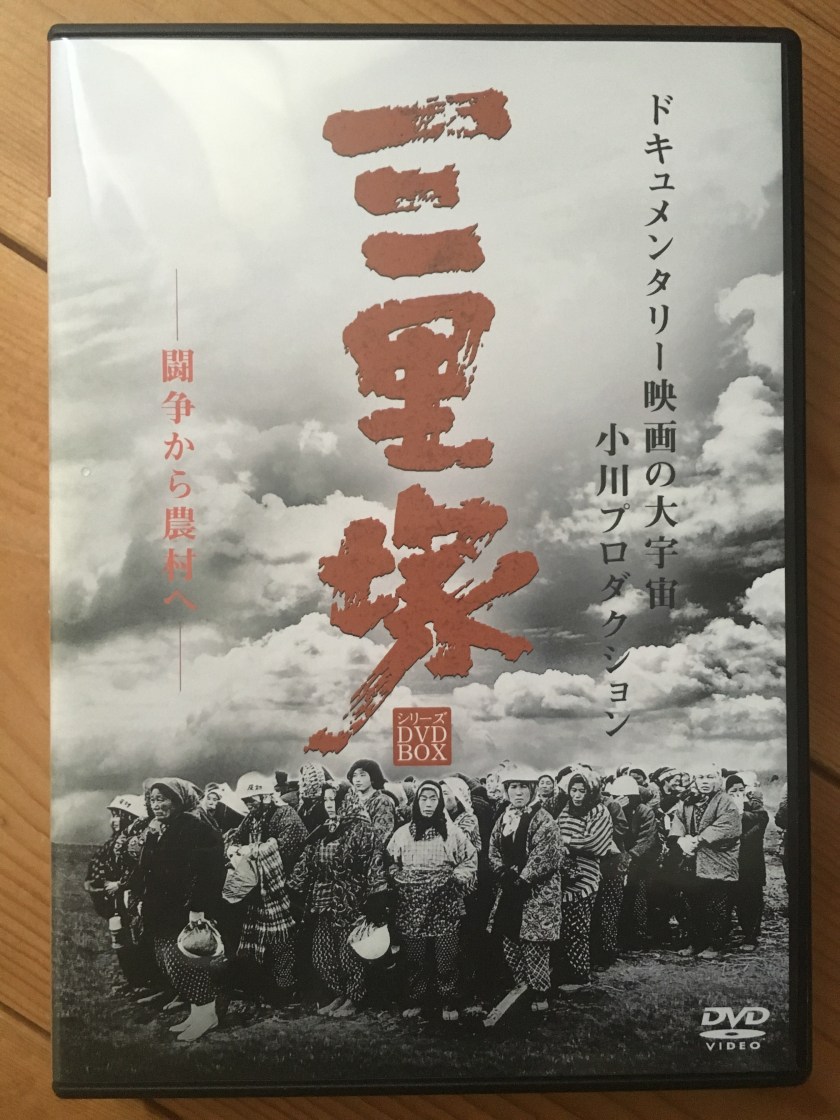
Known outside Japan as the Narita series, the works made by Ogawa Shinsuke and his collective from 1968 to 1973 (with a return to the area in 1977) filming the battle and resistance of farmers, students, activists against the building of Narita airport, are usually called in Japan the Sanrizuka series, from the name of the area where the main struggle and land expropriation took place (an ongiing battle that is not over, by the way). As written briefly in a previous post, the Japanese label DIG is putting out on DVD all the documentaries of Ogawa Production, the first 3 films were released in June, and today (July 2nd) DIG is also releasing a DVD box set of the Sanrizuka/Narita series. Here’s the list of the works included in the box set:

  1.  Summer in Narita『日本解放戦線 三里塚の夏』(1968)
  2. Winter in Narita 『日本解放戦線 三里塚』(1970)
  3.  Three Day War in Narita『三里塚 第三次強制測量阻止斗争』(1970)
  4.  Narita: Peasants of the Second Fortress『三里塚 第二砦の人々』(1971)
  5. Narita: The Building of Iwayama Tower  『三里塚 岩山に鉄塔が出来た』(1972)
  6. Narita: Heta Village 『三里塚 辺田部落』(1973)
  7. Narita: The Sky of May  『三里塚 五月の空 里のかよい路』(1977)
  8. as an extra work, available only in the box set: Fimmaking and the Way to the Village (1973, Fukuda Katsuhiko)『映画作りとむらへの道』(1973)

The box set comes with a booklet where each movie is introduced and a final note by renown documentarist Hara Kazuo. I haven’t had the chance to watch them yet, so I can’t say anything about the transfer*.
All the DVDs don’t have English subtitles, but that fact that finally these important documentaries are available on home-video basically for the first time, the only Summer in Narita was released with a book a couple of years ago, is something to rejoice. My hope is that some label outside Japan (maybe Zakka Films or even Icarus Films, why not?) will one day in the near future put together an international edition.

* July 4th addendum: I’ve watched some minutes of Heta Village, The Building of Iwayama Tower and Narita: Peasants of the Second Fortress just to get an idea of the transfer’s quality. As I expected the DVDs mirror the quality of the original prints – I’ve seen them all on the big screen, but many times on quite battered DVD samples, so my memory might trick me here. Be that as it may, the movies are not in a good state, lots of scratches, flecks and dirt, in a perfect world they would have had a restoration first and they would have been transferred on DVD only later. But we don’t live in a perfect world and the huge debt left by the group is still hindering any “normal” process of preserving and presenting the works in a pristine state. That being said,  this release is an important step anyway, because it will help to introduce Owaga Pro and its documentaries to a wider and younger audience, and just for this reason it’s a project that should be praised.