Yamagata Doc Film Fest, report – day 3 and awards

My final day in Yamagata (October 12th) was a bit more relaxed than the previous two, the festival fatigue started to kick in and the nights spent talking & drinking at Komian did the rest. There were many movies I really wanted to see, Pedro Costa’s Horse Money, Homeland (Iraq Year Zero) by Abbas Fahdel, Ospina’s It all Started at the End and others. Unfortunatly all of them were screened around the same time in the afternoon, and I had to choose one, so finally I opted for Ospina’s, my personal way of completing the discovery of the Cali Group and the independent cinema of Colombia between the 70s and 80s. It All Started at the End is a long and absorbing work that goes back to the beginning of the movement, and using a mix of styles and images (footage, digital, mobile phone’s camera) tells the story of a group of friends and artists who revolutionised cinema in Colombia.

In the morning I attended the screening of a TV documentary (actually a mokumentary) made in 2006 by Mori Tatsuya and Murakami Kenji (edited by Matsue Tetsuaki) Documentary:  Truth or Lies「ドキュメンタリーは嘘をつく」A work that plays with and criticises the way non-fiction is usually planned and made on TV, funny at times but not always entertaining and cutting, this short film has nonetheless the quality of making the audience think and let them see what’s happening behind the camera. 
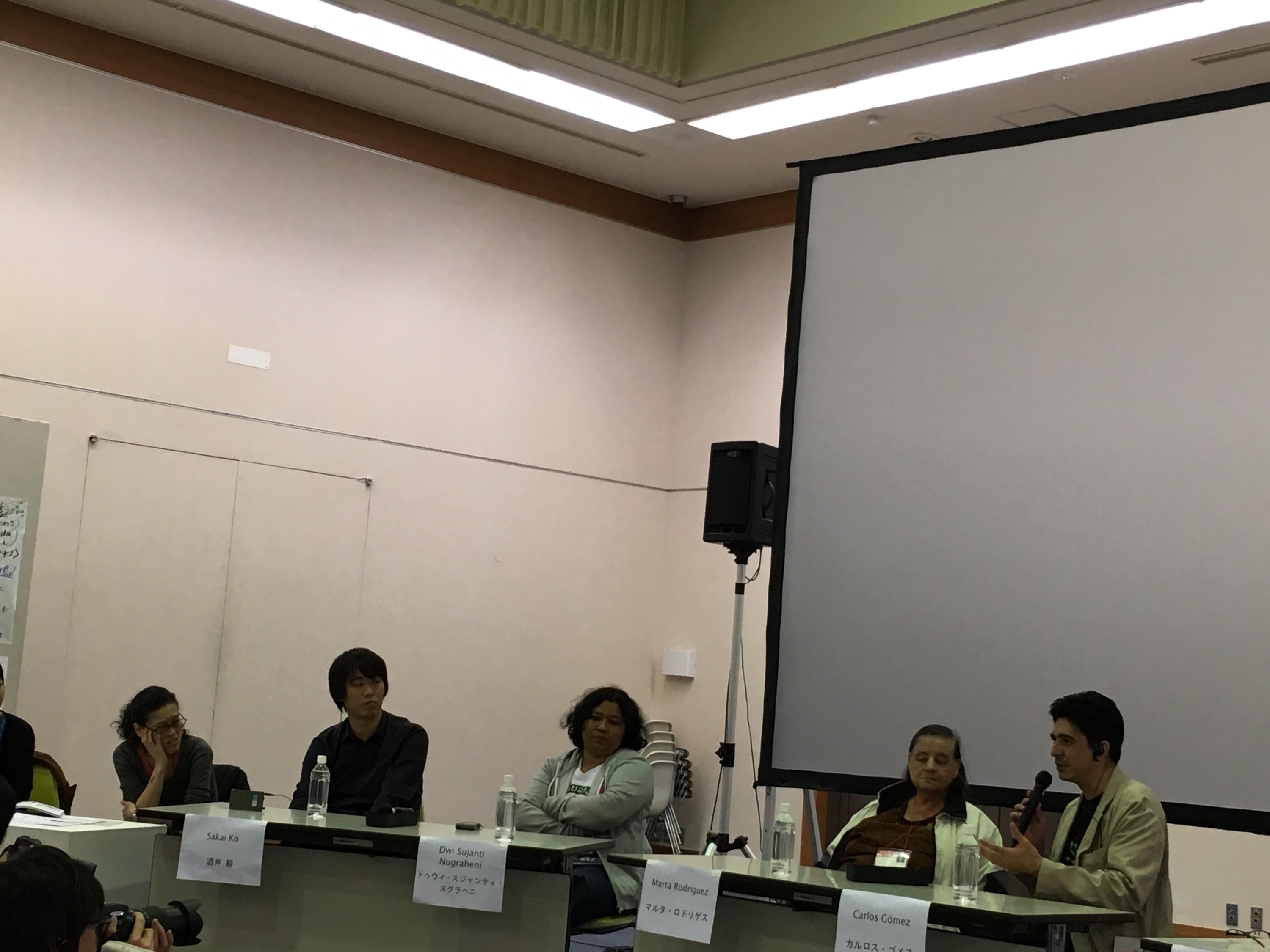
  

In the evening and as my final event for this edition of the festival, I decided to attend a symposium titled Creating a Space for Film, a discussion among six participants from different countries, Dwi Sujanti Nugraheni, Marta Rodríguez, Teng Mangansakan, Sakai Ko, Oki Hiroyuki, Carlos Gómez. Everyone of them brought and talk about his/her experience in creating a space for documentary, with indigenous people in Colombia for Marta Rodrigez and Carlos Gomez, in Indonesian schools with basically no budget for Nugraheni, in Sendai working with old people to find the still existing minwa (folklore in the oral tradition) for Sakai Ko, and in the Philippines in markets and basketball courts for Mangansakan. Very different stories and backgrounds, some governments opposing documentary like Indonesia, other supporting cinema like the Philippines, but everybody seemed to agree that what is fundamental and crucial is to build cinema and documentary literacy, through schools, workshops, festival and other activities. Without visual /media literacy there are no chances to have future generations of filmmakers and and audience capable of understanding and appreciating non-fiction cinema.

  
In conclusion, this year as two years ago, attending YIDFF was for me a really reinvigorating and fascinating experience, I didn’t see as many movies as I wanted to, but I as I wrote in the previous posts, there were some nice discoveries and above all I had the chance to meet, talk and exchange opinions with many filmmakers and film-festival people. The only downside to it is that I’ll have to wait two years until the next edition. See you soon Yamagata!

Today, October 14th the awards for this year festival were announced: 
The Robert and Frances Flaherty Prize (The Grand Prize):

Horse Money Dir: Pedro Costa

The Mayor’s Prize:
The Pearl Button Dir: Patricio Guzmán

Awards of Excellence:
Homeland (Iraq Year Zero) Dir: Abbas Fahdel

Silvered Water, Syria Self-portrait Dir: Ossama Mohammed, Wiam Simav Bedirxan

Special Prize: 
Us women . Them women Dir: Julia Pesce

New Asian Currents Awards

Ogawa Shinsuke Prize:
Standing Men Dir: Maya Abdul-Malak

Awards of Excellence:
Snakeskin Dir: Daniel Hui

Each Story Dir: Okuma Katsuya

Special Mention:
Glittering Hands Dir: Lee-Kil Bora

A Report about Mina Dir: Kaveh Mazaheri

ARAGANE Dir: Oda Kaori

I Am Yet to See Delhi Dir: Humaira Bilkis

Citizens’ Prizes
Homeland (Iraq Year Zero) Dir: Abbas Fahdel

Directors Guild of Japan Award

My No-Mercy Home Dir: Aori


Yamagata Doc Film Fest, report – day 1

From a rainy Yamagata, I wrote down some thoughts about yesterday, October 10th, my first day at this year festival. Good movies, some unexpected discoveries, lively discussions and as always, great atmosphere at Komiya, the place where almost everybody meets & drinks at night.

My day started with a surprisingly good documentary, France Is Our Mother Country (2015), from Rithy Panh, the French-Cambodian filmmaker author of The Missing Picture and s21, works that focus on the aftermath of the Khmer Rouge regime in Cambodia. France Is Our Mother is an archive documentary entirely made of footage from the former French colony of Indochina, but Panh uses these images in a creative and even ironic way, when not sarcastic, to express all the sense of superiority of the colonizers (France) towards the colonized. Without a single spoken word but rich in music, now minimalist, now almost noise-like, and with the use of ironic but thought-provoking intertitles, the movie reaches almost an hypnotic quality. After few minutes in it we already start to realise how the film is a history in images, but also and at the same time a history of images, besides the obvious but tragic elements of oppression shown, what slowly sneaks into the viewers’ mind is a sense that basically everything can be demonstrated with images, after all wasn’t the footage shot by the colonizers themselves? At a certain point, this is my personal and extreme experience of it, I even started to doubt about the “reality” of the images, “couldn’t some of them just be fake?” I asked myself. The answer is: of course not, but this reaction made me realised how deceptive and open to interpretations images can be, and this is for me the best quality of France Is Our Mother Country.
The second movie of the day was Millets Back Home (2013) by the Taiwanese Sayun Simung, a documentary about the small Tayal ethnic minority living in a mountain village in Taiwan, a tribe to which the young director herself belong to. A very interesting work for its topic – how to transmit and keep alive minor languages, traditions and customs in our present world- but less for its style, too journalistic and straightforward, at least for my taste. Better was the talk after the screening when a member of the Tayal went onstage and sang a traditional chant.

The first movie in the afternoon was the highly anticipated The Pearl Button by Patricio Guzmán, a film that deserves all the praised it earned around the world. It stretches from the very distant – in time and space, the stars and the universe – to the very small of a button found at the bottom of the ocean. From the purity of a quartz and the almost celestial lightness of the sky and the water, to the gravity of death, torture and human beings smashed in the cogs of History (the Chilean dictatorship).
The 4th documentary of the day was Under the Cherry Tree (2015) by Tanaka Kei, a young Japanese director who followed the lives and struggles of 4 elderly people in a public housing complex in Kawasaki. Shot in low-tech and very simple in its style, no narration but intertitles to explain the background of these people and their problems, nonetheless Tanaka is very good at conveying through her camera the loneliness, the feeling of approaching death and the dreariness of their lives.
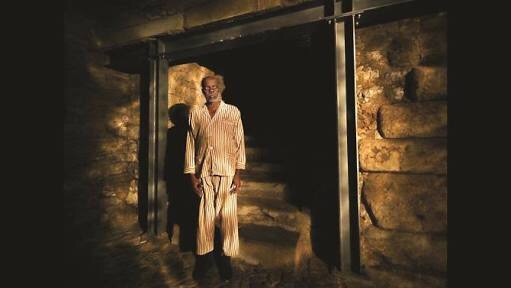
The last one of the day wasn’t a novelty for me, I had watched Aragane (2015) by Oda Kaori a couple of months ago on a screener, but seeing it on the big screen and with the proper sound system just confirmed the quality of the movie and the boldness of Oda in making an experimental work in form of documentary. Shot in a mine in Sarajevo, Aragane is composed of long takes mainly in the underground darkness, the real protagonists of the movie are the machinery, the flashing lights and a ceaseless noise enveloping the images. Hypnotic in the way Oda conveys the materiality of time and the sense of duration, Aragane reminded me, with due distinctions, of some works made by Harvard University’s Sensory Ethnography Lab, I’m thinking especially of The Iron Ministry and Manakamana.

That’s all for the first day in Yamagata, tomorrow or maybe after tomorrow for the next reports.

Yamagata International Documentary Film Festival 2015 – Perspectives Japan and Latinoamérica

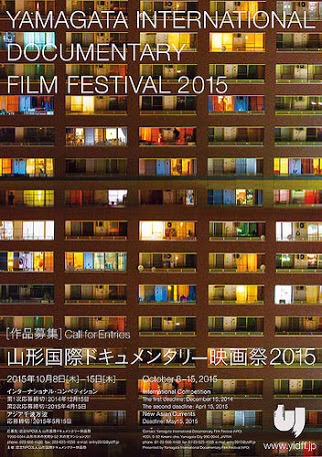
This year Yamagata International Documentary Film Festival is kicking off today Oct 8th in the Japanese city, and promises an intense and full week of non-fiction cinema and all its forms, a must for everyone interested in documentary.
This is the second post I dedicated to this year event and its line-up. While in the first one I wrote about Competition and New Asian Currents (you can read it here), today I’d like to take a look at Perspectives Japan, a selection of new Japanese docs, and Latinoamérica—The Time and the People: Memories, Passion, Work and Life, a retrospective on the so called Third Cinema (Tercer Cine) and its resonances with the contemporary non-fiction production in Latin America.

Perspective Japan, as stated on the official page, will introduce “Five dynamic films that defy convention (…) in a display of the powerful contemplation and fresh vibrancy being explored in Japanese documentary filmmaking.”
Of the 5, the only one I had the chance to see is THE COCKPIT, a relatively short documentary (just a bit more than an hour) about a group of hip-hop musicians working on a new song. A static and almost hypnotic work, especially in its first part where the camera in a fixed position is showing us the rapper OMSB at work on his mixing console chatting to his mates. The Cockpit is a nice piece of non-fiction cinema, minimalistic in its approach, but interesting and watchable not only for wannabe-musicians. Okinawa: The Afterburn, directed by John Junkerman – an American who has lived in Japan for almost 40 years (and for a certain period in Okinawa itself) – is a deep look at the recent history of the islands, always a crucial geopolitical space to understand Japan and its tensions and relationship with the outside. Completing the line-up for Perspective Japan: PYRAMID: Kaleidoscope Memories of Destruction (Sasakubo Shin), Under the Cherry Tree (Tanaka Kei) and Voyage (Ikeda Sho).

As for the Latinoamérica section, it’s going to be an incredible journey at the heart of what was happening – social and political changes, resistance, upheavals, revolutions, massacres -during the 60s and 70s in Central and South America. Milestones of word documentary such as Patricio Guzmán‘s The Battle of Chile 1,2 and 3 will be screened alongside works of Luis Ospina and a mini-retrospective of short chilean documentaries, including films from Raúl Ruiz (The Suitcase, 1963) and Joris Ivens (. . . A Valparaiso, 1963, with commentary written by Chris Marker), almost 30 works in total, a visual feast not to be missed.

As written before, I’ll be there for 3 days (Oct 10th to 12th), if time permits, I’ll be posting, or more likely twitting, about it. Stay tuned.