Yamagata Doc Film Fest, report – day 3 and awards

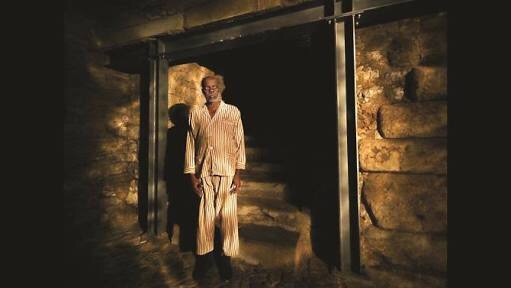
My final day in Yamagata (October 12th) was a bit more relaxed than the previous two, the festival fatigue started to kick in and the nights spent talking & drinking at Komian did the rest. There were many movies I really wanted to see, Pedro Costa’s Horse Money, Homeland (Iraq Year Zero) by Abbas Fahdel, Ospina’s It all Started at the End and others. Unfortunatly all of them were screened around the same time in the afternoon, and I had to choose one, so finally I opted for Ospina’s, my personal way of completing the discovery of the Cali Group and the independent cinema of Colombia between the 70s and 80s. It All Started at the End is a long and absorbing work that goes back to the beginning of the movement, and using a mix of styles and images (footage, digital, mobile phone’s camera) tells the story of a group of friends and artists who revolutionised cinema in Colombia.

In the morning I attended the screening of a TV documentary (actually a mokumentary) made in 2006 by Mori Tatsuya and Murakami Kenji (edited by Matsue Tetsuaki) Documentary:  Truth or Lies「ドキュメンタリーは嘘をつく」A work that plays with and criticises the way non-fiction is usually planned and made on TV, funny at times but not always entertaining and cutting, this short film has nonetheless the quality of making the audience think and let them see what’s happening behind the camera. 
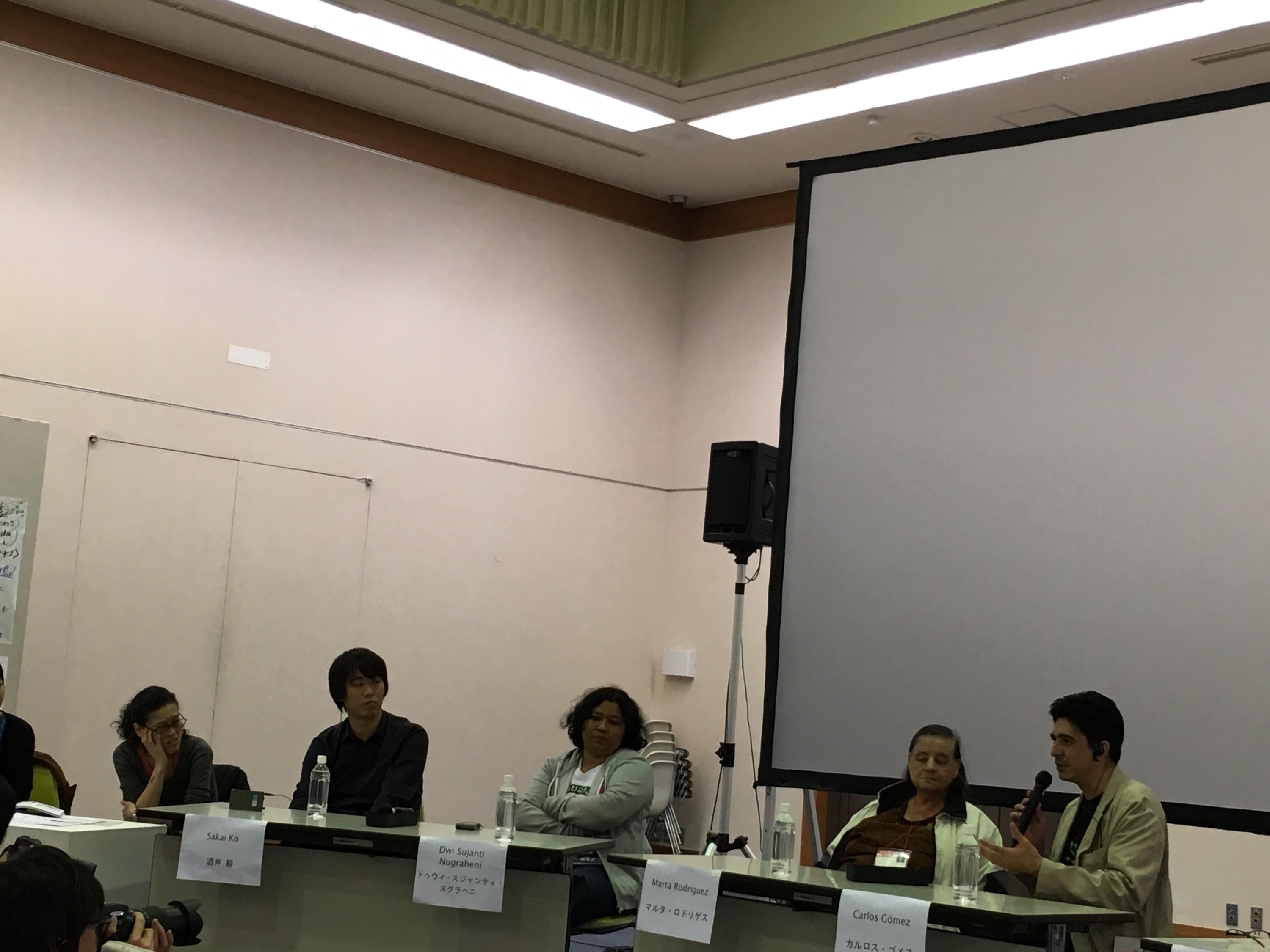
  

In the evening and as my final event for this edition of the festival, I decided to attend a symposium titled Creating a Space for Film, a discussion among six participants from different countries, Dwi Sujanti Nugraheni, Marta Rodríguez, Teng Mangansakan, Sakai Ko, Oki Hiroyuki, Carlos Gómez. Everyone of them brought and talk about his/her experience in creating a space for documentary, with indigenous people in Colombia for Marta Rodrigez and Carlos Gomez, in Indonesian schools with basically no budget for Nugraheni, in Sendai working with old people to find the still existing minwa (folklore in the oral tradition) for Sakai Ko, and in the Philippines in markets and basketball courts for Mangansakan. Very different stories and backgrounds, some governments opposing documentary like Indonesia, other supporting cinema like the Philippines, but everybody seemed to agree that what is fundamental and crucial is to build cinema and documentary literacy, through schools, workshops, festival and other activities. Without visual /media literacy there are no chances to have future generations of filmmakers and and audience capable of understanding and appreciating non-fiction cinema.

  
In conclusion, this year as two years ago, attending YIDFF was for me a really reinvigorating and fascinating experience, I didn’t see as many movies as I wanted to, but I as I wrote in the previous posts, there were some nice discoveries and above all I had the chance to meet, talk and exchange opinions with many filmmakers and film-festival people. The only downside to it is that I’ll have to wait two years until the next edition. See you soon Yamagata!

Today, October 14th the awards for this year festival were announced: 
The Robert and Frances Flaherty Prize (The Grand Prize):

Horse Money Dir: Pedro Costa

The Mayor’s Prize:
The Pearl Button Dir: Patricio Guzmán

Awards of Excellence:
Homeland (Iraq Year Zero) Dir: Abbas Fahdel

Silvered Water, Syria Self-portrait Dir: Ossama Mohammed, Wiam Simav Bedirxan

Special Prize: 
Us women . Them women Dir: Julia Pesce

New Asian Currents Awards

Ogawa Shinsuke Prize:
Standing Men Dir: Maya Abdul-Malak

Awards of Excellence:
Snakeskin Dir: Daniel Hui

Each Story Dir: Okuma Katsuya

Special Mention:
Glittering Hands Dir: Lee-Kil Bora

A Report about Mina Dir: Kaveh Mazaheri

ARAGANE Dir: Oda Kaori

I Am Yet to See Delhi Dir: Humaira Bilkis

Citizens’ Prizes
Homeland (Iraq Year Zero) Dir: Abbas Fahdel

Directors Guild of Japan Award

My No-Mercy Home Dir: Aori
 

Yamagata International Documentary Film Festival 2015 – International Competition and New Asian Currents

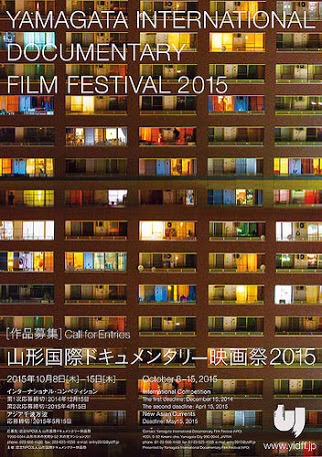
The Yamagata International Documentary Film Festival has completed its line-up, once more a rich and very interesting one, at least if you’re into the world of non-fiction cinema. The biennial event co-established in 1989 by Ogawa Shinsuke and dedicated to the exploration of the world of documentary, in its broadest sense, will take place as usual, in the Japanese city of Yamagata next October from 8th to 15th.                        I’ll be there for 3 days, from the 10th to the 12th, and hopefully I’ll be able to write down and post something, possibly a brief daily report, after-screening parties permitting….anyway, let’s see what this year program is offering us, of course I’ll focus more on the Japanese works.

These are the sections:

– International Competition

– New Asian Currents

– Perspectives Japan

– Yamagata Rough Cut!

– Latinoamérica The Time and the People: Memories, Passion, Work and Life

– Double Shadows—Talking about Films that Talk about Films

– Past and Future Stories of the Arab Peoples

– Cinema with Us 2015

– Yamagata and Film

The competition this year is graced with the presence of some big names such as Patricio Guzmán and Pedro Costa, in Yamagata with The Pearl Button and Horse Money respectively. Another title, among the 15 in competition, that has attracted my attention is the long (334′) Homeland (Iraq Year Zero) by Abbas Fahdel, “two years in the life of a family amidst the Coalition Forces’ 2003 invasion of Iraq”.                                         There will be only one documentary representing Japan in competition, We Shall Overcome (戦場(いくさば)ぬ止(とぅどぅ)み) from director Mikami Chie who 2 years ago was at the festival with her The Targeted Village (標的の村). We Shall Overcome continues to explore and document the ongoing “battle” of Okinawans against the plan to build a new American base in Henoko, and telling the story of Fumiko, an elderly woman who witnessed the battle of Okinawa in 1945, the film is connecting the past with the present of the archipelago. The documentary is also enriched by Cocco‘s voice over, the singer and actress herself is from Okinawa and is known by Japanese cinema fans because of her amazing and phisical performance in Tsukamoto Shin’ya’s Kotoko (2011).

Three Japanese docs and thus more to talk and write about in the New Asian Currents section, a selection that in total includes 20 works from different parts of Asia.  Distance is the debut behind the camera for Okamoto Mana, reading the description on the festival site it seems to be a sort of self-documentary, created by crossing family home movies with new shooting material, and in doing so reflecting on the director’s family and her past. The second work made by a Japanese is Each Story (Okuma Katsuya) a movie that takes place in India and “For their summer homework, Jigmet and Stanzin are assigned to study the Epic of King Gesar, passed down from generation to generation in the northern Indian region of Ladakh, where the boys live. As they splash in the river and run through the streets, the boys come to understand each story shared with them by the adults of their village.”                                                         Last but not least there’s Aragane, the feature debut for Oda Kaori, an artist leaving in Sarajevo and studing in a graduate program under Tarr Béla. I had the privilege of watching the documentary on a sample screening, and although it was on a TV screen, I was very impressed.  The camera follows patiently and almost hypnotically the workers of an old coal mine in Bosnia down into the darkness of their daily routine. Aragane is visually stunning, Oda knows how to use the digital for her cinematic purposes, partly documentary and partly experimental cinema, the movie possesses an impressive sound design, and a stilistic and poetic touch akin to the works produced by The Sensory Ethnography Lab (SEL) at Harvard University (Leviathan, Manakamama). I’m really looking forward to seeing it on a big screen and with a proper sound system.

Not from Japan but worth mentioning are the two Special Invitation Films: Almost a Revolution (Hong Kong, by Kwok Tat Chun, Kong King Chu) and Sunflower Occupation (Taiwan, by the Sunflower Occupation Documentary Project), both of them dealing with students street protests and uprising occured in Hong Kong and Taiwan in the last two years.

In the next post I’ll write about Perspectives Japan, a selection of new Japanese docs, and Latinoamérica—The Time and the People: Memories, Passion, Work and Life, a retrospective on the so called Third Cinema (Tercer Cine) and its resonances with the contemporary non-fiction production in Latin America.