
Completed only in 2001, although the preliminary works for its construction started 30 years prior (in 1971), the Okumiomote Dam is one of the many mammoth projects built in Japan in the latter part of the 20th century in order to satiate the country’s growing thirst for energy; the other side of the Japanese post war economic miracle. Constructed also to prevent flooding in the Miwa water reservoir, the main purpose of the dam remains to generate hydroelectric power, a type of energy considered, and rightly so, “green”. However, as a “side effect”, the construction of dams often ends up reshaping the geographical and social landscape of the area where they are built, destroying villages, displacing people, and erasing the cultural and historical heritage of the area.
There are several documentaries that explore how the construction of a dam impacts and alters the lives of people and their histories, from Before the Flood by Li Yifan and Yu Yan in 2005, about the colossal Three Gorges Dam in China, to Mizu ni natta mura (2007) by photographer and director Ōnishi Nobuo on the Tokuyama Dam in Gifu prefecture.
Last August I had the chance to attend a screening of Echigo Okumiomote: A Traditional Mountain Village (越後奥三面 山に生かされた日々) at the newly established Kinema Neu in Nagoya. Side note, this is a mini-theater born from the ashes of the Nagoya Cinematheque, a cinema that, in turn, arised from the jishu jōei undō (自主上映運動), the independent screenings organised throughout Japan during the 1970s and 1980s, in this specific case to show Ogawa Production’s documentaries.
Echigo Okumiomote is a documentary directed by Himeda Tadayoshi (1928-2013), a film director and visual folklorist who, in 1976, established the Center for Ethnological Visual Documentation, an organization that has produced almost 300 works, both films and videos, exploring and capturing the varied folk culture of the archipelago. Originally released in Japan in September 1984, Echigo Okumiomote was recently restored in 4K. This was my second time watching it, I took part in the crowdfunding project to restore it organised last year (2023), and so I received a temporary digital screener as a perk.

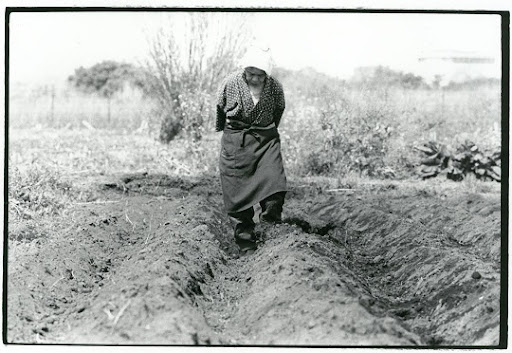
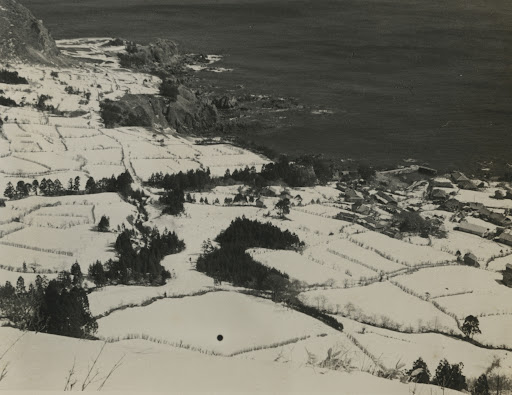
Shot in four years, between 1980 and 1984, after Himeda visited the village for the first time in the spring of 1979, the movie follows the everyday life of the people of Okumiomote, an isolated mountain village in Niigata prefecture, located near the border with Yamagata prefecture. The village, its inhabitants, the mountains, the forest and the rivers, all together form a fascinating ecosystem and microcosm of a life dependent upon and regulated by the interaction of natural and human elements, where the former are predominant.
This lifestyle and the specific traditions, customs, and habits practiced—changed and improved for centuries by the people—would eventually disappear as a result of the construction of the dam: the village and the surrounding area would be completely submerged. The villagers were relocated to a nearby place, this was the subject of Himeda’s Echigo Okumiomote dai ni-bu furusato wa kieta ka (1996) a documentary that follows the villagers from 1984 to 1995, a film that unfortunately I have have not seen.
While, as we learn in the first minutes of the film, there had been an anti-dam movement active since 1971, the entirety of the documentary depicts and focuses on various jobs done in the mountains and in the fields by the villagers, such as hunting, plant gathering, and harvesting, and on the rituals practiced in the hamlet. Only the last thirty minutes are a more direct reflection on the disappearance of the village, and on the act of documenting its existence, and thus preserving its memory on film. The work is narrated by Himeda himself—more like a commentary of what is happening on screen, a reflection on his and his staff experience, than a traditional narration— and his presence and that of the troupe are never hidden. Once we even see a special meeting, requested by Himeda himself, when the village’s hunters are strongly opposing the presence of the camera during an upcoming and very important bear-hunting trip.
The theatrical viewing allowed me, ça va sans dire, to focus more, and the darkness of the teather made the colours stand out even more since the very beginning: the blue screen of the title, the white of the snowy landscape, and the greens of the woods in the first opening minutes, plunge the viewer in a world rich and abundant in colours and tonalities.
It’s a didactical movie in a way, but, as written above, the narration by Himeda keeps everything very matter-of-fact. Moreover, while the pace is not fast, the film moves very quickly from one aspect of the village to the other. What slowly emerges on screen is the complex economics of the microcosms that is the village: gathering chestnuts, burning different patches of the land every three years to plant different grains, fishing, hunting bears and chamois, and gathering zenmai, a type of edible fern that, as we learned, provided half of the income for the town. This is one of the most fascinating sections of the film, families would usually go into the woods for a month, living in a shed, gathering, boiling and then drying the plants, everything onsite. There was even a school holiday in the area that allowed kids to go into the woods with their parents for about ten days.
This and all the activities in the fields, mountains, and rivers captured on film signal a natural abundance, on the one hand, and a very harsh life dictated by the natural elements and the cycle of seasons for the people of the village, on the other. I think it is this contrast, together with the specificity of the practices developed in the area for centuries, that makes Echigo Okumiomote a unique and enriching viewing experience, especially seen now, 30 years after everything was filmed.
There is no doubt that by focusing mainly on ancient practices—more on this later—the documentary can be read as a slightly traditionalist work, that is, a film that glorifies the way of the past. While this take might be partly true, I think the images, the time spent by the crew with the people of the village, and the care with which Himeda and his group recorded and preserved aspects of a way of life about to disappear, make it nonetheless a compelling chapter in the history of Japanese documentary cinema.

An interesting statement by a responsible of the Center for Ethnological Visual Documentation, and, if I’m not mistaken, a member of the crew that was with Himeda in Niigata, posted online in August 2024, sheds light on the process behind the making of Echigo Okumiomote. According to his words, I’m paraphrasing, this is not a film that records the real life of the Okumiomote community in 1984, but a film that captured the various inherited customs before they were submerged under the dam. I think this statement could and should be read more as a stylistic choice than a reflection about what was going on at the time. Also it is worth adding that documentary is always a form of “fiction”, a construction that cannot reproduce or represent the totality of “life” or “lifestyle” of a certain area and a certain time. Documentary is not a point of view on the real, but a real point of view.
In 1984 Japan was about to enter into its bubble economy phase, and lifestyle was changing even in rural areas. By focusing their camera on old and traditional practices still alive in the village, and not on the changes brought by modern life, Himeda and his crew stayed true to their ethnographic and folkloric approach. Not to the extent done in Oku-Aizu kijishi (奥会津の木地師, 1976), when the practice of building a temporary shed in the woods was basically exhumed and brought to life one more time for the camera, but nonetheless, it is a cinematic choice that functions as a philosophical foundation for the film.
The documentary pairs very well, in my opinion, with Haneda Sumiko’s Ode to Mt. Hayachine (早池峰の賦 ,1982), filmed almost during the same years in the mountains of Iwate prefecture, although their approach could not be more different. On the one hand, Himeda is interested, as we have seen, to preserve and document on film practices on the cusp of oblivion, on the other, Haneda, while documenting an ancient tradition (Kagura), seems to be more interested in the changes happening in the two towns and how ritual practices have evolved and are evolving in time.
Echigo Okumiomote was accompanied by a publication of a massive volume about the life of the village, an ethnographic study and document of the area that is as impressive as the film itself.















 Asian Docs
You must be logged in to post a comment.