
Sōda Kazuhiro is back with a new observational-style documentary, his 6th, and he’s getting better and better, Oyster Factory confirms his talent and his status as a non-fiction filmmaker of international level. The movie had its international premiere at the last Locarno International Film Festival.
Here the synopsis (from the official homepage):
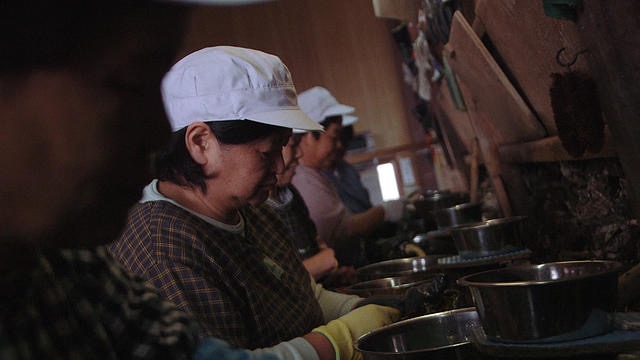
In the Japanese town of Ushimado, the shortage of labor is a serious problem due to its population’s rapid decline. Traditionally, oyster shucking has been a job for local men and women, but for a few years now, some of the factories have had to use foreigners in order to keep functioning. Hirano oyster factory has never employed any outsiders but finally decides to bring in two workers from China. Will all the employees get along?
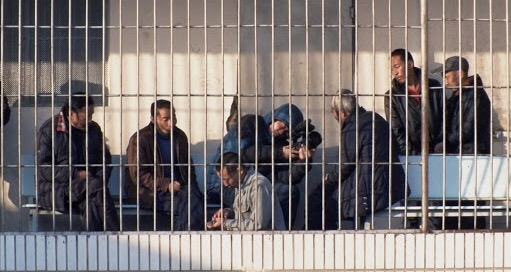
The New York-based director this time turns his attention to the small town of Ushimado, in Okayama prefecture – Sōda’s in law are from Okayama, if I remember correctly, and were the protagonists of his Peace (2012) – a microcosm that even in its marginal geographical position, or maybe because of it, reflects and resonates with some of the problematics going on on a wider scale in Japan, and more generally, in the so-called developed countries. Chinese workers (read: migrants “others”) and their relationship with the small community and the family-run processing plants. The decision of one of the main protagonists, who now works in the oyster factory as a manager, to move from Miyagi to Okayama as a consequence of the Great Tōhōku Earthquake in 2011. Population ageing, an inevitable factor that Japan will have to face enourmosly in the near future, and that will dictate political, economic e social decisions and agendas. Everything in Oyster Factory is presented and captured by Sōda and his gaze with a sublte touch, it’s something emerging gently and slowly from the film texture itself and surfacing image after image from casual conversations among workers, or in talks between the director and the people of the factory, owner, manager, owner’s son, wives. There is not a big theorem to be proved, neither a theory to be confirmed in Oyster Factory, of course Sōda knows the ontological impossibility of an objective documentary, every decision and every cut is a strong assertion of a point of view, nonetheless his gaze is open and willing to learn and explore uncharted territories. As perfectly noted by Clarence Tsui on The Hollywood Reporter:
Online and in print, Kazuhiro Soda is never hesitant to make his political views known. The New York-based Japanese filmmaker writes damning posts about the rise of warmongers in his home country and abroad in his blog, (…) His films, however, have taken a very different approach, with problems in Japan’s national narrative gently revealed through exposition-free representations of ordinary lives on the margins.
Or in Sōda’s own words:
In this film, I did not depict any violence, miseries, or social injustices that are often the favorite subjects of documentaries. You could find a trace of the disaster that shook the whole world, but the disaster itself doesn’t happen in this film. What you see are the ordinary lives of loveable fishermen and workers.
Consequently an important part in Oyster Factory is played by sea and costal landscapes – if I’m not wrong, this is the first time for Sōda to use such images in his works, I mean images capturing wide views from an higher perspective. At a first glance they might seem to function as pillow shots to connect one scene to the next, but at a deeper level, these landscapes (sea, small islands, boats) together with scenes of a white cat wandering through the streets (a recurrent “guest” in Sōda works) are to be placed on the same plane of expression with scenes of people talking or working. That is, everything helps and contributes to create a bigger picture, a cinematic sketch depicting the life in Ushimado’s Oyster Factories in all its complexity.

Harsh and difficult to forget are the words, uttered almost en passant, from a technician who’s helping setting the prefab house for the coming Chinese, “Chinese are terrible, they steal everything and are not like Japanese, they don’t have common sense. You need to know that, if you wanna work with them.” Words spoken without strong contempt, but in a-matter-of-fac tone, strong words indeed and part of a broader discourse about Chinese people that widely circulate and proliferate throughout Japan. What these sentences and the movie itself are telling us though, is far more complex than what it seems; it is more about the inadequacy of a society, or part of it, to accept and face “the other” and the changes brought about,and less about the personal hate of one person towards a nation and its people. It also implies, more subtly, the impossibility for the capitalistic society not to exploit the weakest and the less fortunate. If it’s true, as stated by one person in the movie, that young Japanese nowadays don’t want these kind of jobs (raising and shucking oysters), it’s also equally true that Chinese workers are employed because cheaper and “available” to work longer hours.
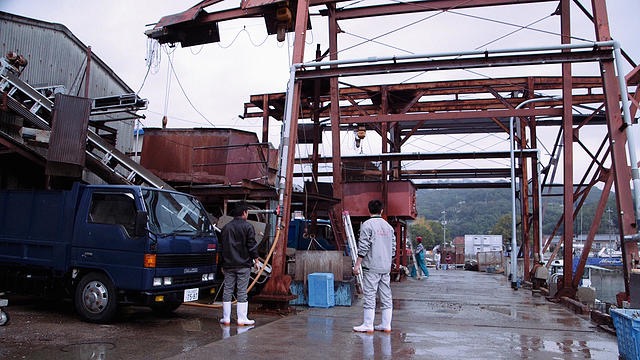
The documentary’s climax, or at least one of its more intense parts is when the Hirano’s family prepares for and welcomes the Chinese workers, building the prefabricated house and setting everything first, introducing them to the Japanese workers later. The reactions upon meeting with the 2 young Chinese are very different – it’s important to note that they can’t speak Japanese – pretty cold from the old owner who calls them “China-men”, warmer those from the old ladies and the girls in general who try to make them more at ease. The film ends with a long take – I might be wrong on this technical detail – on a boat at anchor, the first day of work for the two Chinese. The camera follows them wandering at lost and completely puzzled to what to do, a Japanese worker tries to teach them the job, but the language barrier and their total inexperience of sea vessels seem to be an insurmountable hurdle. Sōda here has mastered the skill ( à la Wiseman) – and it’s one of the reasons why Oyster Factory might be his best work to date – to capture and edit together moments apparently normal, but charged with a subtle and deeper sense, meanings not already given, but to be searched by the film viewers.
If you live outside of Japan, you can buy or rent (VOD) Sōda’s documentaries here. For those of you living in Japan, you can rent his movies at your local DVD rental shop, or buy them on DVD.




 Asian Docs
You must be logged in to post a comment.