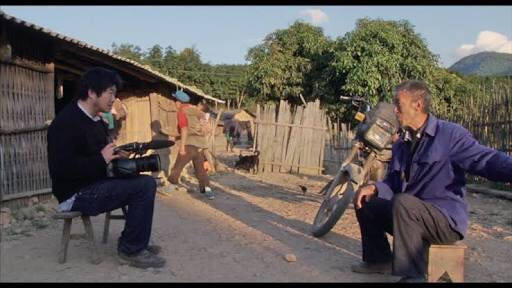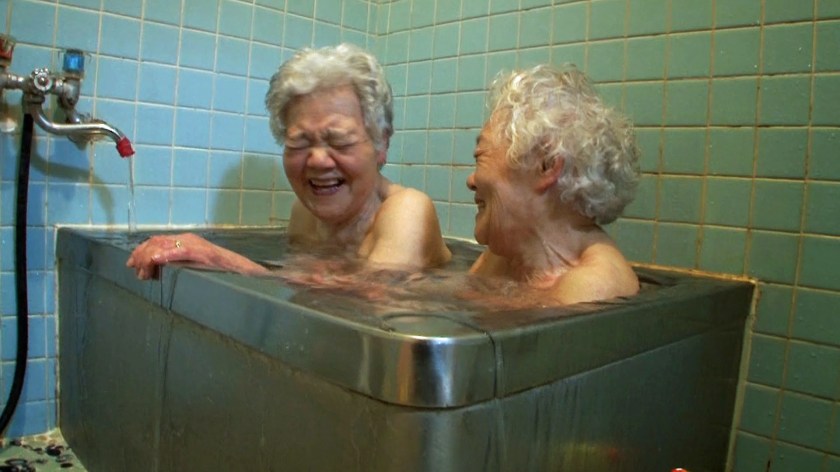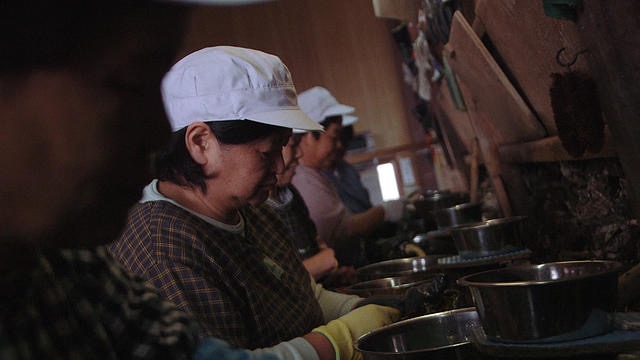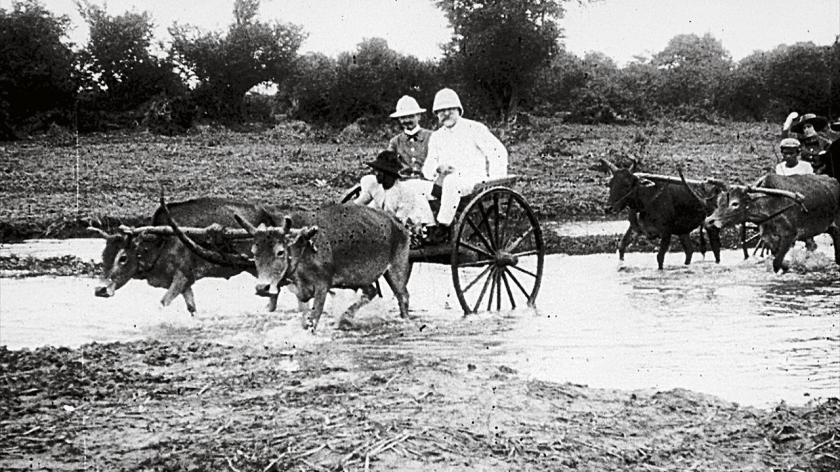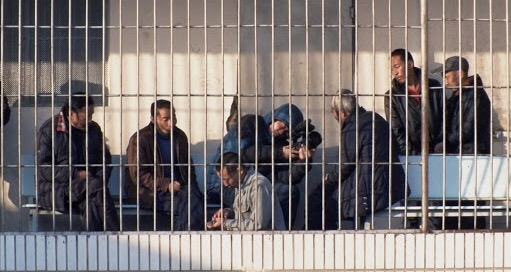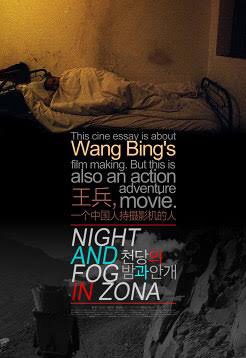
Night and Fog in Zona (Jung Sung-il, 2015)

I’m reposting a slightly edited version of a piece I wrote 8 years ago, an article about Night and Fog in Zona, directed by South Korean film critic, Jung Sung-il.

It’s always fascinating when cinema reflects on cinema, and even more so when a documentary’s subject is director Wang Bing filming one of his movies. Night and Fog in Zona is a documentary, or better yet a cine-essay as it is called by its author: South Korean critic turned director Jeong Sung-il, who follows the renowned Chinese filmmaker throughout a whole winter while working on two of his projects, ‘Til Madness Do Us Part and a sequel to his Three Sisters.

The “coming” of Wang Bing has been, and still is, one of the most important events that occurred in the world of cinema in the last 15 years: not only did he contribute asserting the aesthetic value of digital filmmaking, but with his documentaries he also brought an auroral and liberating gaze upon the world.
Jung Sung-il had the same kind of dawning experience watching West of the Tracks in 2001.

“When I was at the Rotterdam Film Festival I bought a ticket for a movie 9 hours and 10 minutes long, I was surprised by its length but went anyway. It begins with a train in movement and it reminded me of the first movie ever made by the Lumière brothers in 1895. Watching Wang Bing’s work I had the feeling of witnessing the cinema of 21st Century just like the audience in 1895 witnessed its birth.”

There’s no narration in Night and Fog in Zona, everything is explained with intertitles: geographical coordinates, places where Wang Bing is headed to, his plans. Sometimes these intertitles also work as a poetic comment to the following scene.
The only time when Wang speaks directly to the camera is in an interview-like fashion at the very beginning of the film, a sequence that works as a brief introduction to his world and his filmmaking style. A few minutes where, among other things, he talks about his filmmaking process, truth in cinema, the impossibility of conveying the totality, his projects, Chinese history and peasants, and the similar cultural background his generation shares with Andrei Tarkovsky.

In 235 minutes Night and Fog in Zona illuminates a great deal about Wang Bing’s approach to filmmaking. Among other things, we learn about his habit of taking photos of the people he films, his relationship with them, and, most fascinating of all, about his “interview technique”: it’s compelling to see how he is able to seamlessly switch from “chatting with” to “shooting at” his subjects, as if there was no real break between the two actions.
It’s also interesting to witness how “Wang searches for the ‘strategic point’, the single position from which all of the actions in the scene can be recorded”. This is a fundamental feature of his filmmaking, as the relationship between the camera and the people and things around it determines both the movie’s sense of space and how space itself is conveyed in his works. And space, together with time/duration, is one of the most crucial elements of his cinema.
Another revelation of Night and Fog in Zona is to discover how Wang Bing is a director whose involvement with the subjects of his movies is deeper than we might think from just watching his works: when the camera is off, he’s often seen giving practical help and advices to his “protagonists”.

Particularly fascinating, from a movie making point of view, is a scene where the director and his two collaborators have an evening meeting to watch the footage shot during the day at the Asylum — footage that would eventually become ‘Til Madness Do Us Part. A few but meaningful minutes where he explains the reasons behind his use of long takes, why avoiding telephoto lens, and other rules to follow while shooting, so that the final work can gain a certain consistency, a certain style.
However, the best quality of Night and Fog in Zona is that it’s not only a documentary about Wang Bing shooting his movies, but it’s also shot and conceived — with all the due differences – just like one of Wang’s documentaries. In terms of style, it mirrors Wang Bing’s filmmaking: long takes, no narration, abstract landscapes and experimental music, everything put together to explore his filmmaking and, in a broader sense, contemporary China, a country gazed upon, as in most of Wang Bing’s works themselves, from a peripheral and rural point of view.
One of the best examples of this mirroring process is to be found towards the beginning of the film, when the Chinese director and his collaborators move to the Yunnan province.

A very long sequence shot from the car everyone is on, that shows us streets, mountains, plains, lights and tunnels almost melting together. A scene almost 10 minute long, matched with a hypnotic and minimalistic music interacting with the abstract landscape captured by the camera.
We encounter these sort of sequences a couple of times during the movie: another powerful one, shown in slow motion, is inside the asylum. Bing is sleeping and ten or so patients are sitting and moving around him. What gives Night and Fog in Zona a further experimental and even meta-filmic touch are two scenes, placed at the beginning and at the end of the movie, that show a Korean girl dressed in red sitting in a theater and making a phone call.
The only flaws to be found in this documentary, an otherwise almost perfect work, are some editing choices, in some cases too abrupt, and the pace of the intertitles, definitely too fast. But that’s just splitting hairs, Night and Fog in Zona is definitely one of the best non-fiction movies seen this year, not only for its fascinating subject, but also for its ability to resonate with Wang Bing’s own style at a deep and aesthetic level.
ALONE (Gudu/孤独), Wang Bing and immanent cinema 


Alone
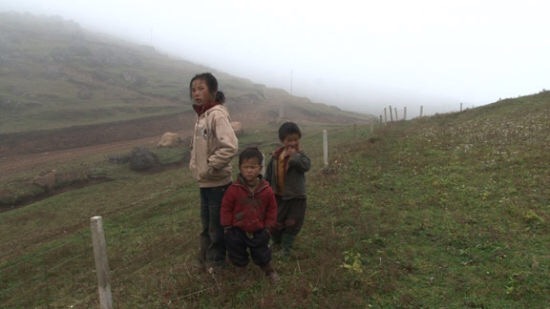
is the shorter version (89′) of Three Sister, a documentary about three little girls living alone in the mountains of the Yunnan province in China, a movie that was entered at the Venice Film Festival in 2013. Both of them are directed by Wang Bing, one of the most prominent filmmakers working today in non-fiction. Here’s the synopsis, taken from the International Documentary Film Festival Amsterdam where the movie premiered in 2013:

Ten years after Tie Xi Qu: West of the Tracks, which documented China’s transition to a modern industrial society and the growing pains this involves, filmmaker Wang Bing finds three sisters aged four, six and ten living with no parents 10,000 feet above sea level, in a small village in Yunnan province. Their mother has disappeared, while their father works in a nearby city and comes home every now and again to bring them new clothes. Family members and other villagers help keep the three children alive – efforts which, along with the communal vegetable garden, evoke the old days of socialism. This oscillation between modernization on the one hand and older values on the other is reflected by switching from long, patient observation by the camera to sudden accelerations and questions from the filmmaker, who operates the camera himself while recording the silent desperation and deprivations of this fragmented family. The mist that surrounds the village almost daily gives the impression that it has withdrawn from the rest of the world – although this proves an illusion. The surrounding areas are modernizing, the mayor explains, so the cost of living will have to increase here, too. All this escapes the children completely. They are too busy collecting food and delousing one another to notice.

More than a review of the movie, I’m sure you can find them out there in the vastness of the internet, what I’d like to do today is to throw some thoughts on the technical and aesthetic aspects of Wang Bing’s filmmaking, elements that make his movies – specifically Alone and by extension Three Sisters – a cinema of immanence (the definition is of course taken from Deleuze, you can read something about Wang Bing and the French philosopher here, while this review in Italian gave me the idea for this post). 

I think it’s not far fetched to say that it is because we, as viewers, are compelled and fascinated by the visual quality of Wang Bing’s works, that we also feel so engaged and moved by the stories he depicts in his documentaries. Remarkable is for instance the use he does of light, natural when shooting in the big expanses of rural China, and artificial -diegetic – when the filming takes place indoor; it’s something really impressive, but that often goes unnoticed because the subjects filmed and the stories told, socially and politically relevant, capture and consume the viewer attention. Every scene shot inside the shack where the three sisters live feels in fact like a painting, and this happens for a series of technical reasons: use of light, camera position, framing, duration and time of filming. 

IMG_0377
(a still from Night and Fog in Zona)

Something I’ve noticed when I was watching Night and Fog in Zona, the beautiful documentary on Wang Bing by Jung Sung-il, something very simple but at the same time a sort of revelation on his movie making style, is the way Wang Bing holds his camera (if I’m wrong I hope some readers will correct me). Rarely on his shoulder, and this is true especially when shooting indoor or outdoor while sitting, the camera often rests on his lap, or at least below his head, static and almost devoid of movements, it forges images that are less distant and thus more engaged with, and almost merged, with what he’s shooting. Wang Bing is crafting a cinema of immanence, an immanence made possible by the digital, and this is all the more true when he is filming people and their faces. It’s in these shots and scenes that the sound design gains its importance, the camera is gazing at the sisters from such an extreme proximity that we can literally hear their breathing, swallowing and sniffling, adding an element of almost tactile sonority to the movie. It is through this style and aesthetics that Wang Bing is able to convey the poverty and miserable destiny of the sisters, but at the same time their playfulness and innocence, everything here is depicted against the background of mountains, villages and shacks, deep inside the cold desolation of rural China, landscapes of absolute beauty and absolute indifference. 

The best documentaries of 2015 – my list

As 2015 comes to an end, it’s that time of the year again, the period when every cinephile is compelled to make his/her best movies list. I couldn’t not post my own one. I’ve mostly watched documentaries from East Asia, my list is then more like a “Best documentary of 2015 from East Asia” type of list, but at the end I’ve added a couple of movies from other part of the world and some (re)discoveries I’ve done during this 2015. Just a disclaimer, it’s a favorite list more than a best list, here we go (listed in the order I’ve seen them):

Walking with my Mother (Sakaguchi Katsumi, 2014)

An exploration of loss, sickness and memory in a society (the Japanese one) that is getting older and older, told in the shape of a private documentary, here some thoughts on the movie.

walking_with_mother

Aragane (Oda Kaori, 2015)

The camera follows patiently and almost hypnotically the workers of an old coal mine in Bosnia down into the darkness of their daily routine. The movie is visually stunning, partly documentary and partly experimental cinema, director Oda Kaori knows how to use the digital medium for her cinematic purposes in a work that revolves around the concept of duration and its materiality, and that is almost structural cinema in its construction. I had the pleasure of meeting and interviewing the director, the conversation was published on the Italian newspaper Il Manifesto, I’m currently working on an English translation and on a review/piece for this blog (maybe next year).

Oyster Factory (Sōda Kazuhiro, 2015)

The latest work from Japanese director Sōda Kazuhiro, together with Theatre 1 and 2, my favourite among his documentaries. I’ve written more about the film here.

IMG_5344

France Is Our Mother Country (Rithy Panh, 2015)

Rithy Panh (2-21: The Khmer Rouge Killing Machine, The Missing Picture) constructs a critical and satirical work about the colonial rule of Cambodia by France, using only footage, archival images and propaganda films shot by the rulers themselves. The power of re-editing and collage documentary.

france-is-our-mother-country

Night and Fog in Zona (Jung Sung-il, 2015)

A documentary about the great Wang Bing by movie critic-turned-director Jung Sung-ilhere you can read my review.

IMG_0379-0

The Moulin (Huang Ya-li, 2015)

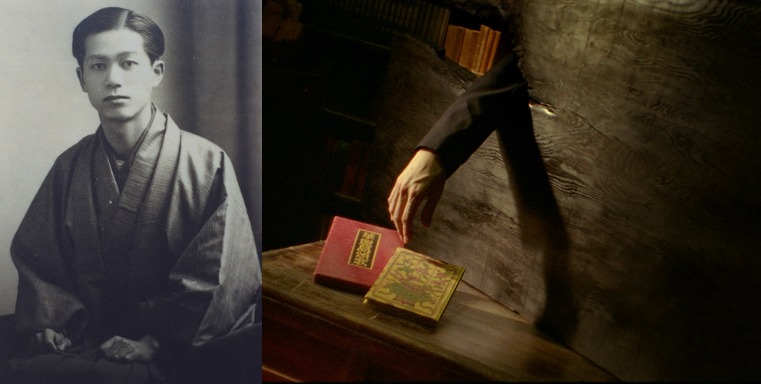
Formally engaging and elliptical, I don’t really know how much of my fascination for this movie comes from its themes, a group of Taiwanese avant-garde artists active in the 30′ during the Japanese colonial period, and how much from the documentary itself.

TheMoulin_Taiwan4

Documentaries from other parts of the world:

The Iron Ministry ( J.P. Sniadecki, 2014) and in general all the movies by Sniadecki: Demolition, People’s Park, Yumen….

Jujun (Paul Thomas Anderson, 2015)


(re)discoveries of 2015:

The Vampires of Poverty (Carlos Mayolo, Luis Ospina, 1977)

All the documentaries/works of the great Agnès Varda (it was a pleasure watching 14 of her films this year)