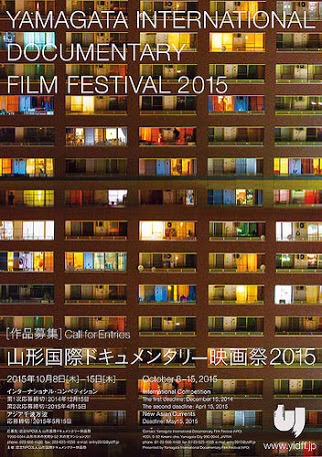
Yamagata International Documentary Film Festival 2015 – Perspectives Japan and Latinoamérica

This year Yamagata International Documentary Film Festival is kicking off today Oct 8th in the Japanese city, and promises an intense and full week of non-fiction cinema and all its forms, a must for everyone interested in documentary.
This is the second post I dedicated to this year event and its line-up. While in the first one I wrote about Competition and New Asian Currents (you can read it here), today I’d like to take a look at Perspectives Japan, a selection of new Japanese docs, and Latinoamérica—The Time and the People: Memories, Passion, Work and Life, a retrospective on the so called Third Cinema (Tercer Cine) and its resonances with the contemporary non-fiction production in Latin America.

Perspective Japan, as stated on the official page, will introduce “Five dynamic films that defy convention (…) in a display of the powerful contemplation and fresh vibrancy being explored in Japanese documentary filmmaking.”
Of the 5, the only one I had the chance to see is THE COCKPIT, a relatively short documentary (just a bit more than an hour) about a group of hip-hop musicians working on a new song. A static and almost hypnotic work, especially in its first part where the camera in a fixed position is showing us the rapper OMSB at work on his mixing console chatting to his mates. The Cockpit is a nice piece of non-fiction cinema, minimalistic in its approach, but interesting and watchable not only for wannabe-musicians. Okinawa: The Afterburn, directed by John Junkerman – an American who has lived in Japan for almost 40 years (and for a certain period in Okinawa itself) – is a deep look at the recent history of the islands, always a crucial geopolitical space to understand Japan and its tensions and relationship with the outside. Completing the line-up for Perspective Japan: PYRAMID: Kaleidoscope Memories of Destruction (Sasakubo Shin), Under the Cherry Tree (Tanaka Kei) and Voyage (Ikeda Sho).

As for the Latinoamérica section, it’s going to be an incredible journey at the heart of what was happening – social and political changes, resistance, upheavals, revolutions, massacres -during the 60s and 70s in Central and South America. Milestones of word documentary such as Patricio Guzmán‘s The Battle of Chile 1,2 and 3 will be screened alongside works of Luis Ospina and a mini-retrospective of short chilean documentaries, including films from Raúl Ruiz (The Suitcase, 1963) and Joris Ivens (. . . A Valparaiso, 1963, with commentary written by Chris Marker), almost 30 works in total, a visual feast not to be missed.

As written before, I’ll be there for 3 days (Oct 10th to 12th), if time permits, I’ll be posting, or more likely twitting, about it. Stay tuned.

Yamagata International Documentary Film Festival 2015 – International Competition and New Asian Currents

The Yamagata International Documentary Film Festival has completed its line-up, once more a rich and very interesting one, at least if you’re into the world of non-fiction cinema. The biennial event co-established in 1989 by Ogawa Shinsuke and dedicated to the exploration of the world of documentary, in its broadest sense, will take place as usual, in the Japanese city of Yamagata next October from 8th to 15th.                        I’ll be there for 3 days, from the 10th to the 12th, and hopefully I’ll be able to write down and post something, possibly a brief daily report, after-screening parties permitting….anyway, let’s see what this year program is offering us, of course I’ll focus more on the Japanese works.

These are the sections:

– International Competition

– New Asian Currents

– Perspectives Japan

– Yamagata Rough Cut!

– Latinoamérica The Time and the People: Memories, Passion, Work and Life

– Double Shadows—Talking about Films that Talk about Films

– Past and Future Stories of the Arab Peoples

– Cinema with Us 2015

– Yamagata and Film

The competition this year is graced with the presence of some big names such as Patricio Guzmán and Pedro Costa, in Yamagata with The Pearl Button and Horse Money respectively. Another title, among the 15 in competition, that has attracted my attention is the long (334′) Homeland (Iraq Year Zero) by Abbas Fahdel, “two years in the life of a family amidst the Coalition Forces’ 2003 invasion of Iraq”.                                         There will be only one documentary representing Japan in competition, We Shall Overcome (戦場(いくさば)ぬ止(とぅどぅ)み) from director Mikami Chie who 2 years ago was at the festival with her The Targeted Village (標的の村). We Shall Overcome continues to explore and document the ongoing “battle” of Okinawans against the plan to build a new American base in Henoko, and telling the story of Fumiko, an elderly woman who witnessed the battle of Okinawa in 1945, the film is connecting the past with the present of the archipelago. The documentary is also enriched by Cocco‘s voice over, the singer and actress herself is from Okinawa and is known by Japanese cinema fans because of her amazing and phisical performance in Tsukamoto Shin’ya’s Kotoko (2011).

Three Japanese docs and thus more to talk and write about in the New Asian Currents section, a selection that in total includes 20 works from different parts of Asia.  Distance is the debut behind the camera for Okamoto Mana, reading the description on the festival site it seems to be a sort of self-documentary, created by crossing family home movies with new shooting material, and in doing so reflecting on the director’s family and her past. The second work made by a Japanese is Each Story (Okuma Katsuya) a movie that takes place in India and “For their summer homework, Jigmet and Stanzin are assigned to study the Epic of King Gesar, passed down from generation to generation in the northern Indian region of Ladakh, where the boys live. As they splash in the river and run through the streets, the boys come to understand each story shared with them by the adults of their village.”                                                         Last but not least there’s Aragane, the feature debut for Oda Kaori, an artist leaving in Sarajevo and studing in a graduate program under Tarr Béla. I had the privilege of watching the documentary on a sample screening, and although it was on a TV screen, I was very impressed.  The camera follows patiently and almost hypnotically the workers of an old coal mine in Bosnia down into the darkness of their daily routine. Aragane is visually stunning, Oda knows how to use the digital for her cinematic purposes, partly documentary and partly experimental cinema, the movie possesses an impressive sound design, and a stilistic and poetic touch akin to the works produced by The Sensory Ethnography Lab (SEL) at Harvard University (Leviathan, Manakamama). I’m really looking forward to seeing it on a big screen and with a proper sound system.

Not from Japan but worth mentioning are the two Special Invitation Films: Almost a Revolution (Hong Kong, by Kwok Tat Chun, Kong King Chu) and Sunflower Occupation (Taiwan, by the Sunflower Occupation Documentary Project), both of them dealing with students street protests and uprising occured in Hong Kong and Taiwan in the last two years.

In the next post I’ll write about Perspectives Japan, a selection of new Japanese docs, and Latinoamérica—The Time and the People: Memories, Passion, Work and Life, a retrospective on the so called Third Cinema (Tercer Cine) and its resonances with the contemporary non-fiction production in Latin America.

Yamagata: un archivio dei documentari sul terremoto, tsunami e crisi nucleare dell’ 11 marzo 2011

311_yamagata_film_archive_opt

Yamagata è una cittadina ed una prefettura situata nella zona nord occidentale del Giappone, per intenderci dall’altro lato dell’arcipelago rispetto a dove l’11 marzo del 2011 il terremoto prima e lo tsunami poi colpirono e si scagliarono con una forza inaudita tanto da portare a quella crisi nucleare nelle centrali nucleari di Fukushima che ancora oggi non vede vie d’uscita. Ma Yamagata è anche la zona dove ogni due anni si tiene il più importante festival del cinema documentario asiatico, e aggiungerei anche un dei più importanti a livello internazionale, il Yamagata Internatinal Documentary Film Festival, fondato nel 1989 anche per volere di Ogawa Shinsuke, colui che forse più di chiunque altro ha plasmato la storia del documentario dell’arcipelago. Un festival che soprattutto nei primi anni della sua esistenza ha funzionato anche da volano per la comunità documentaristica asiatica (cinese e coreana, ma non solo) che molto si è ispirata in un momento particolare per il continente asiatico all’opera di Ogawa e del suo collettivo.

yidff2013poster_rgb-2

Ebbene, nell’edizione del festival del 2011 molto del programma fu dedicato inevitabilmente alle produzioni non-fiction scaturite dalla tragedia del terremoto e da quella conseguente di Fukushima, una crisi quella nucleare che colpì e che continua a colpire ancora oggi la prefettura di Yamagata in quanto la distanza dalle centrali nucleari non è poi così vasta. Soprattutto a livello umano poi il legame fra le due zone è molto forte in quanto molti dei rifugiati che sono scappati dalle zone colpite dallo tsunami o dal fallout nucleare hanno trovato ospitalità e riparo proprio a Yamagata. Il festival grazie anche alla collaborazione di Markus Abè Nornes, lo studioso occidentale che sta più di tutti aiutando a (ri)portare il documentario giapponese sulla mappa cinematografica internazionale, ha deciso di costituire un archivio con i film indipendenti sulla triplice tragedia, realizzati sia da giapponesi che da non giapponesi. L’archivio si propone quindi come una memoria collettiva dove poter vedere e studiare, anche a distanza di decenni, ciò che fu prodotto come conseguenza del terremoto e dello tsunami del 2011, al di là dei prodotti documentari televisivi che comunque hanno già un archivio tutto loro.
Per ora l’archivio consta di circa una sessantina di documentari, la lista la potete trovare qui. Come detto, ciò che piace e sembra importante di questa iniziativa è il suo puntare su tempi lunghi se non lunghissimi, in una contemporaneità in cui siamo continuamente soffocati da un presente che sembra allargarsi sempre di più senza portare da nessuna parte, iniziative di questo genere, che nella loro vastità temporale e concettuale si rivolgono a tempi storici lenti ma più profondi, risulta come una vera e propria boccata di aria fresca.