Before being overwhelmed by the wave of film festivals approaching —like last year Yubari, Pordenone, OpenCity and for the first time Yamagata are offering an online edition—I wanted to gather some thoughts on a couple of documentaries (and experimental works) I recently watched.
Sayonara TV (Hijikata Kōji, 2020) It’s a pity that the documentaries produced by Tokai Terebi are not released, by their own choice, on DVD and more widely known, and as far as I know they are not even streaming. I had the chance to see some of them in theater here in Japan in the past ten years or so, and while they are not formally challenging, some of the documentaries are really good and worth watching, this one included. I would also suggest Aozora Dorobō (2011) and Shikei bengonin (2012).
Sayonara TV starts as an investigation into the routine of the news channel Tokai TV in Nagoya, at first a camera films the daily work in the office, but after most of the employees express a sense of uneasy at being followed around and filmed, Hijikata moves his focus on three specific employees. However in the course of the documentary the director starts to doubts the factuality of his own endeavour. Reminded me of some work by Mori Testuya and Imamura Shouhei.
The Witches of the Orient (Julien Faraut, 2021). A pop-documentary about the Japanese volleyball players called the “Oriental Witches”, now in their 70s, a team that took the world of sport by storm during the 1960s. The film follows the formation of the team of the Dai Nippon Spinning’s factory in Kaizuka, Osaka, until their victory at the Tokyo Olympics in 1964. Not the kind of documentary I’m usually attracted to, but well, this was highly entertaining. The cinematography is by the great Yamazaki Yutaka (Still Walking, Nobody Knows), and splashy is the use of animation from Attack No. 1, a manga and series inspired by the team itself. The great animation at the beginning is Dan Dan’emon bakemono taiji (1935) by Kataoka Yoshitaro, and the images of the team’s training are from the short documentary Challenge by Shibuya Nobuko.
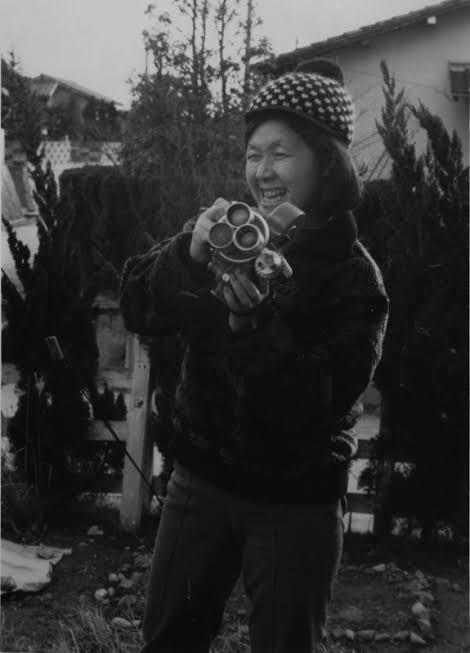
As written above, Challenge, also known as The Prize of Victory (Shibuya Nobuko, 1963) is a short documentary about the so called Oriental Witches, the legendary Japanese women’s volleyball team active in the late 1950s and 1960s. The short was awarded a prize at Cannes in 1964, and Shibuya ended up contributing to Ichikawa’s Tokyo Olympiad, she filmed the section about volleyball of course. Shibuya was a script supervisor, filmmaker, and video reporter born in Dalian, occupied China, in 1932, and she moved to Japan only after the war. As a script supervisor she worked also for Dokuritsu Pro with Imai Tadashi, Shindō Kaneto, and Yamamoto Satsuo. After this documentary, in the next decades she would work mainly for TV, and, as far as I know, worked as an editor for some non-fiction films directed by others (Iizuka Toshio, for instance). She passed away in 2016. Shibuya is a fascinating figure, another forgotten Japanese female filmmaker and documentarian I would like to explore more in the future. On YouTube there’s a channel dedicated to her films, I believe it’s a semi-official one:
Minamata Mandala (Hara Kazuo, 2020). Synopsis from Letterboxd: After years of dumping industrial wastes from the factory to the ocean, Chisso Chemical Corporation contaminated the area of a small Japanese fishing village with excessive amounts of methylmercury. This highly toxic chemical bioaccumulated in fishes of the local water, which when consumed by the local populace resulted in mercury poisoning. In 1977, Minamata disease certification criteria was set by a strange method that tried not to recognize the rights of environmental disease patients. However, an Osaka court won the case for some patients because of a newly developed theory by medical doctors’ recent experiments and proofs. For decades, these patients struggled within the Japanese judicial system for their rights to receive compensation as victims of environmental disease. Those different aspects of these patients’ lives have been filmed by director Hara for the last 15 year inspired by the late director Tsuchimoto Noriaki documentaries.
This would need a longer and in-depth piece, but for now suffice it to say that Minamata Mandala is, in my view, one of Hara’s best works, and the masterpiece of the second part of his career. Not a minute of the documentary (373 minutes!) is superfluous.
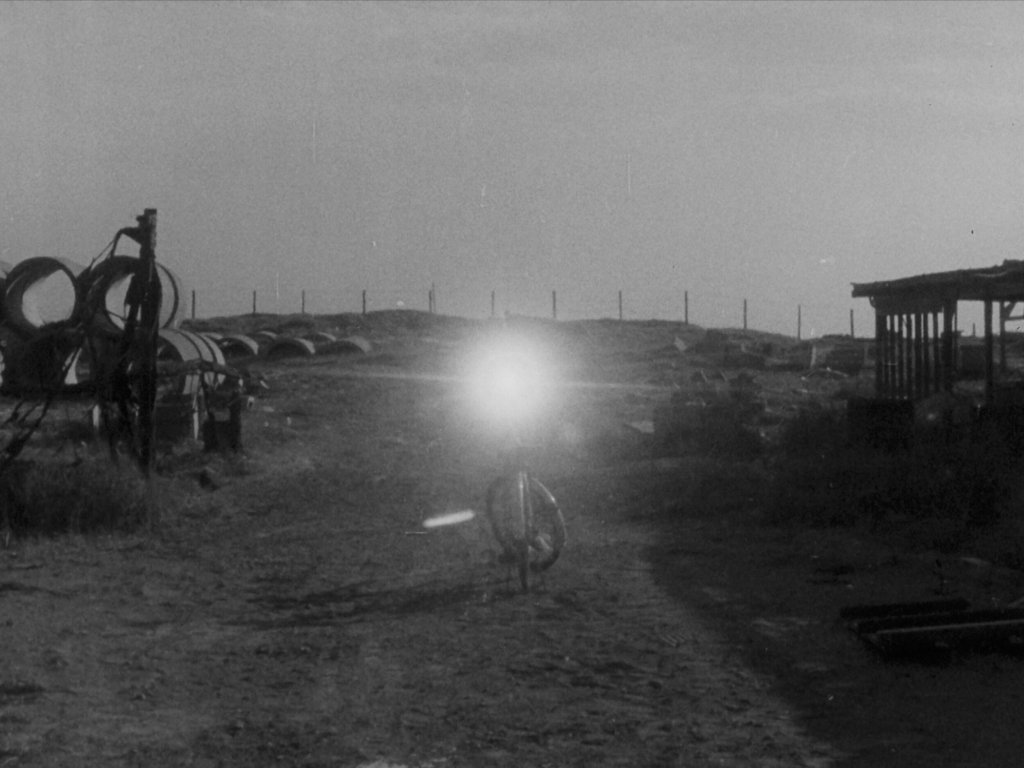
Alchemy (Nakai Tsuneo, 1971). Official synopsis: The camera slowly zooms, in over a long period of time, on the light of the sun reflected in the mirror of a bicycle parked at the construction site. To this is added a slowly evolving flicker effect derived from negative-positive reversals, progressively dismantling the distance from the subject. Nakai created a masking film with a calculated pattern of black and white frames into which he inserted positive and negative images and made a print out of two separate rolls of film. The original projection speed was 16 frames per second, but the sound is separate from the open-roll tape rather than burned in, so it can also be screened at 24fps. Also, the original sound consisted of the friction noise of rubbing steel, but in 2019 a new version of the sound was created featuring the friction noise of glass. Two versions of the film exist: 24:15 mins at 24 fps and 40 mins at 16 fps. This was one of the best discoveries of the year for me, thanks to the Collaborative Cataloging Japan (CCJ), a structuralist work made in 1971 by Nakai, clearly inspired by Michael Snow’s Wavelength, but at the same time highly original, and somehow anticipating Matsumoto’s Atman.
 Asian Docs