In a peripheral corner of Japanese cinema, one where experimental film, photography, and documentary film encounter, overlap, and merge, there seem to be a thread connecting some films made by different artists in different eras. Alchemy (Nakai Tsuneo, 1971) and Heliography (Yamazaki Hiroshi, 1979), but also parts of Magino Village: A Tale (Ogawa Shinsuke, 1986) and Gootariputra (Yamazaki Mikio, 1999), just to name a few, all share a common fascination for, and a total cinematic dedication to the Sun, its path, and its astral movements in the sky.
The photographer and filmmaker Yamazaki Hiroshi (1946-2017) is particularly important in this context, in the past I wrote about Heliography, here, and on his photographic works, here. After having dedicated a large part of his career to the creation of long-exposure photographs of the sun, Yamazaki in 1979 crowned this artistic path with the short film Heliography, one of the most important experimental films in the history of the genre in Japan. In the work, as the title indicates, the sun is placed at the center of the filmed universe, while everything else moves around it, horizon, sky and city. A visual and artistic vertigo that in the following years evolved and took a similar path when Yamazaki collaborated with Ogawa Production. Yamazaki went to Yamagata prefecture and for the collective filmed the time-lapse sequences of the Sun for the masterpiece Magino Village: A Tale (1986).

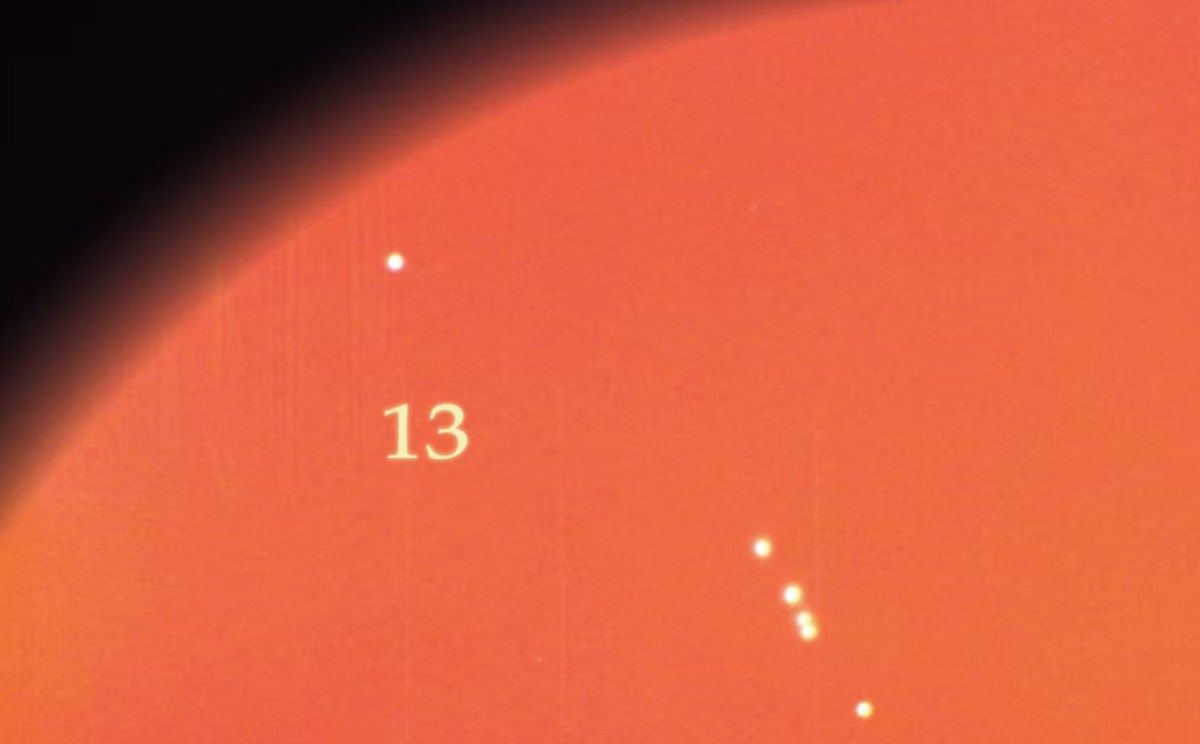
This “solar community” has now a new practitioner, Isobe Shinya. In 13 the young Japanese filmmaker left his camera in exactly the same spot for five years to shoot a picture of the sunset every thirteen seconds. In a series of merged time-lapses, we see the sun(s) moving repeatedly from the left part of the screen to the right. Superimposing these images collected over half a decade, Isobe created a work where the sky, while going through a series of permutation in colours, from black to purple, from red to blue, is also being slowly populated by fluorescent dots, the sun(s), gradually clustering the screen.
13 begins with a black screen and without sound, but soon the sun(s) and other drapes of light begin to appear from the upper left corner. As the progression and arcs of the sun(s) get faster, the images are paired first with a what could be described as a sort of background noise, and as the film moves along, with a soundscape composed of accelerating instrumental music. This musical progression peaks with the arrival on screen of a C-shaped cluster of sun(s), a sensorial explosion in a screen now transformed almost into a pink canvas perforated by a multitude of blinding lights. 13 offers a vision of the cosmos and of life conceived as the alternation of solar cycles, and this passage of time – the years, the sun(s), the skies – is condensed and visualised in its 10 minutes with an intense and almost haptic quality. The travel in time that 13 represents, the creation of a different time, could be also read as a travel in space: from the deep darkness of the first images, the journey passes through different phases and different colours of the universe – the sky – to land, in the last minute or so, again on planet earth. The sun(s) turn here into a singular Sun, and the purple, red and pink skies make way to a blue one. We are now back on earth, we can finally see the horizon, the clouds passing, and the shape of a house with its antenna. The singular Sun is setting, concluding its astral path. The film definitely belongs to the same realm of visions created by Yamazaki, and with his solar works, both cinematic and photographic, almost establishes an artistic and long-distance dialogue.
13 has won several awards around the world, and in 2021 has been shown in many festivals, online and in-presence, in the United States and Europe. If you read this in 2021, the film is made available by Isobe himself on Vimeo until December 28th:
 Asian Docs
3 thoughts on “13 by Isobe Shinya”