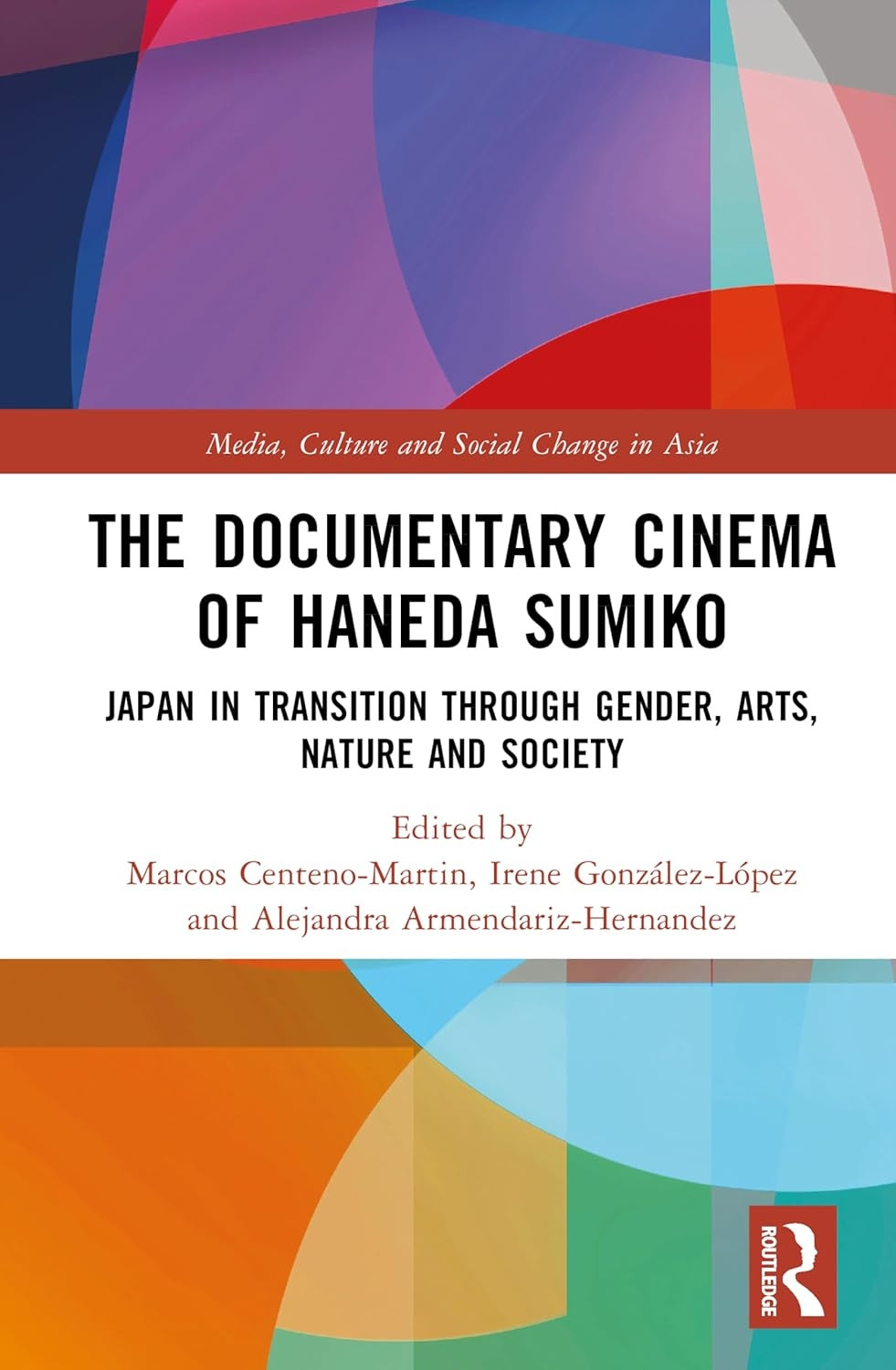
Perhaps not the best time—ongoing and looming wars are killing and disrupting the lives of thousands—but it’s nonetheless a great pleasure to announce the publication of The Documentary Cinema of Haneda Sumiko – Japan in Transition through Gender, Arts, Nature and Society. Edited by Marcos Centeno-Martin, Irene González-López, and Alejandra Armendariz-Hernandez, the volume offers an in-depth exploration of Haneda Sumiko’s career—from her early work at Iwanami Productions to her independent documentary practice, trailblazed by The Cherry Tree with Gray Blossoms.
I’m honored to be included in the book with an essay: Ode to Mt. Hayachine (1982). Between an End of an Era, and the Dawn of a New One: Capturing the Flow of History, a piece I could not have brought to its final form without the support and insightful feedback of the three editors, and without this webpage, which has helped me foster and develop it over the years.
On the publisher’s webpage, the volume is described as follows:
The first academic book to provide a comprehensive survey of the work of Haneda Sumiko (1926-), the first woman to regularly direct documentaries in postwar Japan, by examining her major documentaries amongst the extensive filmography she developed over sixty years.
Bringing together scholars from a range of disciplines—including film studies, gender studies, art history, eco-criticism, and aging studies—this volume explores Haneda’s depiction of critical issues in Japanese society, culture, history, and nature. It showcases how her cinema provides a personal and reflective view on Japan’s drastic transformations of the twentieth century, while her career also bore witness to changes taking place in the national cinema industry. It thus situates Haneda’s oeuvre within the history of Japanese non-fiction film whilst offering new perspectives on questions of authorship and representation.
Collectively, the chapters in this book make a case for Haneda to be recognised as a key figure in Japan’s postwar documentary scene. Bridging gaps in research on both documentary studies and women filmmakers, this will be a valuable resource to scholars and students of film studies, Japanese studies, gender studies and art history, as well as to film curators and programmers.
You can check the table of contents here.
It’s an academic book, so it’s not inexpensive—hopefully a paperback edition will be available in the near future. In the meantime, if you can, please recommend it to libraries, universities or related institutions.
 Asian Docs